Festival · The great bathing fair where the nectar fell
Kumbh Mela
The Kumbh Mela is the largest gathering of people on earth, a bathing fair that moves between four river towns, Prayagraj, Haridwar, Ujjain and Nashik, returning to each every twelve years. It is told as the place where drops of the nectar of immortality fell when the gods carried the pot away from the demons. Holy men of the akharas lead processions into the river on the great bathing days, and millions follow them.
How longAbout one to three months at each place, around a few great bathing days
Every twelve years at each place, when the sun, the moon and Jupiter stand in the right signs; Haridwar and Prayagraj also hold an Ardh Kumbh at the half-way mark
Why it is kept
The Kumbh Mela, the festival of the pot, is a fair without stalls at its heart: its purpose is a bath. Every three years or so it gathers in one of four river towns, and at each one it comes back every twelve years. The 2027 mela is Haridwar's Ardh Kumbh in the spring and Nashik's Simhastha in the monsoon, and Ujjain follows in 2028.
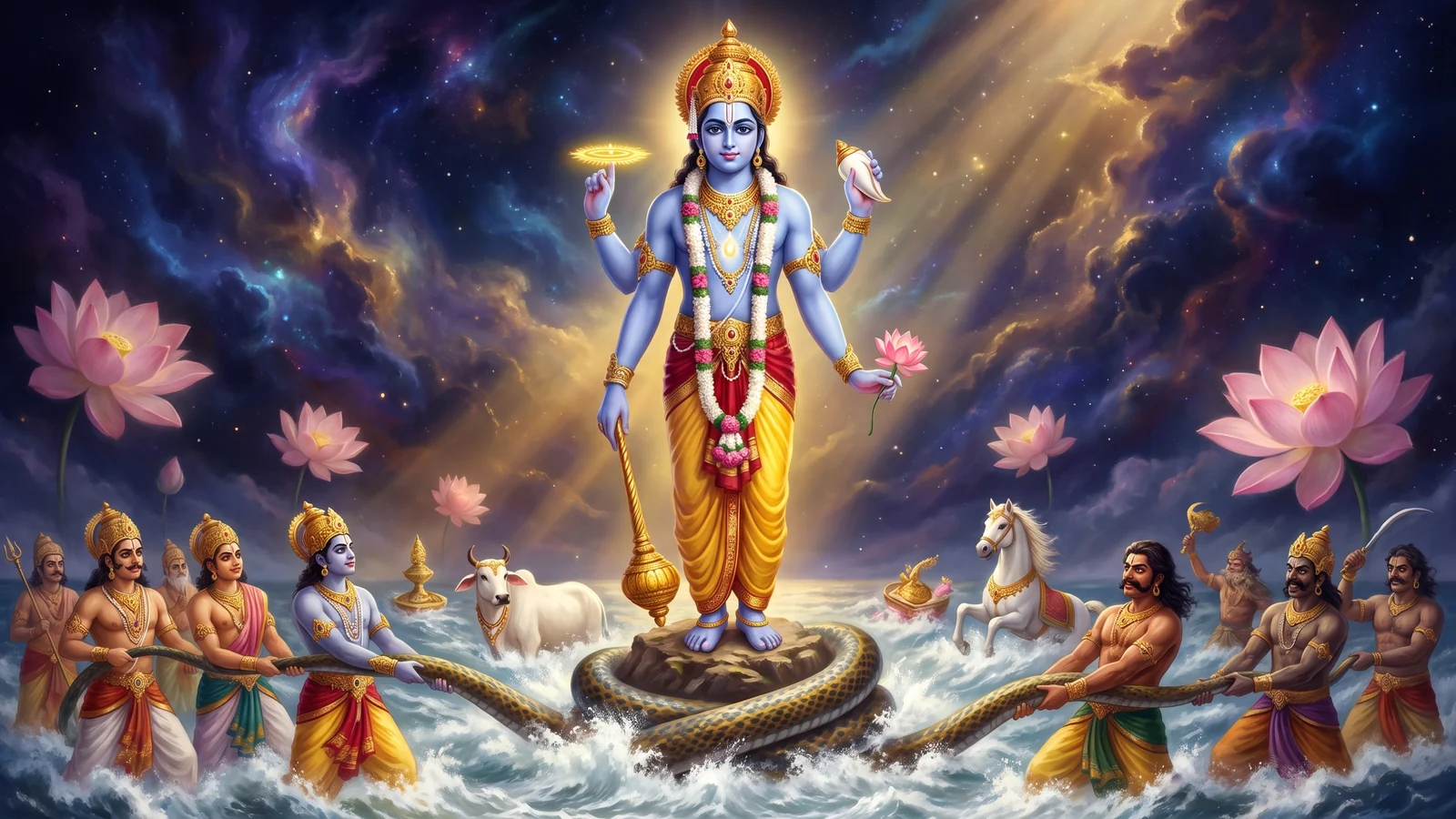
When the gods and the demons churned the ocean, the last thing to rise was a pot, a kumbha, of amrita, the nectar of immortality. In the Kumbh telling, Indra's son Jayanta ran away with it, and the demons chased him for twelve days of the gods, which are twelve years of ours. Four times he set it down on earth, and four times drops of the nectar spilled into the river beneath, at Prayag, Haridwar, Ujjain and Nashik.
When the sun, the moon and Jupiter stand where they stood then, the nectar is said to wake again in that river. To bathe in it at that time is to wash away the sins of many lives. So the Kumbh comes to each town when its stars come round, and the people come to the river.
Vishnu took the form of the enchantress Mohini to win the pot of nectar from the demons and give it to the gods. The nectar the Kumbh remembers is the nectar he saved.
T
Prime god
The rivers
Ganga at Haridwar, the meeting of Ganga, Yamuna and the hidden Saraswati at Prayagraj, the Shipra at Ujjain and the Godavari at Nashik, which keep the drops of nectar and are the real objects of the pilgrimage.
The teacher of the gods and the planet Jupiter, who guarded the pot with the sun, the moon and Saturn. Jupiter's place in the sky decides when and where each Kumbh falls.
S
Shiva
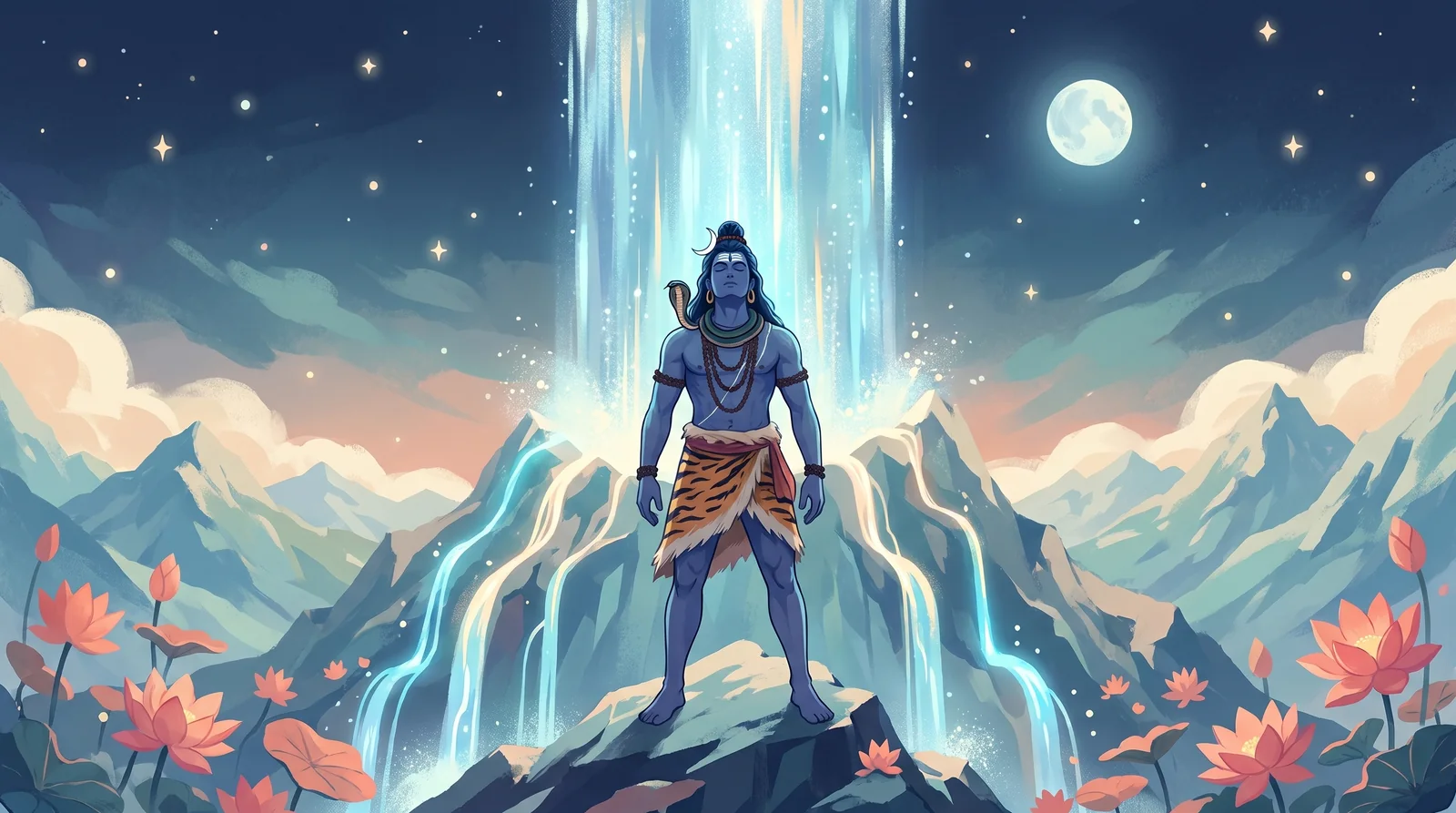
The god of Ujjain's Mahakaleshwar and Nashik's Trimbakeshwar, and of the Shaiva akharas, the naked Naga sadhus who bathe first.
The great bathing days, 2027
1
Mahashivratri and Phalguna Amavasya
The fourteenth of the dark half of Phalguna and the new moon · Saturday 6 March 2027
The first and second Amrit Snans at Haridwar
At Haridwar the akharas march in procession to Har Ki Pauri, the Naga sadhus first, and bathe in the Ganga before anyone else is allowed into the water. The second Amrit Snan follows on the new moon two days later, 8 March.
The day the sun enters Aries · Wednesday 14 April 2027
Baisakhithe third Amrit Snan
The greatest bath of the Haridwar Kumbh, on Baisakhi. The sun's entry into Aries with Jupiter in Aquarius is the Haridwar Kumbh's own conjunction. The mela ends on the full moon of Chaitra, 20 April.
3
The Amrit Snans at Nashik and Trimbakeshwar
The new moons of Ashadha and Shravana, and the eleventh of Bhadrapada · Monday 2 August 2027
The Simhastha on the Godavari, with Jupiter in Leo, has its great baths on 2 August and 31 August, and on 11 September at Ramkund in Nashik for the Vaishnava akharas and 12 September at Kushavarta in Trimbakeshwar for the Shaiva ones.
The Kumbh at the confluence of the Ganga and the Yamuna, when Jupiter is in Taurus, is the largest of all. The last Purna Kumbh, in 2025, drew hundreds of millions of bathers over six weeks. A smaller Magh Mela is held here every January and February, and the next Kumbh at Prayag is due in 2037.
Haridwar, Uttarakhand
Where the Ganga leaves the mountains, at the ghat called Har Ki Pauri, the steps of Vishnu. The Kumbh falls when Jupiter is in Aquarius and the sun in Aries; the Ardh Kumbh of 2027 runs from January to April.
Ujjain, Madhya PradeshSimhastha
On the Shipra, below the temple of Mahakaleshwar, when Jupiter is in Leo, the lion. The next is in spring 2028.
Nashik and Trimbakeshwar, MaharashtraSimhastha
On the Godavari, at Ramkund in Nashik, where Rama is said to have bathed in his exile, and at Kushavarta, the river's source near the Trimbakeshwar temple, when Jupiter and the sun are both in Leo. The mela opened with the raising of the flag on 31 October 2026.
The akharasThe orders of ascetics
Thirteen akharas, orders of sadhus, Shaiva, Vaishnava and Udasin, lead the great baths in a fixed order, with the Naga sadhus, naked and smeared with ash, going into the water first. The akharas are traced to Adi Shankara, and the Kumbh is where new members are initiated.
Sikhs of the Udasin and Nirmal ordersUdasin and Nirmal akharas
Two of the thirteen akharas belong to orders that grew out of the Sikh tradition, the Udasins, founded by Guru Nanak's son Sri Chand, and the Nirmalas, and they take their turn in the processions.
How it is kept
A tent city rises on the riverbank, with roads, bridges, hospitals and police stations, and the akharas set up their camps with flags and fires. On the great bathing days, fixed by the stars, the akharas go down to the water in procession, on foot, on horses, on chariots, with drums and trumpets, the Naga sadhus first, and only after them do the pilgrims bathe.
The rest of the time is for listening and giving: discourses by teachers in their camps, kirtan, the feeding of sadhus and the poor, and the ceremonies of new ascetics. Pilgrims bathe at dawn, offer lamps to the river at dusk, and many stay for a month, the kalpavas, sleeping on the sand and eating once a day.
In the old texts
The churning of the ocean is told in the Mahabharata, the Ramayana and the Puranas, and the holiness of the confluence at Prayag is praised in the Mahabharata and the Matsya Purana. The Chinese pilgrim Xuanzang described a great gathering at Prayag around 643, at which King Harsha gave away his treasures, though he does not call it a Kumbh.
The story of the pot and the four towns is told in the towns themselves and credited to the Skanda Purana, but it is not in the early texts. Historians find Haridwar's twelve-year Kumbh in records from the seventeenth century and the name Kumbh for the Prayag mela only from the nineteenth, when the mela there grew into what it is now.
Where this page comes from. Written by Devalok from the Kumbh tradition of the four towns, the Mahabharata and the Bhagavata Purana on the churning of the ocean, the Skanda Purana as the towns cite it, the accounts of Xuanzang and of later travellers, and the mela authorities' calendars for 2027 and 2028, as recorded in the Devalok Lore. Our own words throughout.