As the Bhagavata Purana tells it
Bhagavata Purana, canto 8 · 3 min read
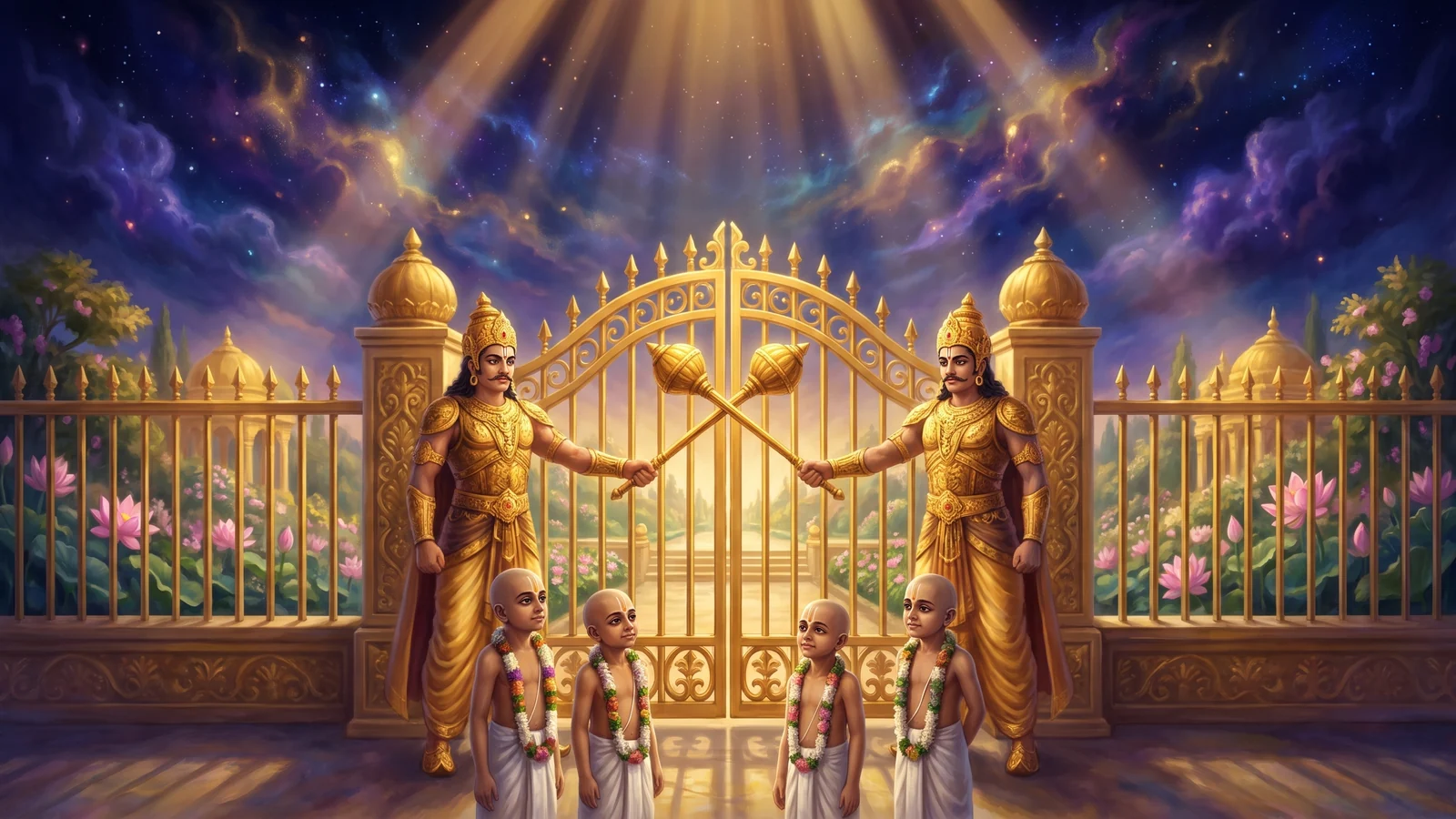
It began with a garland.
The sage Durvasa, who was not a patient man, met Indra riding on his elephant and offered him a garland of flowers. Indra took it and hung it on the elephant's head. The elephant shook it off and trod on it.
Durvasa looked at the flowers in the dust.
"That was a gift," he said. "Then lose everything. Lose your strength, lose your fortune, all of you."
The curse took. The gods grew weak, their luck drained away, and Shri, the goddess of fortune, vanished into the sea. Beaten in every fight, the gods went to Vishnu.
He heard them out. "You cannot win this now," he said. "So do not fight. Go to the asuras and make a truce. Tell them that at the bottom of the ocean of milk lies amrita, the nectar that ends death, and that it takes both sides to bring it up. Churn the ocean together. I will see to the rest."
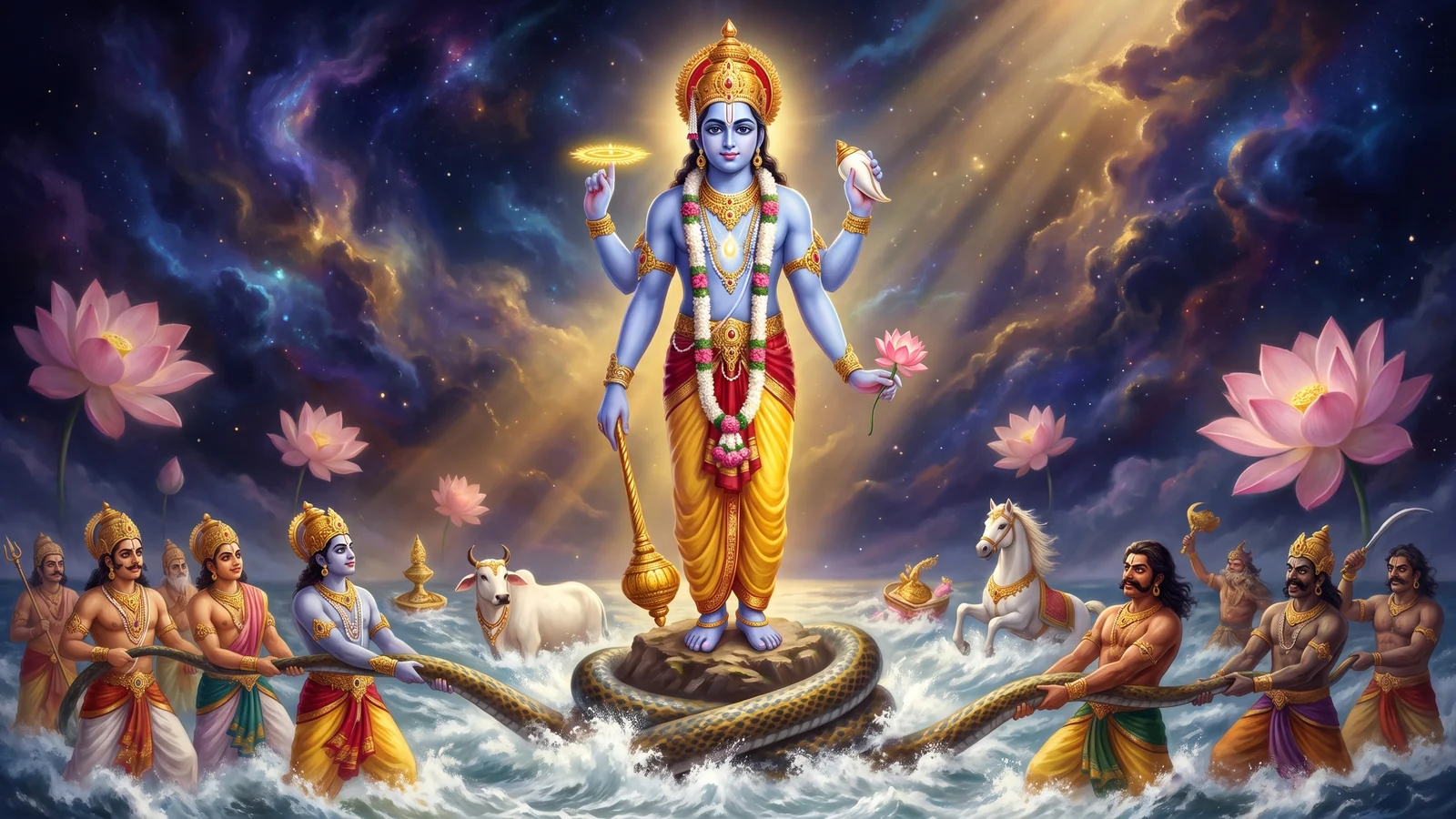
They did as he said. The asuras, under their king Bali, agreed. Mount Mandara was pulled up for a churning rod, and the serpent Vasuki was wound round it for a rope. The asuras took one end, the gods the other, and they pulled.
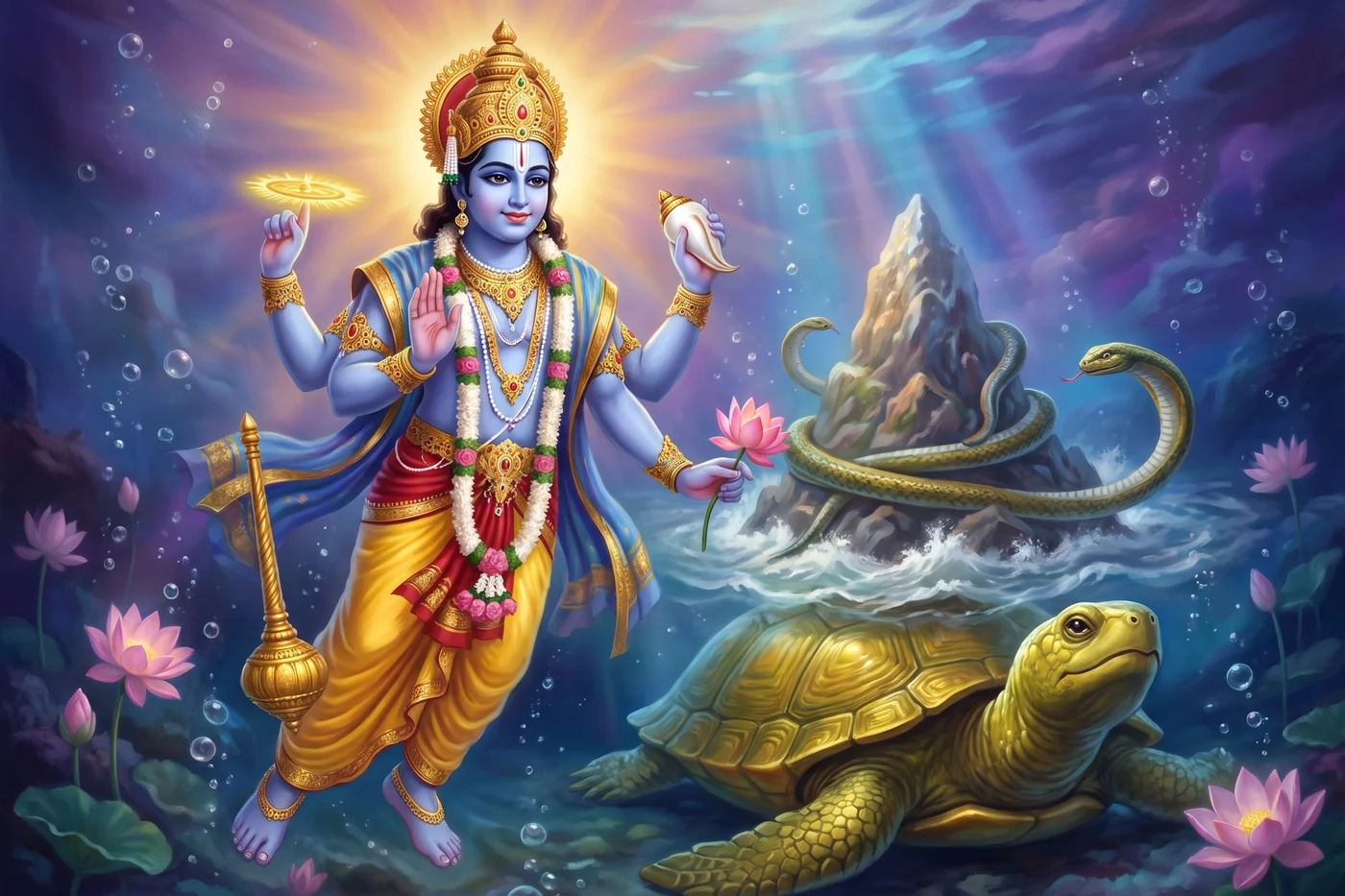
The mountain began to turn, and then it began to sink. It had nothing to stand on, and the whole weight of it was going down through the sea.
So Vishnu went down under it. He took the shape of a tortoise, Kurma, big enough to carry a mountain, and he set his shell under Mandara and held it up while the serpent turned it.
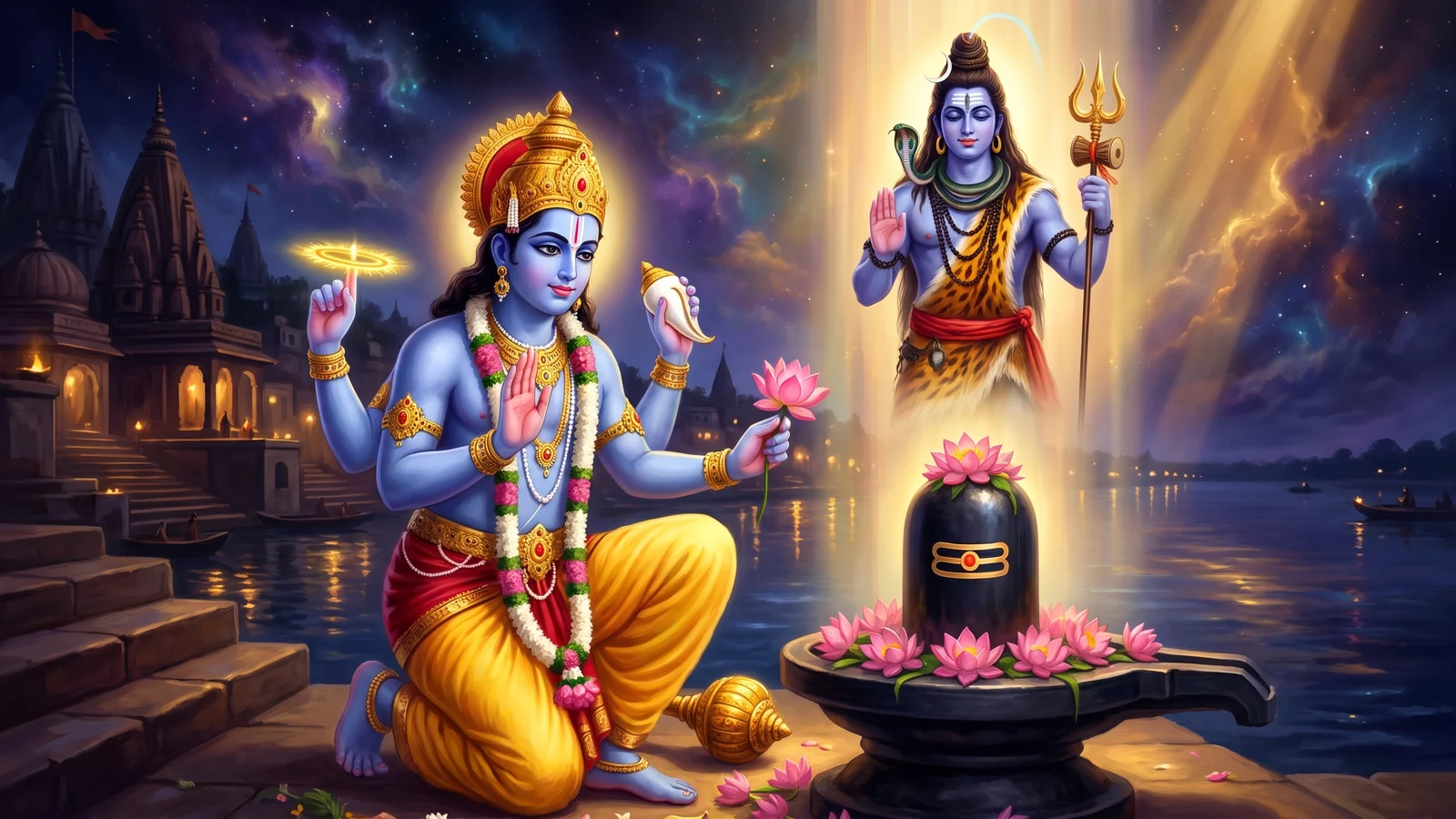
The first thing to rise was a poison. Shiva drank it, and it stayed in his throat and turned it blue; that part has its own story.
Then the sea began to give. A wish-granting cow. A horse as white as the moon, which Bali claimed. The elephant Airavata. The Kaustubha jewel, which went to Vishnu's chest, and the parijata tree, and the heavenly dancers, and the moon. Lakshmi herself rose, looked over them all and chose Vishnu, and that too is a story of its own. The liquor Varuni came up and went to the asuras.
At last a figure walked out of the water carrying a jug. He was Dhanvantari, and the text calls him a portion of a portion of Vishnu. The jug was full of nectar.
The asuras did not wait. They snatched it and ran.
The gods stood with empty hands, and Vishnu did what he had promised.
He became a woman. The Bhagavata says her skin had the colour of a newly opened dark lotus, and that nobody who looked at her could look away. Her name was Mohini, the one who enchants, and she walked straight into the camp of the asuras, who were already quarrelling over the jug.
"Give that to me," she said, "and I will share it out fairly. Nobody is going to get a fair share the way this is going."
They handed her the pot.
She had the gods sit in one line and the asuras in another, and she went down the line of the gods first, pouring. The asuras watched her and waited their turn, and she was so lovely to watch that they did not notice the pot going round.
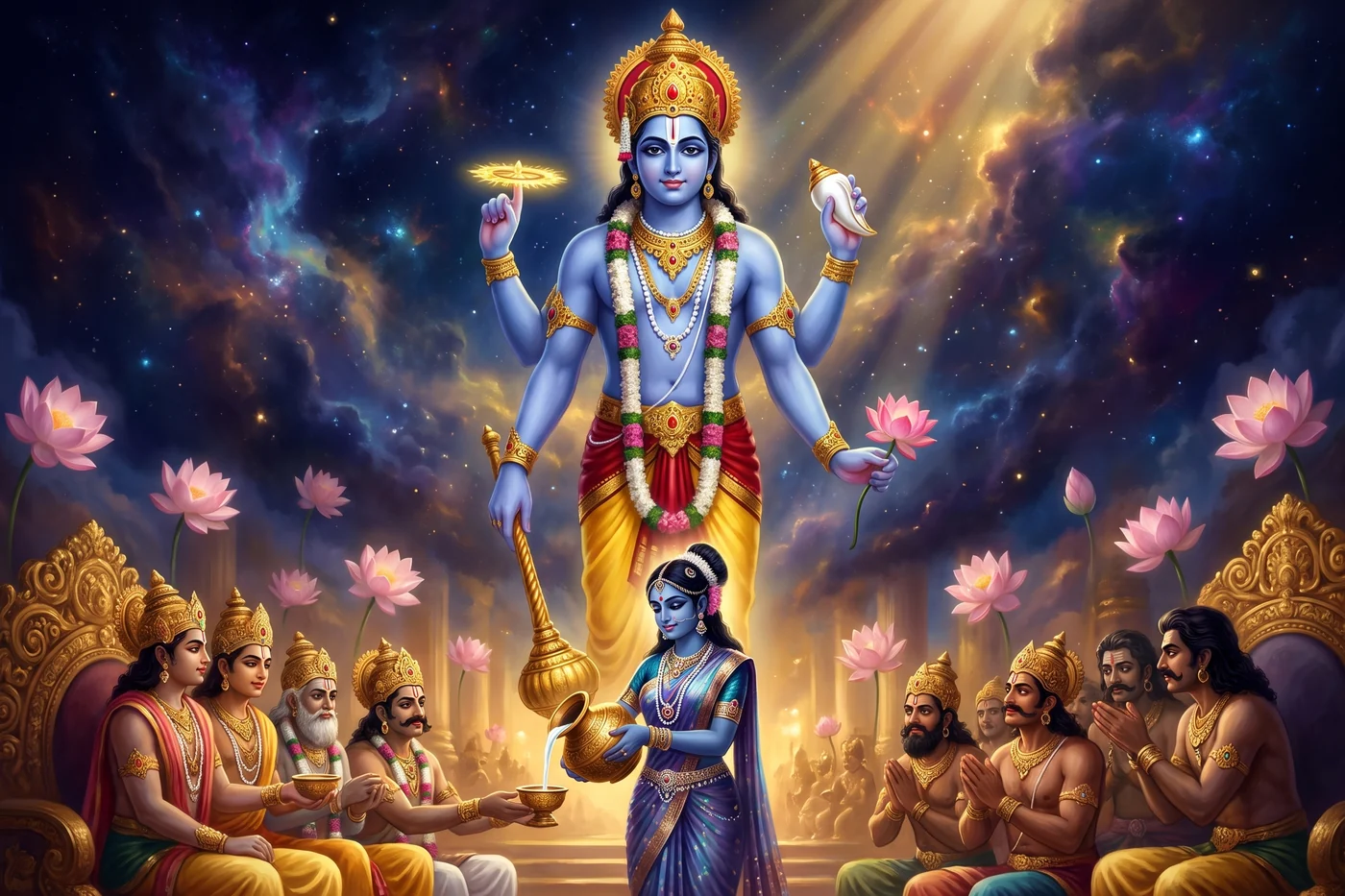
One of them was not watching her. The asura Svarbhanu had slipped into the line of the gods in a god's shape, and when Mohini came to him he drank.
The sun and the moon were sitting in that line, and they knew him.
"That one is not ours," said the sun.
Mohini did not stop to argue. Her discus took his head off before the nectar had passed his throat. But what he had swallowed was enough, and the head did not die. It lives on as Rahu, and when it catches the sun or the moon, the two who gave it away, it swallows them for a while. That is an eclipse.
Then Vishnu was Vishnu again, and the pot was empty, and the gods were strong.
As the Kumbh Mela and Mandar hill tell it
Haridwar, Prayagraj, Nashik, Ujjain; Banka district, Bihar · 2 min read
The Purana leaves the churning in the ocean of milk, which is not on any map. The people of five places in India have brought it home.
The first four are towns, each on a river: Haridwar, Prayagraj, Nashik with Trimbak beside it, and Ujjain. The story they tell is short. When the pot of nectar came up out of the sea and was carried off, drops of it spilled. Four drops fell to earth, one at each of these towns, and the ground where they fell has kept something of the nectar. So, at the appointed times, people come to bathe there, and the great bathing fairs called the Kumbh Mela are held in the four towns.
Who carried the pot when the drops fell, and whether it was the asuras running with it or the gods or Mohini herself, the local telling does not settle, and the Bhagavata, which keeps the whole matter at sea, says nothing about any drops at all.
Scholars who have looked into the fairs say something that should be said plainly here: the link between the Kumbh Mela and the churning seems to be fairly recent. The bathing is old. The story that explains the bathing was, several of them think, attached to it later. The pilgrims do not mind. For them the drop fell where they stand.
The fifth place is not a town but a hill. In Banka district of Bihar there is a hill called Mandar, and the people around it hold that this is the mountain itself: the churning rod, Mandara, which the gods and the asuras wound the serpent round. Beside it is a pond called Paapharni, and it too is tied to the nectar in local belief.
"This is the hill," they will say. "Not one like it. This one."
Pilgrims here can say what nobody can say at the ocean of milk, and point. A story that in the text happens nowhere in particular has, in Bihar, a slope to walk up and a pond to sit beside.