As the Vilwamangalam tradition tells it
Thiruvananthapuram · 3 min read
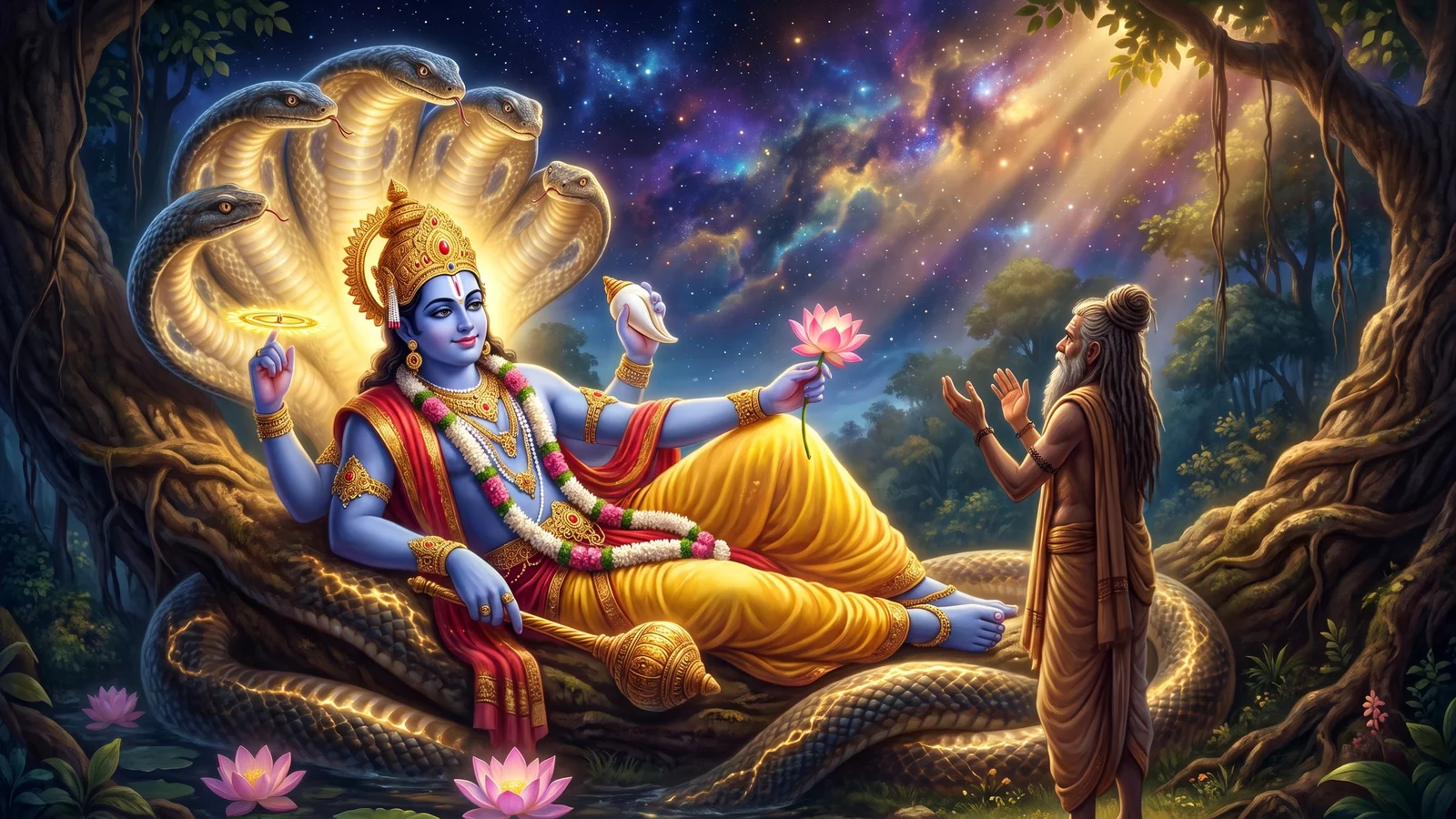
The sage Vilwamangalam, whom some call Divakara Muni, worshipped alone. He had his place, his water, his flowers and his hours, and he kept them exactly.
Then a small boy started turning up.
Nobody knew whose he was. He would sit down beside the sage in the middle of the worship, pick up the things laid out for the god and play with them, and by the time he was done nothing was fit to be offered. The sage would set everything right, and the next day the boy would be back.
For a while the sage bore it. The child was small and quick and pleased with himself, and it is hard to be angry with a face like that. But one day the boy reached out in the middle of the rite and spoiled the whole offering at once, and the sage lost his temper.
"Enough," he said. "Get out. Go home to whoever you belong to and do not come back here."
The boy looked at him. He did not cry and he did not run.
"If you want me," he said, "come to the Ananthavanam. I will be there."
And he was gone. Not out of the door, not into the trees. Simply gone.
The sage sat for a long time looking at the place where the boy had been. Then he understood what he had just sent away, and he got up and went to find him.
The Ananthavanam, the forest of Ananta, was a wild stretch of woodland, and the sage wandered in it without knowing what he was looking for. He had been told a place, not a sign.
Then he heard a woman's voice, raised in anger.
She was a woman of the Pulaya people, and she had a small child with her who had tried her past bearing. She was shouting at it the way a tired mother shouts.
"Stop it," she said. "Stop it now, or I will throw you into Ananthankadu and leave you there."
The sage stood still. A child, and the forest of Ananta. He followed her.
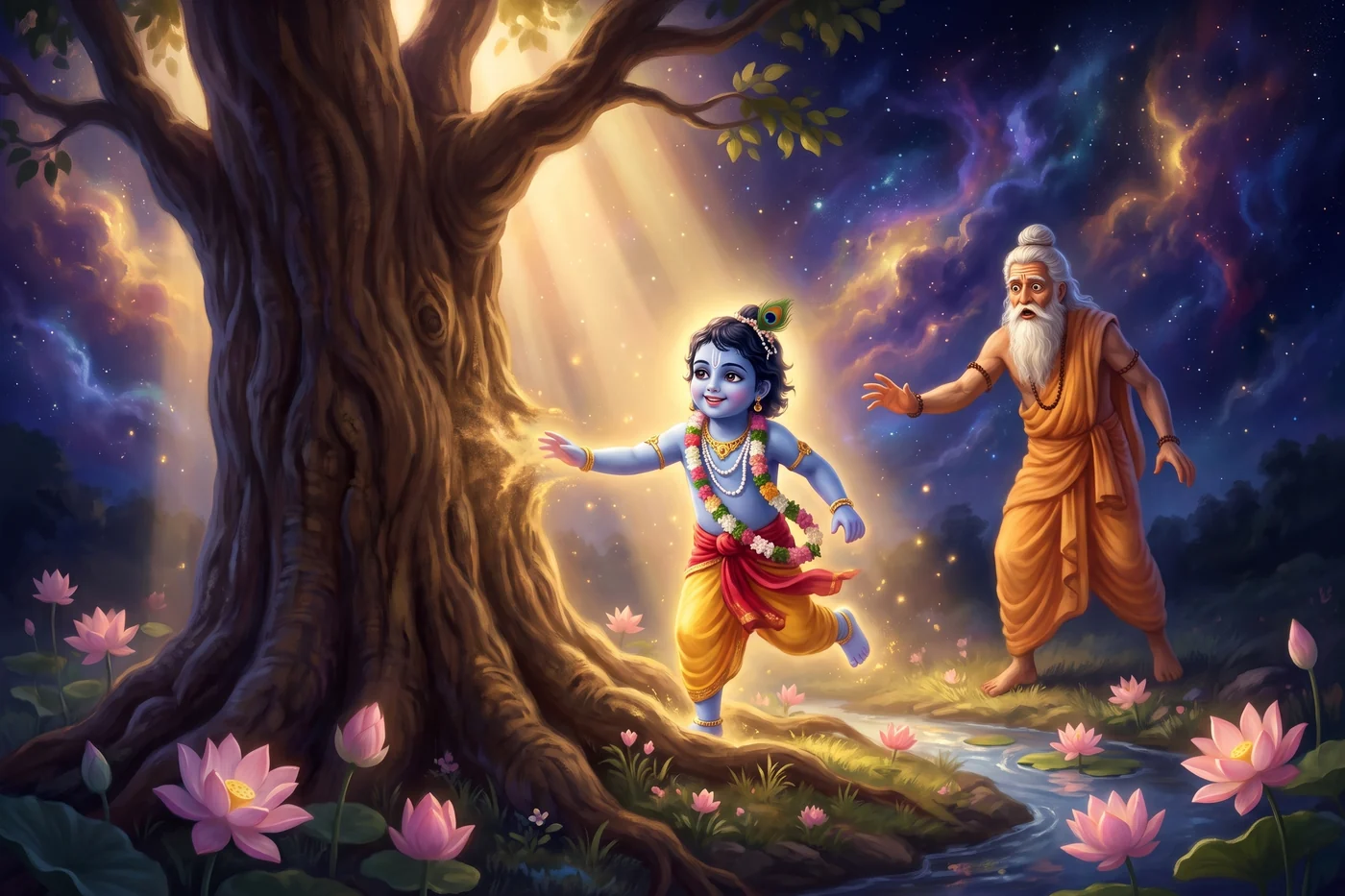
The child did not wait to be thrown. It broke away from its mother and ran, and the sage ran after it, and it ran straight at an enormous iluppa tree and into it, and became one with the trunk.
Then the tree fell.
It came down with its whole length and it did not lie as a tree lies. It lay as a man lies, on his side, at rest. The sage, standing beside it, saw the form of Ananta Padmanabha, Vishnu asleep on the serpent, and the form was beyond any size he could take in. The head lay at Thiruvallom. The navel lay at Thiruvananthapuram. The lotus feet lay at Thrippadapuram. Three places, far apart, for one body.
"Lord," the sage said, "I cannot see all of you. Nobody could."
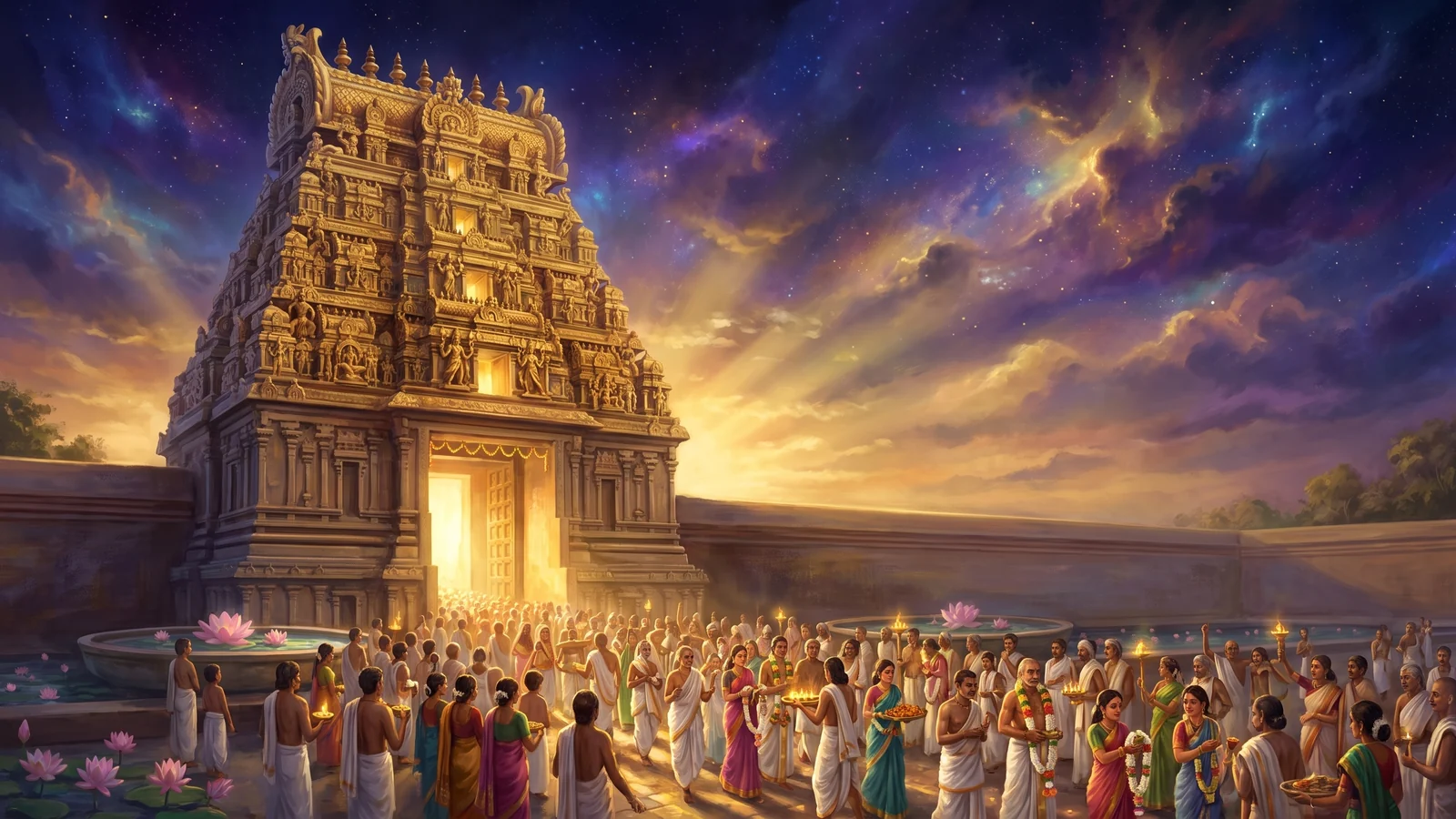
That is why, the tradition says, the god in the temple at Thiruvananthapuram is not seen whole. He is seen through three doors, one at a time, in three parts. Through the first door his face, the thirumukham. Through the second his body, the thiruvudal. Through the third his feet, the thrippadam. Whoever stands before him today is standing where the sage stood, looking at more than one pair of eyes can hold.
And the forest is not quite gone. To the northwest of the great temple there is still a small shrine, the Ananthankadu Nagaraja temple, the last of the woodland the boy ran into.
As the Kerala Mahatmyam tells it
Brahmanda Purana · 2 min read
The older account does not have a boy or a tree. It has Parashurama, the avatar who carries an axe.
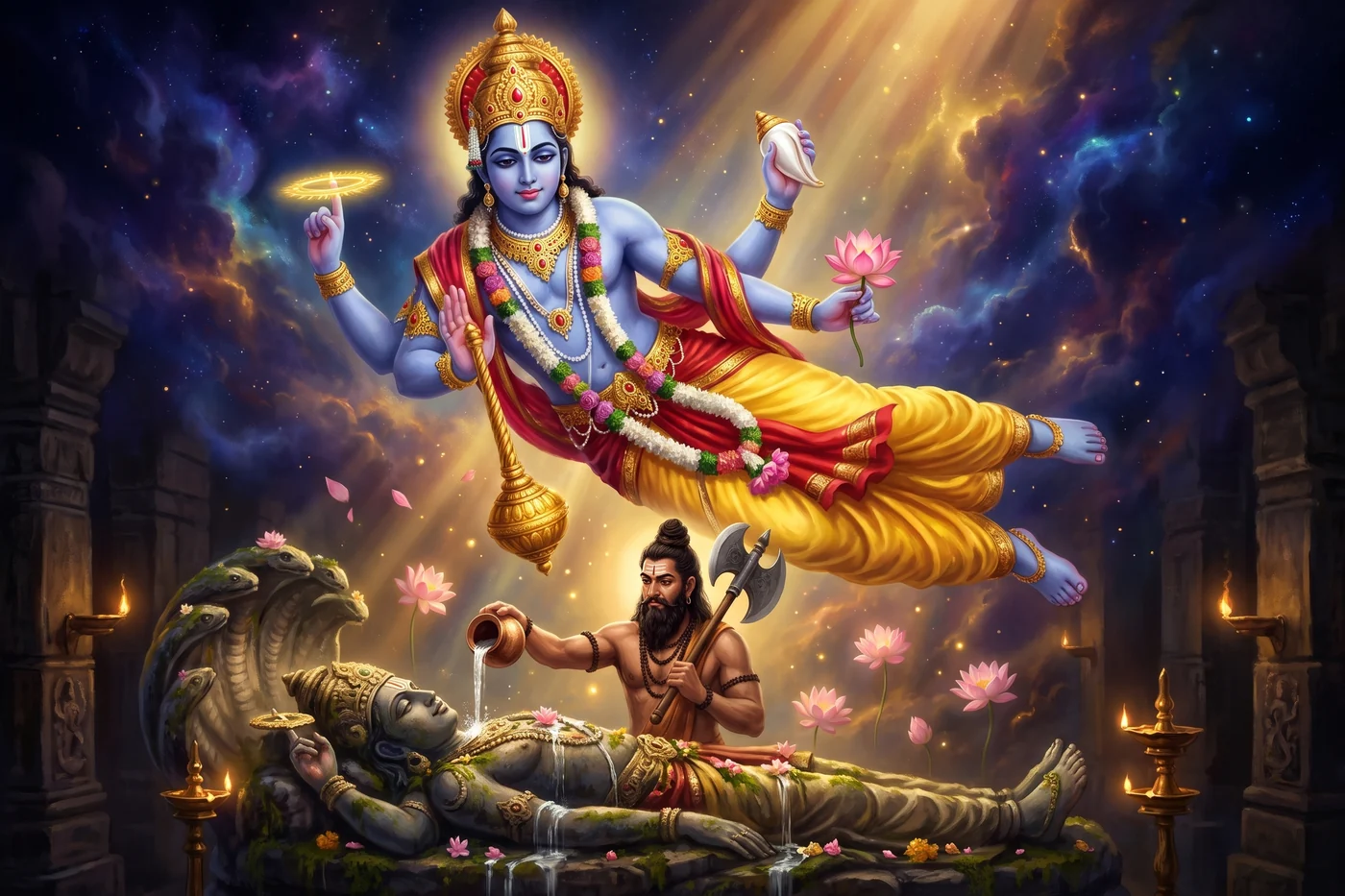
Kerala has its own story about him, that he threw his axe into the sea and the sea drew back and gave him the land. The Kerala Mahatmyam, which is counted as a part of the Brahmanda Purana, gives him the temple as well. In the Dvapara age, it says, the image of the reclining Vishnu was already there, and Parashurama came to it.
He cleansed the image and he honoured it. He did not stop at a single act of worship; he arranged for the worship to go on without him. He appointed the Potti families to serve the god, and he gave the Tharananallur Namboothiripad the charge of the rites, so that the right things would be done in the right order after he had gone.
That was the founding, in this telling: not an appearance but a setting in order.
The record after that is history rather than story, and the temple is proud of it. The Silappatikaram, the old Tamil epic, names the temple, which puts it on the map very early. And in the eighteenth century it gained a king.
Marthanda Varma of Travancore brought twelve thousand shaligrama stones from the Gandaki river for the god. Then, on the seventeenth of January 1750, he did a strange thing for a king. He gave the kingdom away. In a rite remembered as the Thrippadidanam, he surrendered Travancore to Padmanabhaswamy and took it back only as the god's servant, the Padmanabha Dasa, who would govern the land on the god's behalf and not his own.
From that day the land belonged, in name and in rite, to the sleeping god in the temple, and the man on the throne was his steward.