Festival · The rice that boils over, for the sun and the cattle
Pongal
Pongal is the harvest festival of the Tamils, kept over four days at the start of the month of Thai in mid January. On the main day new rice is boiled with milk and jaggery in a new pot in the open, facing the rising sun, and everyone shouts "Pongalo pongal" as it boils over. The day before is Bhogi, when old things are burned, and the days after are for the cattle and the family.
Also calledThai PongalBhogiMattu PongalKaanum PongalThai Thirunal
Next, in 2027Friday 15 January 2027
14 to 17 January 2027
Prime godSurya
with 3 more
WhereTamil Nadu and Puducherry, and Tamils in Sri Lanka, Malaysia, Singapore and across the world
How longFour days, Bhogi, Thai Pongal, Mattu Pongal and Kaanum Pongal
The last day of Margazhi and the first three days of Thai, in mid January, when the sun enters Capricorn
Why it is kept
Pongal is the Tamil word for boiling over, and the name of the dish and the day. In mid January, when the paddy is harvested and the sun turns north, Tamil families set a new pot of rice and milk on a fire in the open and watch for it to rise and spill. When it does, everyone shouts. A full pot boiling over is the year to come.
Pongal thanks the things that made the harvest: the sun that ripened it, the rain that watered it, the cattle that ploughed for it, and the family that worked for it. The first of Thai is the day the sun enters Capricorn and begins its northward journey, which the rest of India keeps as Makar Sankranti, and the Tamil saying is that with the birth of Thai a way opens.
The stories of the days follow the same order. Bhogi is for Indra and the rain, and for Andal, who sang through the cold month and was married on its last day. The main day is for the sun. Mattu Pongal is for the cattle, the bull Shiva sent to plough, and the bulls Krishna tamed. Kaanum Pongal is for family.
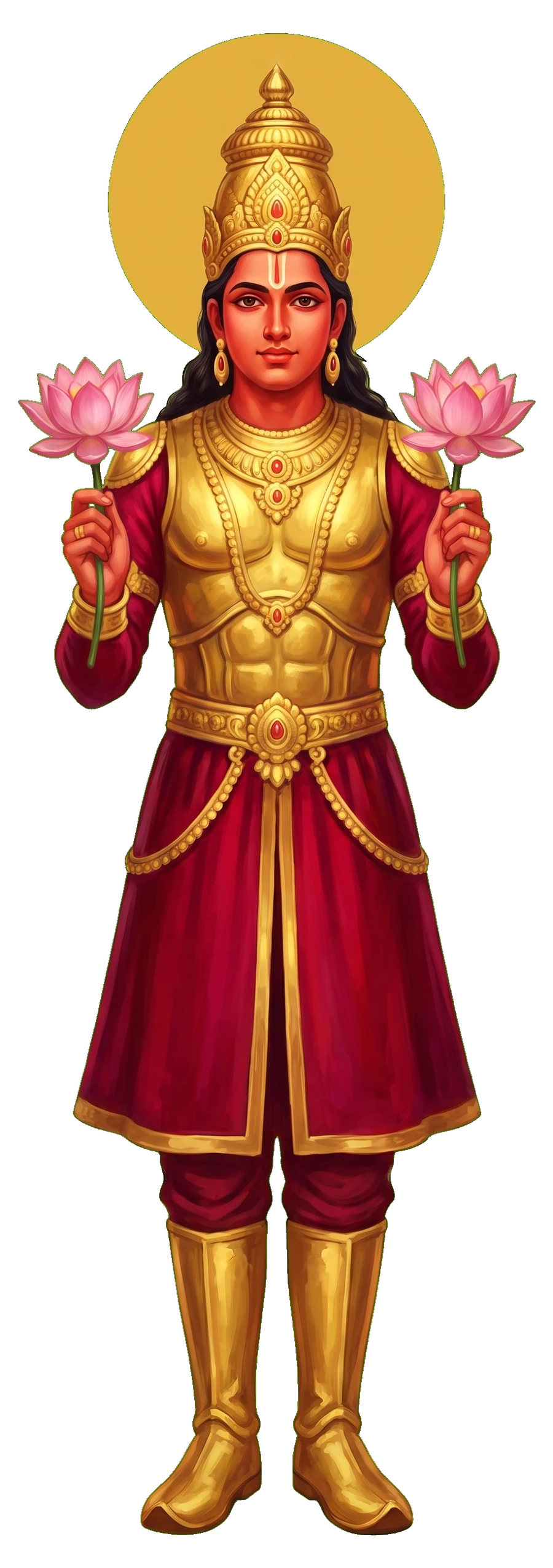
The sun, to whom the pongal rice is offered at sunrise on the first of Thai, as he turns north into Capricorn and the days begin to lengthen. The festival is a thanksgiving to him for the harvest.
Krishna the cowherd, who tamed seven bulls to win Nappinnai, and Ranganatha of Srirangam, whose wedding to Andal is celebrated on Bhogi.
N
Nandi and the cattle
On Mattu Pongal the cattle are worshipped, and the bull is honoured as Shiva's Nandi, sent down to earth to plough.
The four days of Pongal
1
Bhogi
The last day of Margazhi · Thursday 14 January 2027
Bhogi Pandigai
The house is cleaned and old mats, clothes and baskets are thrown on a bonfire at dawn, to burn the old year away. Kolams are drawn, the house is hung with mango leaves, and Indra is honoured for the rains. In the Vishnu temples Andal's wedding to Ranganatha ends the month of the Thiruppavai.
A new clay pot, tied with turmeric and ginger plants, is set on a fire in the courtyard, facing east. New rice is boiled in it with milk, and as it boils over the family shouts "Pongalo pongal". Sweet sakkarai pongal is cooked with jaggery and offered to the sun with sugarcane, bananas and turmeric, then eaten together.
3
Mattu Pongal
The second of Thai · Saturday 16 January 2027
Kanu
The day of the cattle. Cows and bulls are bathed, their horns painted and capped with brass, and they are garlanded and fed pongal. In the villages of Madurai the bulls are let loose for jallikattu, and young men try to hold on to their humps.
The day of seeing. Families go out together to beaches, rivers and relatives' houses. Women set out little balls of coloured rice on a turmeric leaf for the birds, the kanu pidi, and pray for their brothers.
The state's great festival, with four days of holiday. Every house draws its biggest kolam of the year, the streets are full of sugarcane and new pots for sale, and schools and offices hold pongal-cooking in their courtyards.
Madurai and the southJallikattu
On Mattu Pongal and the days after, the bulls of Avaniyapuram, Palamedu and Alanganallur run through crowds of young men who try to hold on to their humps for a set distance. The sport was banned in 2014 and brought back by law in 2017 after huge protests in Chennai.
Sri LankaThai Pongal
The Tamils of Jaffna and the east keep Thai Pongal with the pot boiling over in the courtyard and visits to the temples, and it is a national holiday.
Malaysia, Singapore and Mauritius
The Tamil diaspora cooks pongal at temples and in the Little India quarters, and in Malaysia the cattle of the estates were once decorated as at home.
Andhra Pradesh, Telangana and KarnatakaSankranti
The same days are kept as Bhogi, Sankranti and Kanuma in the Telugu lands and as Sankranti in Karnataka, with their own customs, and have their own page, Makar Sankranti.
All TamilsThai Thirunal
Pongal is kept by Tamils of every faith as the festival of the harvest and of Tamil life. Christian churches in Tamil Nadu hold Pongal services with the pot boiling over at the church door, and Muslim and Christian families cook pongal too.
The Tamil stateThiruvalluvar Day
Tamil Nadu keeps the day of Mattu Pongal as Thiruvalluvar Day, for the poet of the Thirukkural.
How it is kept
On Bhogi the old is burned at dawn, and the house cleaned and painted. On Thai Pongal the women draw a kolam in front of the house, set up a hearth of three bricks or a stove in the courtyard and put on the new pot, tied with fresh turmeric. As the milk rises the family blows conches and shouts "Pongalo pongal", and the sweet pongal is offered to the sun on a banana leaf with sugarcane and bananas before everyone eats.
On Mattu Pongal the cattle are washed, painted, garlanded and fed, and taken round the village; the jallikattu is run. On Kaanum Pongal people visit, picnic, and give to the birds.
In the old texts
The Sangam poems describe the girls of the month of Thai bathing in the river at dawn and praying for rain and good husbands, the Thai Niradal, and the cowherd country's eru thazhuvuthal, in which a young man won his bride by holding a bull. The Silappatikaram gives the cowherd women's bull dance in honour of Krishna and Nappinnai.
Andal's Thiruppavai, of the eighth century, is the song of the Margazhi vow that ends at Bhogi. The name Pongal for the festival is found in medieval inscriptions of Chola temples, which record the offering of pongal rice on the first of Thai.
Where this page comes from. Written by Devalok from the Sangam poetry of the Tamils, the Silappatikaram, Andal's Thiruppavai, the Bhagavata Purana, and accounts of the festival across Tamil Nadu and the Tamil world, as recorded in the Devalok Lore. Our own words throughout.