As the Periya Puranam tells it
South India · the Tamil country · 3 min read
Thinnan was the son of a hunter chief in the hill country. He had grown up with a bow in his hand. He knew every track in the forest, and he had never once been inside a temple.
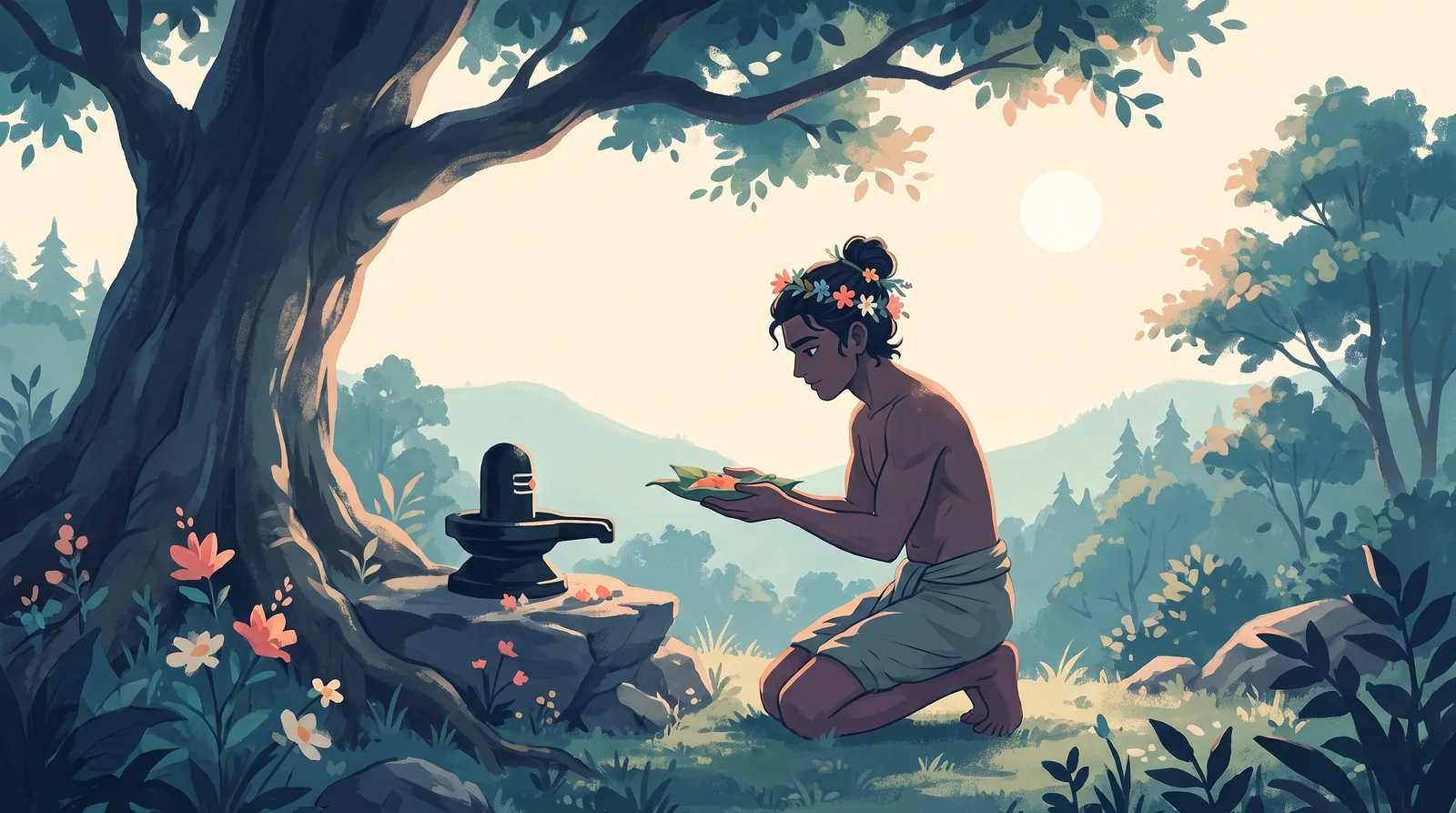
One day, chasing a boar, he ran far up a hill he did not know. There, under a tree, he came on a rounded black stone set upright in the ground. It was a linga. Somebody had put flowers on it.
Thinnan stopped. He could not have said why. He looked at the stone, and something in him turned over. He felt what a man feels when he finds a child alone in the forest.
"You are all by yourself up here," he said aloud. "Who feeds you? Who looks after you at night, with the leopards about?"
He could not bring himself to leave. But it worried him that the god must be hungry. So he ran down to where his kill lay, roasted the meat over a fire and tasted each piece, keeping only the tenderest. He had no pot for water, so he filled his mouth at the stream. He had no basket for flowers, so he stuck them in his hair. Then he ran back up the hill with his hands full of meat.
He pushed the old flowers off the stone with his foot, since his hands were full. He poured the water over it from his mouth, shook the flowers out of his hair on top of it, and set the meat in front of it.
"Eat," he said. "It is good. I tried it myself."
All night he stood guard with his bow. At dawn he went off to hunt again.
A little later the priest arrived. He was a careful, learned man who came every morning with clean water and fresh flowers, and he nearly wept at what he found. There was meat in front of his god, and spittle on the stone.
He cleaned everything and did his worship properly, and the next day it was all there again. So it was the day after. On the fifth night he prayed in misery, "Lord, who is doing this to you? Make it stop."
Shiva came to him in a dream.
"Do not speak of him like that," he said. "The water from his mouth is dearer to me than the Ganga. His love is all he knows, and all of it is for me. Hide behind the tree tomorrow, and you will see what he is."
On the sixth morning the priest hid, and Thinnan came bounding up the hill with his meat. Then he stopped dead and dropped everything.
The linga had eyes, and from the right one, blood was running.
Thinnan cried out. He ran for healing leaves, crushed them and pressed them to the eye. The bleeding did not stop. He tried again and it did not stop. He stood there, shaking.
Then he remembered a saying of the hunters: flesh for flesh.
He pulled an arrow from his quiver. Without stopping to think, he cut out his own right eye and pressed it onto the stone.
The bleeding stopped. Thinnan laughed and leapt for joy, with one eye gone.
Then the left eye of the linga began to bleed.
He was not afraid now. He knew the cure. But once his second eye was out he would be blind, and how would he find the place? So he lifted his foot and planted his toe on the linga, right where the bleeding eye was, to mark it. Then he raised the arrow to his remaining eye.
"Stop, Kannappa!"
A hand came out of the stone and caught his wrist.
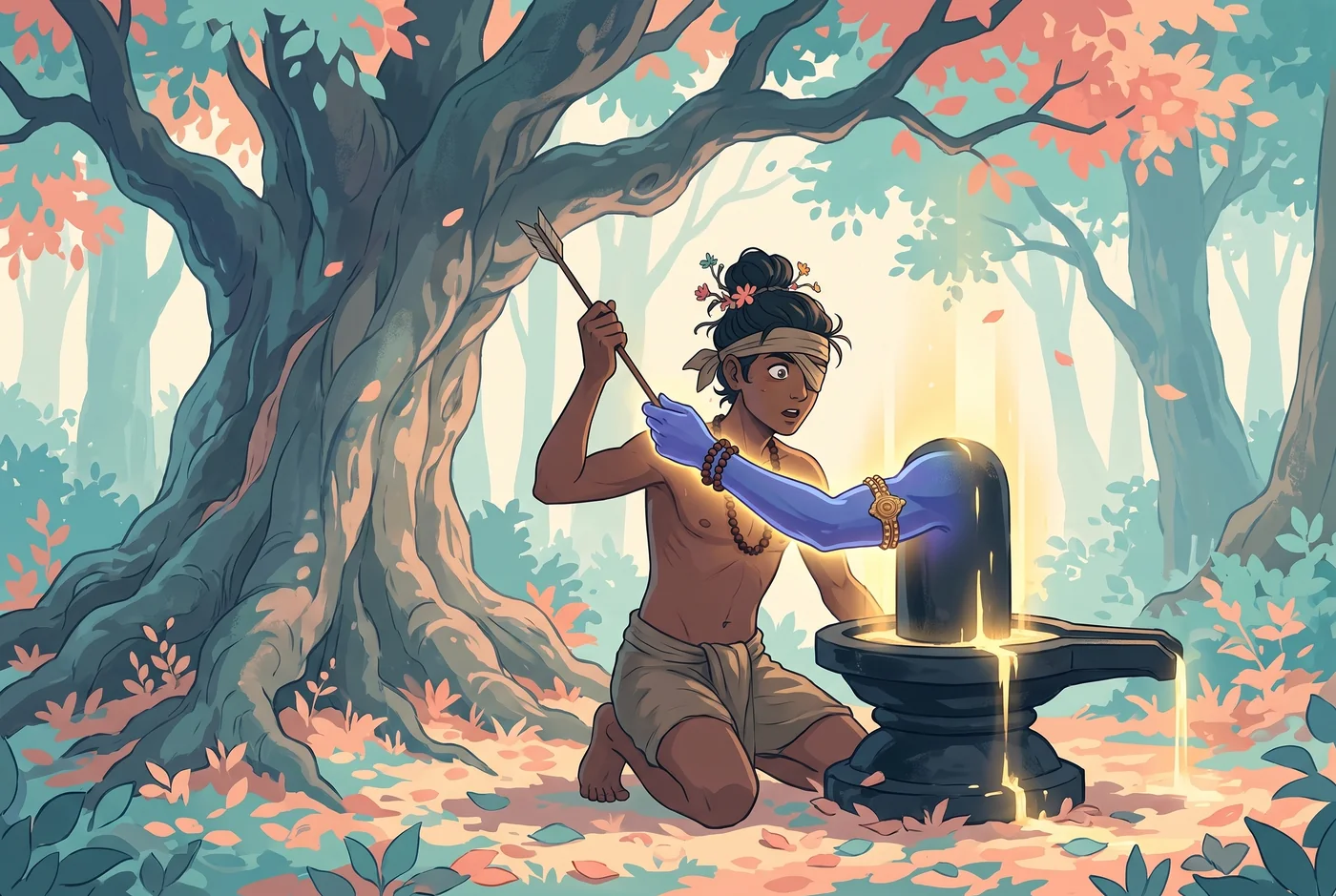
"Stop, Kannappa," said Shiva again. And he gave him back his sight, and kept him by his side for ever.
Behind the tree, the priest had seen everything. He never complained again.
The name stayed with him. Kannappa means the one who gave his eye. He is counted among the sixty-three Nayanars, the great Shaiva saints of the Tamil country.
As Srikalahasti tells it
South India · Srikalahasti, Andhra Pradesh · 1 min read
The hill of the story has a name and an address. It stands beside the Swarnamukhi river at Srikalahasti, in Andhra Pradesh, not far from Tirupati, and the great temple at its foot says: this is where the hunter stood.
Kannappa has his own shrine here, and he is not tucked away in a corner. His shrine looks towards the sanctum. A man who once put his foot on the linga now faces it for all time, and pilgrims greet him on their way to greet his god.
The temple's own telling begins long before him, and it explains the town's name. Three creatures, it says, once worshipped this same linga, each in the only way it could.
A spider, sri, spun webs over the stone to shade it from the sun.
A snake, kala, brought jewels from under the ground and laid them on it.
An elephant, hasti, carried water from the river in its trunk to bathe it, and brought leaves and flowers.
Each thought the others were spoiling its worship. None of them knew any way but its own. Shiva accepted all three and set all three free, and the place has carried their names ever since: Sri-kala-hasti.
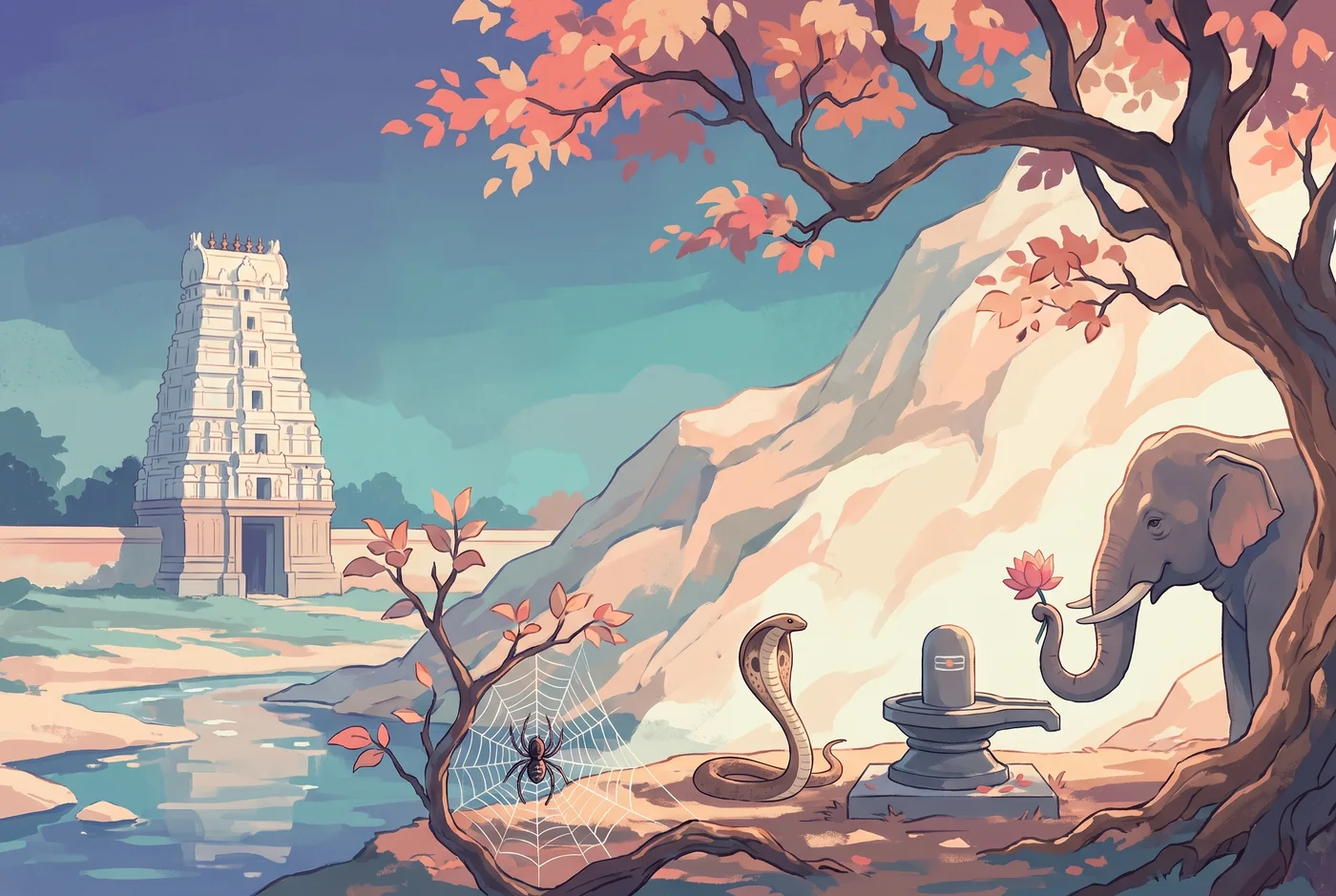
So when the hunter came with water in his mouth and meat in his hands, the hill had seen this kind of thing before. A spider cannot carry flowers. An elephant cannot spin. A hunter cannot chant. Each gave what it had.
The temple keeps one more custom. The linga here is honoured as the linga of air, one of five in the south that stand for the five elements, and not even the priest touches it with his hand.