Purana era
Shaiva and Vaishnava · The celibate forest god of Sabarimala, son of Shiva and Vishnu, found as a baby by the river Pampa, to whom millions of pilgrims climb every winter after forty-one days of vows
Ayyappa
Ayyappa is the god of Sabarimala, a temple on a forested hill in the Western Ghats of Kerala, and one of the great pilgrimage gods of south India.
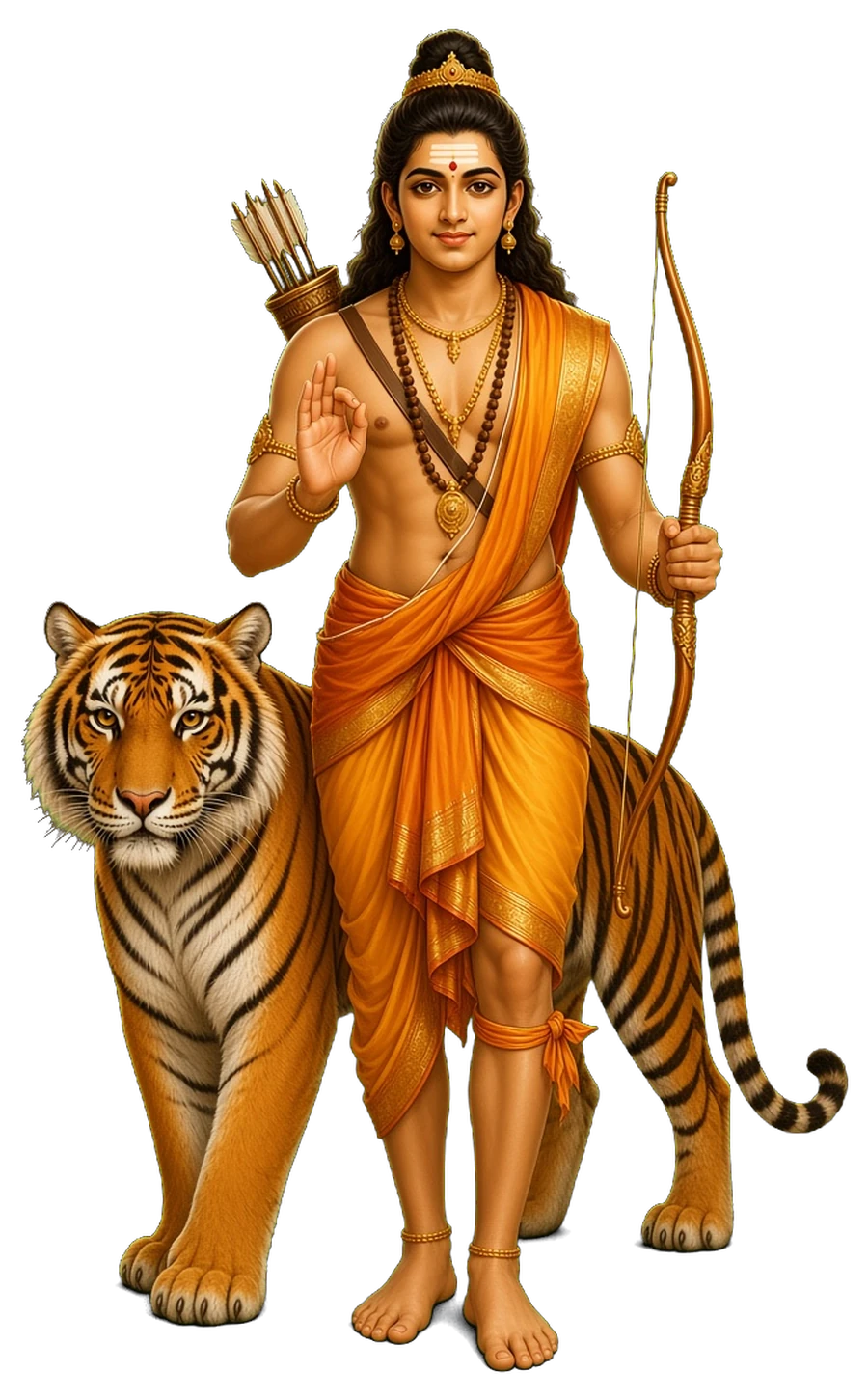
★A little Ayyappa waves from the back of his chubby tiger★A little Ayyappa sits smiling in yoga with a band round his knees
At a glance
TraditionShaiva and Vaishnava
FormA young man seated in yoga
his knees bound by a cloth band, one hand raised in the gesture of teaching
MountA tiger
sometimes a horse or elephant in his Shasta form
Who Ayyappa is
Ayyappa is the god of Sabarimala, a temple on a forested hill in the Western Ghats of Kerala, and one of the great pilgrimage gods of south India.
He is the son of Shiva and of Vishnu in his form as the enchantress Mohini, born to kill a buffalo demoness who could be killed by no one else. As a baby he was left by the river Pampa, with a gold chain round his neck, and found by the childless king of Pandalam, who raised him as a prince and called him Manikandan. At twelve he went into the forest for tigress's milk, killed the demoness, and came home riding a tiger. Then he left the palace and took his seat on the hill.
Swamiye saranam Ayyappa: the pilgrims' cry, lord, in you I take refuge, called out on every step of the climb.
He sits there in yoga, a young celibate, and his worship is a discipline. Pilgrims keep a vow for forty-one days, wearing black and a mala, carrying on their heads the irumudi, a cloth bundle of offerings. Only with it may they climb the eighteen steps to his shrine. At the start of the climb they honour his Muslim friend Vavar at the mosque in Erumely.
Every January the ornaments made for him by the kings of Pandalam are carried on foot to the temple for Makaravilakku, when a light shines on the far hill.
Before the Puranas
The Vedic roots of Ayyappa
Ayyappa grew from more than one root. In the Puranas there is a god called Shasta, the ruler, a son of Shiva born of his meeting with Mohini; the Bhagavata tells of Shiva's chase after Mohini, though not of a child. Across Tamil Nadu the village guardian Aiyanar, who rides a horse and guards the borders of villages, shares his name and his seated pose. Scholars read the Kerala god as the meeting of these streams with local forest worship.
The pilgrimage keeps the old royal tie alive. Every January the Thiruvabharanam, the god's gold ornaments, leave the Valiyakoickal temple at Pandalam in three sandalwood boxes and are carried on foot for three days to Sabarimala. At Erumely, the companies from Ambalappuzha and Alangad dance the Petta Thullal and pass through the Vavar mosque on the way.
The Sabarimala legend, with the king of Pandalam, the minister's plot and the tiger's milk, belongs to the temple's own tradition, and its oldest written forms are recent.
The temple has seen modern history too. In January 2011 a stampede at Pulmedu, on the way home from Makaravilakku, killed more than a hundred pilgrims, and the Travancore Devaswom Board then told the Kerala High Court that the light on the hill is lit by people.
Women of menstruating age were long kept from the shrine because of the god's celibacy. In September 2018 the Supreme Court of India ruled four to one that the exclusion was unconstitutional; the question was later referred to a larger bench of nine judges, which heard it and reserved judgment in May 2026.