Purana era
Vaishnava · Vishnu asleep on the serpent Anantha at Thiruvananthapuram, who owned the kingdom of Travancore and still crosses the airport runway to the sea
Padmanabhaswamy
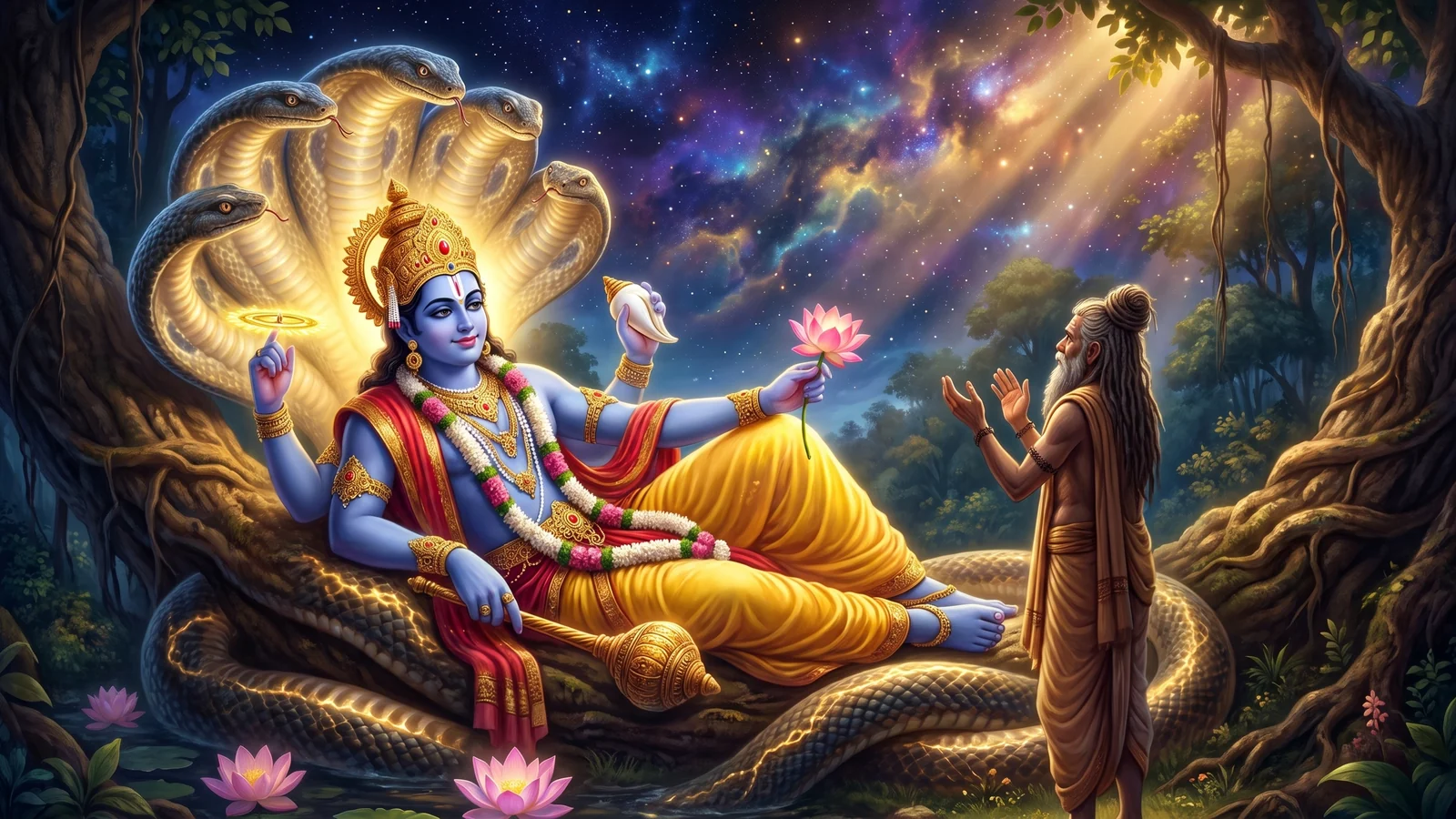
Padmanabhaswamy is Vishnu as he sleeps between the ages of the world: lying on the coils of the great serpent Anantha, on the ocean, with a lotus growing from his navel and Brahma sitting on it. His name means the lord with a lotus at his navel.
FormVishnu lying on his side on the coiled serpent Anantha, whose five hoods shade his head
SizeAbout eighteen feet long
seen only in three parts through three doors: face, navel and feet
Who Padmanabhaswamy is
Padmanabhaswamy is Vishnu as he sleeps between the ages of the world: lying on the coils of the great serpent Anantha, on the ocean, with a lotus growing from his navel and Brahma sitting on it. His name means the lord with a lotus at his navel. His temple is in Thiruvananthapuram, the capital of Kerala, and the city is named after him: the town of the holy Anantha.
The image is so long that no one can see it whole. Pilgrims stand before the stone platform in front of the sanctum and look through three doors in turn: through the first the god's face and the hand resting over a linga, through the second his navel and Brahma on the lotus, and through the third his feet.
His temple's story begins with a boy. The sage Vilwamangalam was worshipping when a child came and played with his offerings, and when the sage pushed him away, the child ran off into the forest and vanished into an iluppa tree. The tree fell and became the god, lying on his serpent across miles of land, until the sage begged him to make himself small enough to worship.
Om Namo Narayanaya: the eight-syllable mantra of Vishnu, said before the sleeping lord.
He is also, uniquely, a god who owned a kingdom. In 1750 King Marthanda Varma laid his sword on the god's step and gave him the whole of Travancore, and the kings after him ruled as his servants, Padmanabhadasa. In 2011 the vaults under his temple were opened and found to hold one of the greatest treasures on earth. And twice a year he goes in procession to bathe in the sea, across the runway of the airport, which closes for him.
Before the Puranas
The Vedic roots of Padmanabhaswamy
The temple is ancient, though how ancient no one can say. The Tamil Vaishnava poet-saint Nammalvar, of around the ninth century, sang of the lord of Anantapuram, and the temple is one of the hundred and eight Divya Desams, the holy places of Vishnu praised by the Alvars. Britannica notes that the earliest record of it is from the eighth or ninth century.
For centuries it was managed by a council of eight and a half, the Ettara Yogam: eight families of priests and nobles, and the king, who had half a vote. The great nobles of Venad, the Ettuveetil Pillamar, held real power over it. Marthanda Varma broke them in the 1730s and took the temple firmly into the royal family's hands.
He also rebuilt it. The image was made new after a fire, from twelve thousand and eight shaligram stones, and he set the single-stone platform in front of it in 1731 and raised the great tower over the east gate. In 1750 came the Thrippadidanam, the gift of the kingdom. The same king began the Murajapam, fifty-six days of continuous chanting of the Vedas held every six years, which ends with the Lakshadeepam, when a hundred thousand lamps are lit around the temple.
The royal family's connection with the temple has outlived the kingdom. In 2011 the Supreme Court ordered the vaults opened and inventoried, and in 2020 it held that the family keeps its role as the temple's custodian. One vault, Vault B, is still closed, and stories of what guards it have spread far beyond Kerala.