Devalok ← All gods
Also calledAnjaneyaMarutiBajrangbaliPavanputraKesari NandanMahaviraSankat MochanAnjaneyarHanumantha

Artwork ›

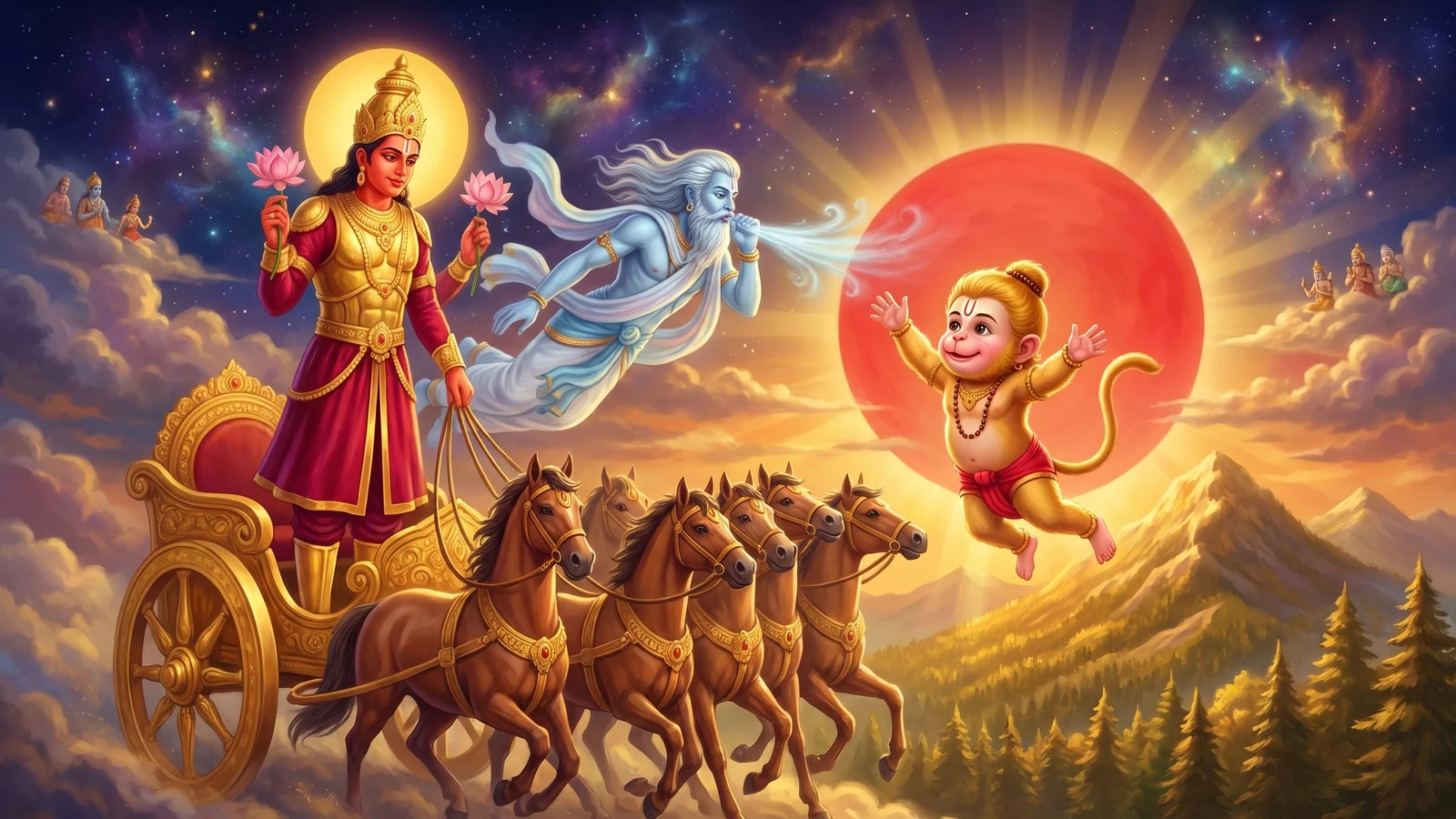
Hanuman Leaps for the Sun

At a glance

TraditionVaishnava
ColourRed or orange

often smeared with sindoor; in the south, sometimes dark stone covered in butter

FaceA monkey's face

with the swollen jaw that gave him his name

Who Hanuman is

Hanuman is the son of the Wind and the monkey woman Anjana. As a baby he took the rising sun for a ripe fruit and leapt at it, and Indra's thunderbolt broke his jaw. He grew up strong, and so wild that the sages laid a curse on him: he would forget his own strength until someone reminded him.

He met Rama in the forest, when Rama was searching for his stolen wife, and served him for the rest of time. He leapt the sea to Lanka, found Sita under a tree in Ravana's garden, gave her Rama's ring, and burnt the city with his own tail when they set it on fire. In the war he flew to the Himalaya for a healing herb and, not knowing which it was, brought back the whole mountain.

He asks for nothing for himself. When Rama was crowned and offered him a gift, it is said, he asked only to live as long as Rama's story is told, and so he is one of the deathless ones, still somewhere on earth, listening whenever the Ramayana is read.

He is the god of strength, courage and quick help. North India sings the Hanuman Chalisa to him on Tuesdays, wrestlers keep his image in the pit, and nearly every village has a red-painted Hanuman at its edge.

Shri Guru charan saroj raj, nij man mukur sudhari: the first line of the Hanuman Chalisa, cleaning the mirror of the mind with the dust of the teacher's feet.

Before the Puranas

The Vedic roots of Hanuman

Hanuman first appears in the Ramayana of Valmiki, where he is the minister of the monkey king Sugriva, a learned speaker, and the hero of the whole fifth book, the Sundara Kanda. He is strong and fast and brave, but in Valmiki he is not yet a god; he is the best of Rama's servants.

Some scholars have linked him to Vrishakapi, a monkey in a hymn of the Rig Veda, but the link is contested and the hymn is obscure. Others suggest that a village guardian, a monkey spirit of fields and boundaries, came into the epic through him; his red-smeared stones at the edge of fields still look like it.

His worship as a god in his own right grew in the second millennium. The Puranas made him Shiva's eleventh Rudra or the Wind's own appearance on earth, and the Madhva school counted him as the first of Vayu's three avatars, with Bhima and Madhvacharya. In Maharashtra the seventeenth century saint Samarth Ramdas set up Maruti shrines across the country as centres of strength and resistance, and wrestlers still keep them.

Above all it was Tulsidas, in the sixteenth century, who made him the god of the north Indian household. The Ramcharitmanas gave him a central place, and the Hanuman Chalisa, forty verses traditionally credited to Tulsidas, is now perhaps the most recited prayer in Hindi. Sankat Mochan, the temple at Varanasi, is said to stand where Tulsidas saw him.

See how the Vedic gods became the Puranic ones →

Every story about Hanuman

Related gods