Devalok ← All gods
Also calledRamachandraRaghavaRaghunathaDasharathiKodandaramaSitaramaRamalalaRamabhadra

Artwork ›

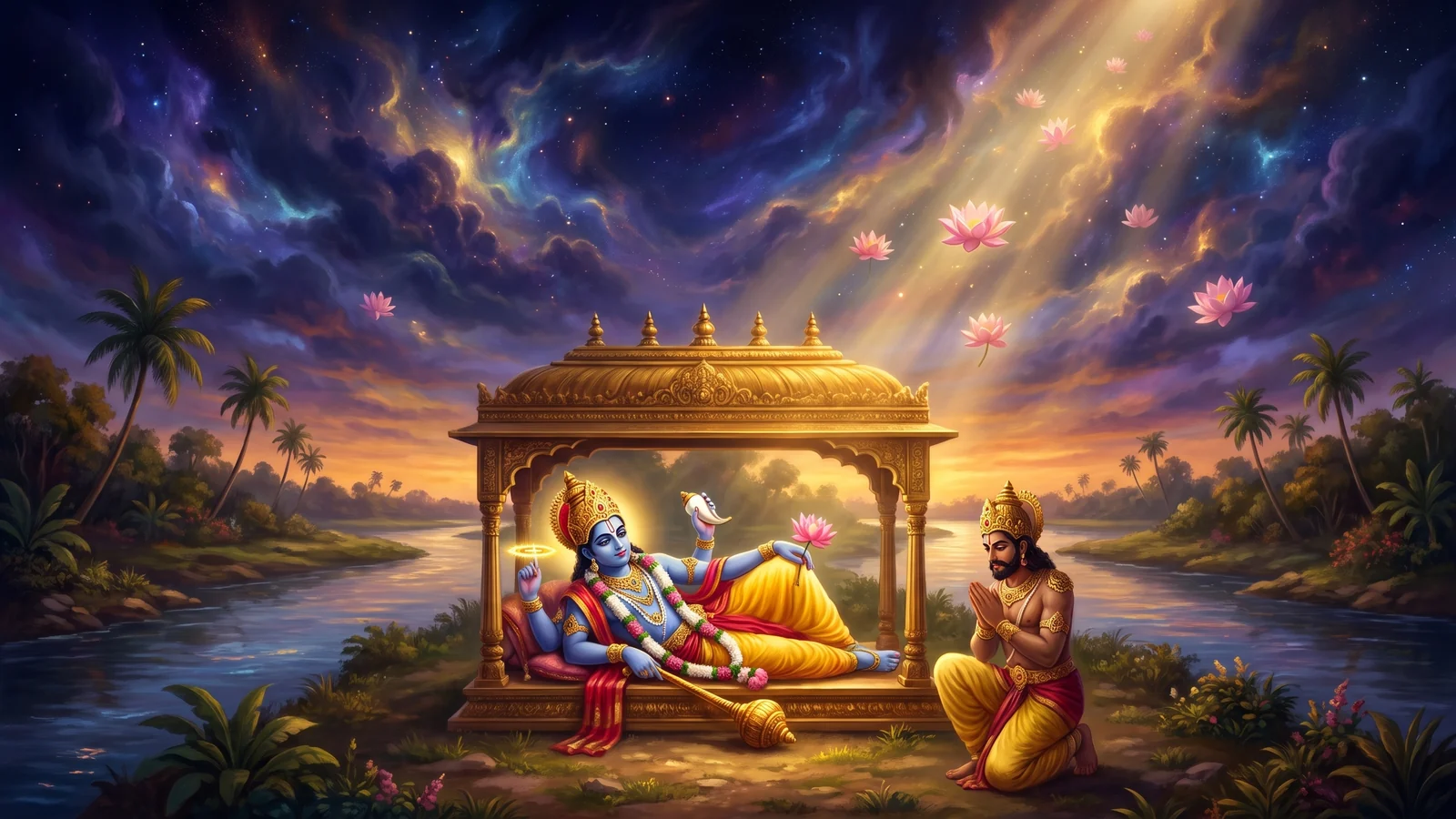
Why Ranganatha Faces South

At a glance

TraditionVaishnava
ColourDark green or blue

the colour of a new rain cloud or a blue lotus

In his handsThe great bow Kodanda and an arrow

a quiver of arrows on his back

Who Rama is

Rama is the prince who did everything a prince should, and was still sent away. His father, King Dasharatha of Ayodhya, had promised his youngest queen two wishes long before, and on the eve of Rama's crowning she asked for them: her own son Bharata on the throne, and Rama in the forest for fourteen years. Rama went the same day, without arguing, so that his father would not have broken his word. Sita, his wife, and Lakshmana, his brother, went with him.

In the forest Sita was carried off by Ravana, the ten-headed king of Lanka. Rama found friends among the monkeys and the bears, and Hanuman leapt the sea and found her. They built a bridge to Lanka, fought a war, and killed Ravana, and Rama came home in the flower chariot to be crowned at last. That homecoming is one of the stories told of Diwali, and the victory is Dussehra.

He is Vishnu's seventh avatar, born a man to kill a demon no god could touch, and he lives his life as a man, grieving, doubting, and making hard choices that people have argued over ever since. His name is the commonest prayer in north India, said at greetings and at funerals.

He is dark, with a bow taller than he is, and he is almost never shown alone.

Shri Rama Rama Rameti, rame rame manorame: the one who says "Rama, Rama" has said all the thousand names of Vishnu.

Before the Puranas

The Vedic roots of Rama

The Rama story is told first, and at most length, in the Ramayana of Valmiki, a Sanskrit epic in seven books. Scholars read it in layers. The five central books, from Ayodhya to the war, are thought to be the oldest, and their Rama is above all a hero and a model king. The first book, with his birth as Vishnu's portion, and the last, with Sita's exile and return to the earth, are generally taken as later, and they are the books that make him a god.

The Mahabharata tells the story too, in short, as the Ramopakhyana, told to the Pandavas in the forest to console them. The Buddhists have their own version in the Dasharatha Jataka, where Rama is a wise prince of Varanasi and Sita is his sister; the Jains have the Paumachariya of Vimalasuri, where Rama never kills anyone and Lakshmana kills Ravana.

From there the story went into every language. Kamban retold it in Tamil in the twelfth century, Krittivas in Bengali, Ezhuthachan in Malayalam, and Tulsidas in Awadhi in the sixteenth, as the Ramcharitmanas, the lake of Rama's deeds. The Manas made him the god of the north Indian household, and its recitation in Ram Lila still fills the autumn. It went east as well, to Thailand, Cambodia and Java, where the Ramakien, the Reamker and the Kakawin are still danced.

Rama worship in its own right, with Rama as the supreme god and his name as the whole of the path, grew in the second millennium with Ramananda and the poets who followed him, Kabir among them, whose Rama has no form at all.

See how the Vedic gods became the Puranic ones →

Every story about Rama

Related gods