Devalok ← All gods
Also calledMuruganSkandaSubrahmanyaKumaraShanmukhaArumugamSenthilVelanSwaminathaGuhaMahasenaKandasamy

Artwork ›

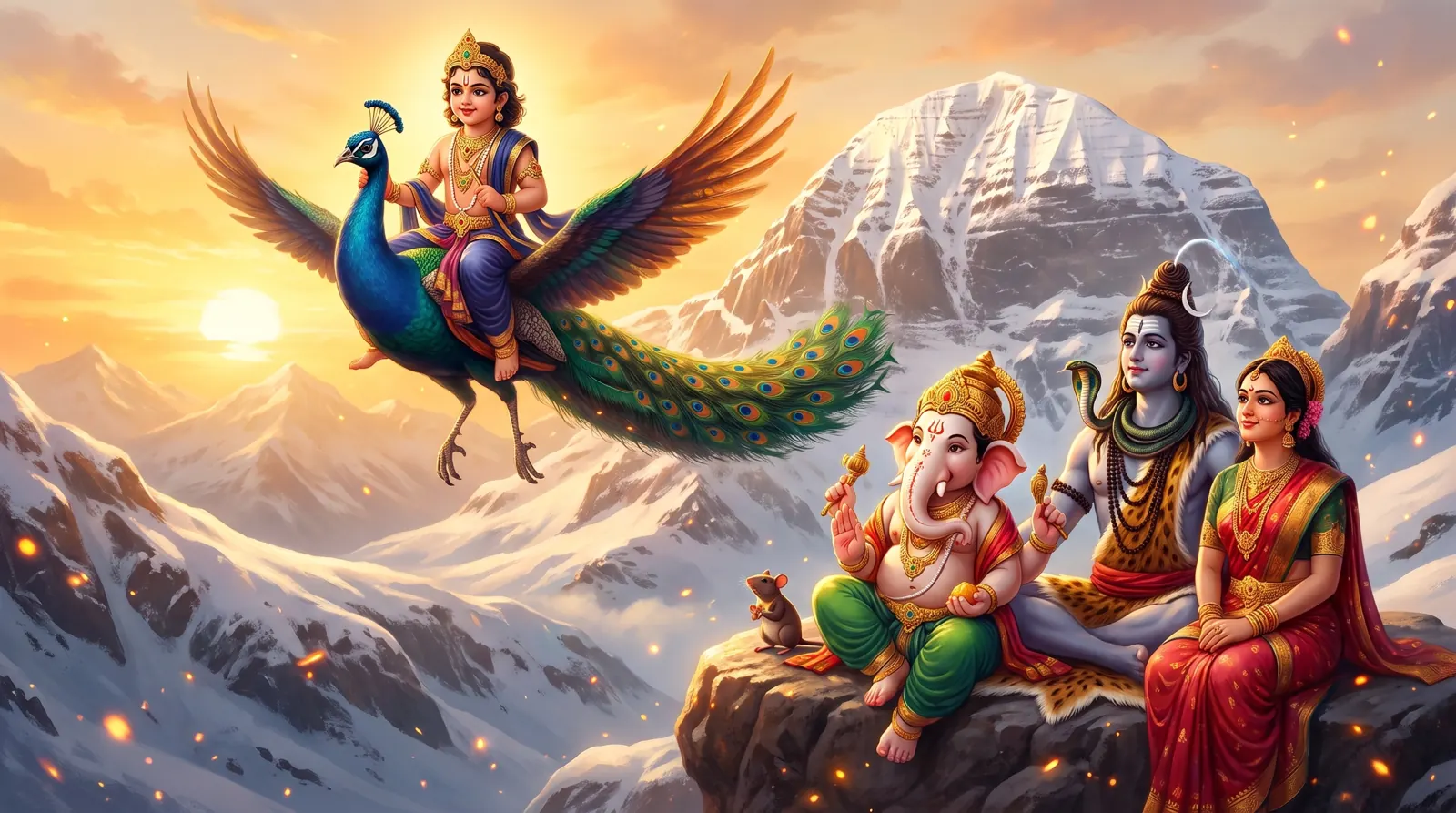
The Race Around the World

At a glance

TraditionShaiva
FormA beautiful young man

or a boy; often with six faces and twelve arms, as Shanmukha

In his handsThe Vel

the leaf-bladed lance his mother gave him; often a cock, a bow or a thunderbolt

Who Kartikeya is

Kartikeya is the son of Shiva who was born to kill a demon. In the north he is Skanda or Kartikeya, the general of the gods; in the south, and above all in the Tamil country, he is Murugan, the young and beautiful god of the hills, and one of the most loved gods of all.

His birth is famously strange. Shiva's seed was too hot for anyone to hold. Agni carried it, then the river Ganga, and it came to rest in a forest of reeds, where six babies were born and were nursed by the six stars of the Krittikas, the Pleiades. Parvati gathered the six into one child with six faces. He was six days old when he killed the demon Taraka.

He rides a peacock and carries the Vel, the lance his mother gave him. In Tamil Nadu his great enemy is Surapadman, whom he split in two at Tiruchendur by the sea, and forgave, so that the demon became his peacock and the cock on his banner. He has two wives, the hunter girl Valli and Indra's daughter Deivanai.

He is also a teacher. At Swamimalai, as a boy, he explained the meaning of Om to his own father.

Om Saravanabhava: the six syllables of Murugan, named for the forest of reeds where he was born.

His devotees carry the kavadi to him, an arch hung with peacock feathers, on festival days, many with their cheeks and bodies pierced with small lances. From Tamil Nadu his worship has gone with Tamil people to Sri Lanka, Malaysia, Singapore, Mauritius and South Africa, and at Thaipusam the crowds at the Batu Caves outside Kuala Lumpur run to more than a million.
Before the Puranas

The Vedic roots of Kartikeya

The Tamil Murugan and the Sanskrit Skanda were once two gods, and have long been one. Murugan, whose name means the young one, or the beautiful one, is the god of the kurinji, the hill country, in the oldest Tamil poetry, the Sangam anthologies. He is the god of hunters and of love in the hills, worshipped with wild dances; the Tirumurukarruppatai, a long Sangam poem, is a guide for the pilgrim to his shrines.

Skanda appears in the north in the Mahabharata, which tells his birth more than once, from Agni and Svaha among other versions, and makes him the commander of the army of the gods. Around the first and second centuries, the Kushan kings struck coins with four of his names on them, Skanda, Kumara, Visakha and Mahasena, and the warrior Yaudheya republic of the Punjab put him on theirs. The Gupta emperor Kumaragupta, named after him, issued coins showing himself feeding a peacock.

Kalidasa's poem the Kumarasambhava, the birth of the prince, and the vast Skanda Purana made his story part of Shiva's. In the Tamil country the poet Kachiyappa Sivachariyar retold that Purana in Tamil as the Kanda Puranam, and joined it to the local god, giving Murugan his war with Surapadman and his marriage to Valli. In the fifteenth century Arunagirinathar sang thousands of songs to him, the Tiruppugazh, still sung in his temples.

In much of north India his worship faded after the Gupta age, and he is remembered there mostly as Ganesha's brother. In the Tamil world it never faded.

See how the Vedic gods became the Puranic ones →

Every story about Kartikeya

Related gods