As the Ramayana tells it
Told across India · 3 min read
Ravana, king of Lanka, was in a very good mood.
He had just beaten his own half-brother Kubera, the god of wealth, and taken from him the greatest prize in the worlds: the Pushpaka, a palace that could fly. Now he was riding it home across the sky, with ten heads full of his own glory.
Somewhere over the Himalaya, the Pushpaka stopped.
It did not slow down first. It simply stopped in mid-air, as if it had come up against a wall. In front of it stood a white mountain.
Ravana leaned out. On the slope below stood a short, sturdy figure with the face of a bull, holding a staff.
"Turn back, king of Lanka," the figure called. "This is Kailash. Lord Shiva is here with the goddess. Nobody flies over this mountain. Not gods, not birds, and not you."
It was Nandi, Shiva's gatekeeper. Ravana looked him up and down and burst out laughing.
"And who are you to tell me so? Look at that face! You look like a monkey!"
Nandi did not laugh.
"Since you laugh at a face like a monkey's," he said, "remember this. One day monkeys will be the ruin of you and all your house."
Ravana waved the curse away like a fly. He would remember it many years later, when an army of monkeys stood at the gates of Lanka. But that is another story.
"A mountain is in my way," said Ravana. "Then I will move the mountain."
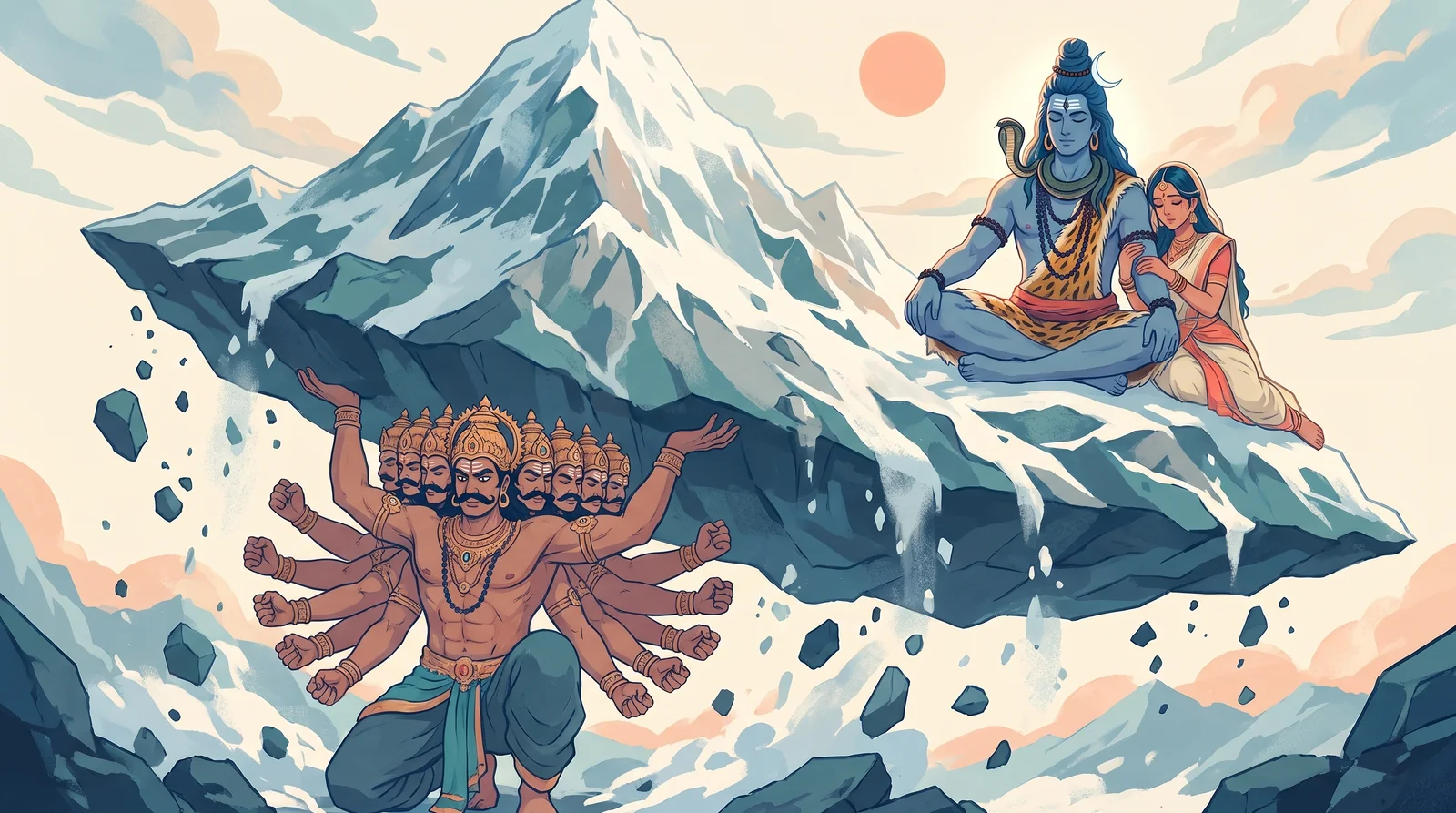
He climbed down, knelt at the foot of Kailash and pushed his arms underneath it, all twenty of them. He took a breath and heaved.
Kailash shook.
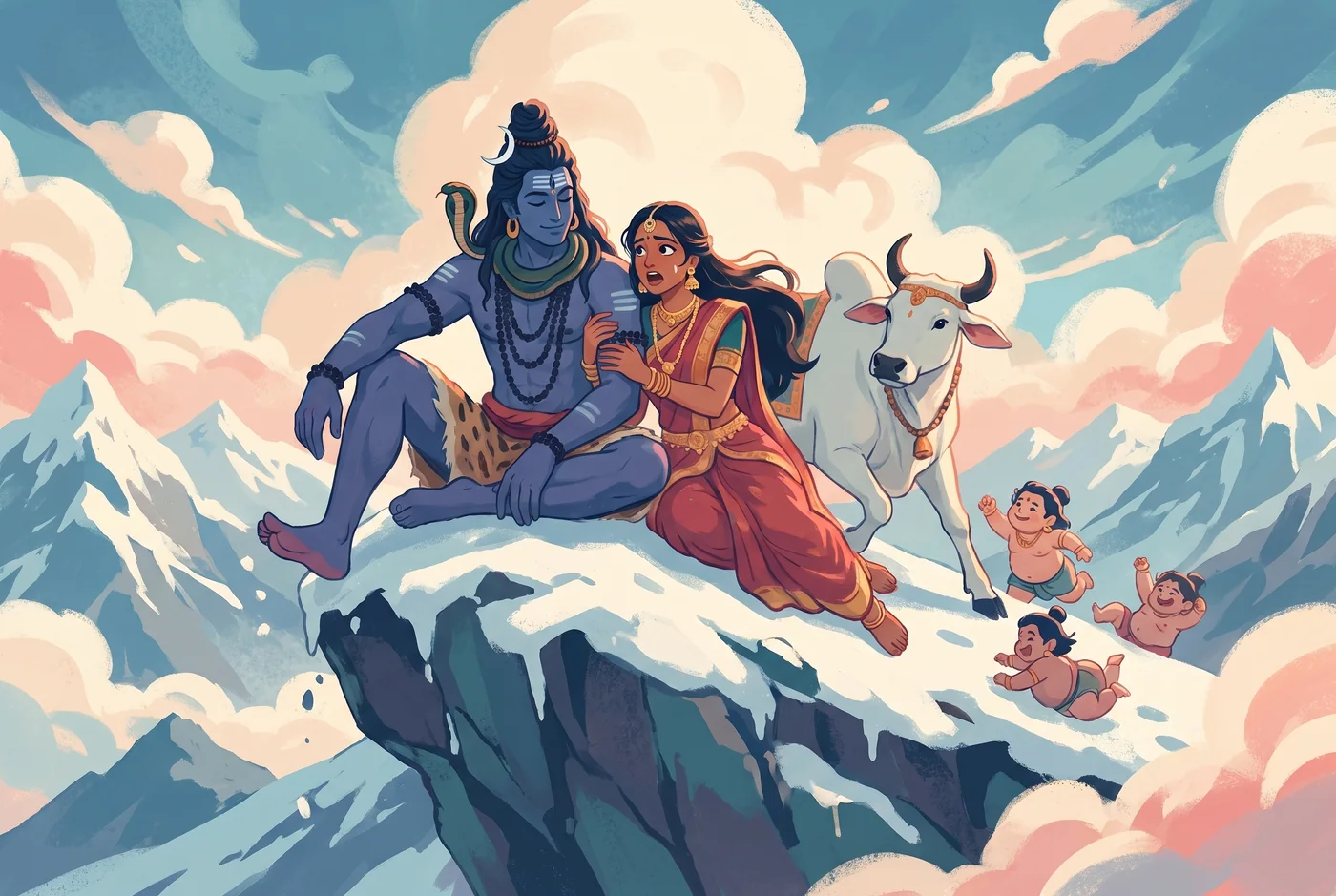
Rocks came loose and went crashing down the slopes. The ganas, Shiva's wild followers, were thrown off their feet. On the summit, where Shiva and Parvati were sitting together, the ground lurched, and Parvati caught hold of her husband's arm.
"What is happening?"
Shiva did not even get up. He knew exactly who was underneath and what he was doing.
He stretched out one foot and pressed down, lightly, with his big toe.
The mountain settled back into place as if it had never moved. Ravana was underneath it.
His twenty arms were caught beneath the whole weight of Kailash, and he let out a roar of pain so loud that the three worlds shook with it. The gods heard it in heaven. It did not move the mountain an inch.
Ravana was proud, but he was not a fool, and he was not a stranger to prayer. Pinned there, he understood at last who lived at the top.
So he began to sing.
He sang the praises of Shiva, hymn after hymn, with all ten of his mouths. He did not sing for a day or a year. He sang for a thousand years, crushed under the mountain.
At the end of that time Shiva lifted his toe.
Ravana crawled out and stood before him, and Shiva was smiling.
"You have a great voice," he said. "The worlds trembled when you cried out. From now on let that be your name: Ravana, the one who roars."
Then he gave him a gift, a shining sword, and let him go.
So the name by which the whole world knows the king of Lanka was given to him by Shiva, at the foot of the mountain he could not lift.
As the Tamil saints sing it
South India · Tamil Nadu · 1 min read
More than twelve hundred years ago, the poet-saints of the Tamil country walked from temple to temple singing to Shiva. Their songs are gathered in the Tevaram, and they come back to this scene again and again: the ten-headed king caught under the mountain.
But they see something in it that the older telling passes over quickly. For them the heart of the story is the music.
In the Tamil telling, Ravana under the mountain does not only cry out. He is a musician as well as a king, and when the pain has taught him his mistake, he turns to the thing he does best. He wants a veena to play, and he has none. So, some say, he makes one out of himself, with his own sinews for its strings.
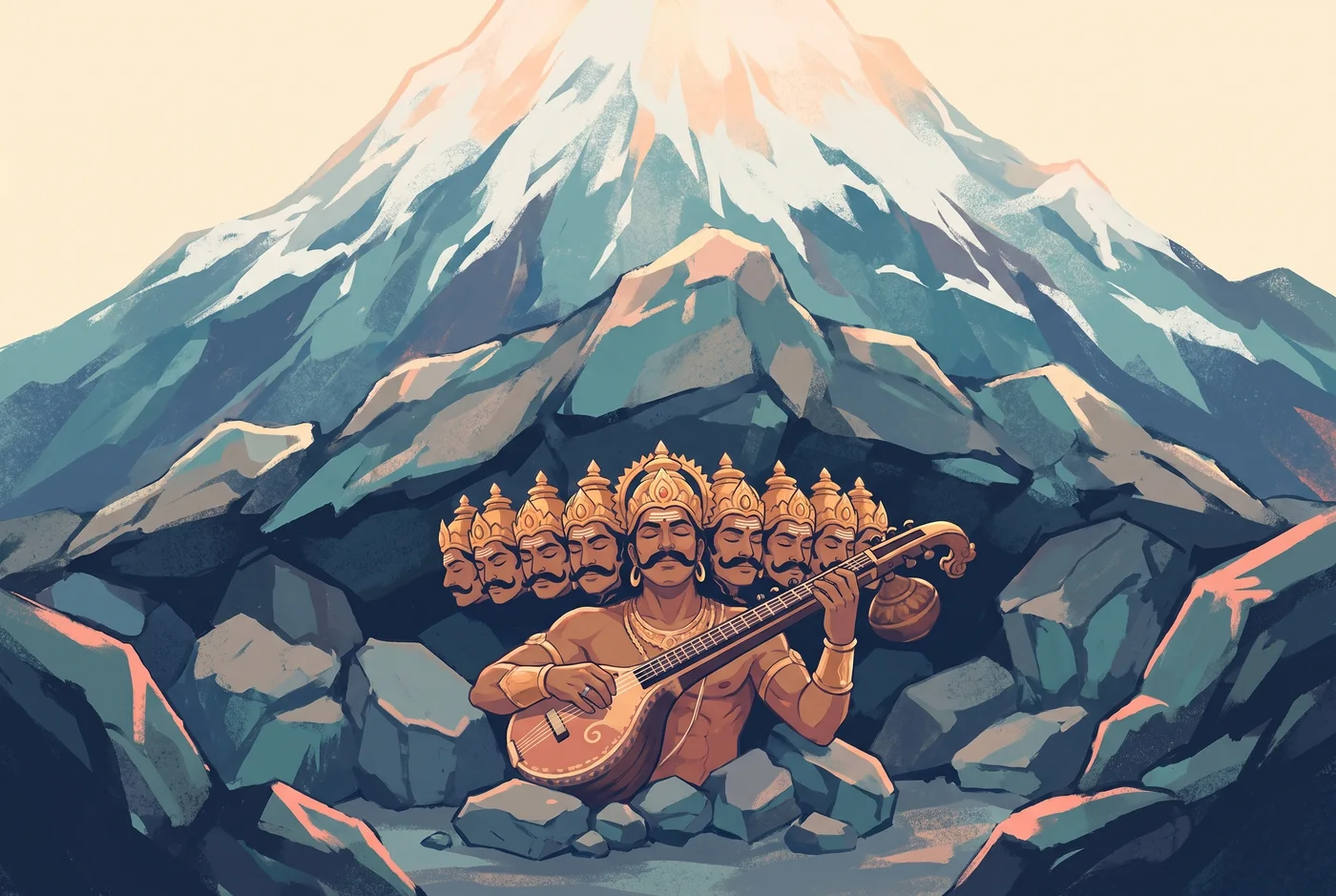
On that terrible instrument he plays, and to it he sings. Tradition says the hymn he made there is the one still chanted today, the Shiva Tandava Stotram, the song of Shiva's dance. It is all rhythm, like a drum. It praises the river tumbling in Shiva's hair, the snake at his throat and the beat of the damaru as he dances.
High above, Shiva listens. In this telling it is not the thousand years of patience that win him. It is the song. He is moved by the music, and he lifts his foot.
That is why the saints sang of it so often. A man who had shaken God's own house was forgiven, and more than forgiven, when his pride broke and turned into music.