As the Bhagavata Purana tells it
Told across India · 2 min read
The gods and the asuras were old enemies, and for once they had agreed on something.
At the bottom of the ocean of milk lay amrita, the nectar that ends death. Neither side could reach it alone. So they made a truce and decided to churn the whole ocean, the way a village woman churns a pot of curd for butter. A mountain was their churning rod. A great serpent, wound around it, was their rope. The gods took one end, the asuras took the other, and they began to pull.
They pulled for a long time. The mountain turned, the ocean foamed, and everyone watched the water for the first gleam of nectar.
What came up first was not nectar.
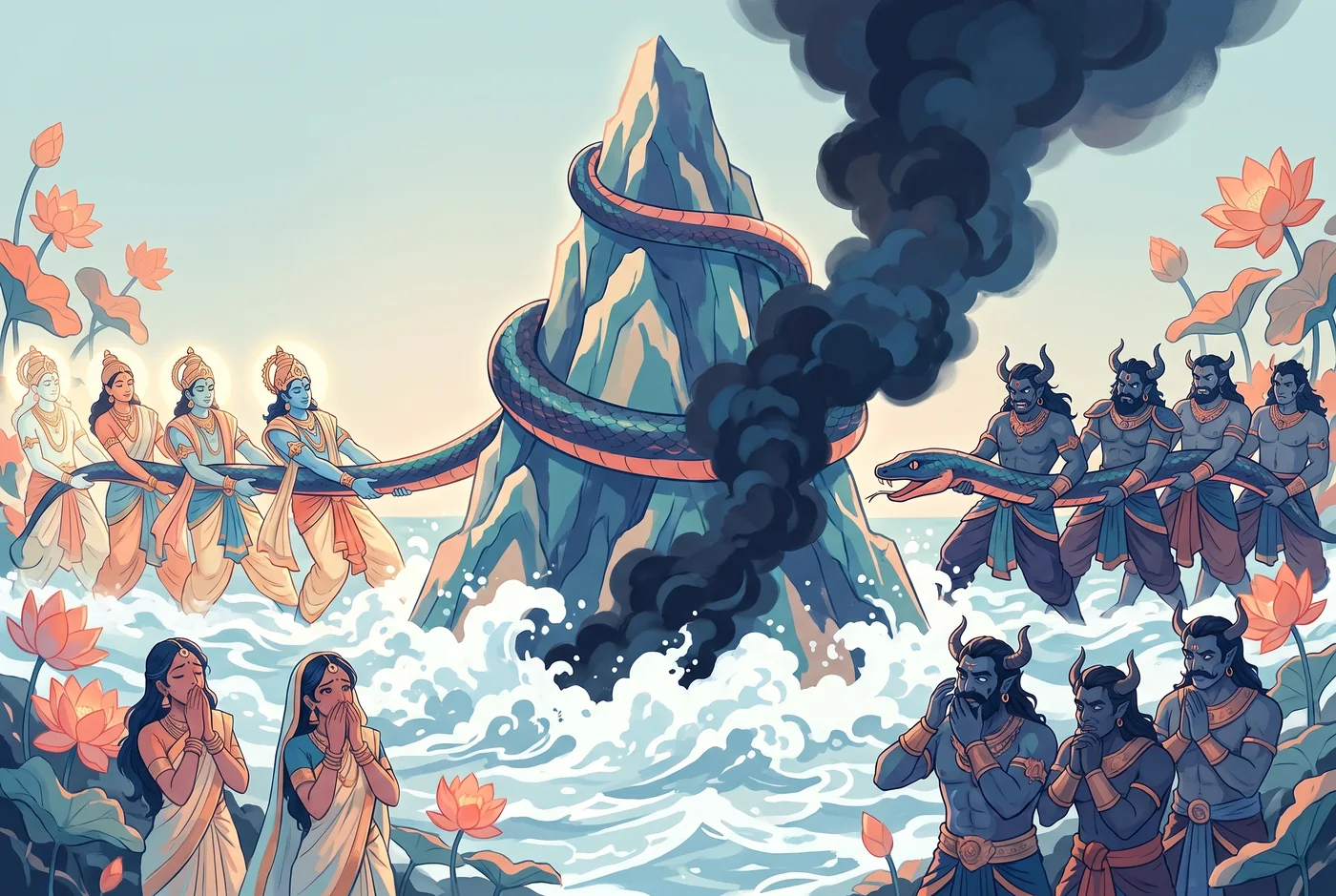
A dark poison rose out of the milk, the halahala, and it spread in every direction at once. It burned the air. It burned the water. The creatures of the three worlds began to fall where they stood, and gods and asuras alike dropped the rope and ran.
There was no one among them who could stop it, and they knew it. So the gods fled to the one place they could think of: Kailash, where Shiva sat with his wife.
They did not have to explain much. He could see their faces, and behind them he could see the sky going dark.
"Save us," they said. "There is nobody else."
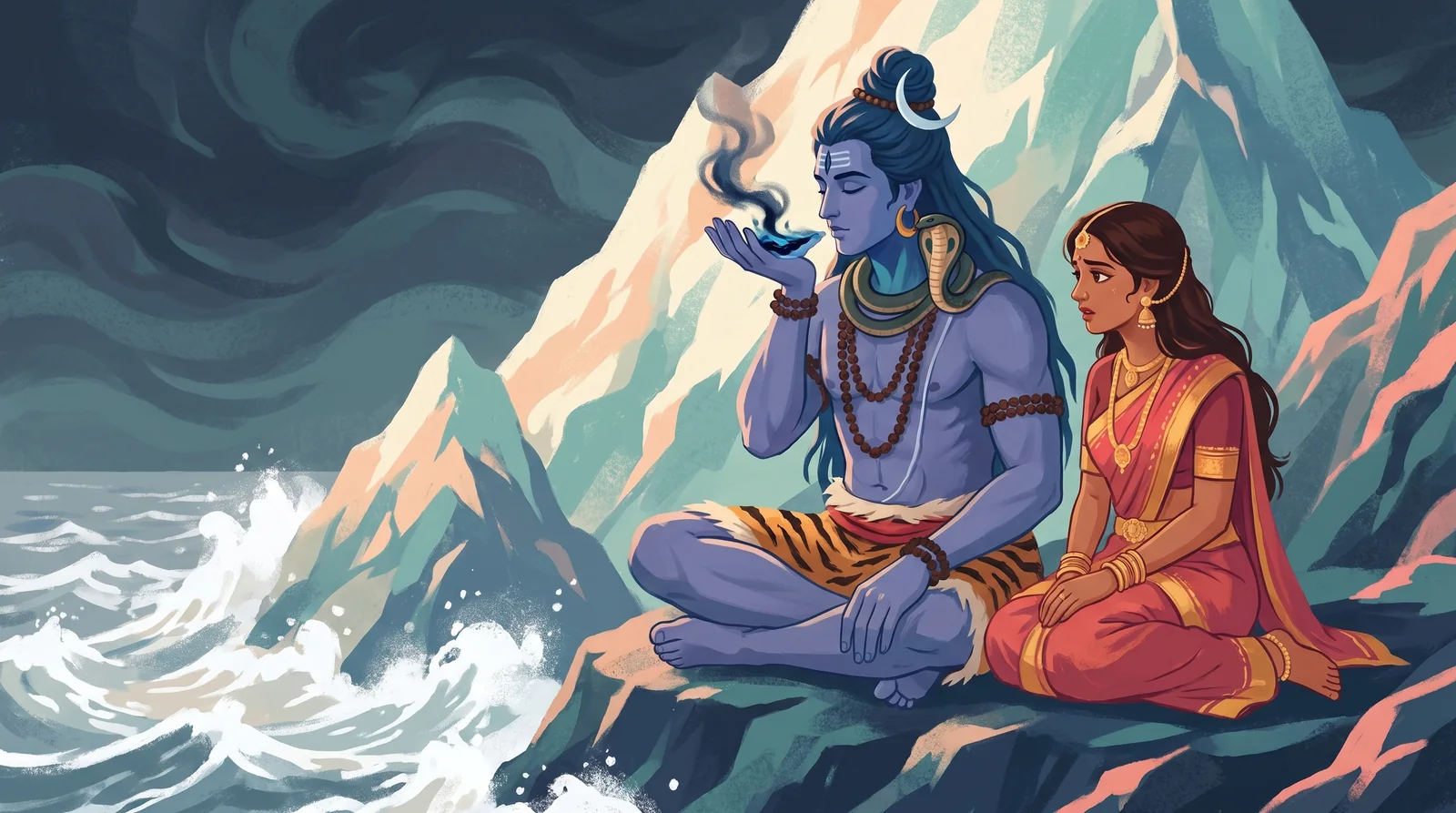
Shiva turned to his wife, whom the Bhagavata here calls Bhavani.
"Look at them," he said quietly. "When the living are in danger, it is the work of the strong to shelter them, even if it costs the strong something. That is all strength is for. I would like to drink this poison. Will you let me?"
It is worth noticing that he asked. She knew exactly who her husband was and what he could bear, and she gave her consent.
So Shiva gathered the poison. All of it, from every corner of the three worlds, he drew into the hollow of his palm, until what had covered the sky was a small dark pool in one hand. Then he raised his hand and swallowed it.
The gods held their breath.
The poison went no further than his throat. It stayed there, and it left its mark: his throat turned a deep blue, like a bruise that never fades. The singers have called him Neelakantha ever since, the one with the blue throat, and they count the stain as an ornament, not a wound.
A few drops, the Bhagavata adds, slipped between his fingers as he drank. The scorpions took those, and the cobras, and certain plants. That is where their venom comes from.
Then the gods and the asuras went back to the rope, and the churning began again. Many wonderful things rose from the ocean after that, and at last the nectar itself. But none of it would have come if someone had not first been willing to take the worst of it.
As Neelkanth Mahadev tells it
Garhwal Himalaya · near Rishikesh, Uttarakhand · 1 min read
High above Rishikesh, about thirty kilometres up into the forested hills, two small streams called the Pankaja and the Madhumati run together. A temple stands at the meeting place, and the people who keep it will tell you plainly: this is the ground where he sat down to drink.
The temple's tower is carved and painted with the whole scene, the mountain, the serpent, the gods on one side and the asuras on the other, so that pilgrims can read the story before they step inside.
Here the telling is the one that most families know, and it has two details the old text does not give.
When Shiva lifted the poison to his mouth, they say, Parvati was watching him closely. She trusted him, but she was his wife. The moment he swallowed, she reached out and caught him by the throat with her own hand, so that the poison could go no further down. That is why it stopped where it did.
And the burning did not stop at once. To cool it, the crescent moon was set upon his head, where it has stayed.
People also say that the gods were afraid the poison would overcome him if he slept. So all that night they stayed awake with him, singing, keeping watch. Devotees who sit up through the night of Maha Shivaratri say they are doing the same.
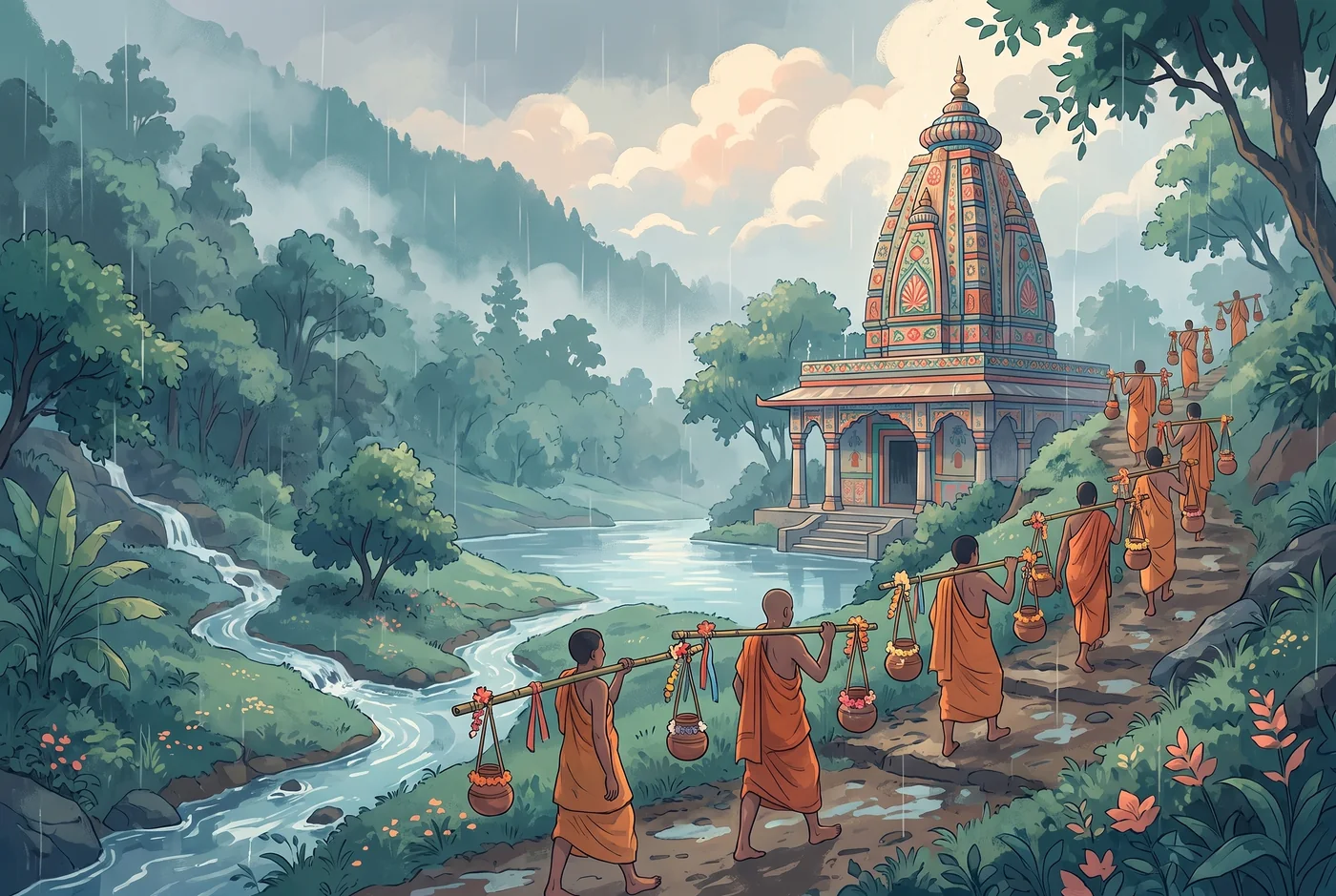
The cooling still goes on. Every year in the rainy month of Shravan, pilgrims walk here in their thousands. They carry water from the Ganga in small pots slung from a pole across the shoulder. At the end of the walk they pour it over the linga, to soothe a throat that took in the world's poison and has held it ever since.