As the Bhagavata Purana tells it
Bhagavata Purana, canto 8 · 3 min read
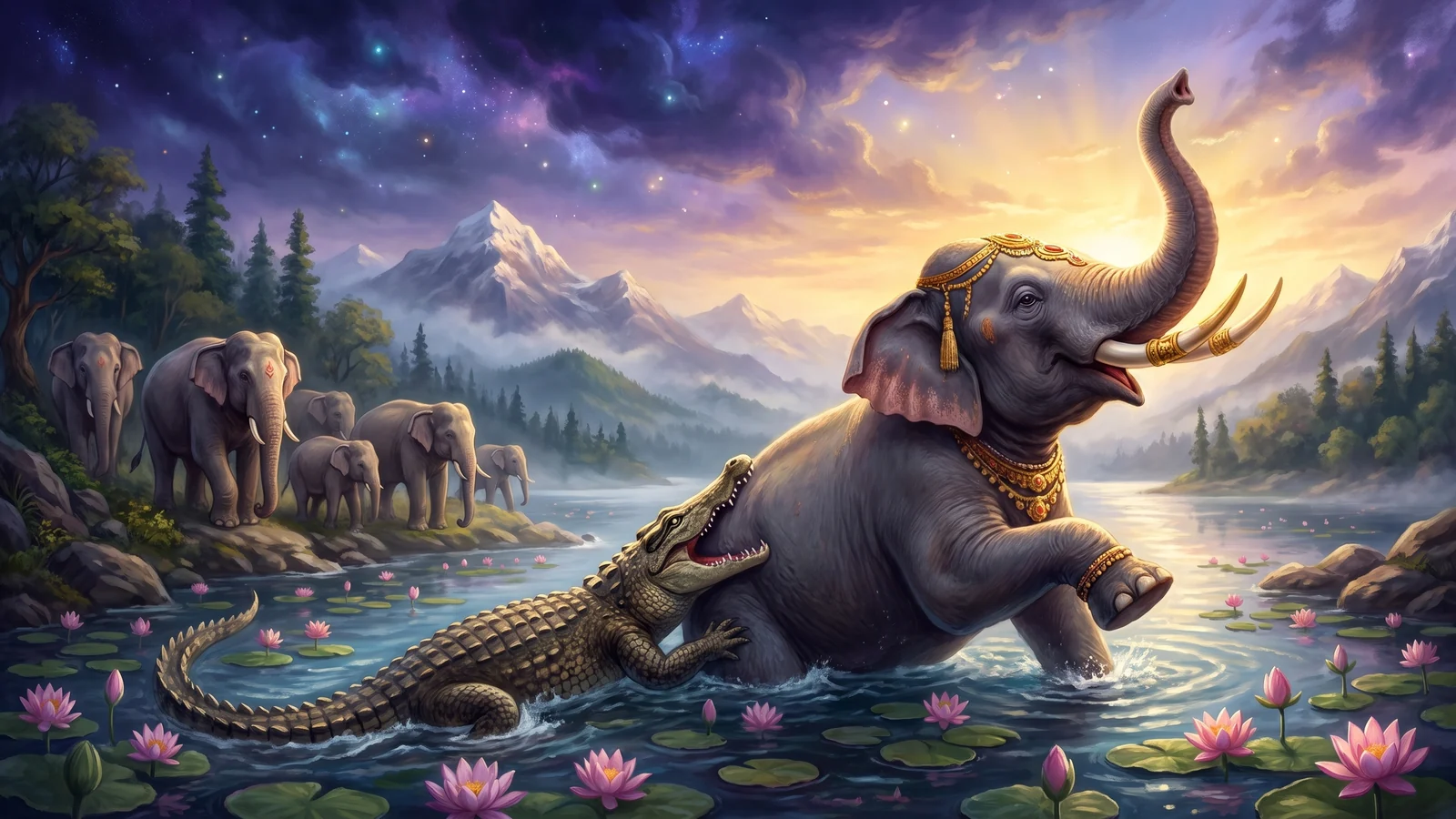
On a mountain stood a forest, and in the forest lay a lake, and one hot day a herd of elephants came down through the trees to drink.
At their head walked Gajendra, the lord of the herd. He was the largest of them and the strongest, and the whole forest made way for him when he passed. The females followed him, the calves ran between their legs, and when they reached the water the lord went in first.
He drank. The water was cool and the lotuses were in flower, and he waded out further than he needed to.
Something took him by the leg.
It was a crocodile. It had him by the hind leg, and it did not let go. Gajendra pulled. The crocodile pulled back. The lord of the herd, who had never met a thing he could not move, found that he could not move this.
"Take hold of me," he trumpeted to the others. "All of you. Pull!"
They came. The females wound their trunks around his, the young bulls set their shoulders against his flanks, and the whole herd heaved. It did no good. An elephant is strong on land. In the water a crocodile is stronger, and this one only tightened its grip and drew him a little deeper.
The Bhagavata does not say the struggle lasted a day, or a season. It says years.
Years of pulling, and the lake churned to mud, and the herd on the bank. The elephant grew thin. The crocodile did not. One by one the others stopped coming to the water's edge. There was nothing they could do, and they knew it, and at last they turned and went back under the trees.
"Do not leave me," Gajendra called after them. Nobody answered.
He stood alone in the lake with the crocodile on his leg and felt the last of his strength going out of him like water out of a cracked pot.
And then, in the quiet, he thought.
He had trusted his own strength, and it had failed. He had trusted the herd, and the herd had gone. There was no one left in the forest to call. So he would call on no one in the forest.
"Whoever you are," he said, "who stand behind every god the gods themselves bow to, whom nobody has seen and nobody can name: I have nothing left. I give myself to you."
He reached out his trunk, broke off a single lotus from the water beside him, and lifted it as high as he could.
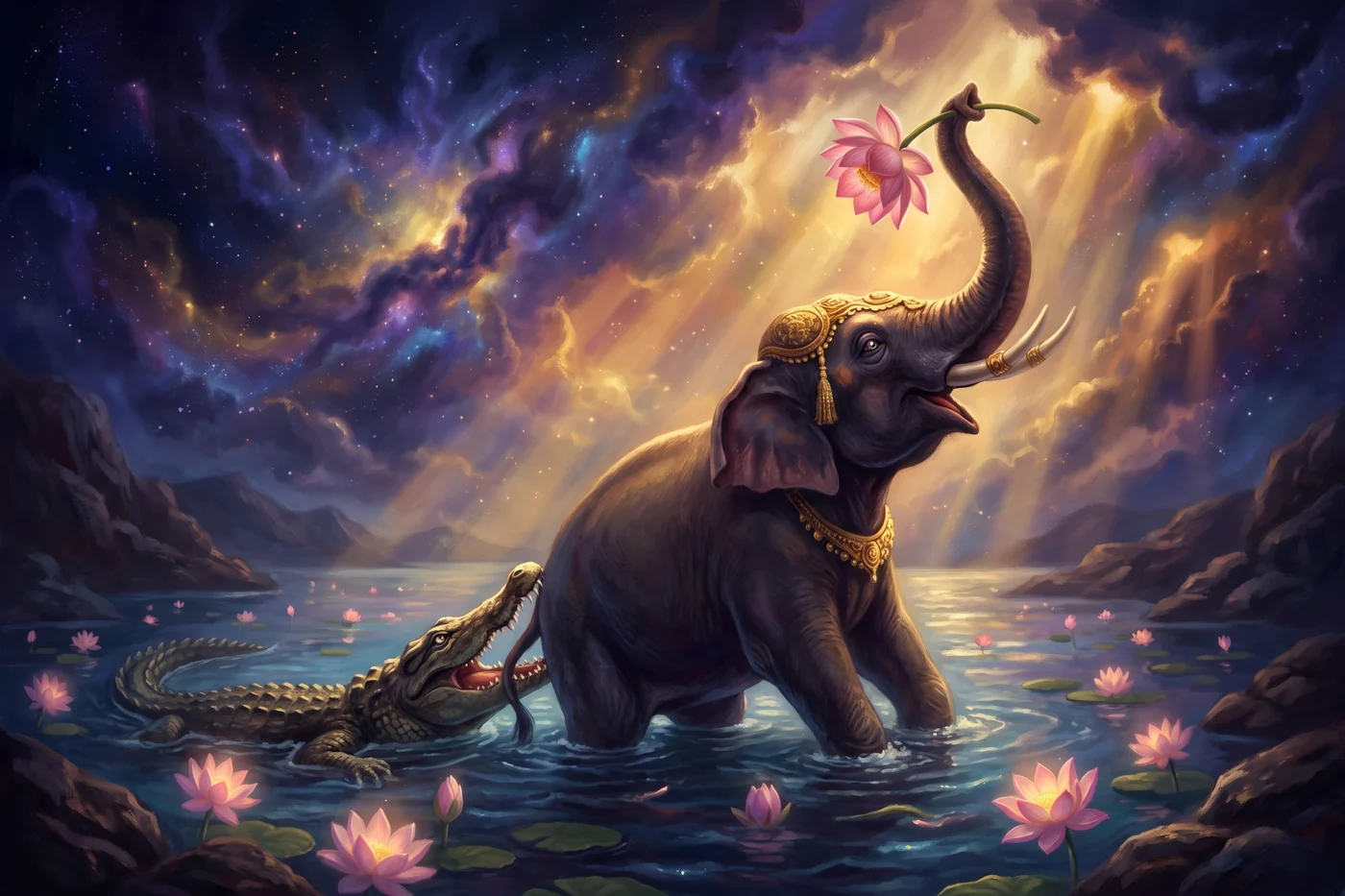
"Take this," he said. "It is all I have."
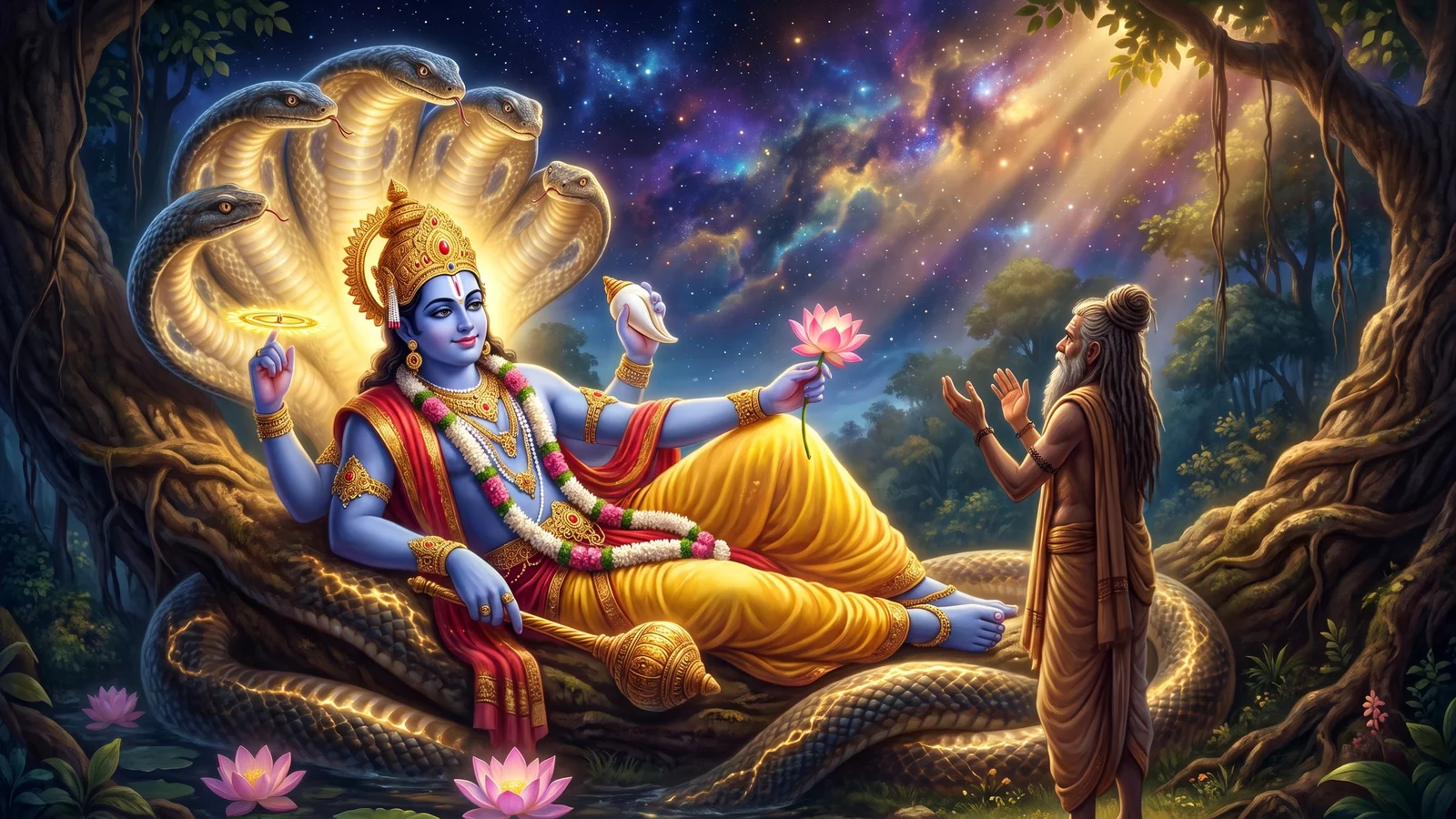
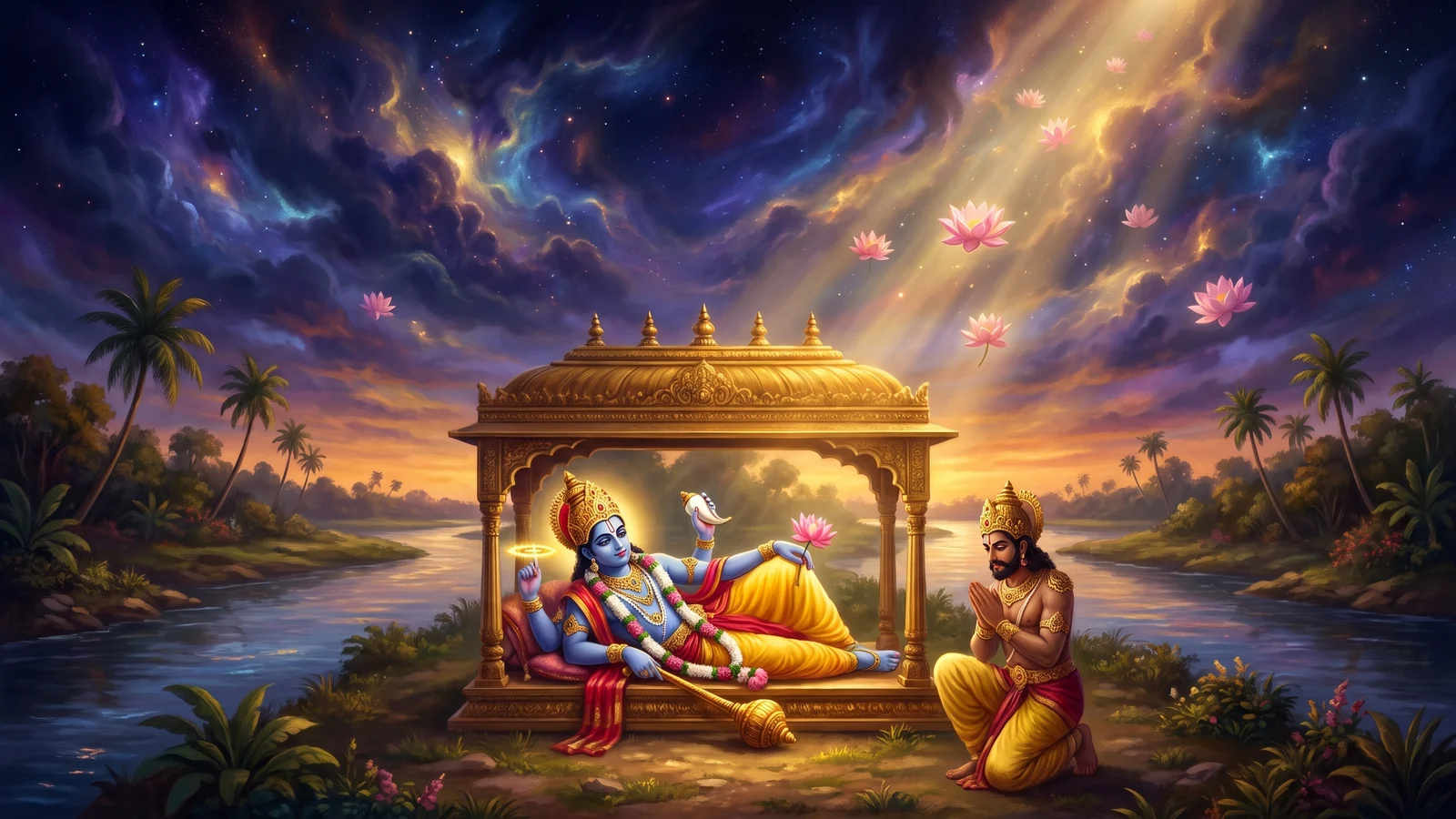
Far off, on the back of Garuda, Vishnu heard him. He did not send anyone. He came himself, and he came at once.
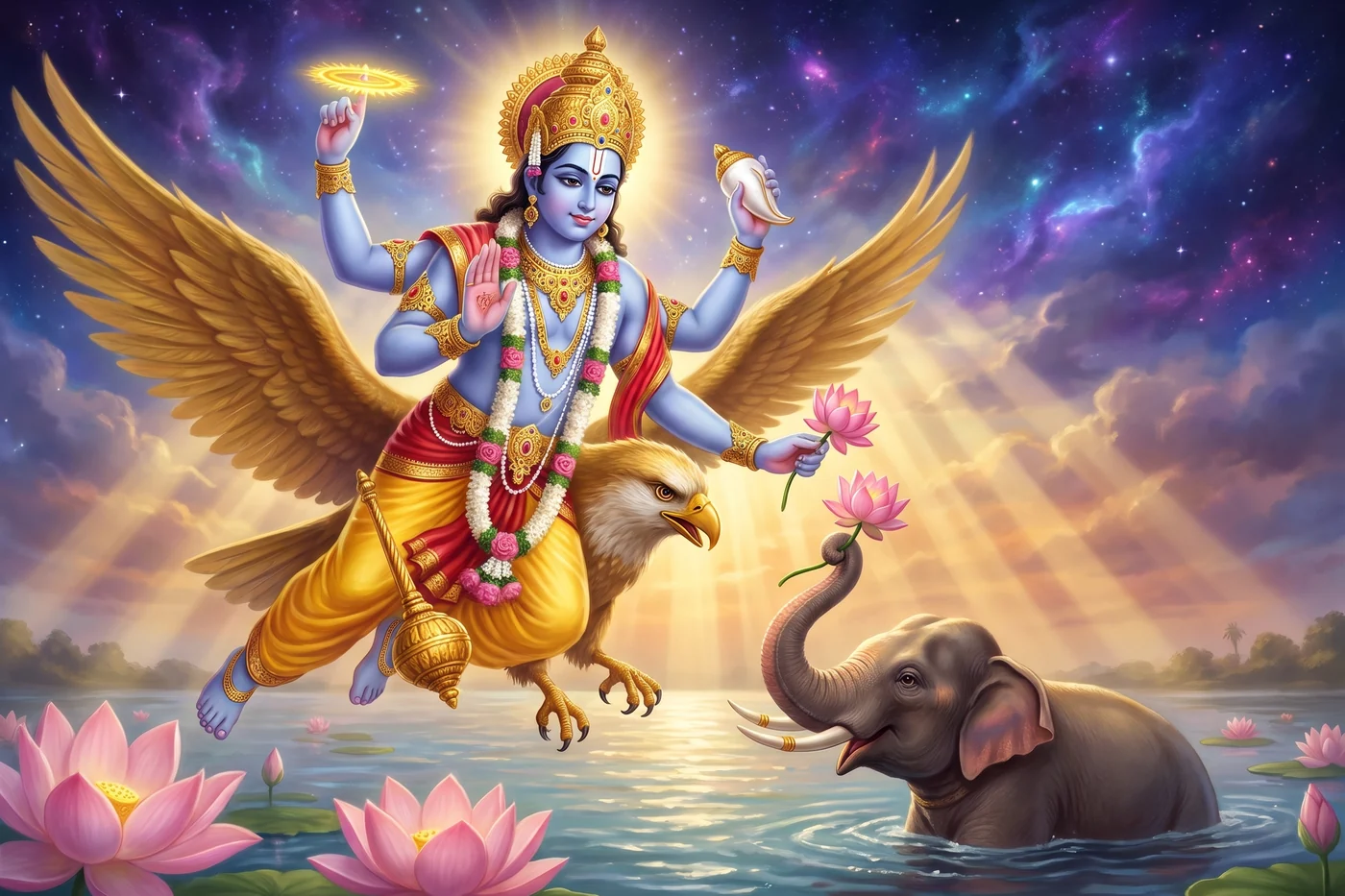
The discus left his hand. It struck the crocodile and cut off its head, and the water went red and then clear.
What rose out of the lake was not a crocodile. It was a gandharva, one of the singers of heaven, named Huhu. A sage called Devala had cursed him long ago, and he had worn the crocodile's body all those years. The curse was finished now. He bowed to Vishnu and went up and away.
Gajendra too, the Bhagavata says, had once been someone else. In another life he had been Indradyumna, a king of the Pandya country in the south, and the sage Agastya had cursed him for his pride. An elephant's body had been the price of it. Now, with the lotus still in his trunk, that debt was paid as well, and the lord of the herd was released.
As Kabisthalam tells it
Kabisthalam, Thanjavur, Tamil Nadu · 2 min read
The Bhagavata gives the lake a mountain and a forest and no name. The village of Kabisthalam, in the Thanjavur district of Tamil Nadu, gives it an address.
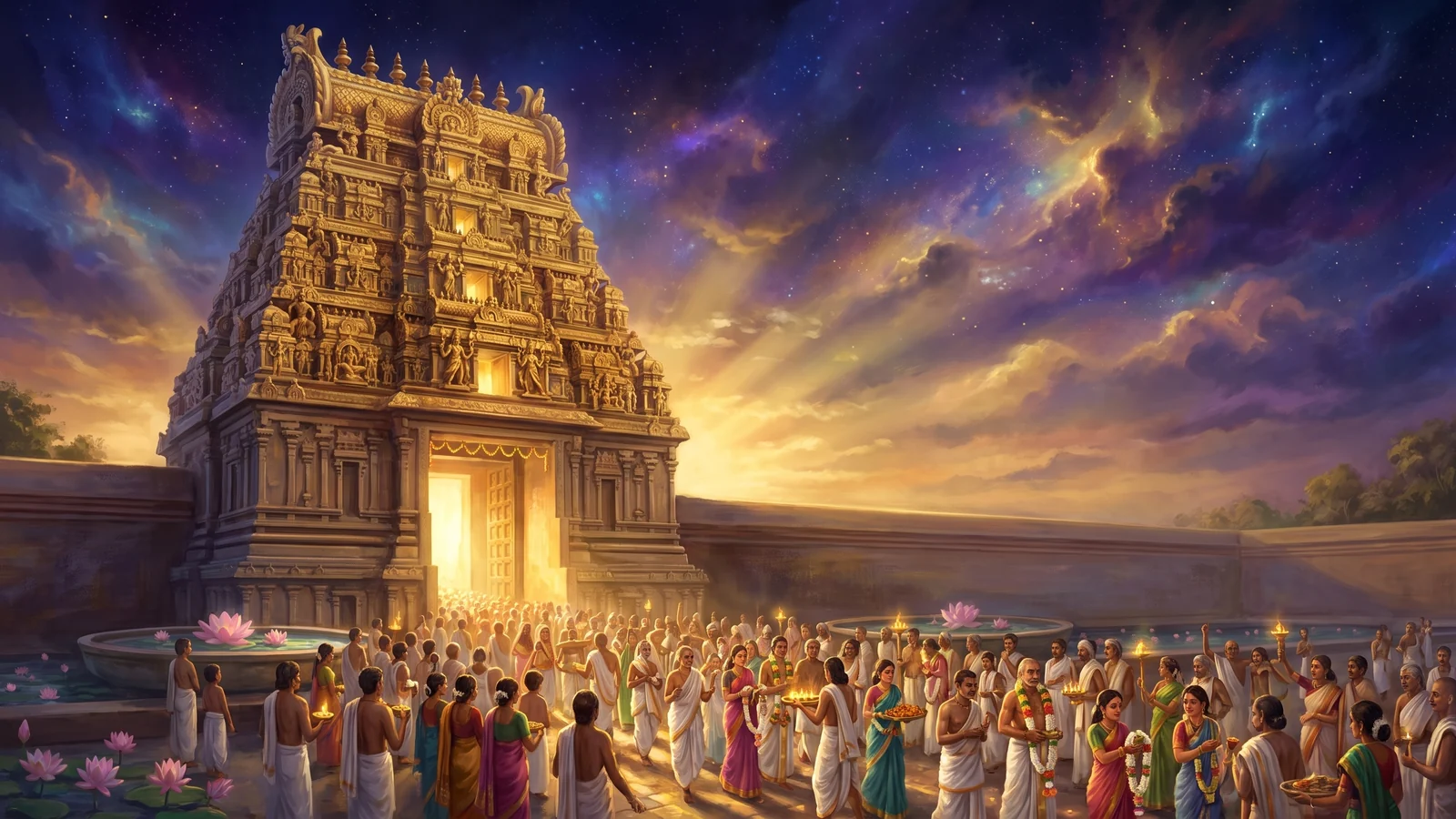
The village stands on the Kaveri, in the river's rice country, and its temple is counted among the hundred and eight Divya Desams, the shrines of Vishnu that the Tamil tradition holds as the holiest of his houses. The god here is called Gajendra Varadha, the one who gave Gajendra what he asked for, and the temple's claim is plain: this is the place.
The water the elephant walked into, the priests will tell you, is the Kabila Teertham, the holy water of this village. The herd did not come to some mountain lake nobody can find. It came here, and the crocodile was waiting in this water, and the flower was lifted on this bank.
The temple holds one thing more to itself. Elsewhere, it says, Vishnu is shown as he is usually shown. Here alone he is seen seated on Garuda in the act of the rescue, with the elephant and the crocodile both before him and both being set free, the animal and its captor together. No other shrine makes that claim, the temple says, and pilgrims who know the story come to stand in front of it.
A reader who has finished the Bhagavata and comes down to the river finds the same story waiting, only now it has a village around it and a month in the year.
For once a year it is played out again. In the Tamil month of Adi, which falls in July and August, the temple holds the Gajendra Moksha Leela, and the rescue is acted on the ground where it is held to have happened: the elephant going into the water, the crocodile taking hold, the flower held up, and the god coming down on his bird.