As the Devi Mahatmya tells it
Markandeya Purana, chapter 1 · 3 min read
The Devi Mahatmya opens with this story, and it tells it to show one thing: whose power moves even the gods.
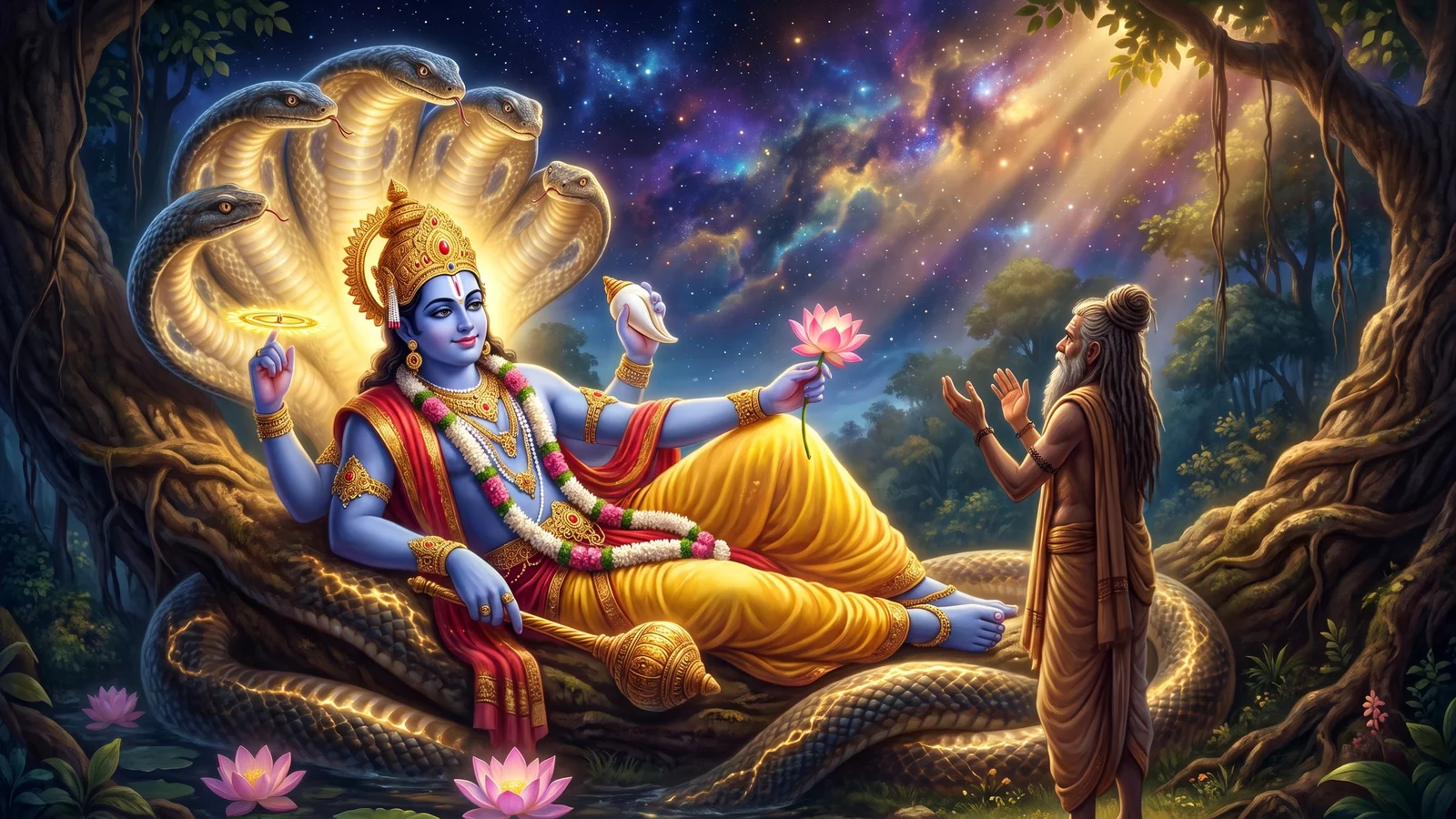
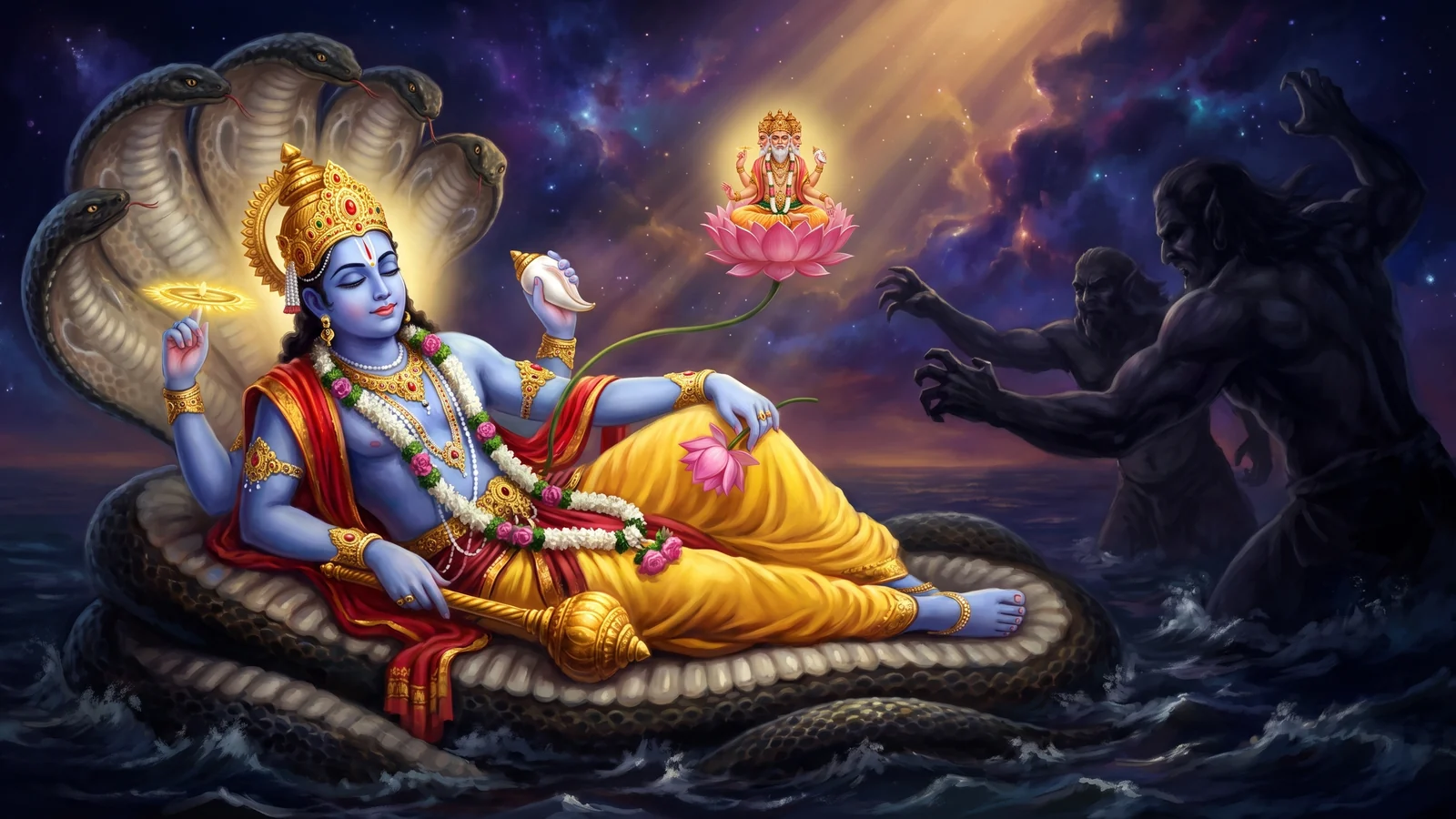
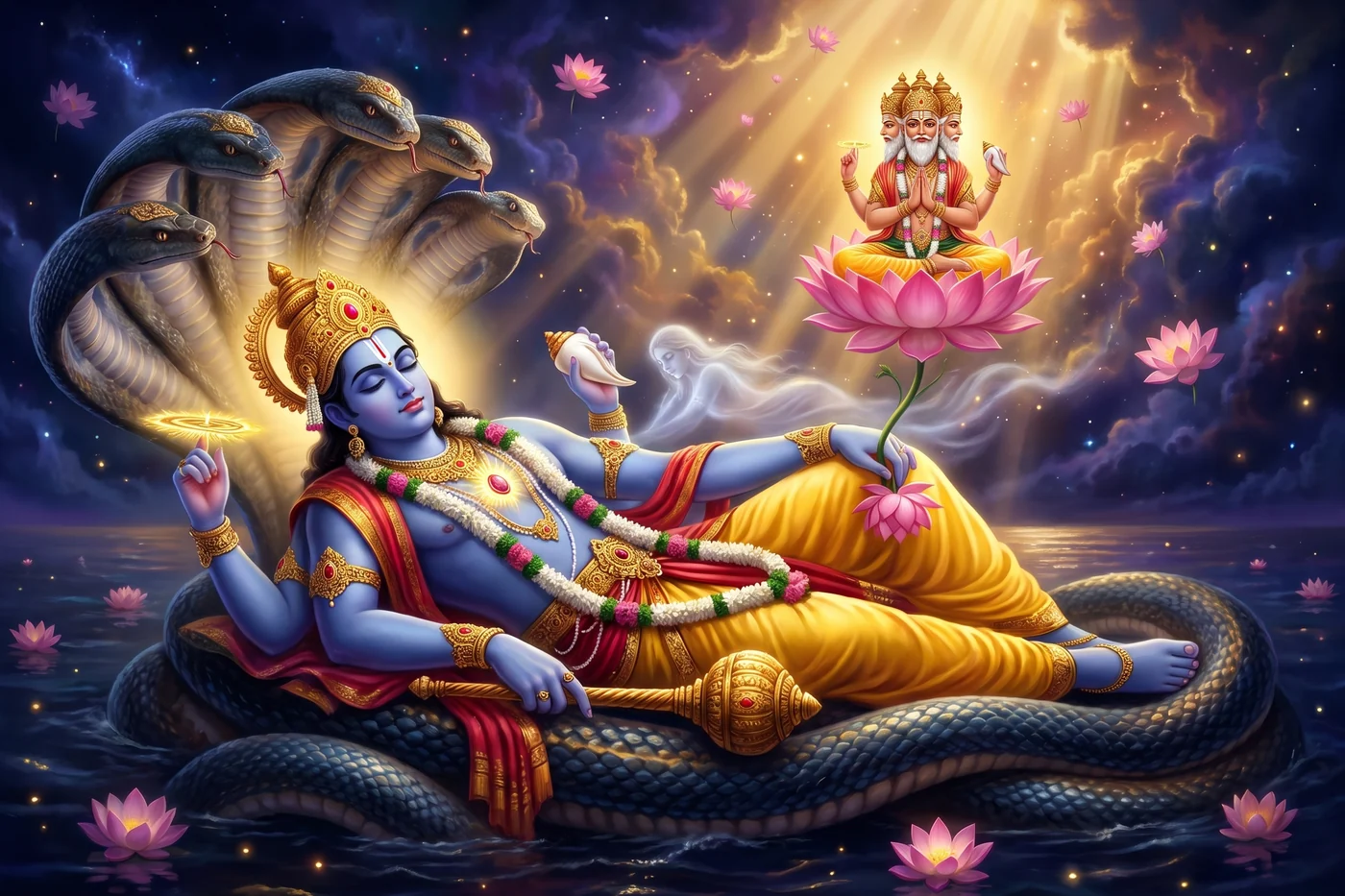
An age had ended. The worlds had gone back into water, and there was nothing to see but dark water in every direction. On that water lay the serpent Shesha, coiled like a bed, and on the serpent lay Vishnu, asleep.
It was not an ordinary sleep. The text calls it yoganidra, the sleep of yoga, and it says plainly that this sleep was the Goddess herself. She had settled over Vishnu like a blanket over a child, and while she held him nothing could wake him.
From his navel grew a lotus, and on the lotus sat Brahma, awake, looking out over the water and thinking about the world he was going to make.
Then two shapes rose from the water beside the sleeper. They were Madhu and Kaitabha, and they had come, the text says, from the wax of Vishnu's ears. They were huge, they were strong, and the first thing they saw was Brahma on his lotus.
"Look at him," said one. "Sitting there alone."
"Then he is ours," said the other, and they came for him.
Brahma had no weapon. He looked down at Vishnu and shouted, and shook the lotus stem, and Vishnu did not stir. Then Brahma understood. It was not the sleeper he had to speak to. It was the sleep.
So he sang. The hymn he sang is the first hymn in the whole Devi Mahatmya, and people also call it the Ratri Sukta, the hymn to Night.
"You are the one who makes the world," he sang, "and the one who keeps it, and the one who takes it back at the end. You are the sleep on Vishnu's eyes. Loosen your hold on him. Let him wake, and let him deal with these two."
The Goddess heard him. She drew herself out of Vishnu's body, out of his eyes and his mouth and his chest, and stood in the air above the water.
Vishnu opened his eyes.
He rose from the serpent and he fought them, and the fight did not end quickly. The text says it lasted five thousand years. Madhu and Kaitabha were strong, and they were also, by now, proud. They had fought a god for five thousand years and were still standing, and the Goddess, the text says, had laid her delusion over their minds.
So they did a strange thing. They stopped fighting and spoke to Vishnu as though they were the masters here.
"We are pleased with the way you fight," they said. "Ask us for a boon. Anything."
Vishnu did not laugh. "Then let the two of you die by my hand," he said. "That is all I want."
They had given their word. But they looked around them at the world, and there was nothing in it but water, and they thought they had found a way out.
"Agreed," they said. "But kill us only where the earth is not covered by water."
Vishnu lifted them up and set them across his thigh. There was no water there. And with the discus he cut off their two heads.
Commentators like to point out that the text is playing with words here: the word for thigh and the word for earth lie close together in Sanskrit. The demons asked for dry ground, and the dry ground was the god.
In this telling the Vedas are not mentioned at all. The demons are after Brahma, and the story is about who it was that let Vishnu wake. In the Devi Mahatmya's view, that was the Goddess, and neither Brahma's prayer nor Vishnu's strength counted for anything until she consented.
As the Vaishnava texts tell it: Hayagriva
Mahabharata and the Bhagavata line · 2 min read
In the Mahabharata, and in the line of texts that follows the Bhagavata, the same two demons commit a different crime, and the story has a different hero. He is still Vishnu. But he does not need waking, and he wears a horse's head.
Here Madhu and Kaitabha do not simply go for Brahma. They go for what Brahma holds. The Vedas, the first words, the knowledge from which everything else will be made, are in his keeping as he sits on the lotus. The two demons seize them and dive, and hide them deep in the primeval waters, where no light reaches.
Brahma is left on his lotus with empty hands.
"They are gone," he says. "How am I to make a world with nothing to make it from?"
He grieves, and the texts say that his grief was answered by Vishnu, who took a form made for this one task. His body was a man's, and his head was the head of a horse. In this shape he is called Hayagriva.
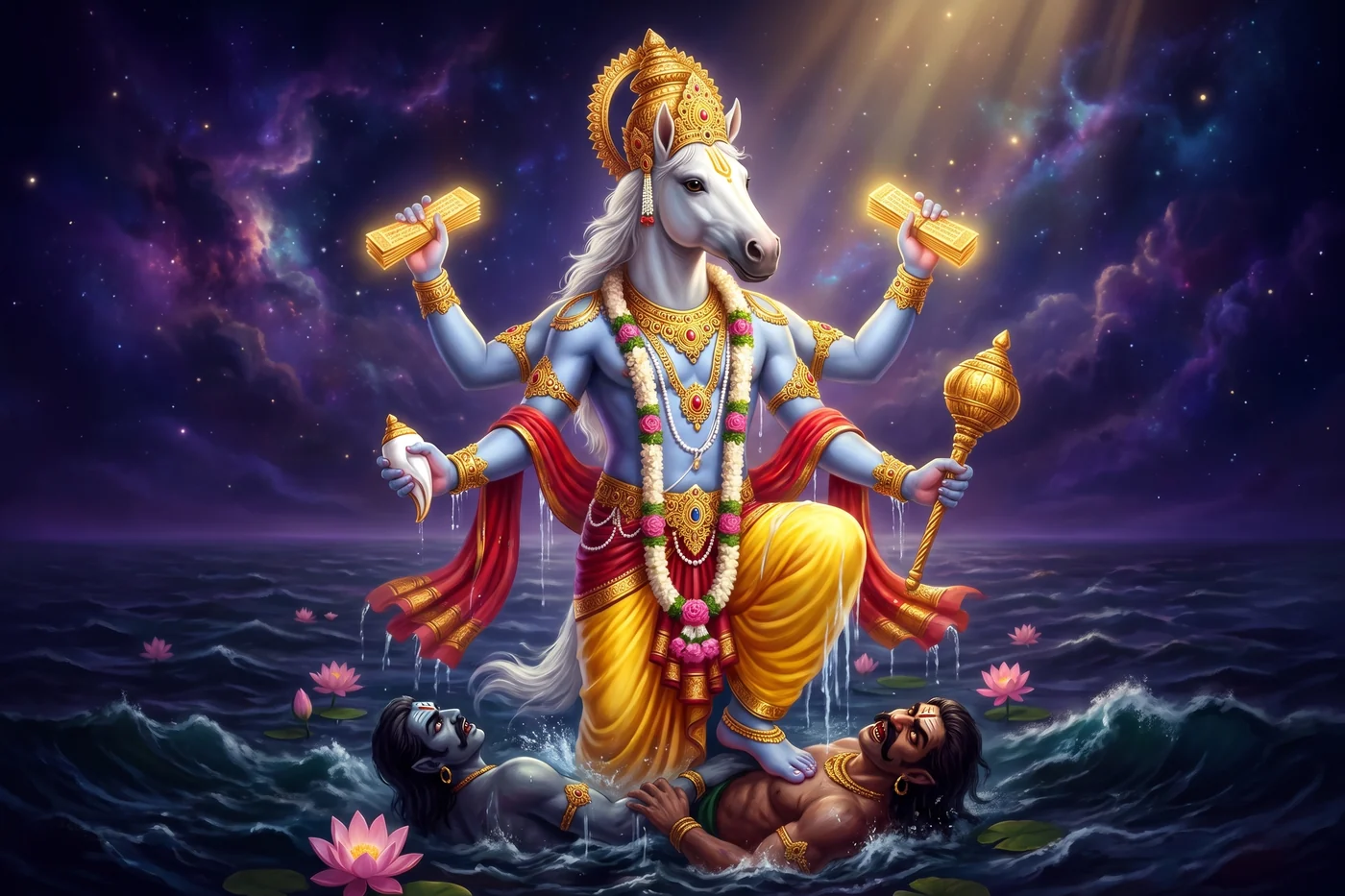
Hayagriva went down into the water after the thieves. He found them, and he killed them both, and he brought the Vedas up out of the dark and put them back into Brahma's hands. The grief ended there. Creation could begin.
The texts add a few things about what was left behind. Some tellings say that the two bodies broke into twelve pieces, and that the pieces became the continents of the earth. And the deed gave Vishnu two of the names his devotees still call him by: Madhusudana, the killer of Madhu, and Kaitabhajit, the conqueror of Kaitabha. A later demon, Dhundhu, is said to have set out to avenge the pair.
Notice what is missing. There is no sleep, no Goddess, no five thousand years, no boon and no thigh. Vishnu is awake from the first line and acts alone, and the whole weight of the story falls on the Vedas: lost, and found again. That is what Vaishnavas take from it. The one who keeps the world is the one who went down into the dark to bring the first knowledge back.
As the Devi Bhagavata tells it
Devi Bhagavata Purana, Book 1 · 2 min read
The Devi Bhagavata, a Shakta text, answers a question the other two leave open: why were two demons born of ear wax so hard to kill?
Its answer is that they had asked. Before they ever troubled Brahma, Madhu and Kaitabha had worshipped the great Goddess, Mahadevi, and she had been pleased with them. She gave them a boon, and the boon was this: they would die only when they themselves consented to die.
With that promise behind them they went for Brahma, took the Vedas from him, and went down to hide in Patala, the world beneath the world.
Vishnu came after them. In this telling he does not fight them for an age. He talks. He praises their strength and their courage until the two of them are swollen with it.
"Nobody has ever fought like the two of you," he tells them. "I have never seen anything like it."
"Then ask us for something," they say, pleased. "We give boons too."
"Give me your deaths."
They had said it. The boon of the Goddess had been that they would die only by their own consent, and now, without meaning to, they had consented. Still they tried to make it impossible. Around them was nothing but the flood.
"Kill us anywhere," they said. "Anywhere except in the water."
Vishnu looked at the water. Then he spread his own thighs out over it, wide and firm, so that they became solid ground where there had been none, and he laid the two demons across that ground. The Sudarshana, his discus, took off their heads.
The Devi Bhagavata keeps the thigh and the discus from the older story, and the Vedas from the Vaishnava one, and sets both under the Goddess: it was her boon that made the demons what they were, and only the loophole in her boon that let them die. We have not been able to read Book 1 in a full translation, and we tell it here as it is reported.