Festival · Once in about twelve years Garhwal walks its married daughter back to Kailash, behind a ram with four horns
Nanda Devi Raj Jat
The Raj Jat is Garhwal's royal pilgrimage for the goddess Nanda, who is Parvati as the daughter of these hills. Roughly once in twelve years she is carried out of her mother's village of Nauti in Chamoli and walked for some twenty days and 280 km, through the villages, past Wan and the meadows of Bedni and the bone lake of Roopkund, to the high pool of Homkund. There a four-horned ram carrying her gifts is let go to walk on alone toward Kailash. Every year, on Nanda Ashtami, Kumaon makes her and her sister Sunanda out of banana trunks at Almora and Nainital.
When is Nanda Devi Raj Jat in 2027? Almora, Nainital and the Nanda temples (the Raj Jat, announced for 2027, is expected round these days; its schedule is read out at Nauti on Vasant Panchami 2027): Nanda Ashtami, the eighth of the bright half of Bhadrapada, is Wednesday 8 September 2027. In 2028: Sunday 27 August 2028. The Raj Jat in late August and September of its year, timed so the procession reaches Bedni on the seventh and Homkund on the ninth of the bright half of Bhadrapada; Nanda Ashtami every year on the eighth of that fortnight, in late August or September.
Also calledNanda Raj JatRaj Jatthe Himalayan MahakumbhNanda JatNanda AshtamiNandashtamithe Nanda Devi fair of Almora and Nainital
In short
What is the Nanda Devi Raj Jat?
A pilgrimage of Garhwal in Uttarakhand, held roughly once in twelve years, in which the goddess Nanda, Parvati as the daughter of the hills, is walked about 280 km over some twenty days from Nauti in Chamoli to Homkund below the high peaks, as a married daughter is seen back to her husband's house. A four-horned ram carrying her gifts leads the way and is let go at Homkund.
When is the next Nanda Devi Raj Jat?
The Raj Jat committee postponed the 2026 pilgrimage and on Vasant Panchami 2026 announced it for 2027. Its day-by-day schedule will be read out at Nauti on Vasant Panchami 2027. By custom it reaches Homkund on the ninth of the bright half of Bhadrapada, which in 2027 falls on 9 September, so late August and early September 2027 are expected. The last Raj Jat was in 2014.
When is Nanda Ashtami in 2027?
Calendars give Wednesday 8 September 2027, the eighth of the bright half of Bhadrapada, and Sunday 27 August 2028. Almora and Nainital make the images of Nanda and Sunanda on the day before and give them life before dawn on Nanda Ashtami.
Why does a four-horned ram lead the Raj Jat?
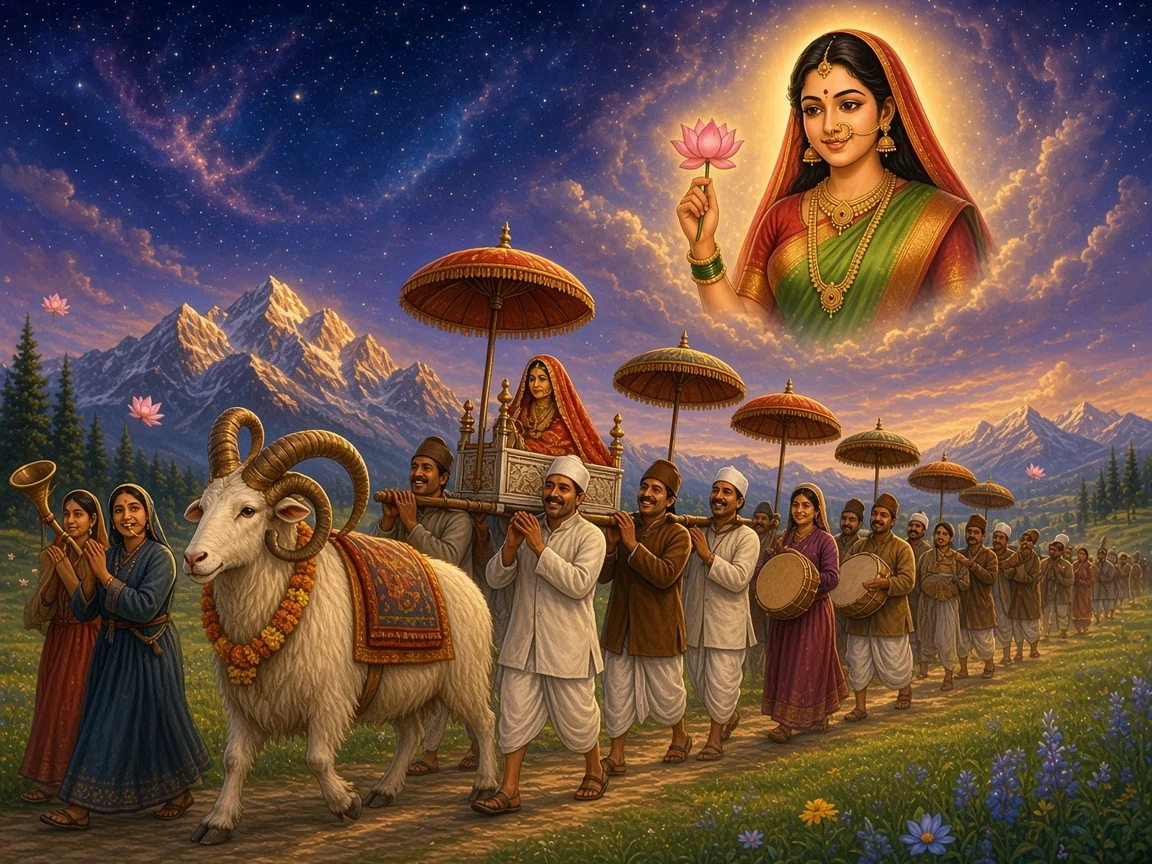
The ram, the chausingya khadu, is taken as the goddess's sign that the pilgrimage is due. It walks at the head of the procession carrying her jewellery, food and clothes, and at Homkund it is released to go on toward Kailash alone, taking her gifts to her husband's home.
Is the Raj Jat really held every twelve years?
Not exactly. The records kept at Nauti give 1820, 1843, 1863, 1886, 1905, 1925, 1951, 1968, 1987 and 2000; the 2012 pilgrimage was put off for an inauspicious month and the 2013 one by the Kedarnath floods, so it was held in 2014, and the 2026 one has moved to 2027.
Next, in 2027Wednesday 8 September 2027
Prime godParvati, as Nanda the daughter of the hills
with 3 more
WhereChamoli district in Garhwal, from Nauti, Kansuwa and Kurud up to Wan, Bedni Bugyal, Roopkund and Homkund; and Kumaon, at Almora, Nainital and Kot Bhramari near Bageshwar
How longAbout twenty days for the Raj Jat, with the vow taken at Nauti on Vasant Panchami months before; three to eight days for the Nanda Ashtami fairs
The Raj Jat in late August and September of its year, timed so the procession reaches Bedni on the seventh and Homkund on the ninth of the bright half of Bhadrapada; Nanda Ashtami every year on the eighth of that fortnight, in late August or September
Why it is kept
The Raj Jat is a farewell that takes three weeks. Nanda, the goddess of Garhwal, is Parvati as these hills know her, a daughter of the villages who married the ascetic of Kailash. Roughly once in twelve years her mother's country fetches her home, and then sends her back the way a family sends back a married daughter: with sweets and clothes and jewellery in her basket, with drums in front, and with crying all the way to the edge of the snow. The procession leaves Nauti in Chamoli, gathers the village parasols and the people of Kumaon on the way, climbs past the last village at Wan and the bone lake of Roopkund, and at Homkund lets a four-horned ram walk on alone toward Kailash with her gifts.
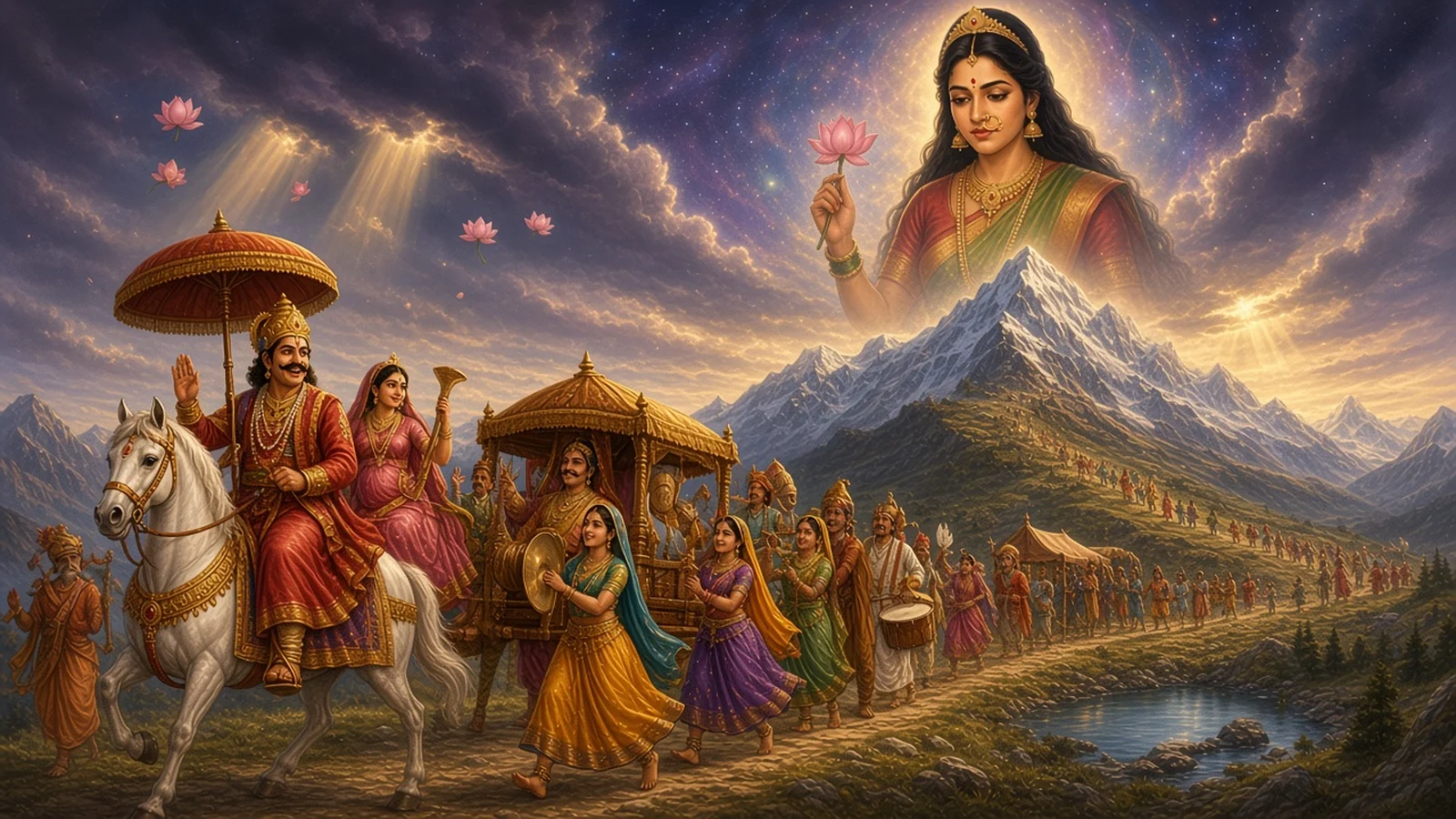
The jagars, the night songs of Garhwal, give the reason. Married to the jogi of Kailash, Nanda sits in the snow in the month when daughters are called home and asks her husband for four days with her mother. He will not let her go. Her grief turns into a curse on her mother's country: cows drop buffalo calves, the milk fails, the grain will not fill, until wise men trace the trouble to the girl nobody has called home. So the king fetches her, feasts her and walks her back himself. That is told in The Daughter Who Goes to Kailash, and her birth to the mountain king in The Daughter of the Mountain.
Nanda sits in the snow of Kailash and asks Shiva for four days with her mother
The pilgrimage is the same leave-taking every hill family knows. A married daughter in Garhwal and Kumaon is a dhiyani, and the gifts loaded on the ram are the ones given to a dhiyani at her vidai. Gangaur in Rajasthan brings Parvati home as a daughter too, and Bathukamma in Telangana sings to her on a cone of flowers; in the hills the road back is walked on foot, over a pass of 5,000 metres.
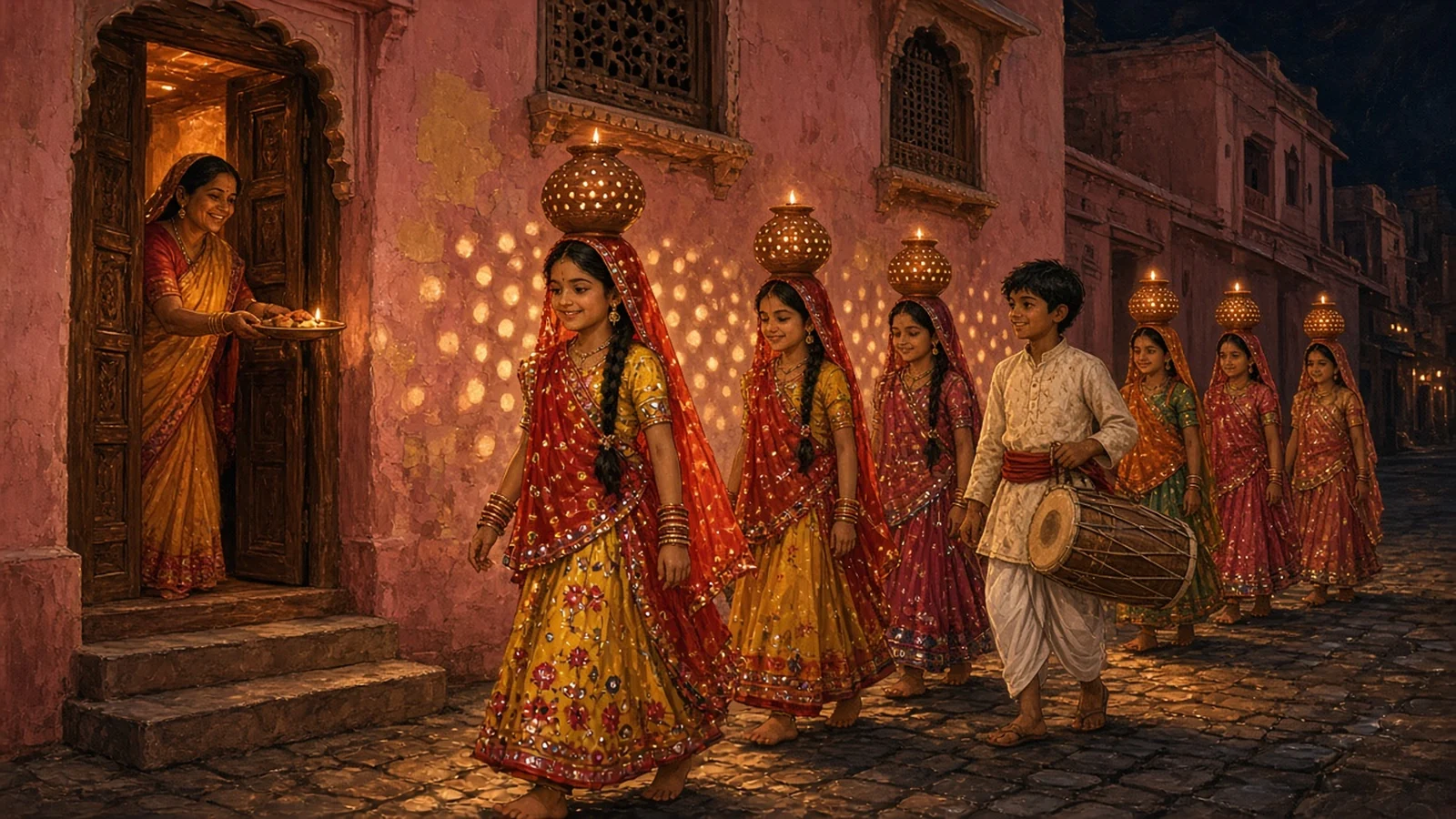
A Garhwali family sends a married daughter back with gifts in her basket
In Garhwal and Kumaon Parvati is Nanda, also called Gaura, a girl of these villages married to the ascetic of Kailash. She is treated as every out-married daughter is treated, a dhiyani who comes home and must be sent back with gifts and tears. The Raj Jat is that sending-off on the scale of a whole kingdom, and the rain that so often falls as it sets out is called her crying.
The groom the songs call a strange jogi, whose snowbound house Nanda goes back to. In the jagars he refuses her leave to visit her mother, and the pilgrimage ends where his country begins, with the ram walking on toward Kailash alone.
L
Latu, Nanda's brother, the god of Wan
A follower of Shiva given to Nanda as a brother, worshipped at Wan, the last village on the route. His temple is opened for the Raj Jat by a priest whose eyes, mouth and nose are covered, and some tellings make him the sender of the hail at Roopkund.
S
Sunanda, Nanda's sister in Kumaon
The older goddess of Kumaon's Chand kings, set beside Nanda at Almora when the image came from Garhwal in the seventeenth century. The two are made together from banana trunks every Nanda Ashtami.
Twelve years, twenty days
1
Nauti and the setting out
The vow on Vasant Panchami; the procession leaves Nauti about twenty days before Homkund
the manautithe vow on Vasant PanchamiIdabadhanithe first day
The Raj Jat begins months before anyone walks. On Vasant Panchami a Kunwar of Kansuwa, heir of the old Chandpur Garhi kings, brings the royal parasol and the golden image to the Nautiyals, the royal priests at Nauti, and the vow is made before the Shri Yantra in the Nanda temple; from that day jagars are sung for her. Around then the four-horned ram, the chausingya khadu, is born somewhere in the Nauti country. On the first day the procession goes out to Idabadhani, because Nanda once promised a family there she would visit before leaving, and then back through Nauti. In 2014 it left on 18 August.
The procession leaves Nauti behind the four-horned ram, the goddess in her silver palanquin
At Kansuwa the king's village says goodbye. At every halt more parasols of ringal cane, each with its village's goddess, join the line: from Sem, from Koti, and at Nandkesari the parasols of Kumaon, who come over by Kausani, Garur and Gwaldam. Bhagoti is the last village of her mother's country and Kulsari the first of her husband's, reached on the night of the new moon. The ram walks in front, then the royal parasol, then the rest. Brahmins carry the parasols, Thakurs blow the conches and horns, and Dalit drummers play the dhol and damau. In the villages people weep as the procession leaves, as they would for their own daughters, and in 2026 the Kurud committee's own jat met its Kumaon parasols at Nandkesari on 12 September.
Village parasols of ringal cane join the line as dhol and damau drummers play
Wan is the last village before the meadows. Its temple of Latu, Nanda's brother, is opened for the pilgrimage, the priest going in with his eyes, mouth and nose bound, and the Dasoli doli, one of the two that go out from Kurud, meets the Raj Jat here. Above Wan there are no more houses.
The seventh of the bright half of Bhadrapada, by custom
Bedinithe Vaitarani poolNanda Saptami
The procession camps on the high meadow of Bedni, beside the small pool called Vaitarani where offerings are made for the dead, and keeps Nanda Saptami. In the old custom women went no further. The yearly jat of Badhan's doli ends here; in 2026 that doli kept its puja at Bedni on 18 September and turned back.
Camp on the high meadow of Bedni Bugyal beside the small pool of Vaitarani
The eighth, Nanda Ashtami, or the day before Homkund
Patar NachauniyaJyuragalithe sea of boulders
Past Patar Nachauniya, where legend turned a king's dancers to stone, the line climbs to Roopkund, the small lake with bones on its shore, and over Jyuragali, the highest point of the route at about 5,000 m, then down into Shila Samudra, the valley of boulders. This is the hardest day of the walk.
The line of pilgrims climbs past the small snow-ringed lake of Roopkund
The ninth of the bright half of Bhadrapada, by custom
HomkundGhumakithe release of the khadu
At Homkund a fire rite is held, the parasols are laid down, and the four-horned ram is loaded with small bags of jewellery, sweets, cloth and the things of a bride's toilet, the gifts a daughter takes to her husband's house. Then it is let go to walk on toward Kailash by itself, and the pilgrims turn back down by Chandaniya Ghat and Sutol. In 2014 Homkund was reached on 3 September; in 2026 the Kurud jat sent three rams on from there on 20 September.
At Homkund the four-horned ram, loaded with a bride's gifts, walks on alone toward Kailash
The eighth of the bright half of Bhadrapada (the same tithi as Radha Ashtami) · Wednesday 8 September 2027
Nandashtamithe Nanda Devi fairNanda Devi Mahotsav
In the years between, Nanda is kept every year. At Almora banana trees are chosen on the sixth by the first leaf to tremble under thrown rice and cut on the seventh, and Nanda and Sunanda are shaped from the trunks and given life before dawn on the eighth, then carried out on a dola and given to the water. Nainital has kept the same rite on its lake since 1903, Kot Bhramari near Garur holds its own fair, and yearly jats go up from Kurud, Badhan and other villages. Calendars give Nanda Ashtami as Wednesday 8 September 2027 and Sunday 27 August 2028.
Nanda and Sunanda, shaped from banana trunks, carried out on a dola at Almora
Chamoli, GarhwalNauti, Kansuwa and the Raj Jat villages
The Raj Jat belongs to the villages of Chamoli district between Karnaprayag and the Pindar valley. Nauti, at about 1,240 m, is held to be Nanda's mother's home and is the seat of her royal priests; Kansuwa is the village of the Kunwars; Kurud, whose Gaur Brahmins keep golden images of Nanda as Rajrajeshwari, sends its own dolis and in 2026 ran its own Nanda Badi Jat. The rest of the route is a string of halts at Sem, Koti, Bhagoti, Kulsari, Tharali, Mundoli and Wan.
Almora, Nainital and Bageshwar, KumaonThe Nanda Ashtami fairs
In Kumaon Nanda is the goddess of the old Chand kings. Almora's fair is held at the temple that received her image from Garhwal; Nainital's has run since 1903 and draws the town onto its lakeside for a week; Kot Bhramari near Garur in Bageshwar district keeps a fair where a Chand king left a sword on his way home. Kumaon's parasols join the Raj Jat at Nandkesari.
The high meadows and RoopkundAbove the last village
Above Wan the route leaves houses behind for the meadow of Bedni Bugyal, the stones of Patar Nachauniya, the bone lake of Roopkund below the peak of Trishul, the pass of Jyuragali and the high pool of Homkund. The same paths are walked each summer by trekkers bound for Roopkund, and by 2014 a helicopter was flying pilgrims from Lohajung to Bedni.
Garhwali and Kumaoni Hindus of every casteThe whole hill country
The Raj Jat is one of the few rites in the hills that every caste walks in, each with its part. Brahmins carry the parasols, Thakurs blow the conches and trumpets, and the Dalit drummers of the dhol and damau lead with the beat; William Sax saw the low-caste drummers go as far as Bhala in 1987. Villages along the route feed the pilgrims, and families give the goddess the gifts they would give a daughter going back to her husband.
The Kunwars of Kansuwa and the Nautiyals of NautiThe king's men and the king's priests
The Kunwars, heirs of the Chandpur Garhi kings, take the vow, make the royal parasol and head the committee; the Nautiyals, once the royal priests, keep the goddess at Nauti and open Latu's temple at Wan. The Gaur Brahmins of Kurud keep the other great Nanda temple of Chamoli, and the two committees have lately disagreed over whose jat is the royal one.
The jagaris and the dhol-damau drummersThe singers
The goddess's story is carried by the jagar, the night song in which a singer and drummers call a god into a person. At Nauti women sang jagars on the day of the vow in 2026, and the drummers play the dhol and damau at every halt of the procession.
How it is kept
The Raj Jat is a royal rite with no king left. The Kunwars of Kansuwa, heirs of the Chandpur Garhi kings, take the vow; the Nautiyals of Nauti, once the royal priests, keep the goddess. The day-by-day route is read out on Vasant Panchami, and the procession moves from halt to halt for about twenty days, timed to reach Bedni on the seventh of bright Bhadrapada and Homkund on the ninth.
Vasant Panchami at Nauti: the royal parasol brought to the priests as women sing jagars
Its twelve years have never been exact. The pilgrimage set for 2012 was delayed by an inauspicious month and then by the Kedarnath floods, and went in 2014. The one due in 2026 was put off in January 2026 because of the September weather in the high Himalaya and the calendar, and on Vasant Panchami the committee announced it for 2027. That September the Kurud committee walked its own Nanda Badi Jat to Homkund, with three rams and well over a lakh of people, and the two sides still differ over which jat is the royal one.
Every year, meanwhile, Nanda Ashtami is kept in Kumaon. Almora and Nainital cut banana trees, shape Nanda and her sister Sunanda from the trunks, give them life at dawn on the eighth and send them to the water a few days later. The animal sacrifices once made at these fairs have stopped, and coconuts are broken instead.
In the old texts
The Raj Jat has no scripture of its own. Its texts are the jagars, sung by drummers and singers who call the goddess into a dancer, and no two villages sing them quite alike; one collection, gathered by Hatwal, was published in Garhwali by Bhishma Kukreti. William Sax walked the 1987 Raj Jat and translated the song of the curse on Rishasau.
The written trail is thin. Sax notes a ninth-century Katyuri king who called himself Nanda's devotee, and the colonial historian Atkinson's report of a Kumaon king carrying a Nanda image off from Garhwal. Kumaon's own account names that king as Baz Bahadur Chand, who set the image in Almora beside Sunanda. Nauti's records list the pilgrimages from 1820 onward. Roopkund's bones, which the procession passes, have a literature of their own, from the ranger who found them in 1942 to the DNA study of 2019; that is told in The Lake of Bones.
Where this page comes from. Written by Devalok from William Sax's study of the 1987 Raj Jat (Scripta Instituti Donneriani Aboensis, 2010), the Nanda jagar as collected by Hatwal and published by Bhishma Kukreti, the Times of India, ETV Bharat and Amar Ujala on the 2026 postponement and the 2027 announcement, ETV Bharat and Uttarakhand Himalaya on the Kurud jat of 2026, The Hindu, the Indian Express, the Hindustan Times, Zee News, the Indian Philately Digest and nandadevitrek.in on the 2014 Raj Jat, euttaranchal, The Tribune, Travel in Devbhoomi, Dainik Jagran and Pioneer Edge on the fairs of Almora and Nainital, the encyclopedia articles on the Raj Jat and Roopkund, Harney and colleagues in Nature Communications (2019), Indiahikes, and Drik Panchang's tables for 2027 and 2028, as recorded in the Devalok Lore. Our own words throughout.