As the Bhagavata Purana tells it
Bhagavata Purana 10.89 · 3 min read
On the bank of the river Sarasvati a company of sages had gathered for a sacrifice, and between the rites they fell to arguing.
"Of the three," said one, "Brahma, Shiva, Vishnu, which is the greatest?"
Everyone had an opinion and nobody had proof. At last they agreed on a test, and on the man to carry it out: Bhrigu, who was Brahma's own son and feared nobody.
"Go to each of them," they told him. "Treat each one badly. See which of them bears it."
Bhrigu went first to his father.
He walked into Brahma's hall, and he did not bow, and he did not greet him, and he did not say a word of praise. He simply stood there. Brahma felt the anger come up in him like heat; a son, in front of the whole court, behaving like this. But the son was a sage too, and Brahma held the anger down and said nothing, and let him go.
Bhrigu went next to Shiva on his mountain. Shiva saw him coming and was glad, and rose and opened his arms to embrace him. Bhrigu stepped back.
"Do not touch me," he said.
Shiva's eyes went red. The trident came up in his hand, and for a moment the sage's life hung on it. Then the goddess at Shiva's side caught his arm.
"He is a brahmin," she said. "Let him go."
Shiva lowered the trident. Bhrigu walked away unharmed, and went to Vishnu.
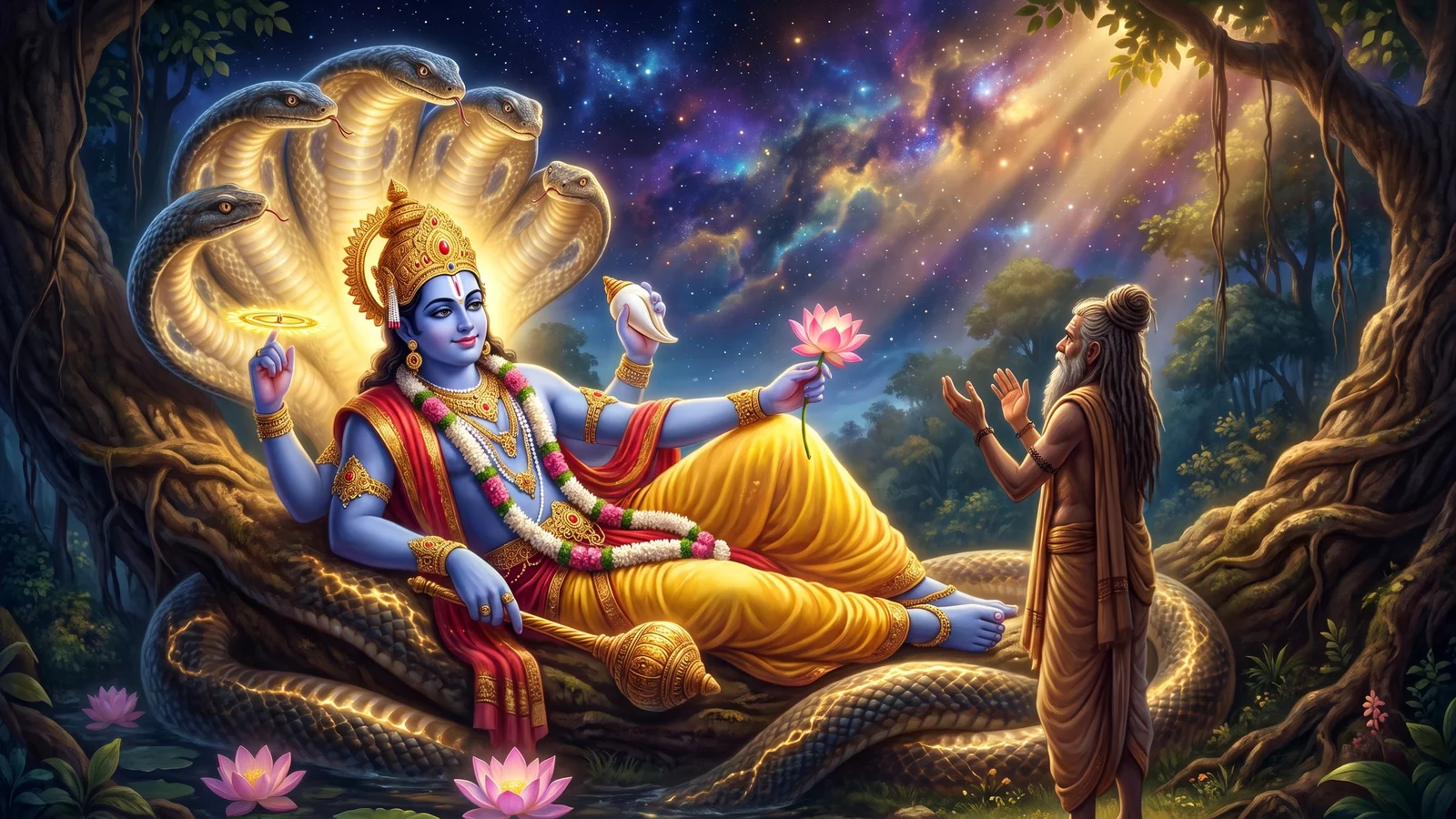
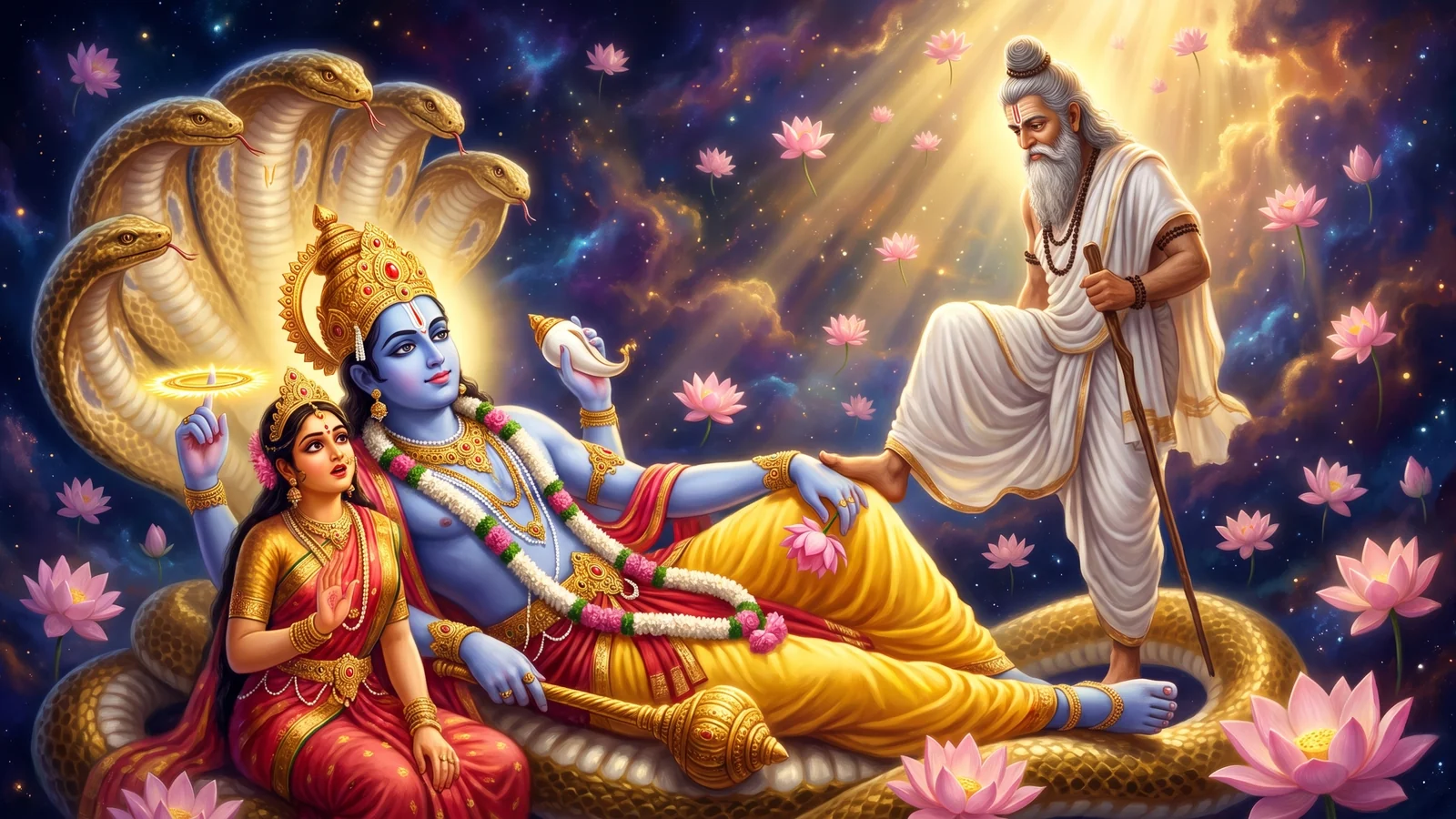
Vishnu was lying down. His head rested in Lakshmi's lap, and he was at ease, the way a man is at home. Bhrigu looked at the two of them for a moment. Then he walked up and kicked Vishnu in the chest, hard, with the flat of his foot.
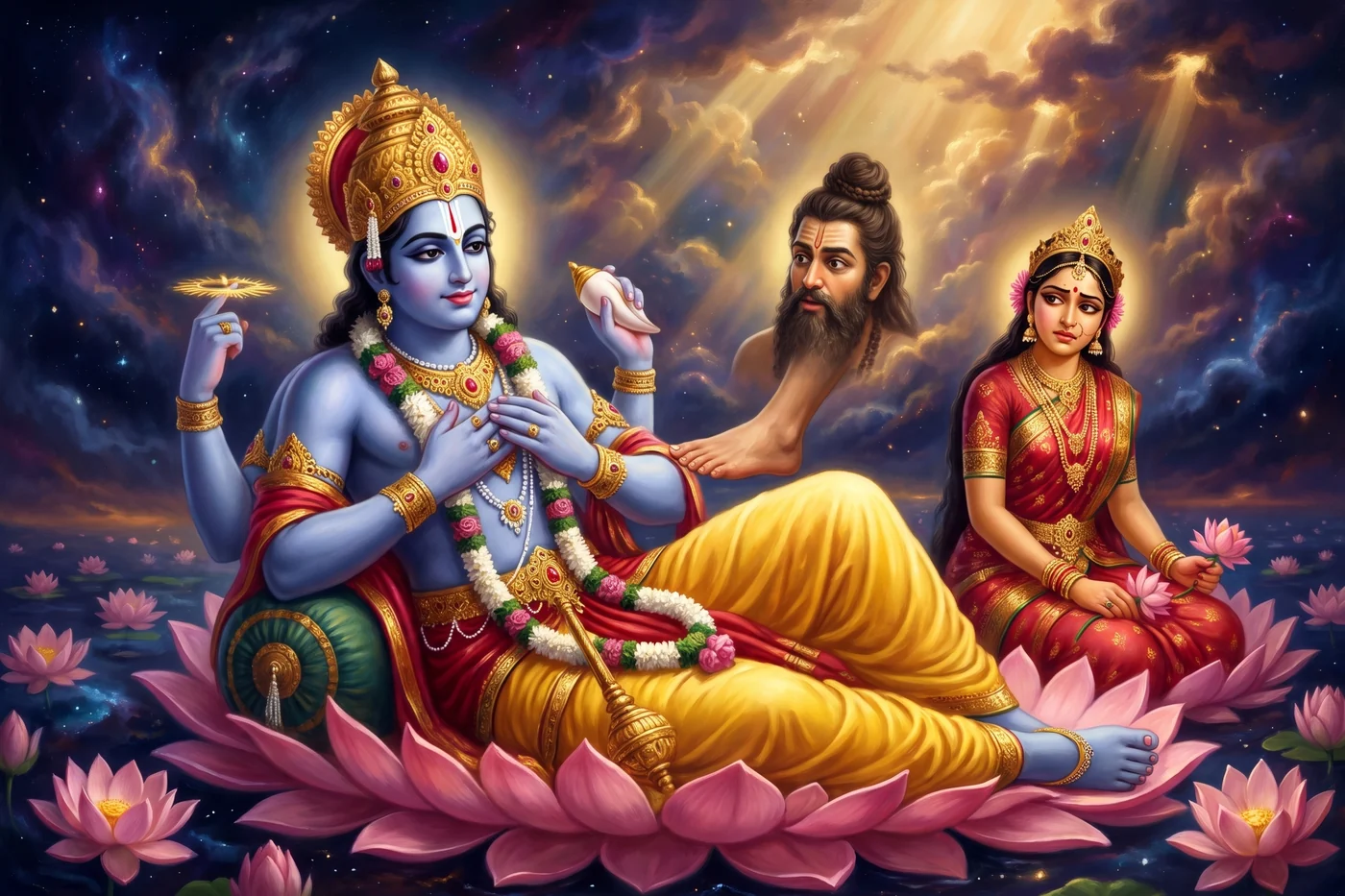
Vishnu was up at once. Not in anger. He came off the couch with his hands folded and his face full of concern, and he bowed.
"Welcome, brahmin," he said. "Forgive me. I did not see that you had come, and I did not rise to receive you. Please forgive us."
And he took the sage's foot in his two hands, the foot that had just struck him, and began to rub it, gently, as though it were the foot that had been hurt.
"Your foot is tender," he said, "and my chest is hard. I hope it did not pain you. The touch of it has done me good. It has cleaned my chest, and made it a better seat for Lakshmi, who lives here."
Lakshmi, the text is careful to say, said nothing. She showed no anger. She did not get up and she did not go anywhere. She stayed where she was, at her husband's side.
Bhrigu went back to the Sarasvati and told the sages everything: the father who swallowed his anger, the god of the mountain whose trident came up, and the one who rubbed the foot that had kicked him.
The sages heard him out, and they came to their conclusion, and the Bhagavata gives it as theirs: of the three, the one whose quality is sattva, calm and clear, is the refuge of the world, and that is the one to worship. The Bhagavata is a Vaishnava text, and it has told the story in order to arrive here.
Did Shiva fail the test, you might wonder. The text does not say so in so many words. It shows three gods and three tempers, and lets the sages judge.
As Tirumala tells it
Tirumala, Andhra Pradesh · 2 min read
The temple on the seven hills begins its story at the moment the Bhagavata stops: with Vishnu's hands on the sage's foot.
Bhrigu, the temple says, had an extra eye, and it was in the sole of his foot. That eye was the root of his pride; it let him see what others could not. When Vishnu rubbed the foot, he pressed that eye, and crushed it. The sage's pride went out with it, and he left humbled.
But Lakshmi was not humbled. She was angry. Her husband's chest was her home, and a man had kicked it; and her husband, instead of answering, had honoured the man. She could not forgive either thing.
"Rub his foot if that is what pleases him," she said. "I will not stay to watch it."
She left Vaikuntha, and she came down to earth, and she settled at Karavirapura, the town that is Kolhapur today, in Maharashtra.
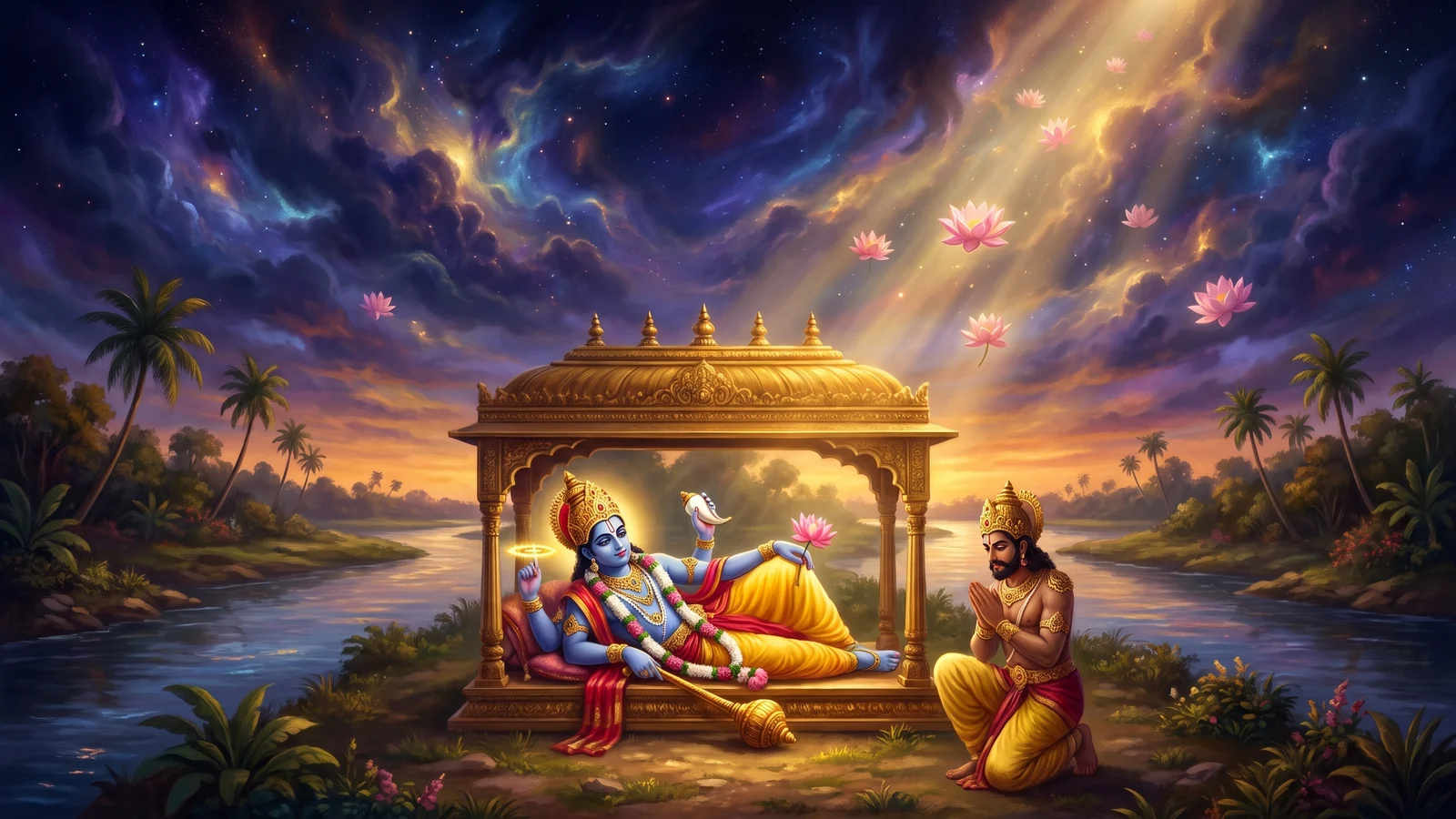
Vishnu went looking for her. The search brought him to the Venkata hill in the south, and there, under a tamarind tree, he found an anthill and went into it, and sat in penance for twelve years.
A woman called Vakula Devi fostered him there. She had been Yashoda in an earlier life, the mother who raised Krishna and never saw him married, and she had been born again so that she could see him wed. The one she raised was called Srinivasa.
Below the hill lived a king, Akasha Raja. Walking in a field of lotuses one day he had found a baby girl, and he had taken her home and raised her as his own, and called her Padmavati. She was Lakshmi, born again on earth, though her father did not know it.
Srinivasa saw her and asked for her hand. A wedding fit for a god costs more than a hermit in an anthill has, so he went to Kubera, the lord of wealth.
"Lend me what I need," he said, "and I will pay it back."
The wedding was held at Narayanavanam, and the god did not go back to Vaikuntha afterwards. He stayed on the hill, the temple says, and he stays there still, until the loan is paid.
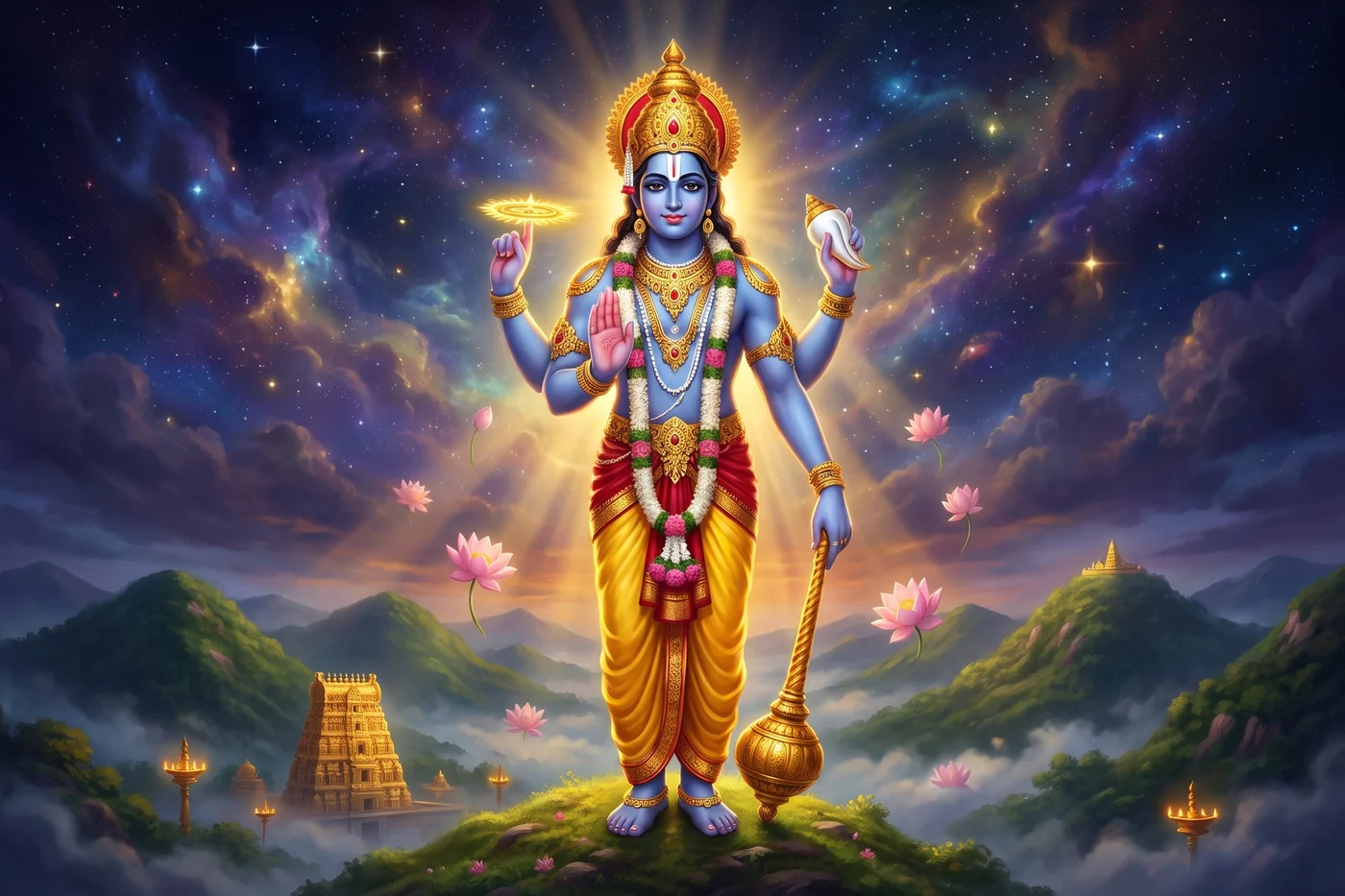
The temple's own name for all this is the Venkatachala Mahatmyam, and it points to the Brahmanda, Bhavishyottara, Padma and Skanda Puranas for its god. But none of these events, from the eye in the foot to the loan, is in Bhagavata 10.89.
As the pilgrims tell it: the loan
Tirupati · 1 min read
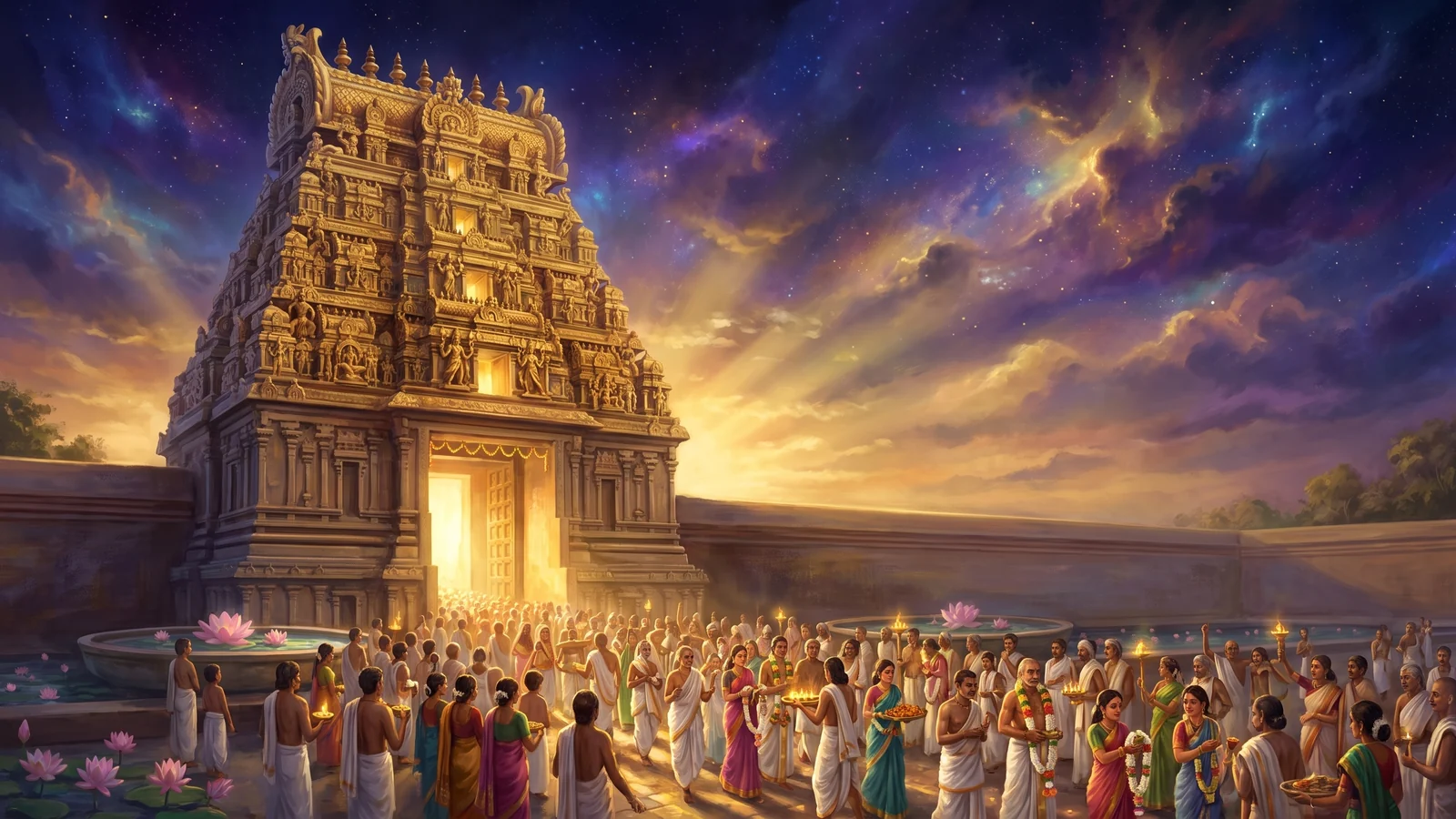
Anyone who walks up the hill at Tirumala will hear the end of the story before reaching the top, because the pilgrims tell it to one another on the way.
The god borrowed from Kubera to pay for his wedding. The loan was in gold coins, and it was enormous, and the terms were hard: the whole sum was to be repaid with interest, and the last payment would fall at the end of the Kali age.
That is why the temple's hundi, the offering box, matters so much to the people who put things into it.
"Every coin goes to the loan," a pilgrim will say, dropping one in. "He is still paying it back. We are helping."
How much he borrowed is a question that gets a different answer from every teller. One will give a figure in the millions of coins. The next will give a figure many times larger. A third will shrug.
"More than anyone could count," he says. "Why else would he still be here?"
No text gives a sum. The loan is in the temple's story; the numbers are the pilgrims' own, and they change from one mouth to the next. The interest, too, is worked out differently by each teller, and nobody on the road agrees on how much of it has been paid so far.
What the pilgrims add to the temple's telling is the shape of a debt that is still being paid: a god who could not afford his own wedding, and every person who climbs the hill helping with the instalments.