As Kalidasa tells it
Kalidasa's Meghaduta · Ramagiri to Alaka · 4 min read
There was once a yaksha, one of the servants of Kubera, the lord of wealth, who was careless of the work he had been given. His master was angry, and the curse was simple: one year away from home. So the yaksha left Alaka, the city of the yakshas in the Himalaya, and his young wife, and went to live on Ramagiri, a wooded hill far to the south, whose streams were holy because Sita had bathed in them.
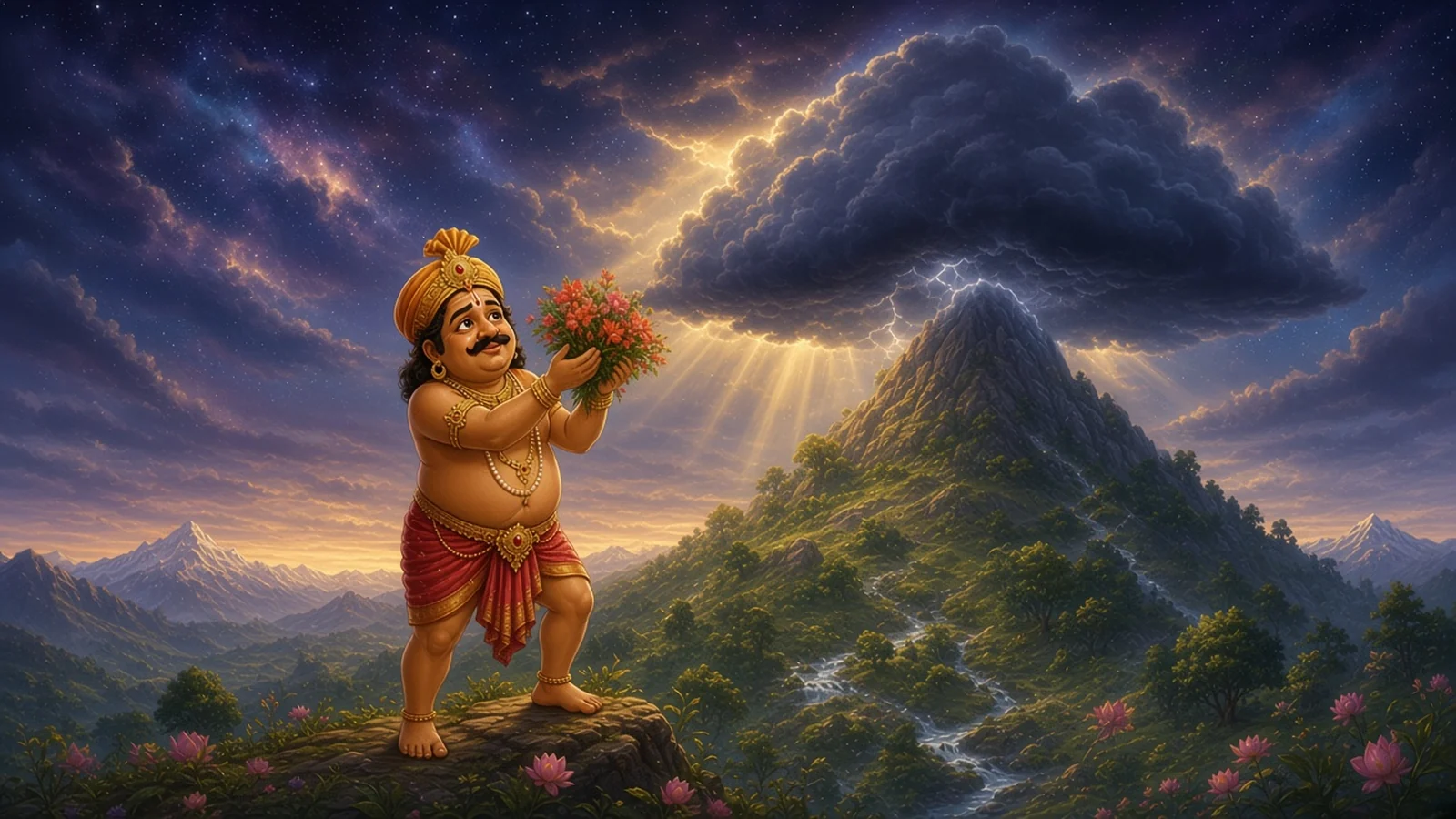
Eight months went by. He grew so thin that his gold bracelet kept slipping down over his wrist. Then, at the start of the month of Ashadha, he looked up and saw the first cloud of the rains pressed against the peak, like an elephant butting a bank of earth in play.
He stood a long time looking at it, holding back his tears. His wife, he thought, would be counting the days, and the rains might break her heart if no word came. A cloud is only smoke and fire and water and wind, and he knew it. But a man in love cannot tell what can hear him from what cannot. He picked fresh flowers, offered them to the cloud as to a guest, and spoke.
"I know your family," he said, "and how high you stand among Indra's counsellors. I am far from my wife because of my master's anger. Take my message to Alaka, where the moon on Shiva's head lights up the palaces at night."
"First learn your road," he went on. "Rest on the mountains when you are tired, and drink from the rivers when you are spent."
Then he sent it north in his mind, stage by stage. Over the farm country of Mala, whose furrows wait for its rain. To the Mango Peak, whose forest fires it had once put out. Down to the river Reva, the Narmada, breaking white against the rocks of the Vindhya. On to Vidisha by its river, and then, though it was out of the way, west to Ujjain.
"Do not miss Ujjain," he said. "Go to the temple of Mahakala at dusk. If you thunder there at the evening worship, you will be Shiva's own drum."
From there to the hill of Skanda, to rain flowers on the god of war. Over Kurukshetra, the field of the great battle, and the Sarasvati, whose water Balarama drank when he would not fight his own kin. To the Ganga where she falls from the mountains, round the footprint of Shiva on the rock, through the narrow Swan Gate in the snows, and so to Kailasa. Alaka lies on its slope, with the Ganga running down past it like a silk scarf.
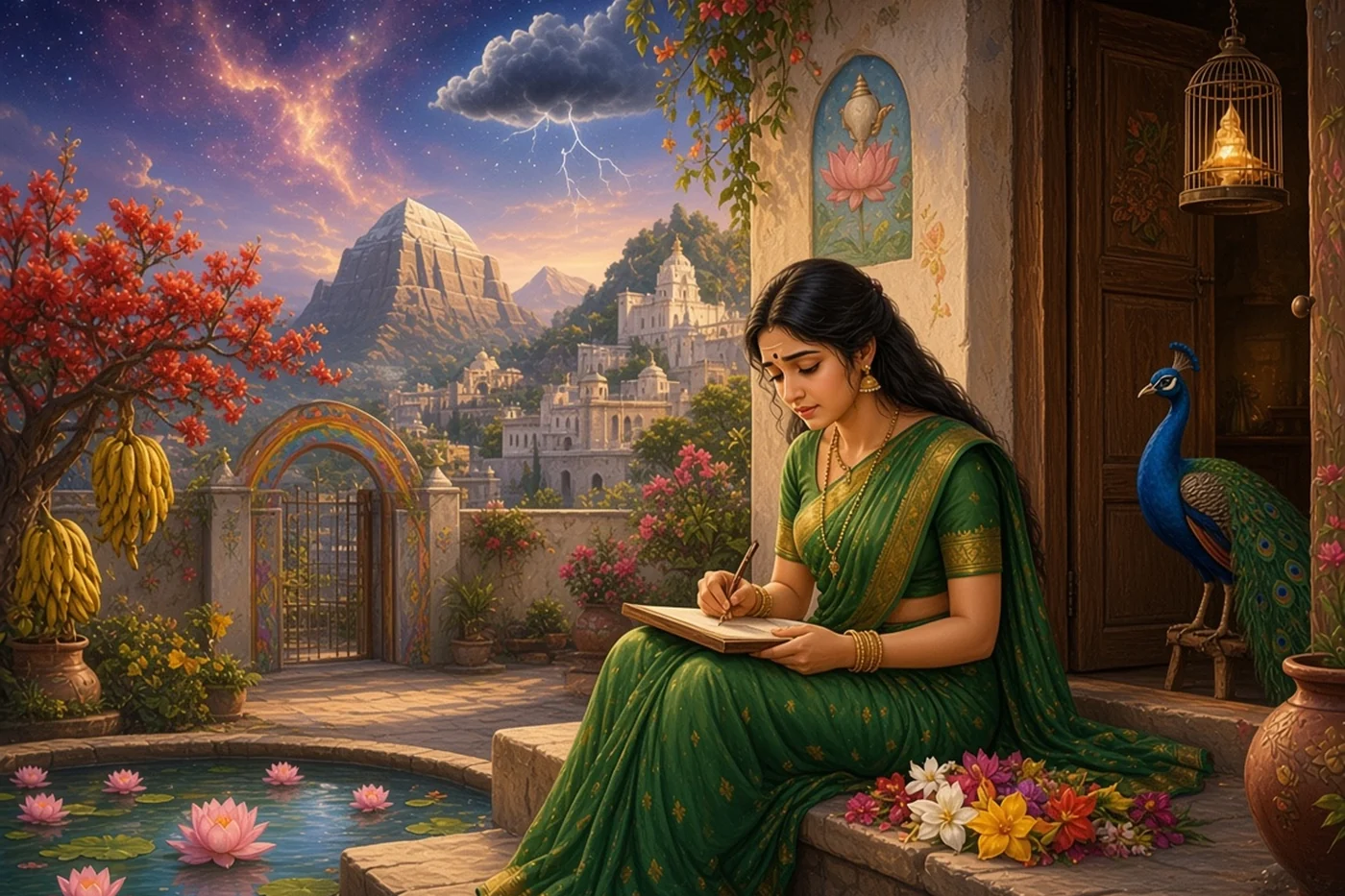
"My house is north of Kubera's palace," said the yaksha. "You will know it by its gate, curved like a rainbow, and by the little coral tree my wife has raised as if it were her child. There is a pool with steps of emerald, a small hill ringed with golden plantains, and a perch where she claps her hands at dusk to make the peacock dance. A conch and a lotus are painted by the door."
He told it how it would find her. Thin with grief, drawing his picture, asking the caged starling whether it remembered its master, counting the months still to wait with flowers laid on the threshold. If she was asleep, the cloud was not to thunder, but to wait, and wake her gently with a cool wind.
"Tell her this," he said. "Your husband lives, and asks if you are well. He sees you in the vines, in the eyes of the deer and in the moon, but never all of you at once. When Vishnu wakes from his sleep on the serpent, the curse is over. Close your eyes and wait four months more."
"And so she knows you come from me," he added, "remind her of the night she woke up crying, and then laughed, and called me a rogue, because she had dreamt of me with another girl."
Then he blessed the cloud, and wished that it would never be parted, even for a moment, from its lightning.
As the hills remember it
Ramtek in Maharashtra and Ramgarh in Chhattisgarh · 2 min read
The poem gives only one name for the place of exile: Ramagiri, Rama's hill. Any hill where Rama rested in his years in the forest could carry that name, and for two centuries readers have gone looking for the real one.
The first English translator, Horace Wilson, wrote in 1813 that Rama's best known forest home was Chitrakuta. But he had read a traveller's account from 1806 of a road from Mirzapur to Nagpur, and it put the poem's hill a short way north of Nagpur: a hill the maps called Ramtek, crowded with shrines to Rama and climbed by pilgrims. Arthur Ryder, a century later, traced the cloud's road from there, a little west of north to the Narmada and Ujjain, then nearly straight north to the upper Ganga and the snows. Up to the Himalaya the road is real. After that, he said, Alaka belongs to no map.
In 1959 the historian V. V. Mirashi made the strongest case. A copper plate of the early fifth century, issued by the queen Prabhavatigupta of the Vakataka kings, whose capital lay a few kilometres away, was granted near the footprints of the lord of Ramagiri. Kalidasa's yaksha, too, bids the cloud embrace a hill marked by Rama's feet. The scholar Hans Bakker later judged that of all the candidates Ramtek had the best claim. Today a memorial to Kalidasa stands on the hill, below the temples, and a festival in his name is held there each November.
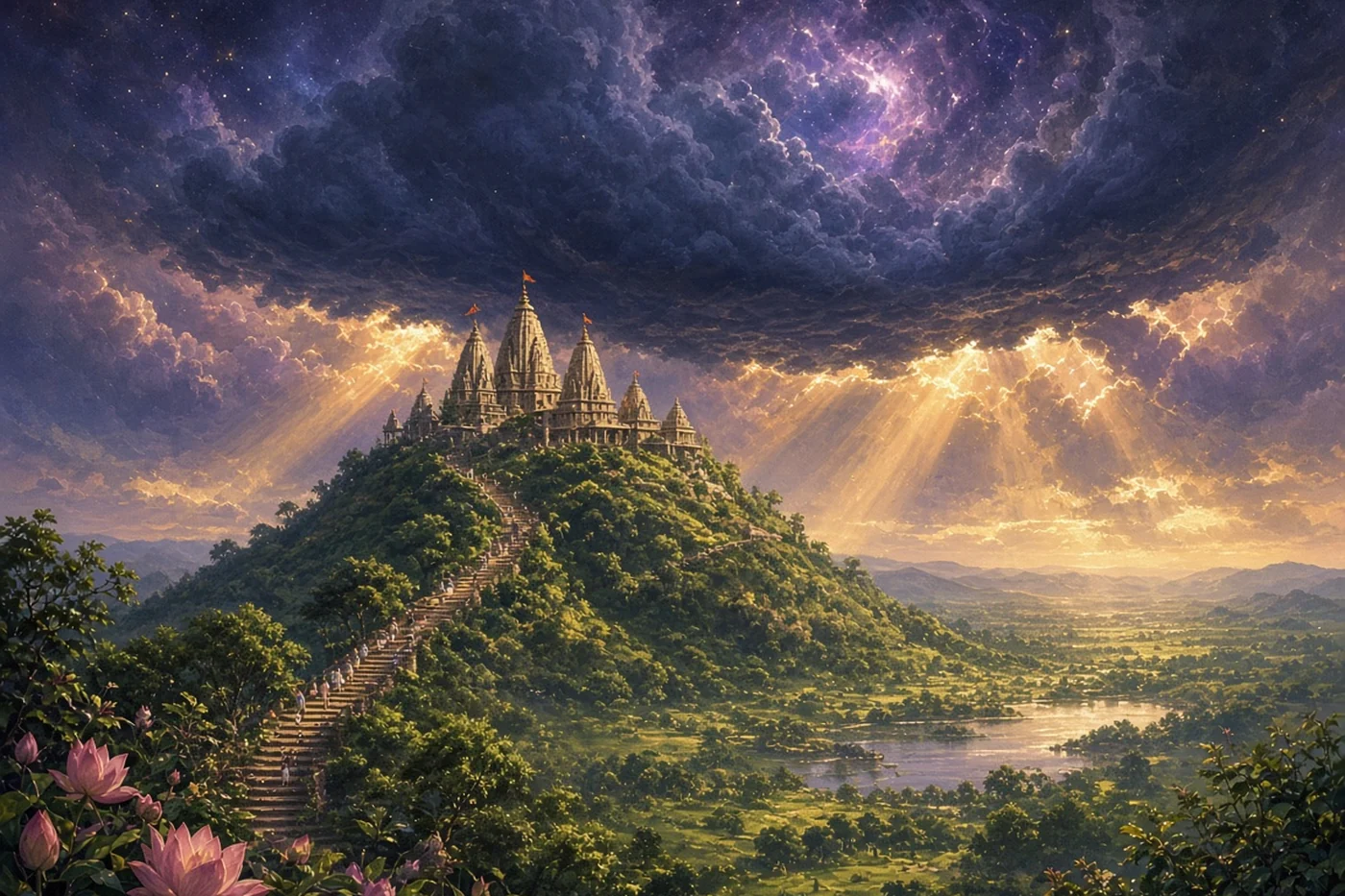
Far to the east, in the Ramgarh hills of Surguja, the people tell it differently. There, in a cave called Sitabenga, rock-cut benches face a level floor, and many take it for one of the oldest theatres in India. Rama, they say, stayed in these hills in his exile, and Kalidasa wrote his poem here. Since 1973, on the first day of Ashadha, the day the yaksha saw his cloud, the district has held its festival at Ramgarh, where scholars talk about the cave, the old theatre and the temple of Rama and Janaki on the hill.
Neither hill can prove it. Both keep watch for the first cloud of the rains.