As the Mahabhagavata Purana tells it
Chapter 8, the moving of Kali's chariot · 4 min read
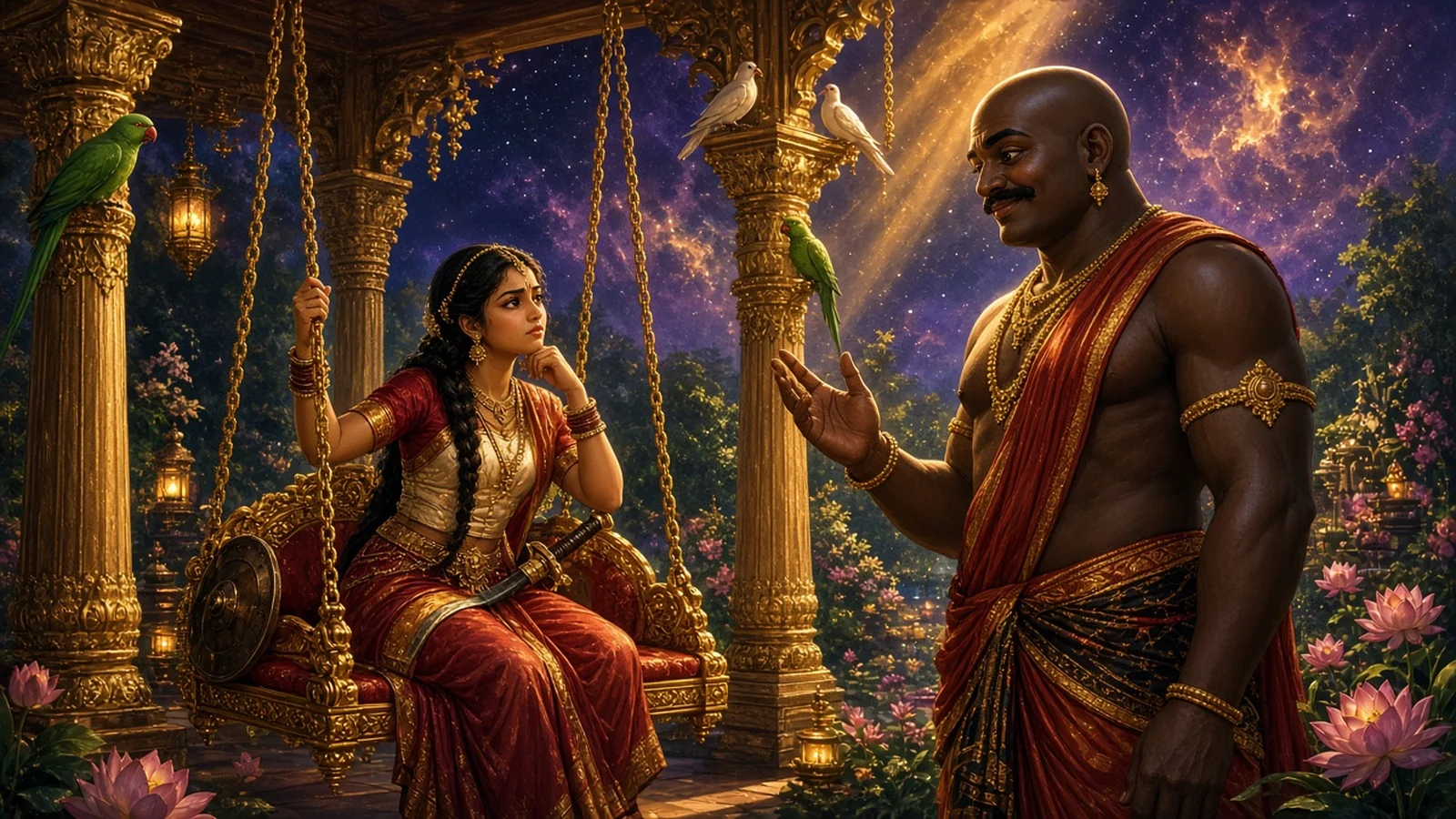
Daksha, the lord of creatures, was holding a great sacrifice. Every god had been asked to it. Only his daughter Sati and her husband Shiva had been left out.
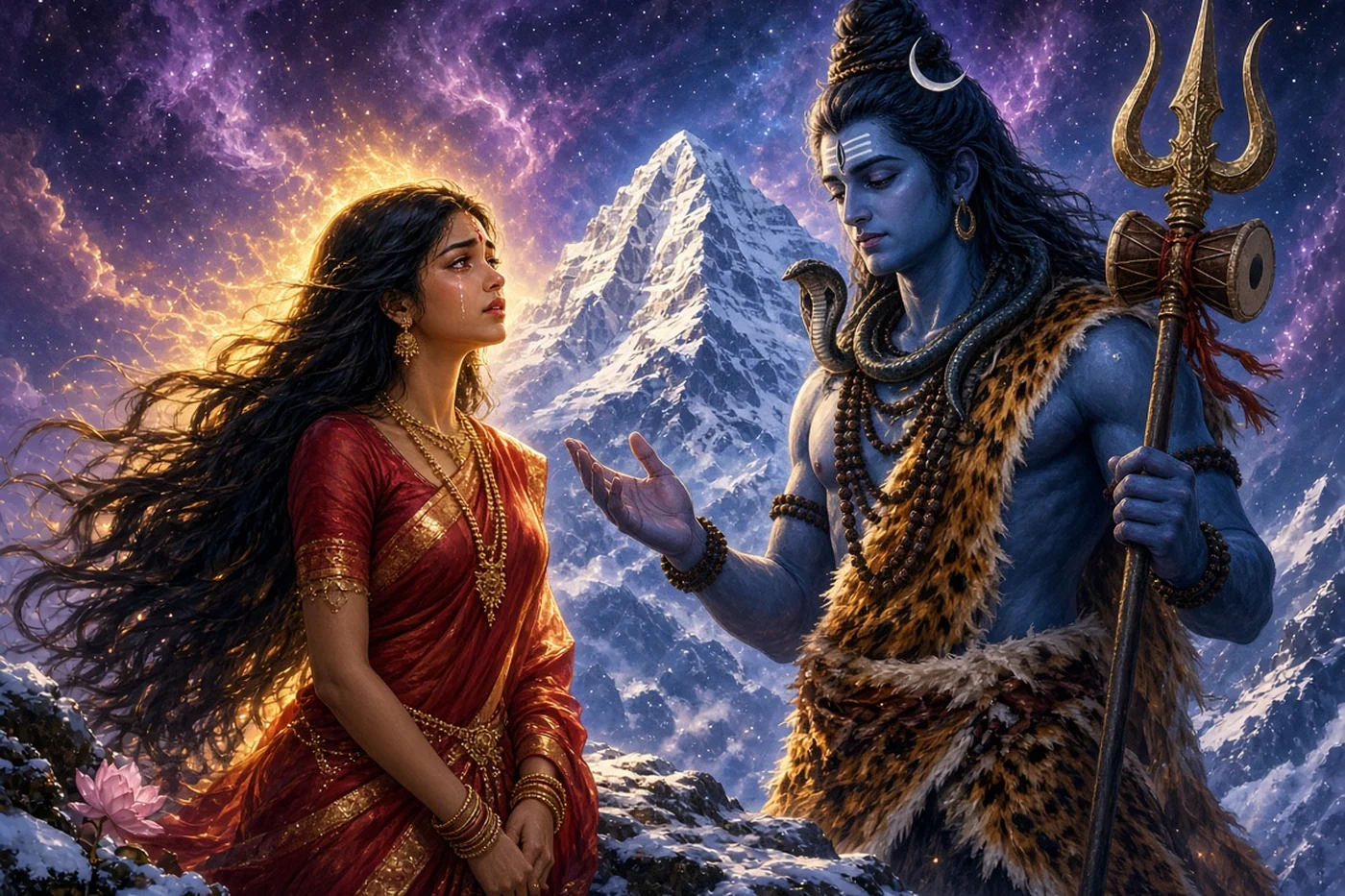
Sati heard of it on the mountain and went to Shiva.
"My father is holding a great sacrifice," she said. "We should go. I am sure he will honour us."
"Sati, do not think it," said Shiva. "To go where you are not invited is as bad as dying. He holds this sacrifice to insult me. Day and night he calls me poor and miserable. If we walk in uninvited, he will say it to our faces."
"Then go or do not go, as you wish," said Sati. "But I am going. A daughter does not wait for an invitation to her father's house. And if he speaks against you in front of me, I will break his sacrifice."
"You will not be honoured there," said Shiva. "You will hear something you cannot bear, and you may give up your life."
She asked again, and again he refused, until at last he said, "I can see you are past my control. Do as you like. Why wait for me?"
Then Sati was angry. Her eyes went red. He won me with his prayers, she thought, and now he brushes me aside. Let him see what I am.
Her lips trembled and her eyes burned like fire, and Shiva shut his eyes.
She laughed, a huge laugh, and he looked through half-closed eyes and was afraid. Her golden colour was gone. She stood up dark, with her hair loose and her long tongue out, with four arms, wearing nothing but a garland of heads. Her body blazed like fire. A crescent moon was on her head, and a crown that shone like the rising sun.
Shiva turned and ran.
"Do not be afraid!" she called after him, again and again. But her laughter frightened him more than her words calmed him, and he did not stop.
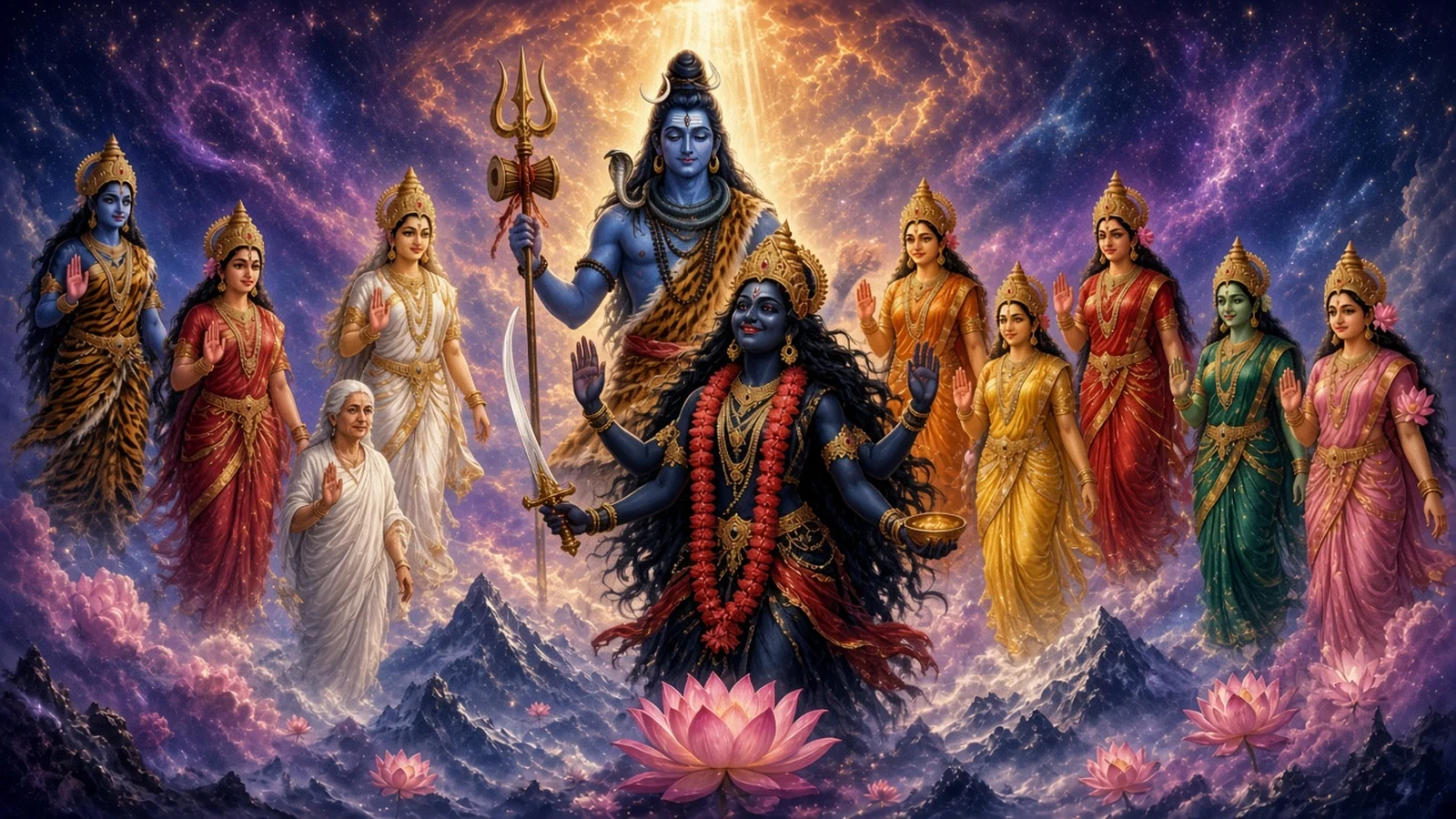
When she saw how frightened he was, her heart softened. But she would not let him go. So she stood in his way, in every quarter of the sky at once, in ten forms. Shiva ran one way and met a terrible goddess. He turned and ran another way, and met another.
There was no direction without one of them. At last he stood still and closed his eyes.
When he opened them, a dark goddess stood in front of him, facing south, laughing, with a face like a lotus in full bloom.
"Who are you, dark goddess?" said Shiva. "Where is my dear Sati?"
"Do you not know me?" she said. "I am Sati, standing in front of you."
"Then tell me who these others are."
"The dark one in front of you is Kali," she said. "Tara is there too, who is like great Time. On your right is Chhinnamasta, and on your left Bhuvaneshvari. Behind you is Bagala, who destroys enemies. In the south-east, dressed as a widow, is Dhumavati. In the south-west is Tripura Sundari, in the north-west Matangi, daughter of the sage Matanga, and in the north-east Shodashi. And I am fierce Bhairavi. Do not be afraid of me. These are my best forms. Whoever worships them gets what they wish for."
Then she said, "I am going to break my father's pride. Allow it or not, I am going."
Shiva was still afraid, but he understood now who she was.
"You are the first of all things and the highest knowledge," he said. "Who could stop you? Forgive what I said to you as a husband. Do as you wish."
She smiled. "Stay here with your attendants," she said. "I am going to my father's house to see his sacrifice."
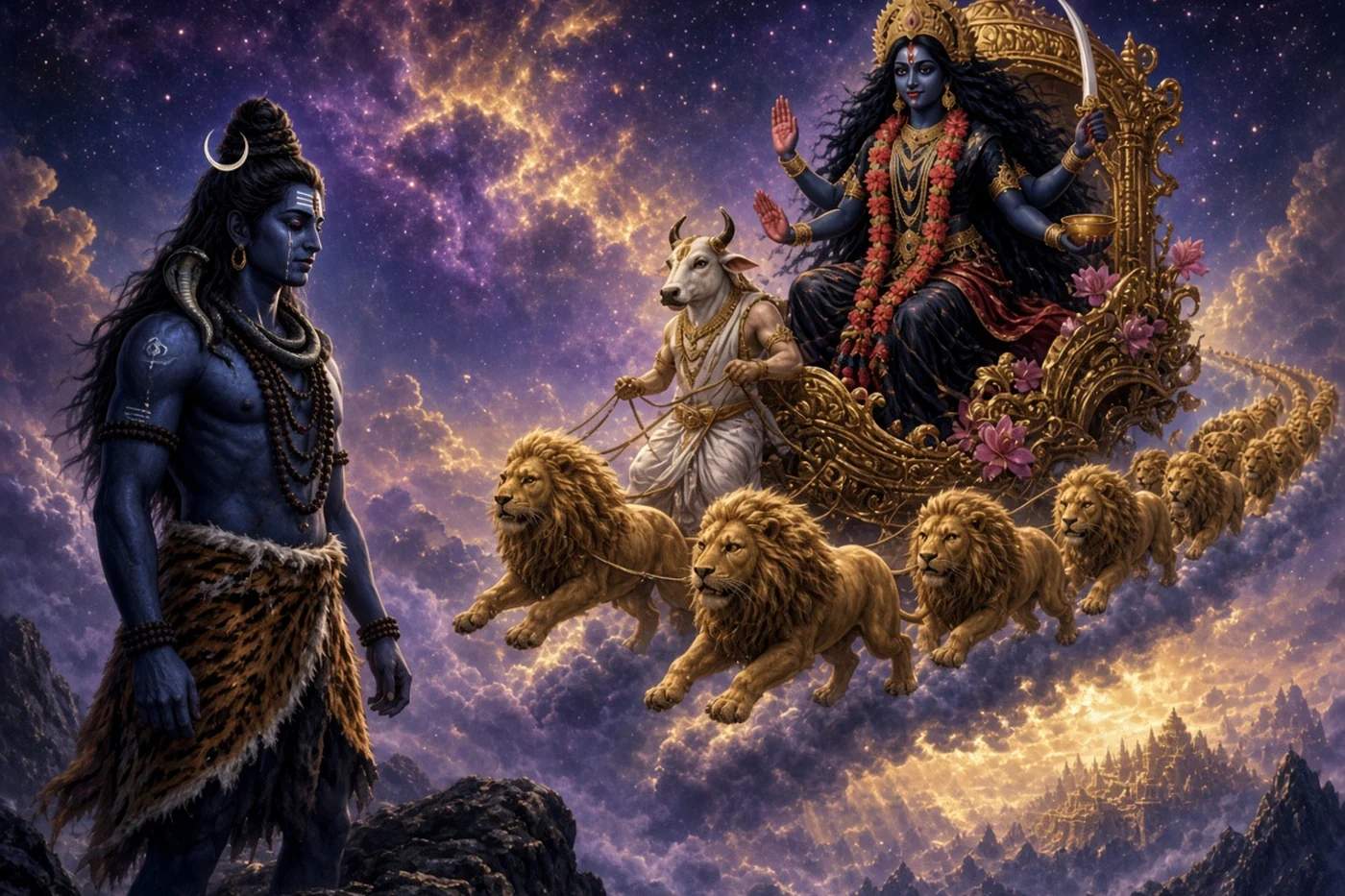
Then she became one form again, high above the stars, and the others vanished. Shiva had a chariot brought, set with jewels and drawn by ten thousand lions, and Nandi drove it. Kali sat in it like a dark storm cloud on the peak of Mount Meru, and the chariot sped away towards Daksha's city. Behind her, Shiva wept.
What happened at the sacrifice is another story.
As the Brihaddharma Purana tells it
Bengal · Madhya Khanda 6 · 2 min read
The Brihaddharma begins the quarrel more gently. Sati sings Shiva's praises first, and he asks her why, and what she wants. When she asks to go, he gives every reason against it, and one that is all his own: "Today is Sunday. It is not right to travel west today."
Sati answers each reason. Then she reminds him of a promise. "At my svayamvara I asked you for one thing: that I should never hear you insulted, and that if I did, I would leave this body at once. You granted it."
"I granted it," says Shiva, "and still you go to hear it. Do as you like. I will not stand in your way."
She says nothing. She only looks at him, and her eyes fill with tears. Then the tears dry. Her two eyes blaze, fire pours from the third, and her golden glow goes out until she is as dark as thick night, four-armed, her hair loose, so heavy with power that the mountain shakes under her.
Shiva runs. "Do not fear, do not fear, do not run!" she cries, and stands in the ten directions in ten forms, until he shuts his eyes where he stands. When he opens them a smiling dark woman faces him from the south.
"Where is my Sati?" he asks.
"I am Daksha's daughter," she says. "Only my colour has changed." She tells him she is the subtle source of all things, born to Daksha only to win him, and that she has shown him these forms to show that she can end Daksha's sacrifice. She names them: Kali before him, naked; Tara in the sky, dark, the shape of time; Chhinnamasta on his right and Bhuvaneshvari on his left; Bagalamukhi behind; Dhumavati, Sundari, Matangi and Shodashi in the four corners. "And as Bhairavi," she says, "I live inside your own body."
Then she gathers them all back into one, and Shiva asks her pardon. She goes as Kali through the open sky, dark as a rain cloud, the tiger skin at her waist streaming in the wind.
As Varanasi tells it: the ten doors
North India · Varanasi, told by word of mouth · 1 min read
The Puranas set the ten forms on the day of Daksha's sacrifice. The tellers of Varanasi know them without any sacrifice at all.
A tantrika told the story to the chief priest of the Kashi Vishvanath temple, and he told it to the scholar David Kinsley. The tantrika said it could be found in all the books of the Tantra. In this telling Shiva has married again, after Sati is gone. He is living with Parvati in her father's house in the mountains, and one day he decides to leave.
"Stay," Parvati asks him.
He will not stay. So she becomes ten, and stands one form in each of the house's ten doors, and there is no door left for him to go out by. The tantrika said the house is the body, and the ten doors are its openings, which a yogi learns to guard.
A Hindi book on the goddess Tara tells it with Kali. In the first and best age of the world Shiva lives with Kali, and grows restless, and gets up to go.
"Where are you going?" asks Kali.
"Wherever I wish!" says Shiva.
She does not answer him. He walks off, and in front of him stands Kali. He turns, and there is Tara. Every way he goes, another of her forms is waiting: Shodashi, Bhuvaneshvari, Bagalamukhi, Bhairavi, Kamala, Dhumavati, Matangi, Chhinnamasta. In the end he no longer wants to go anywhere. He knows now that there is no place where she is not.