As the Lalitopakhyana tells it
Brahmanda Purana, Lalitopakhyana 16 and 26 to 30 · 4 min read
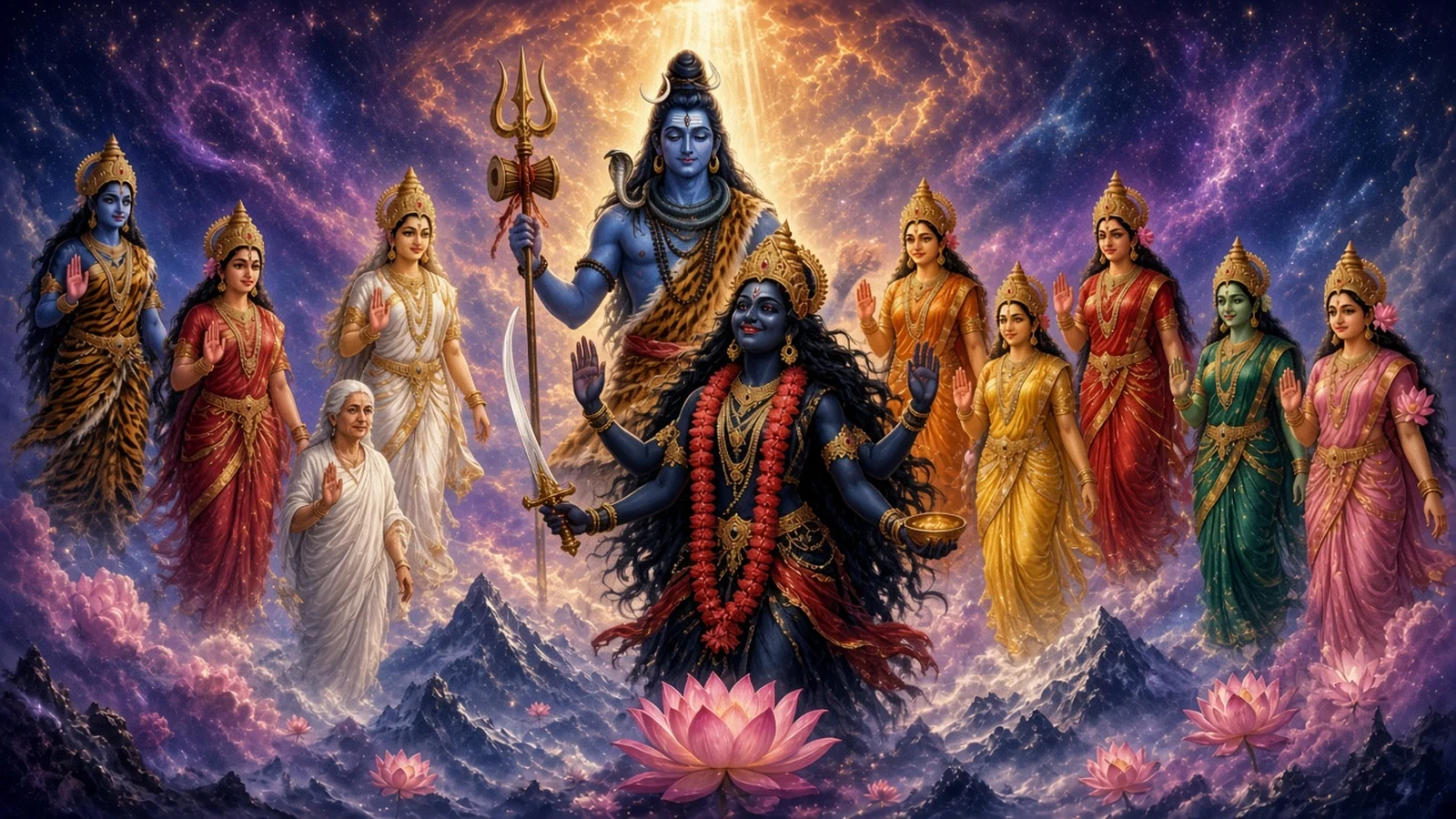
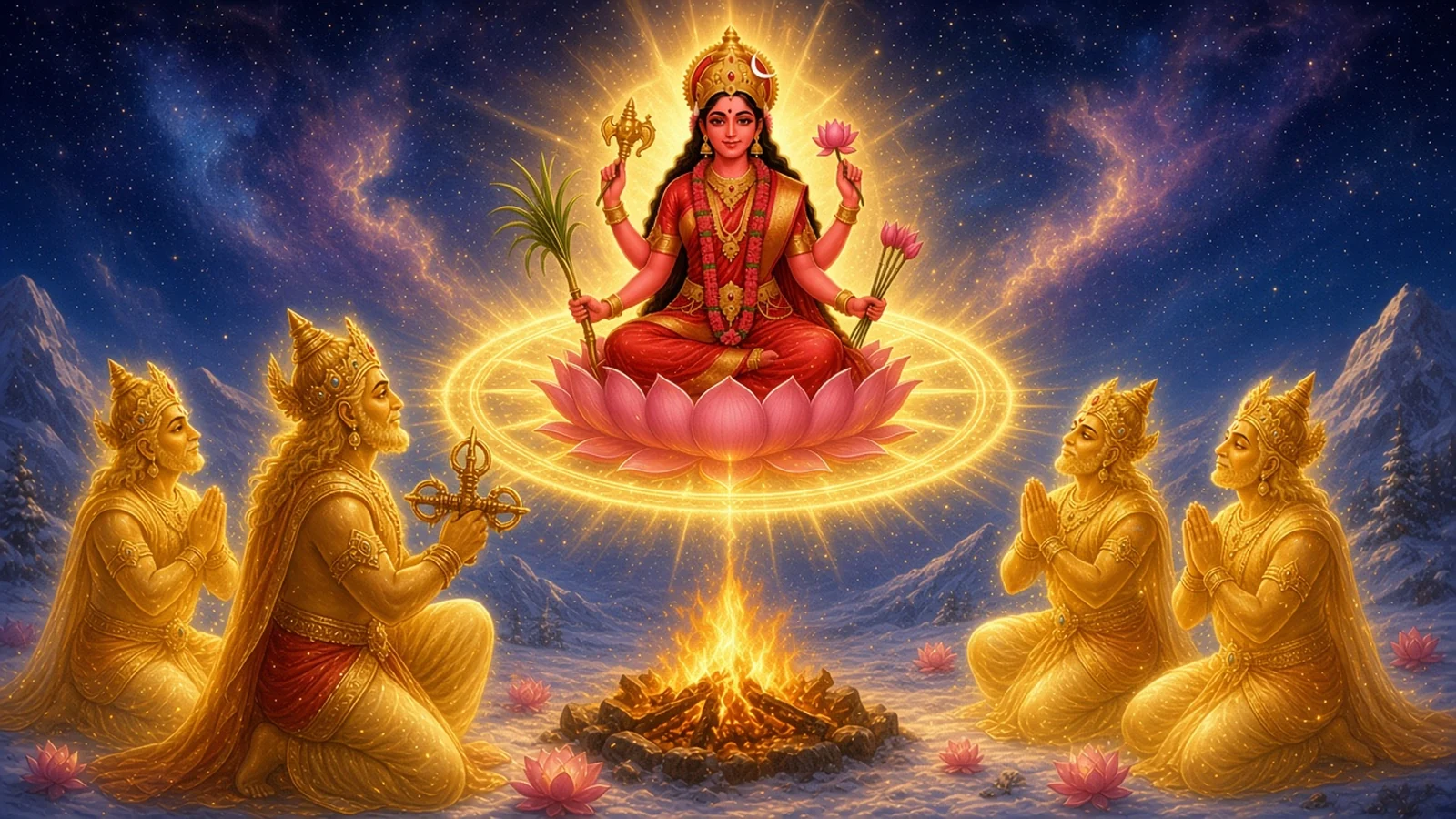
Lalita set out to conquer Bhanda with the sound of drums. Goddesses came out of her own weapons to lead her army. Sampatkari rose from her goad and rode at the head of the elephants; another rose from her noose and led the horses. Her two great generals were Mantrini, the minister, and Dandanatha, the commander. Round her camp burned a wall of fire.
Bhanda's generals fell one after another. So he sent his thirty sons, with two hundred armies behind them.
"Bring me that woman alive," he told them.
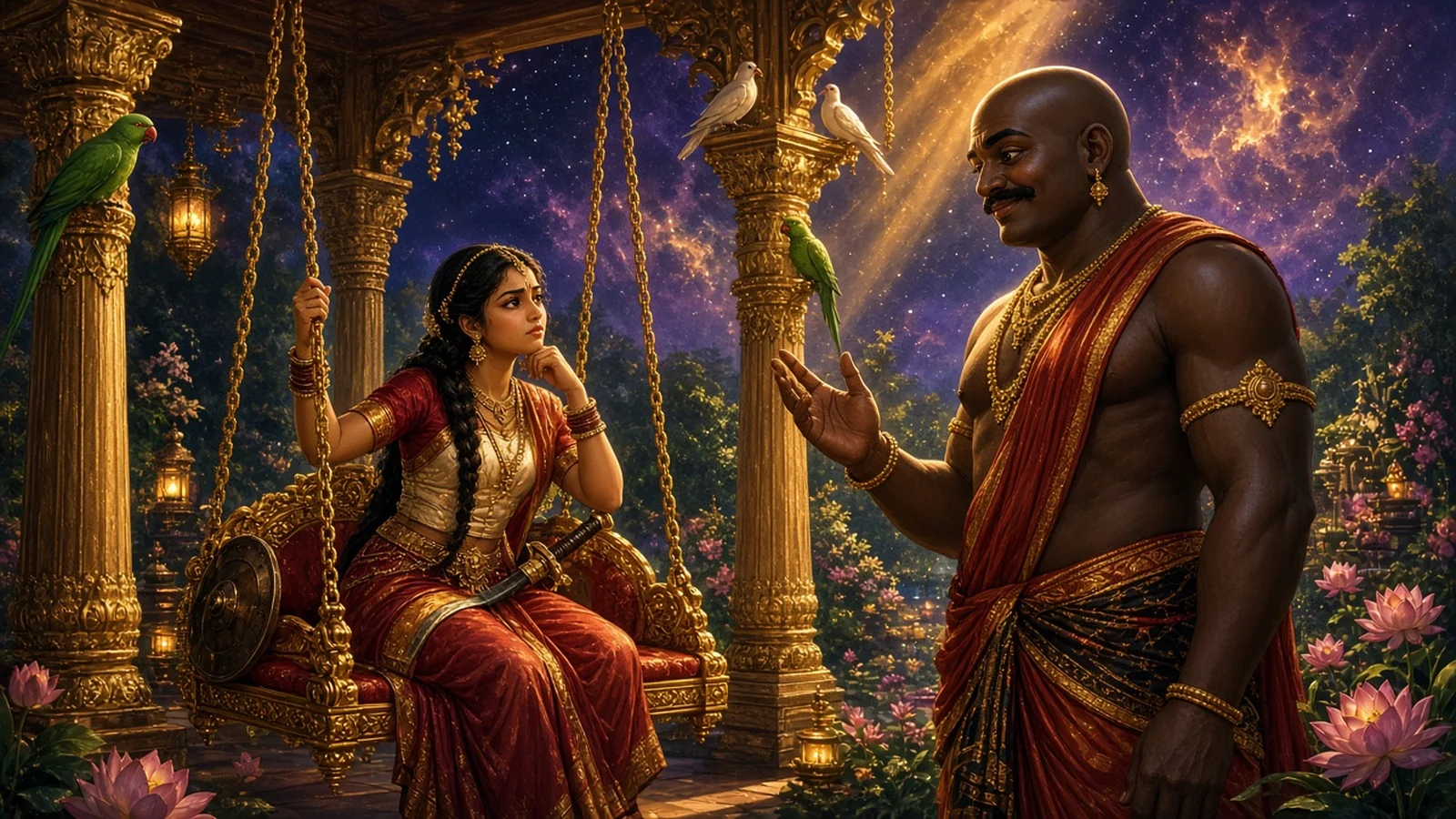
In Lalita's camp there was a girl called Bala, Lalita's daughter. She always looked about nine years old, but she knew every art there was, and the art of war best of all. When she heard that the thirty sons were coming, she went to her mother.
"Let me fight them," she said. "I am young and my arms are itching for battle."
"Dear child," said Lalita, "your limbs are so soft. You are my very breath. Why would you do such a thing?"
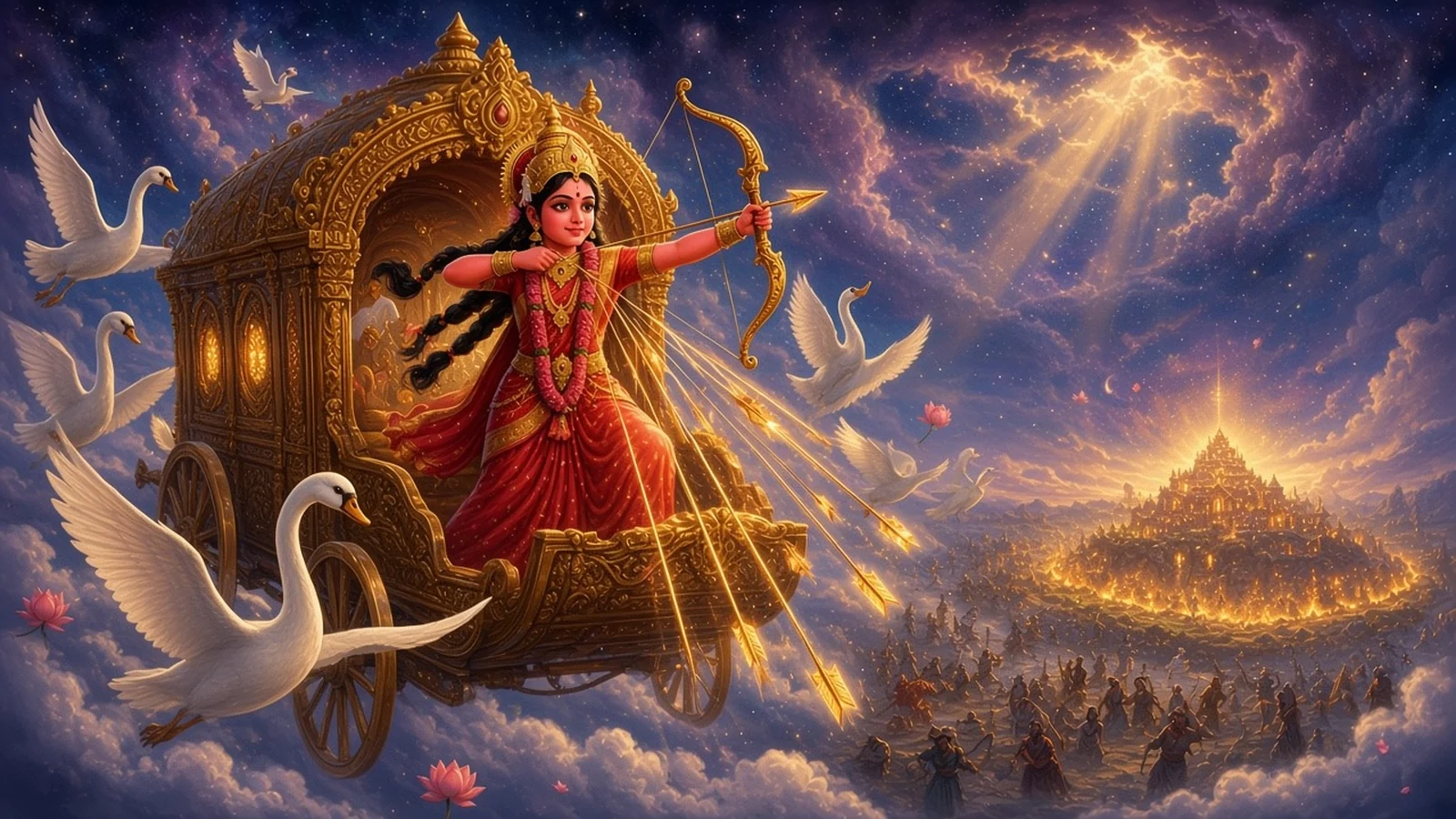
Bala asked again. Lalita saw that she would not give up, so she held her close and gave her a set of her own armour and weapons. Then she drew out of the staff of her own bow a covered carriage, drawn by hundreds of swans, and Bala rode to war in it.
Mantrini and Dandanatha rode close to guard her. Bala covered the field with fiery arrows. She sent the Narayana missile into the two hundred armies, and they were ash in a moment. Then she set thirty crescent-headed arrows on her bow at once, and let them go, and the thirty sons of Bhanda fell together.
Flowers rained from the sky. The generals hugged her. When Lalita heard what her daughter had done, she was full of joy.
Bhanda's brother Vishukra tried a trick. Outside the wall of fire, at the southern gate, he carved a great charm on a slab of rock, the Jayavighna, the yantra that blocks victory, with eight tridents round it and eight goddesses of laziness, gloom and pride to guard it. He threw it over the wall into the camp.
The goddesses of Lalita's army put down their weapons.
"Why should we fight?" they said. "Hurting anyone is a sin. Sleep is better. And who is this queen of ours, anyway?"
Only Mantrini and Dandanatha were untouched, and Mantrini went to Lalita.
Lalita looked at the face of Kameshvara, her husband, and laughed. From the light of that laugh came an elephant-headed god with ten arms and a crescent moon on his head, the great Ganapati. He bowed to her and went straight out into the camp. He found the hidden slab, struck it with his tusks, and ground it to powder.
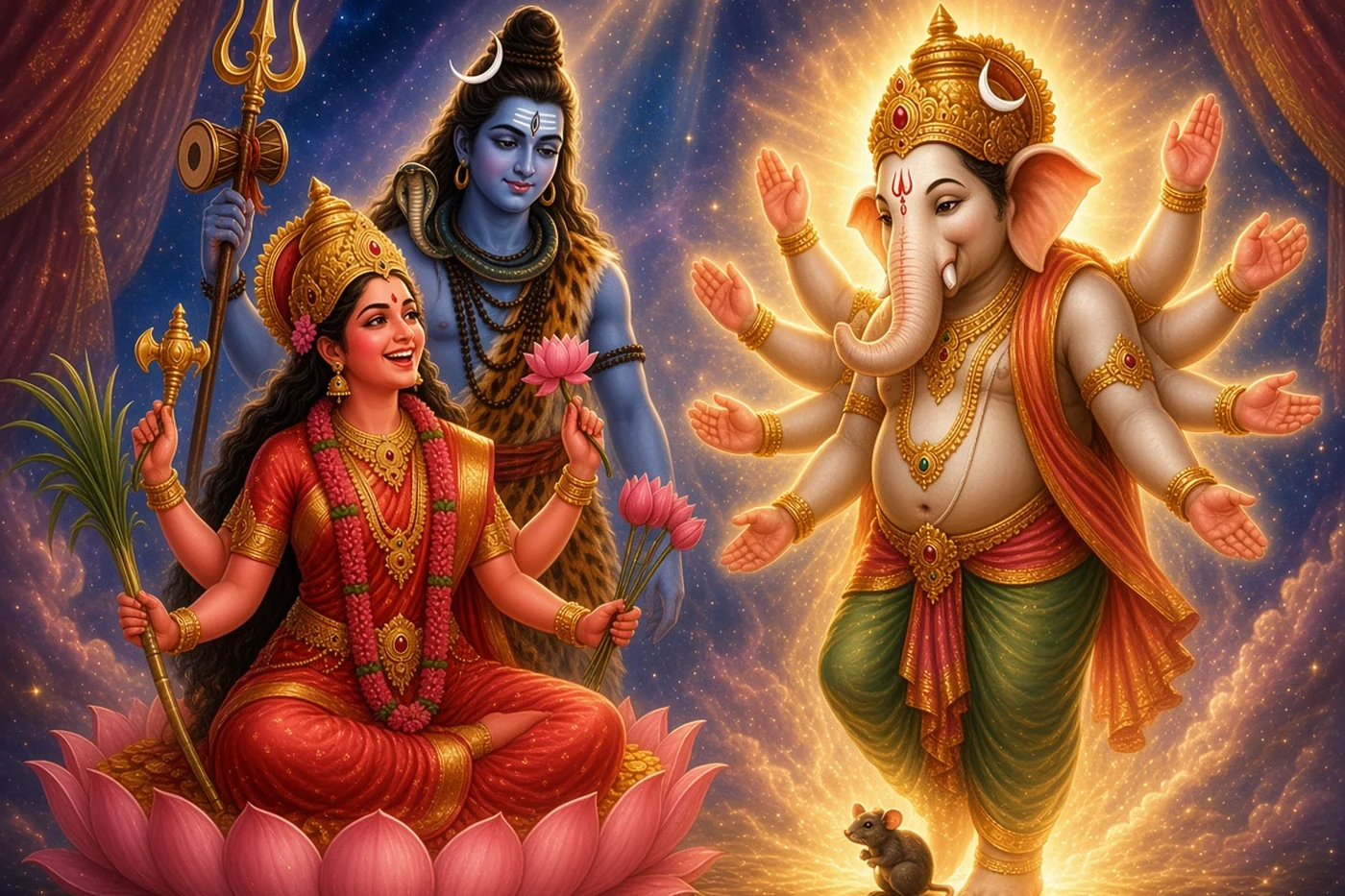
At once the goddesses woke up and reached for their weapons. Ganapati went on, riding his mouse, and smashed the elephant demon Gajasura and his army. For this Lalita gave him a gift: he would be worshipped before every other god.
Mantrini killed Vishukra, and Dandanatha killed Vishanga. Bhanda was left alone.
He came out raging, with a vast army, and Lalita went out herself in her great chariot, the Chakraraja. Every weapon he sent, she answered. When he called up the demons of old, Hiranyakashipu and Ravana and their kind, she called up Vishnu's avatars from her fingernails: the tortoise, the boar, the man-lion, the dwarf, Parashurama, Rama and the rest, each one against its old enemy. The Narayana missile burned his armies. The Pashupata missile felled his forty generals. Last of all she loosed the great weapon of Kameshvara, bright as a thousand suns, and Bhanda fell. His city, Shunyaka, burned down to bare ground, and its name came true, for Shunyaka means empty.
Afterwards Brahma, Vishnu and Shiva came to her throne with all the gods.
"Mother, bring Kama back," they begged. "Shiva must be moved to marry Uma, or Taraka will never die. End the sorrow of Rati."
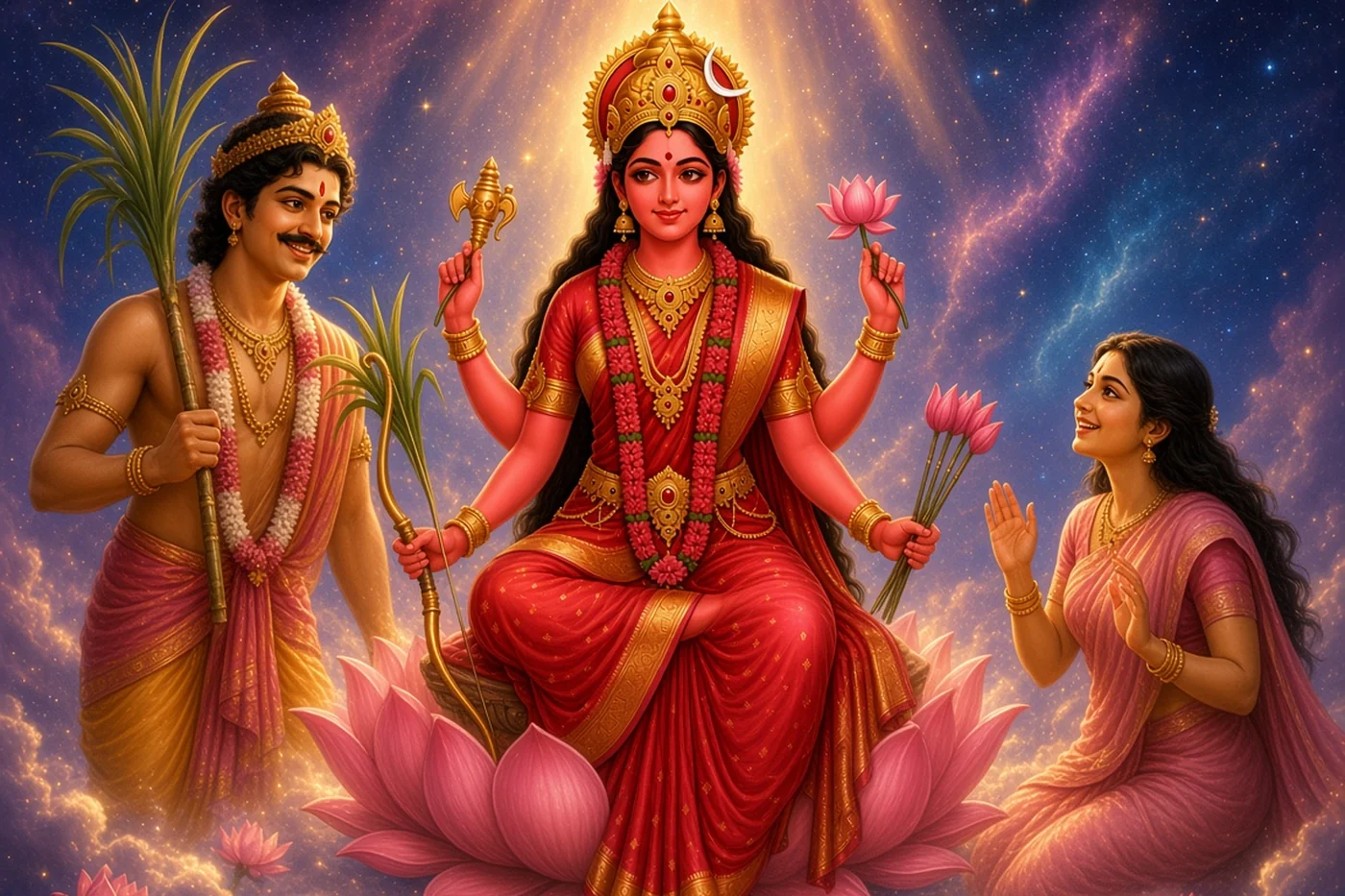
They brought Rati before her, grieving, without a single ornament. Lalita's heart melted. She turned her eyes to one side, and from that glance Kama was born again, handsome, with his flower bow in his hand.
"Go and enchant the world," she told him.
He went. His arrows reached Shiva, Shiva married the mountain's daughter, and their son Skanda killed Taraka.
As the thousand names tell it
Lalita Sahasranama, names 64 to 84, with Bhaskararaya's commentary · 2 min read
The thousand names tell the war in about twenty names, one after another, almost like a chant of the battle.
She has an army of Shaktis, ready to kill Bhanda. Herds of elephants follow her, led by Sampatkari, and crores of horses, led by Ashvarudha. She sits in the chariot Chakraraja with every weapon. Mantrini attends her in the chariot Geyachakra, the chariot of song. Dandanatha goes in front in the chariot Kirichakra, which Bhaskararaya says is shaped like a boar. She lives in the middle of the fortress of fire built by Jvalamalini.
She rejoices at the courage of the Nityas, the goddesses of the fifteen days of the moon. She rejoices at Bala, ready to kill the sons of Bhanda. She is pleased when Mother Mantrini kills Vishanga. She delights in the strength of Varahi, who takes the life of Vishukra.
Shri Ganeshvara was made by her look at the face of Kameshvara. She is delighted when the great Ganesha breaks the yantra that blocked the way. She answers Bhanda's weapons with weapons of her own. From the nails of her ten fingers came the ten forms of Narayana; Bhaskararaya counts them from the fish on her right thumb to Kalki on her left little finger. She burned the demons' army with the Mahapashupata, and Bhanda with his army in the fire of Kameshvara's weapon.
Brahma, Vishnu and Indra praise her power. And the last name of the war is the gentlest: she is the healing herb that gave life back to Kama, burned by the fire of Shiva's eye.
Bhaskararaya also reads many of these names inward. Bhanda, he says, is the soul that thinks itself bound; his army is the mind's habits of seeing two where there is one; the Shaktis are the thoughts that see through it.