As the Mahabhagavata Purana tells it
Chapters 76 and 77, Shiva to Narada · 2 min read
The sage Narada had heard Shiva tell the glory of the Ganga, and he was not tired of listening yet.
"Lord," he said, "now tell me about Kamarupa."
"There is no place in the world better than Kamarupa," said Shiva. "A part of Sati's body fell there, when her body was scattered over the earth, and so the goddess lives there. The gods come there, and the gandharvas. Brahma, Vishnu and I have all sat in penance there to reach her. The sage Vasishtha received his mantra there. Whoever walks round that place, keeping it on his right, has walked round the three worlds. And the seeker who bathes in the river Lohita below it and offers sacrifice there becomes a master of mantras."
Then Narada asked for more.
"Lord, tell me about the goddess of that place, and the ten Vidyas with her."
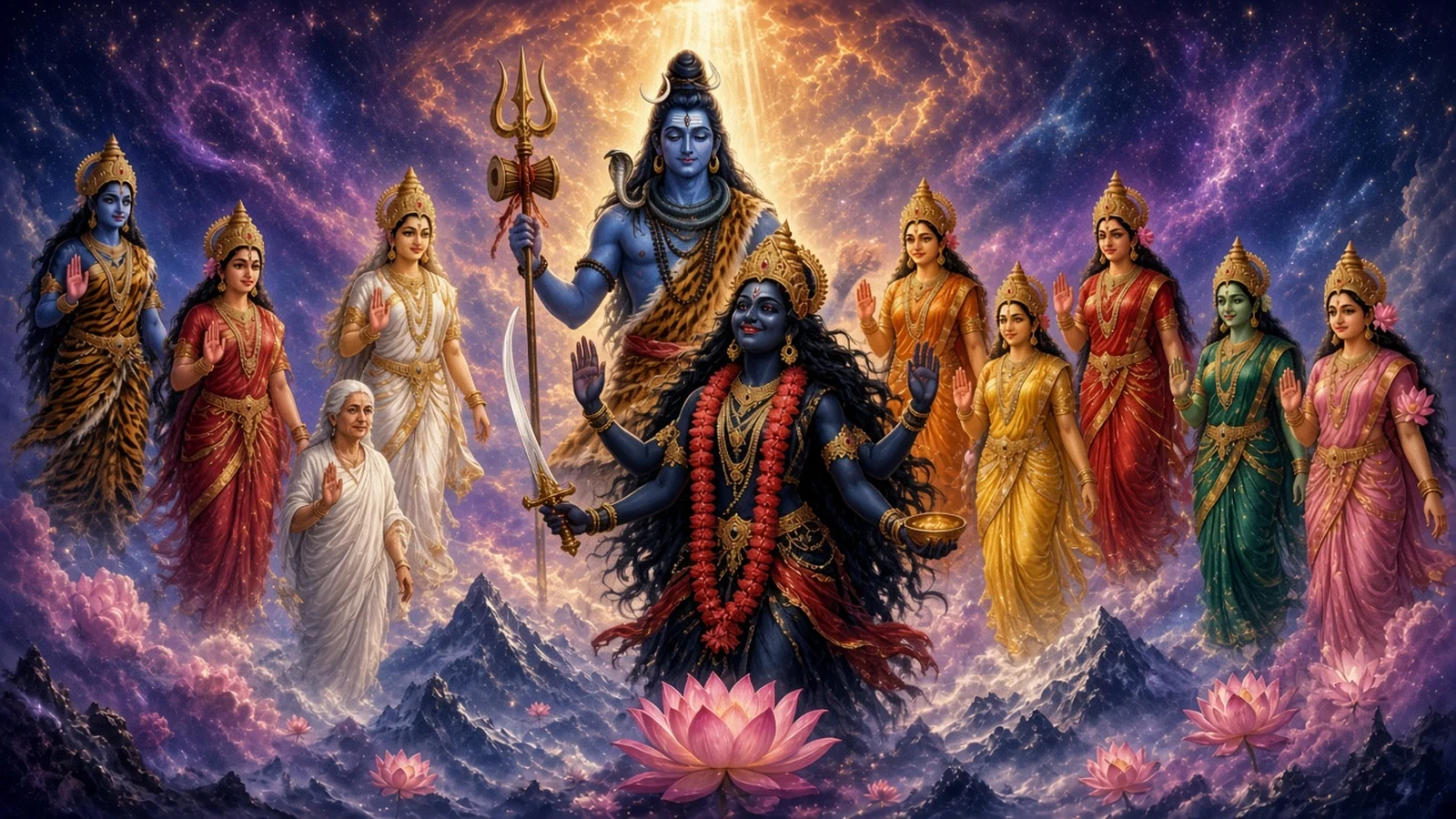
"The ten great Vidyas live there," said Shiva, "for the good of all who seek them. Kamakhya is Kali herself, the first goddess, who has always been. The other nine stand beside her."
"What does she look like?"
"She wears red. She has three burning eyes and four hands, and she is dark like the cloud at the end of the world. Her teeth are terrible and her tongue hangs out, and her crown is gold. She sits on a seat made of three things: a lion, a body lying still as a corpse, and a lotus. The lion is Vishnu, the body is Shiva, and the lotus is Brahma."
"And the nine?"
"On her left is Tara. On her right is Bhuvaneshvari. In the south-east stands Shodashi, in the south-west Bhairavi, in the north-west Chhinnamasta, in the north-east Sundari. Bagalamukhi stands behind her, and Dhumavati to the south of that great seat. Beneath it all lies Rudra, like a mountain of ash. And Brahma, Vishnu and the other gods are always there with their goddesses, though nobody sees them."
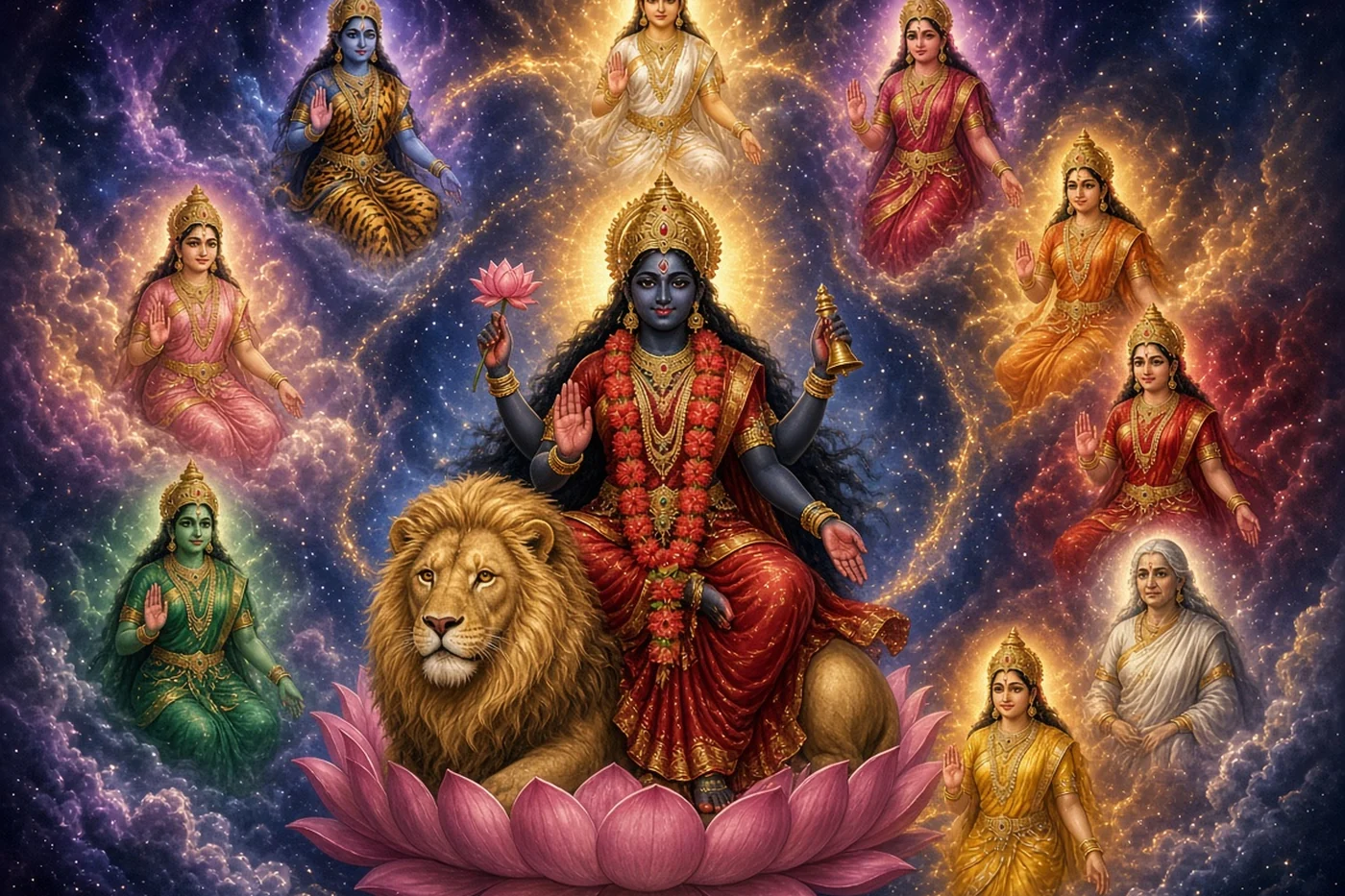
These were the same goddesses who had once stood round Shiva in every direction, the day Sati would not be kept at home. On the hill of Kamarupa they stand round her instead.
"Lord," said Narada, "is there a prayer by which one can be guarded there?"
"There is her armour," said Shiva, and he taught it to him. It is a prayer that gives each goddess one side of the person who prays. Tara guards the east and Dhumavati the south. Bhuvaneshvari guards the west and Bagalamukhi the north. Shodashi, Bhairavi, Chhinnamasta and Tripura Sundari each guard a corner, Matangi guards from above, and Kamakhya Kali, who is all of them, guards all round.
"Whoever says it," said Shiva, "is touched by no fear at all."
As the hill keeps it today
Nilachal hill, Guwahati, Assam · 2 min read
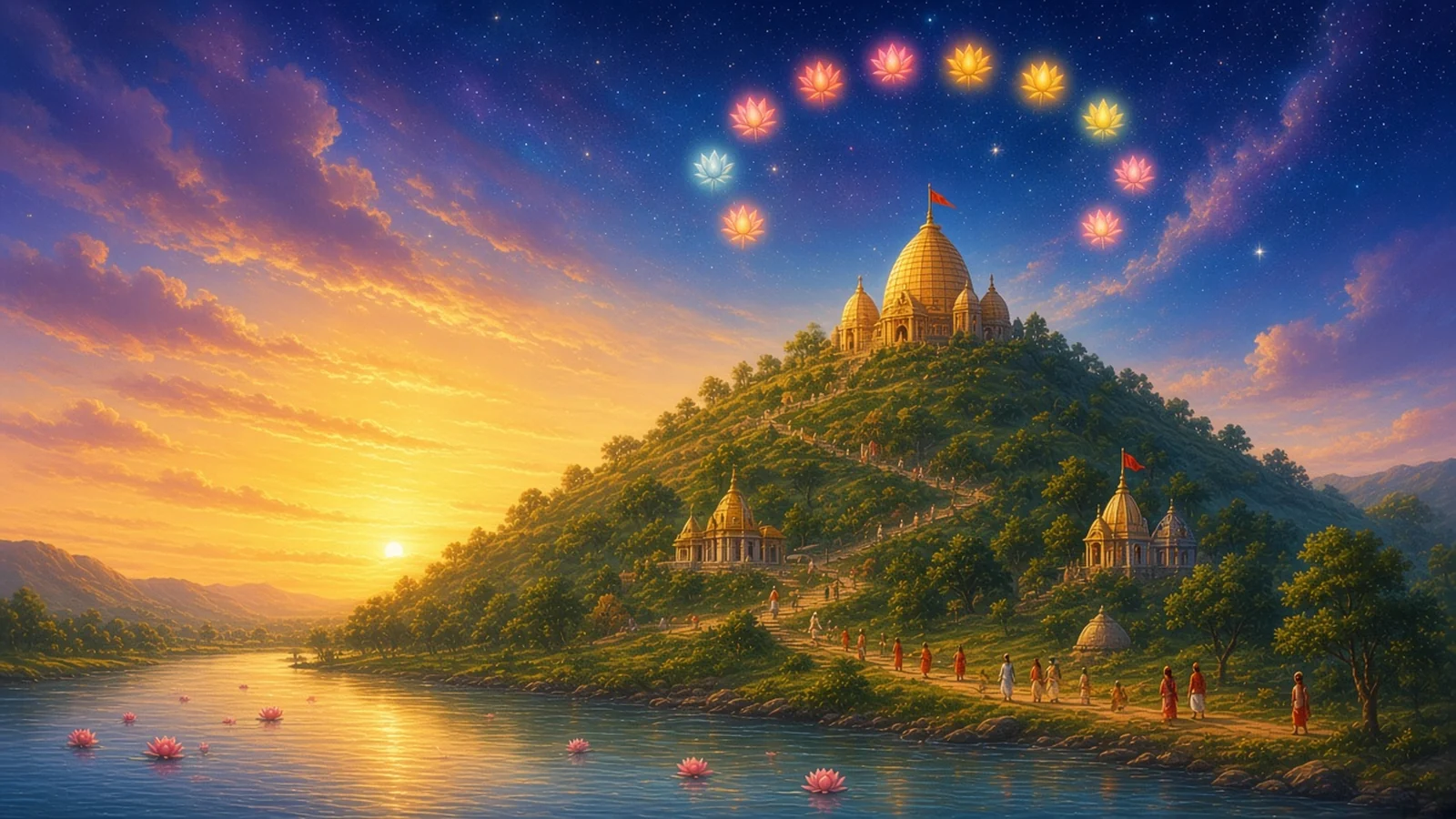
The hill is called Nilachal, the blue mountain. It rises from the south bank of the Brahmaputra at Guwahati, and the temple's own pages say it is really three hills joined together: Brahma's hill, Shiva's hill, and the hill of Varaha, Vishnu's boar.
The great temple stands near the top. Its inner room is below the ground, and there is no statue in it. The goddess is a cleft in the rock, kept full by a spring that never runs dry. The priests of the hill honour her as Shodashi, the third Mahavidya, the girl of sixteen also called Tripura Sundari. With her, in the same dark room, are two more of the ten: Matangi, who is the goddess of speech like Saraswati, and Kamala, who is Lakshmi. All three are stones in that one room.
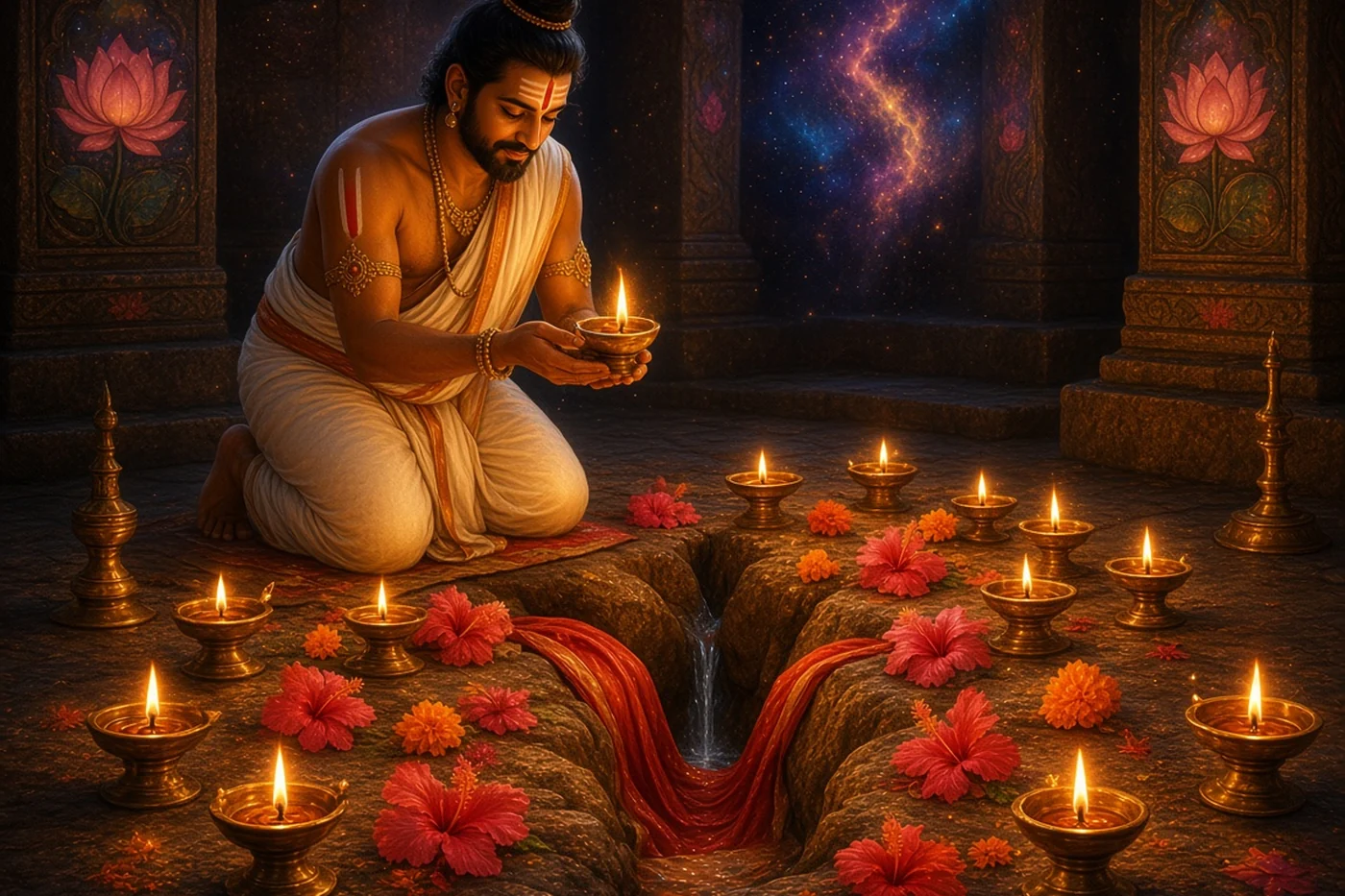
The other seven have temples of their own across the slopes. Kali's is called the seat of the nine Kalis. Tara's is the seat of the eight Taras, and it is large, built like the main temple. Bhuvaneshvari's temple knows her also as Mahagauri and Annapurna. Bhairavi is Tripura Bhairavi here, and the other nine are painted round the top of her walls. Chhinnamasta's shrine is called the hidden Kamakhya. Dhumavati and Bagalamukhi have theirs.
A pilgrim who climbs from shrine to shrine sees few faces. Most of the goddesses here are not carved figures at all. They are stones, hidden under flowers and cloth and offerings, and some sit in caves under the ground that open only on certain days.
The hill is old. The earliest inscription to name Kamakhya is from the ninth century, in copper plates of King Vanamalavarmadeva found at Tezpur. The temple that stands now was rebuilt under the Koch king Naranarayana and finished in 1565, its building watched over by Chilarai.
Temples to all ten together are rare. The scholar David Kinsley, searching across North India, found only one other, a small shrine at Cossipore in north Kolkata, beside the burning ground on the river.