As the Lalitopakhyana tells it
Brahmanda Purana, Lalitopakhyana 11 to 15 · told by Hayagriva to Agastya · 3 min read
When Shiva opened his third eye and burned Kama, the god of love, a heap of grey ash was left on the mountain. We tell that in The Burning of Kama. This is what came after.
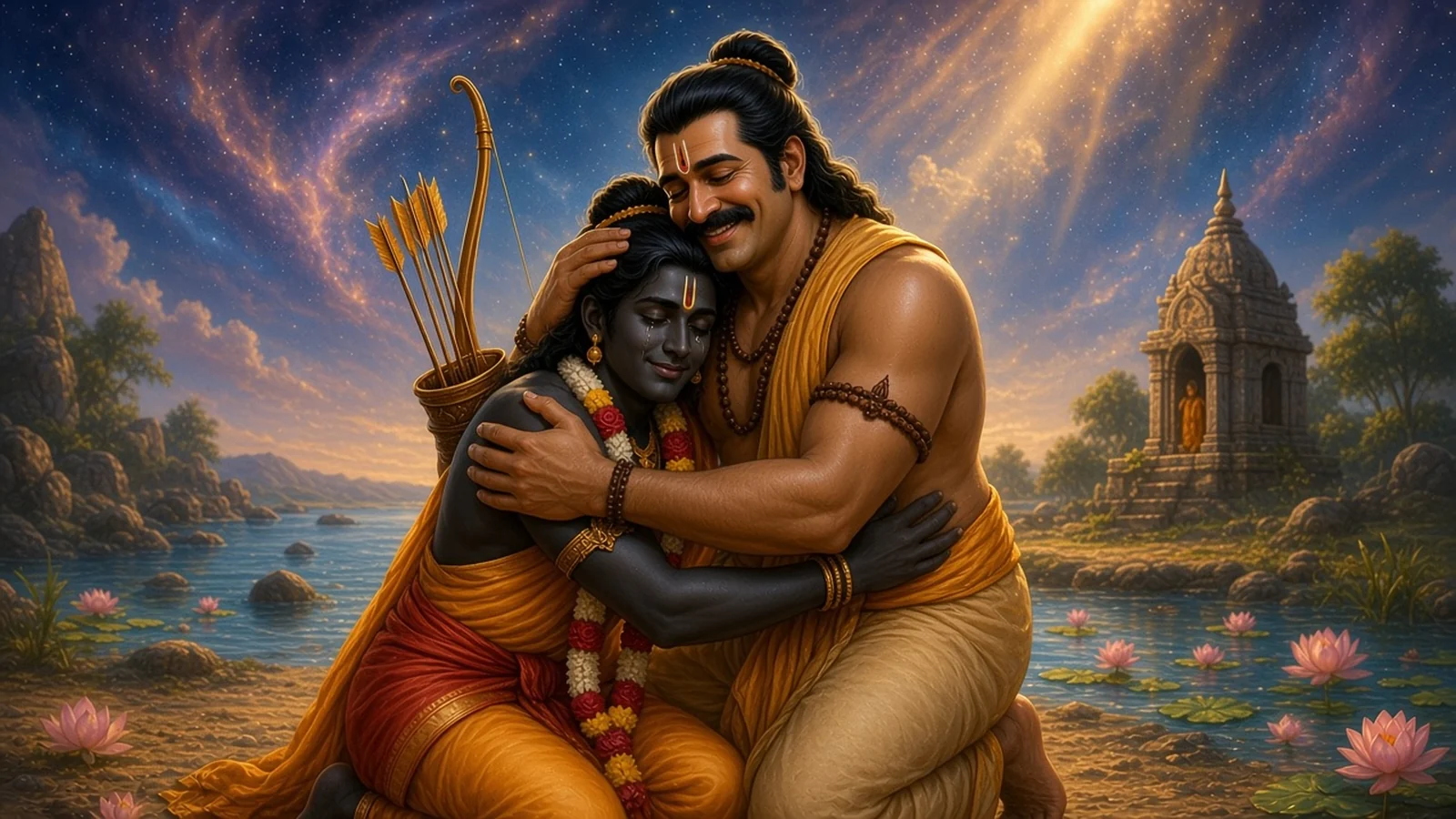
A lord of Shiva's ganas named Chitrakarma gathered up the ash and shaped it into the figure of a man. Shiva looked at the figure, and it came alive. It stood up strong and shining, as if Kama had been given a body again.
Chitrakarma embraced him. "Praise Mahadeva," he said, and the new creature chanted the Shatarudriya, the hymn to Rudra, a hundred times over.
Shiva was pleased. "Ask me for a boon."
"Let half the strength of anyone who fights me flow into me," said the creature, "and let my arrows make every weapon of my enemy useless."
Shiva granted it, and gave him sixty thousand years to rule. Brahma, watching, cried out, "Bhanda, bhanda!", and that cry became his name.
Bhanda had been born from the fire of Rudra's anger, and he grew into a terrible demon king. Shukra, the teacher of the demons, came to him with hundreds of followers, and the demon architect Maya rebuilt for him the old city of Shonitapura, as fine as the city of the gods. For sixty thousand years he ruled the three worlds, and Indra and the gods served at his court.
Then the sage Narada came to Indra.
"His splendour is greater than yours," said Narada. "No penance will help you, not if you kept it up for ages. Only the supreme Shakti, the Great Goddess, can bring him down. Worship her before he rises against you."
So Indra and the gods went up the slopes of the Himalaya and worshipped the Goddess for ten thousand years. Bhanda marched on them with his armies, but a wall of light stood round the gods. Each time he broke it, it rose again, and at last he went home.
Still the gods trembled.
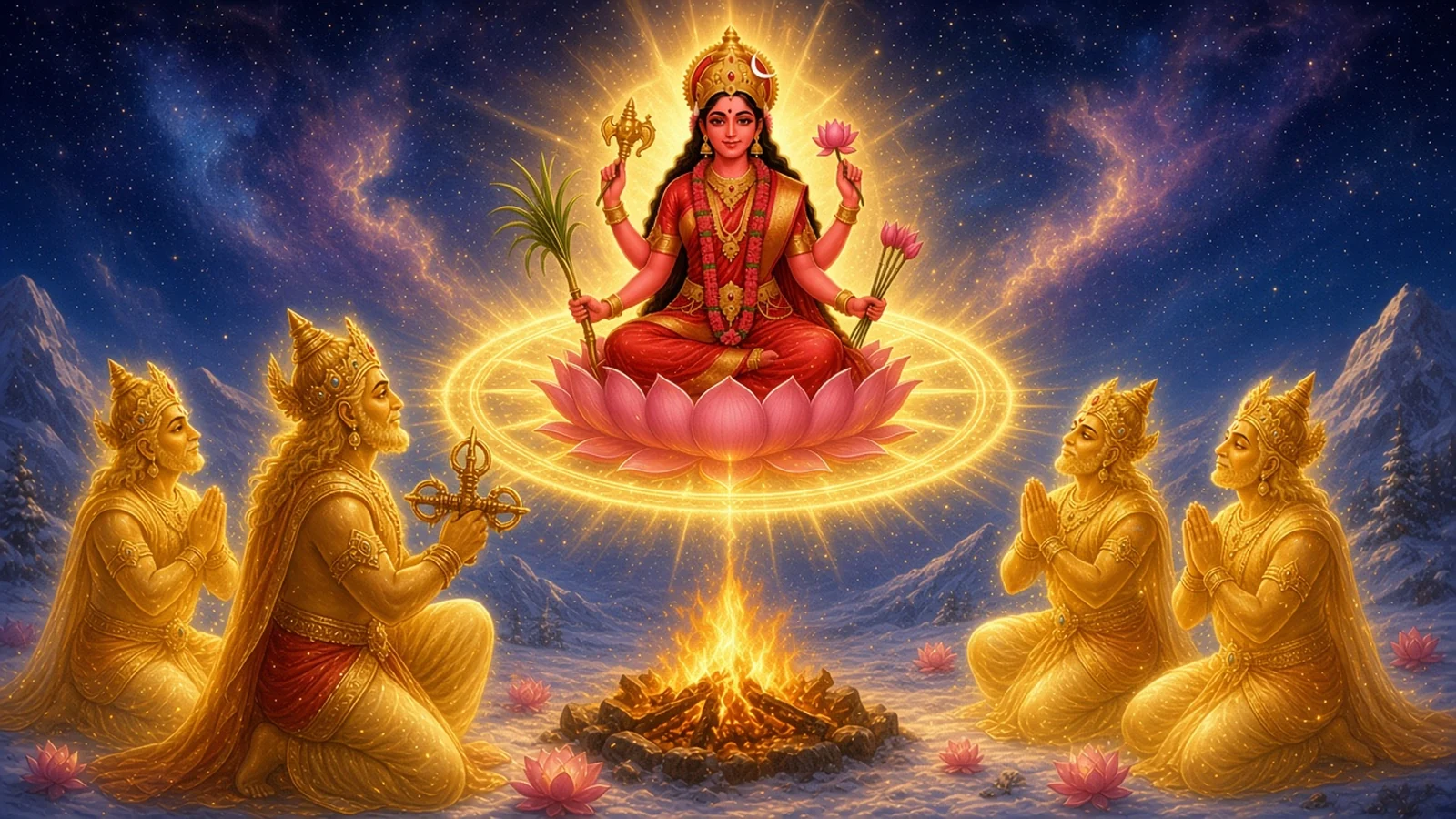
"Even all of us together cannot beat him," said Indra. "There is no refuge left anywhere. Let us dig a fire pit a yojana wide and give the Goddess the greatest offering there is."
They lit the fire and chanted, and they fed it with flesh cut from the body. When they were ready to give it the whole body, a great light rose up in front of them.
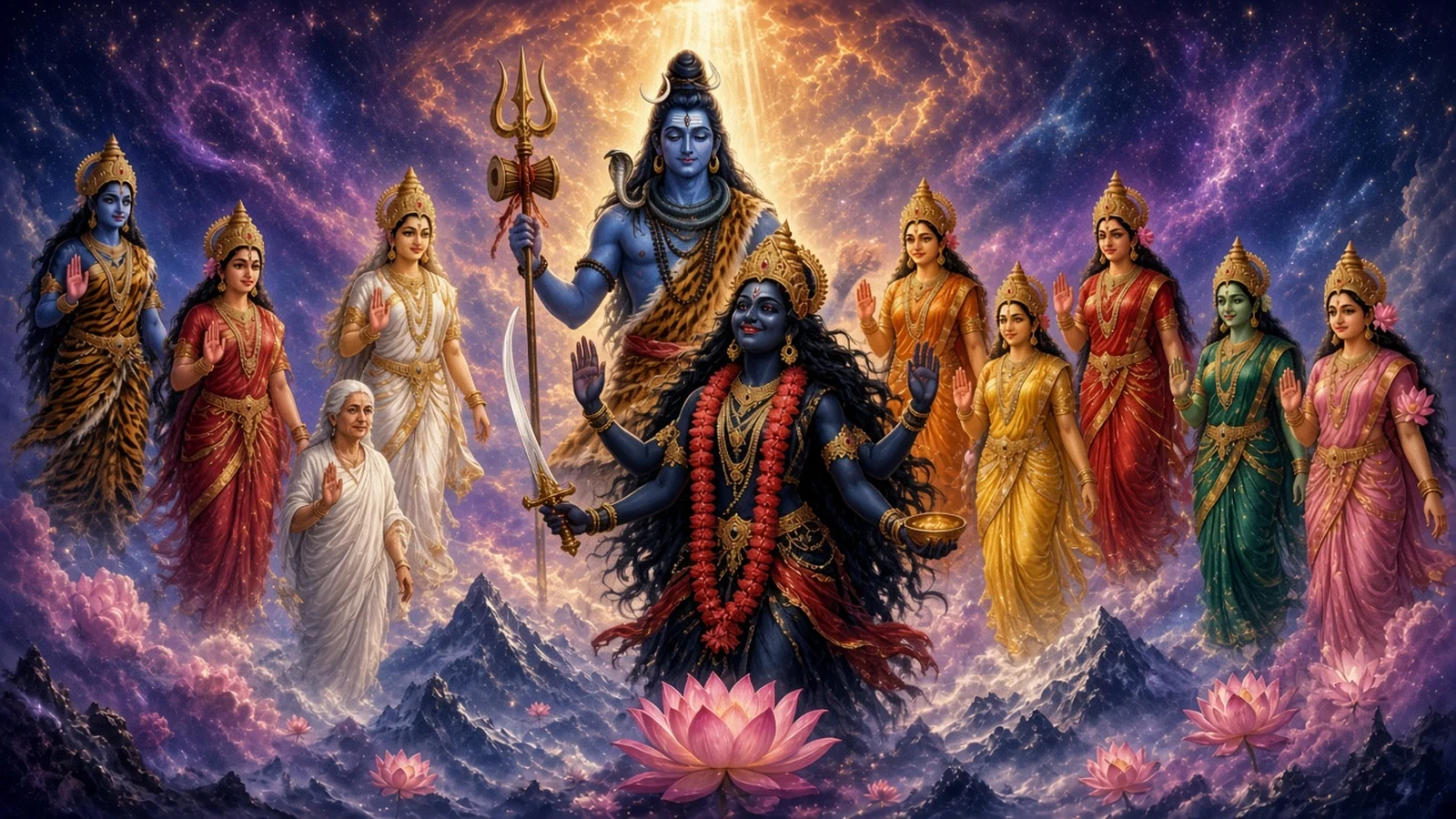
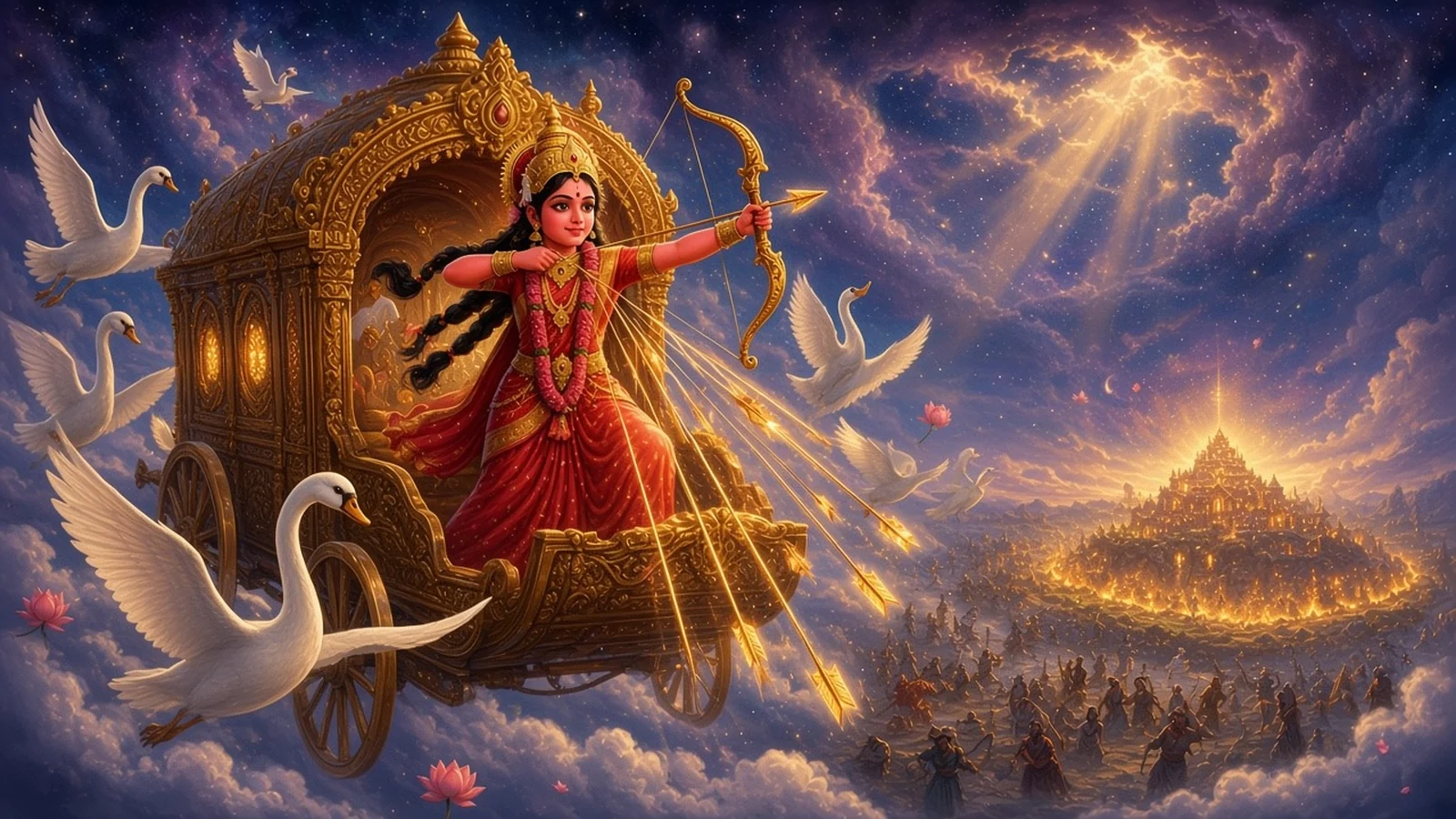
In the middle of the light turned a wheel of brightness, and in the middle of the wheel was a goddess. She shone like the rising sun. She was the red of the china rose, dressed in the colour of pomegranate flowers, and in her four hands she held a noose, a goad, a bow of sugarcane and five arrows. She did not speak. She only looked at the gods, and at her glance their wounds were gone and their bodies grew hard as diamond.
"Ambika!" they cried, and fell at her feet. "Mother, who gives everything!"
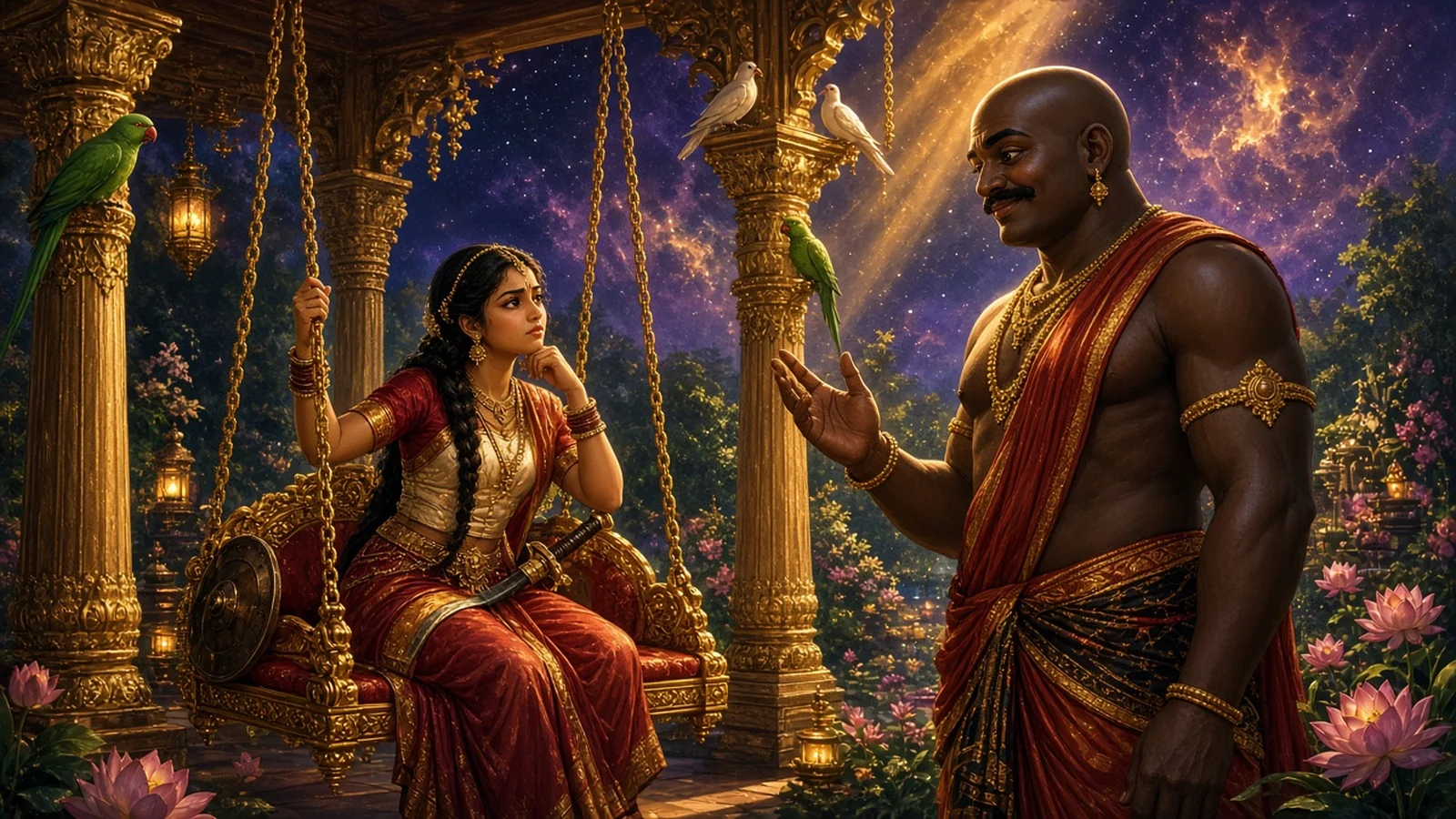
Brahma had Vishvakarma build her a city, with a throne of wish-granting stone at its heart. Then he thought, "A woman alone should not rule, nor a man alone. No one in the three worlds but Shankara can be her husband."
Shiva appeared before him in a form ten million times more beautiful than Kama's, and Brahma embraced the young hero and named him Kameshvara, the lord of love.
"I am my own mistress," said the Goddess. "The man I marry must match me."
But the gods begged her, and she threw a garland. It fell round Kameshvara's neck.
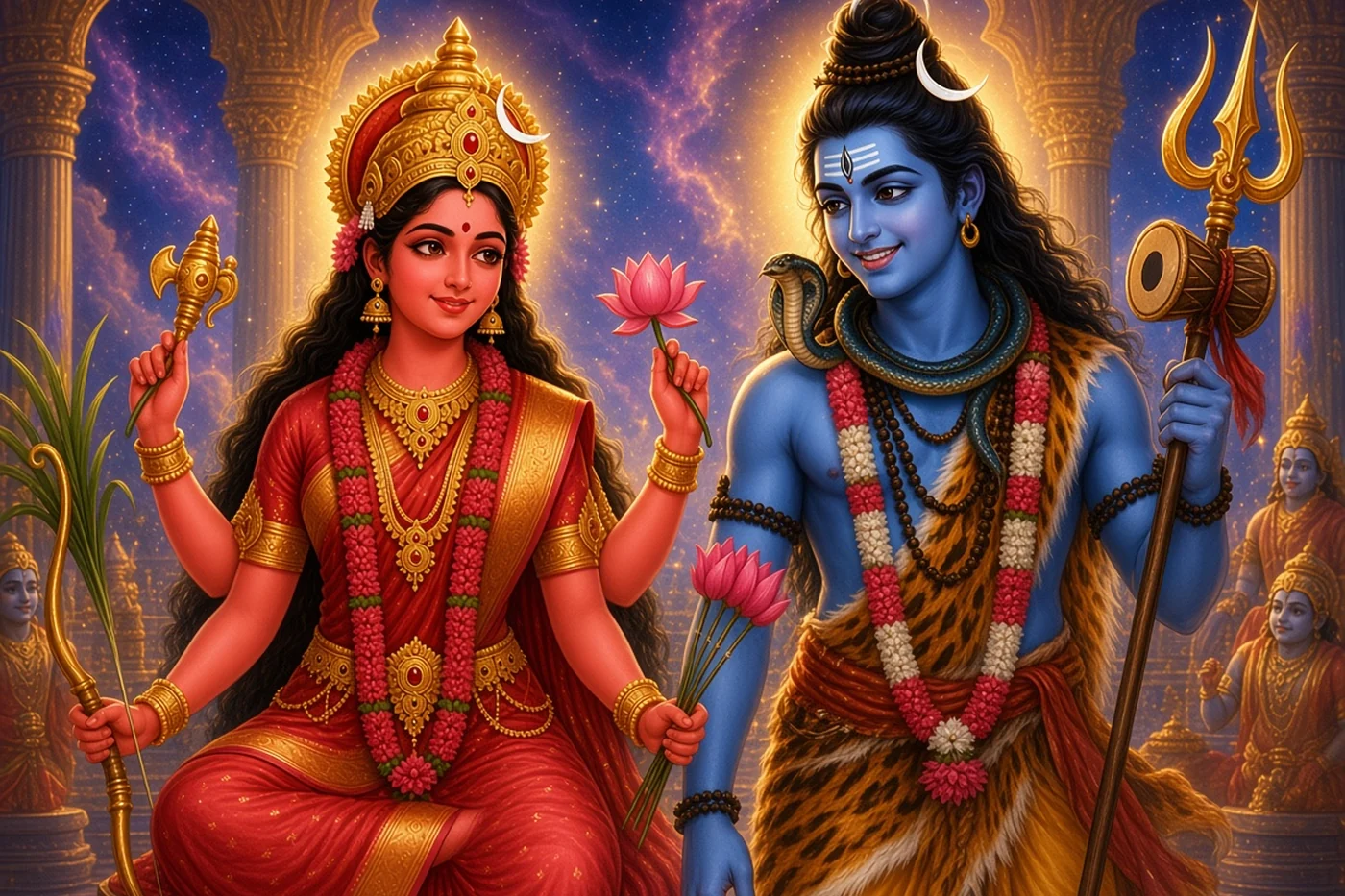
Vishnu gave her away. Brahma gave her a sugarcane bow that would never break, Vishnu flower arrows that would never fade, Varuna his serpent noose and Vishvakarma a goad. She sat on the throne beside Kameshvara, and Brahma named her Kamakshi and Kameshvari.
They ruled the three worlds together for ten thousand years. Then Narada came to her court.
"Bhanda is harassing the three worlds again," he said, "and he can be subdued by you alone."
As the thousand names tell it
Lalita Sahasranama, names 1 to 11, with Bhaskararaya's commentary of 1728 · 2 min read
The Lalita Sahasranama tells her whole story as a string of names, and after three titles it begins at the fire.
The first three names are Shrimata, the holy Mother; Shri Maharajni, the great queen; and Shrimat Simhasaneshvari, the empress on the lion throne. The fourth is Chidagni kunda sambhuta, born from the fire altar of consciousness. The fifth is Devakarya samudyata, risen for the work of the gods.
In 1728 the scholar Bhaskararaya finished a commentary on the thousand names, and he quotes the Lalitopakhyana as he read it. In his copy the man of ash is not shaped by Chitrakarma. Ganesha, the skilful worker, sees the ashes of the god of love and makes a handsome man of them, and Brahma, seeing it, says "well done, well done", which in the old words is bhanda, bhanda.
His quotation is plainer about the offering too. The gods gave the fire the flesh of their own bodies, and as they were about to give their bodies whole, a light appeared, bright as millions of suns and cool as millions of moons. In it was a wheel, which he names the Shri Chakra, and from its centre the Goddess rose like the morning sun.
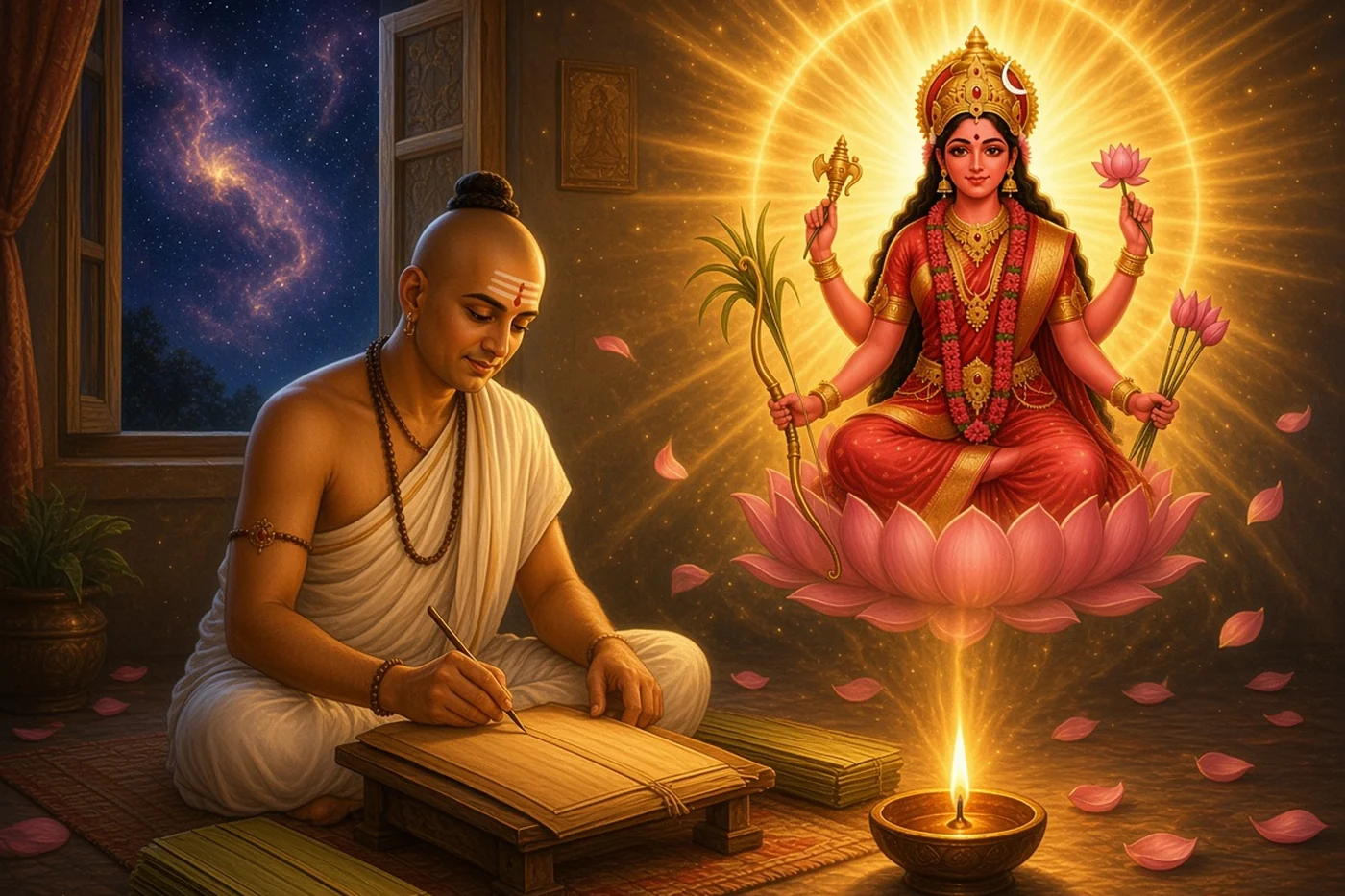
Then he stops to ask a question. How can a goddess who has no beginning be born? The fire, he answers, is consciousness, the fire that burns inside without fuel and eats up the dark. She was not born from it; she was always in it. The fifth name settles the doubt. She is said to be born whenever she comes out for the work of the gods, against Mahishasura in one age and against Bhanda in another.
Names eight to eleven give her the four things she holds, and the commentary reads each one inward. The noose is desire. The goad is anger. The sugarcane bow is the mind. The five arrows are the five subtle elements, sound, touch, form, taste and smell, that the senses take in. In the Purana they are wedding presents from Brahma, Vishnu, Varuna and Vishvakarma; in the hymn they are the powers of every person who sings it.