As the thousand names begin
Lalita Sahasranama, opening chapter, with Lalitopakhyana 5 · 3 min read
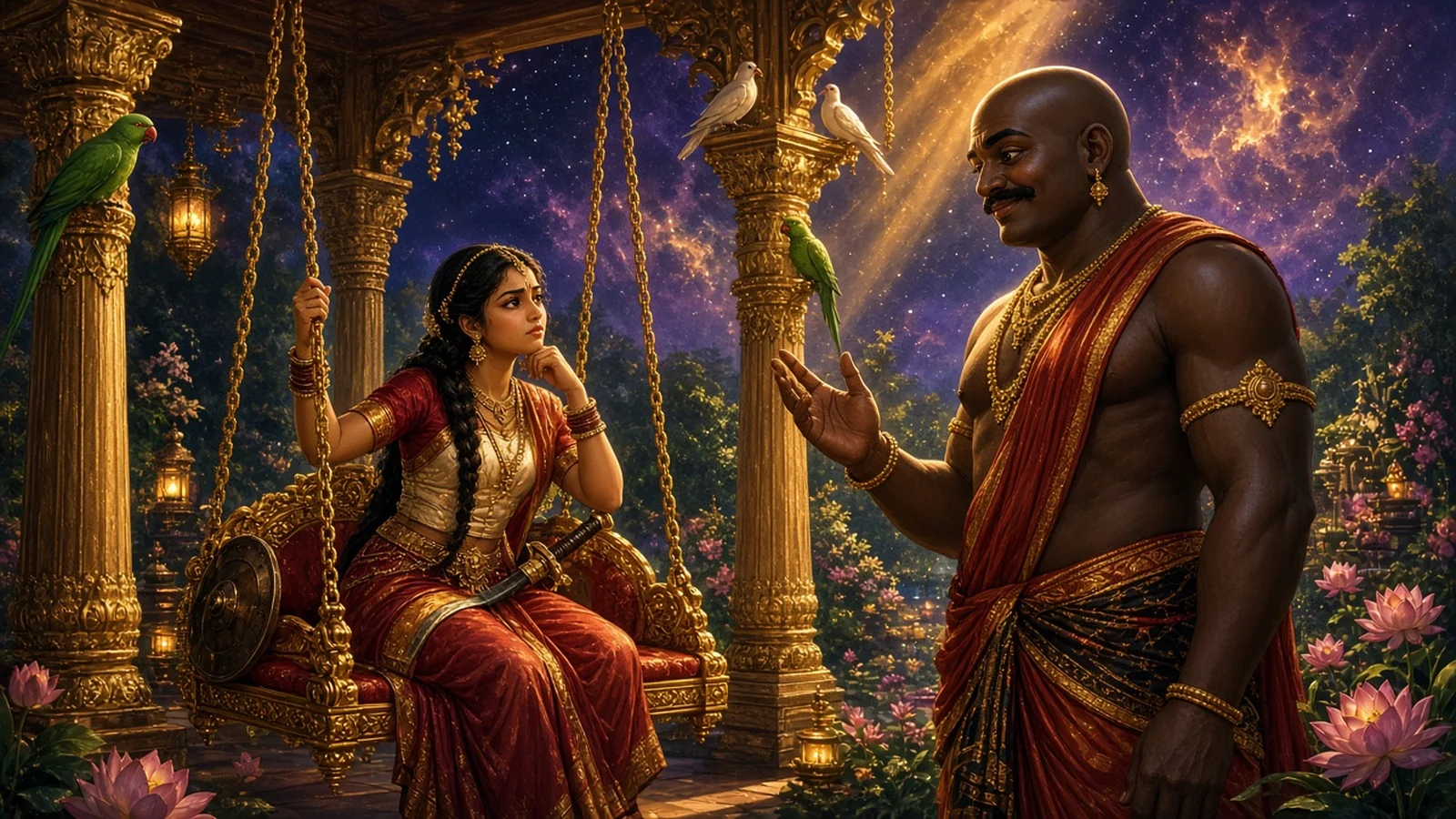
The sage Agastya had wandered from one holy place to the next, through mountains and forests and along sacred rivers. Everywhere he went he saw people lost in the dark, thinking of nothing but hunger and desire, and it troubled him.
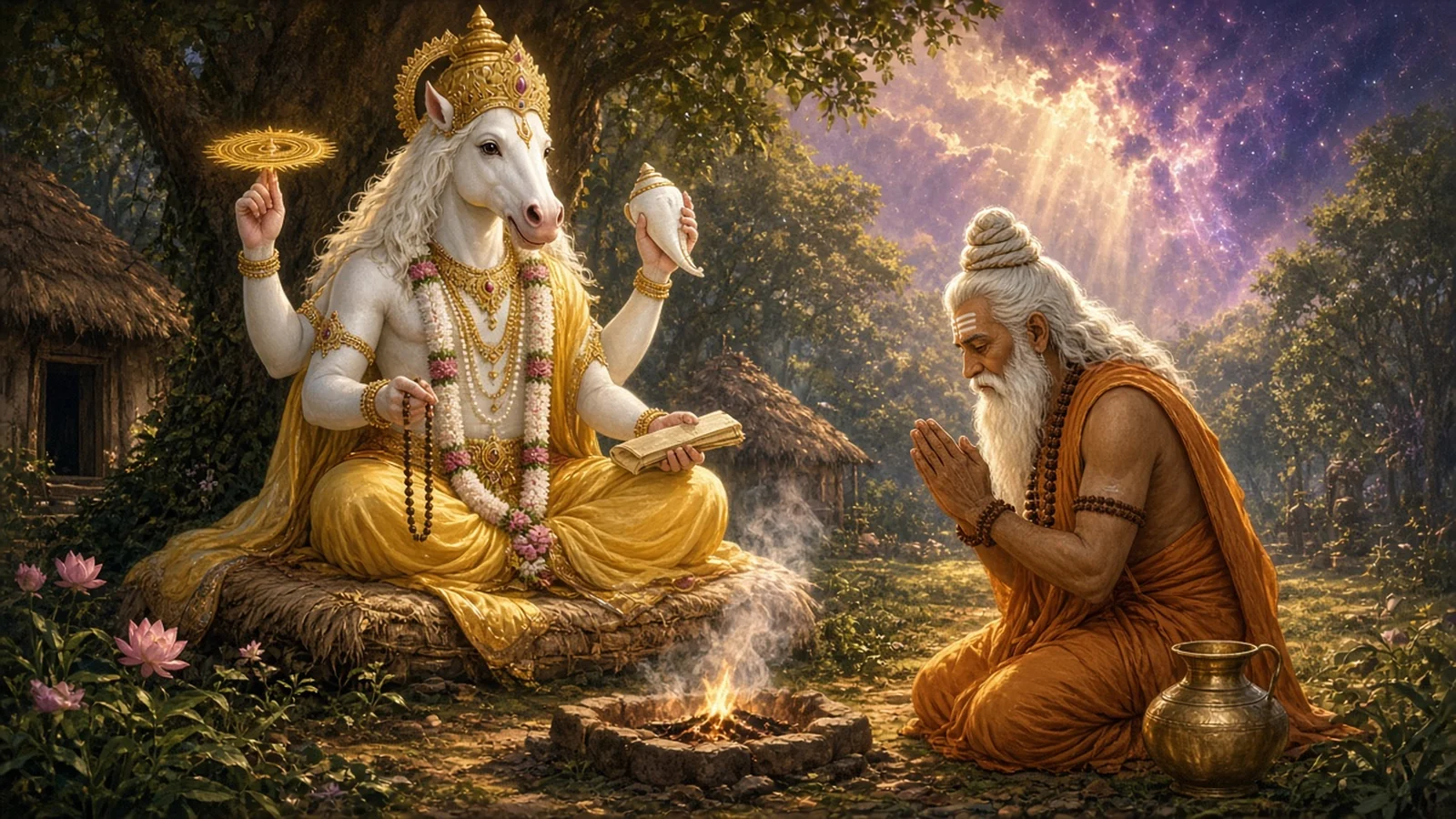
At last he came to Kanchi. He worshipped Shiva there and the goddess Kamakshi, and he kept up his penance until Vishnu came to him, in the horse-headed form of Hayagriva, holding a conch, a discus, a rosary and a book.
"I am pleased with you," said the god. "Choose your boon."
"How can such people be set free?" asked Agastya.
Through the worship of the supreme Shakti, the god told him, through Tripura. Then he said that Hayagriva would teach Agastya whatever he wished to hear, and vanished, and Agastya went home to his hermitage with Hayagriva as his teacher.
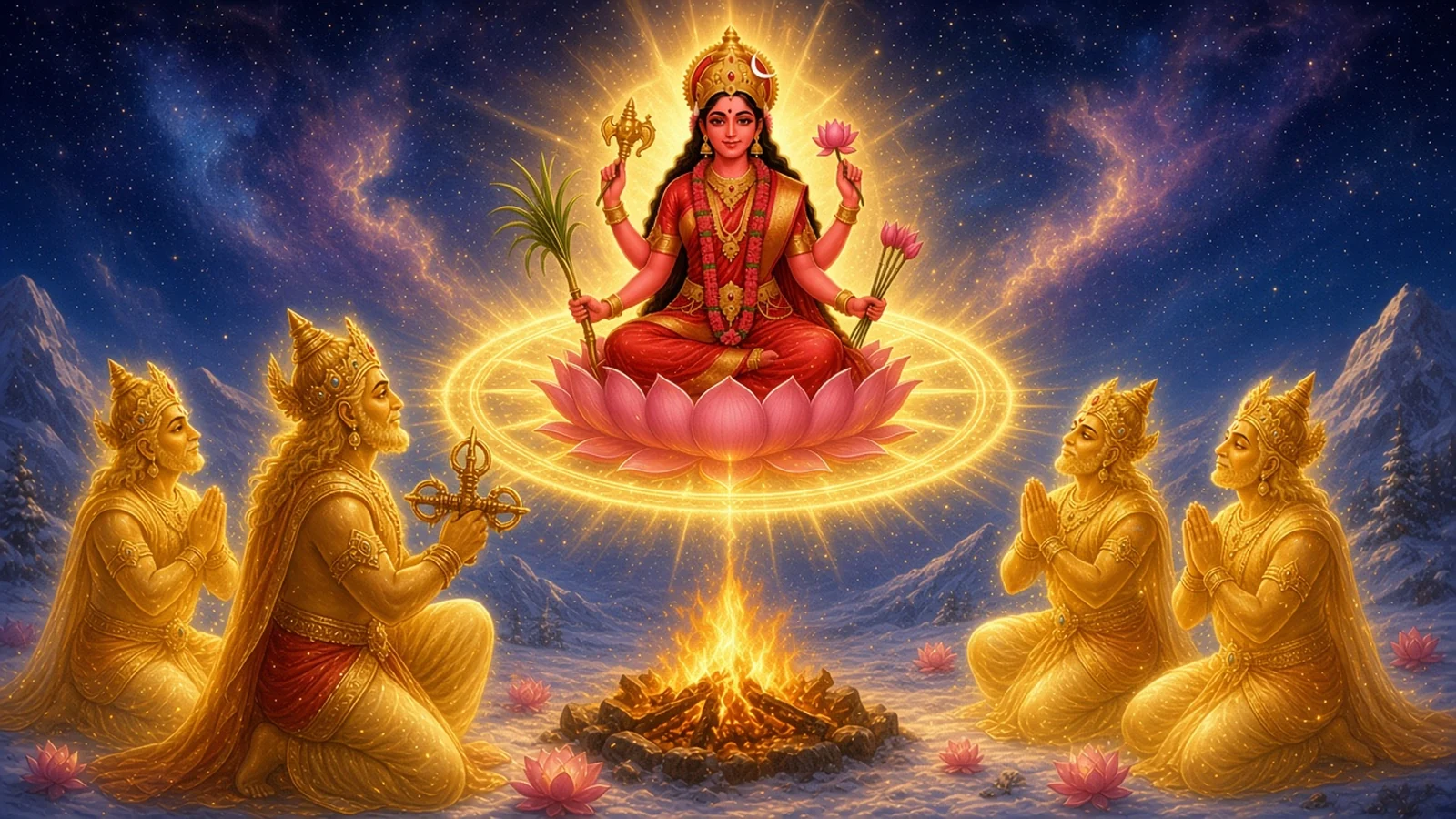
Hayagriva taught him for a long time. He told him the whole history of Lalita: how she rose from the fire, how she was crowned, how she killed Bhanda. He described her city, Shripura. He taught him her fifteen-syllable mantra, the ways of placing the gods on the body, the fire rites, the inner worship and the outer, and her hymns. He even taught him the thousand names of her two generals, Mantrini and Dandini.
And then he stopped.
Agastya thought about it for a long while. At last he asked.
"Horse-faced one, you know every science," he said. "You have told me the thousand names of Mantrini and of Dandini, but not the thousand names of Lalita herself. Did you forget them? Did you leave them out on purpose? Or am I not fit to hear them? Tell me why."
Hayagriva was delighted.
"Listen, husband of Lopamudra," he said. "I did not tell you only because they are secret. Now that you have asked with devotion, I will. A teacher may give even a secret to a pupil who loves the Goddess. But never give it to a cheat, or to someone without faith."
Bhaskararaya, who wrote on this passage in 1728, says the teacher had been waiting all along, because a secret must not be given until it is asked for.
Then Hayagriva told him where the names came from.
Once, wishing to do good to those who loved her, Lalita called the goddesses of speech, Vashini and the others.
"Your gift of speech comes from my grace," she told them. "You know the secret of my wheel, and you love my names. Make me a hymn of a thousand of them, so that when my people sing it, I am pleased at once."
So the goddesses of speech made the hymn.
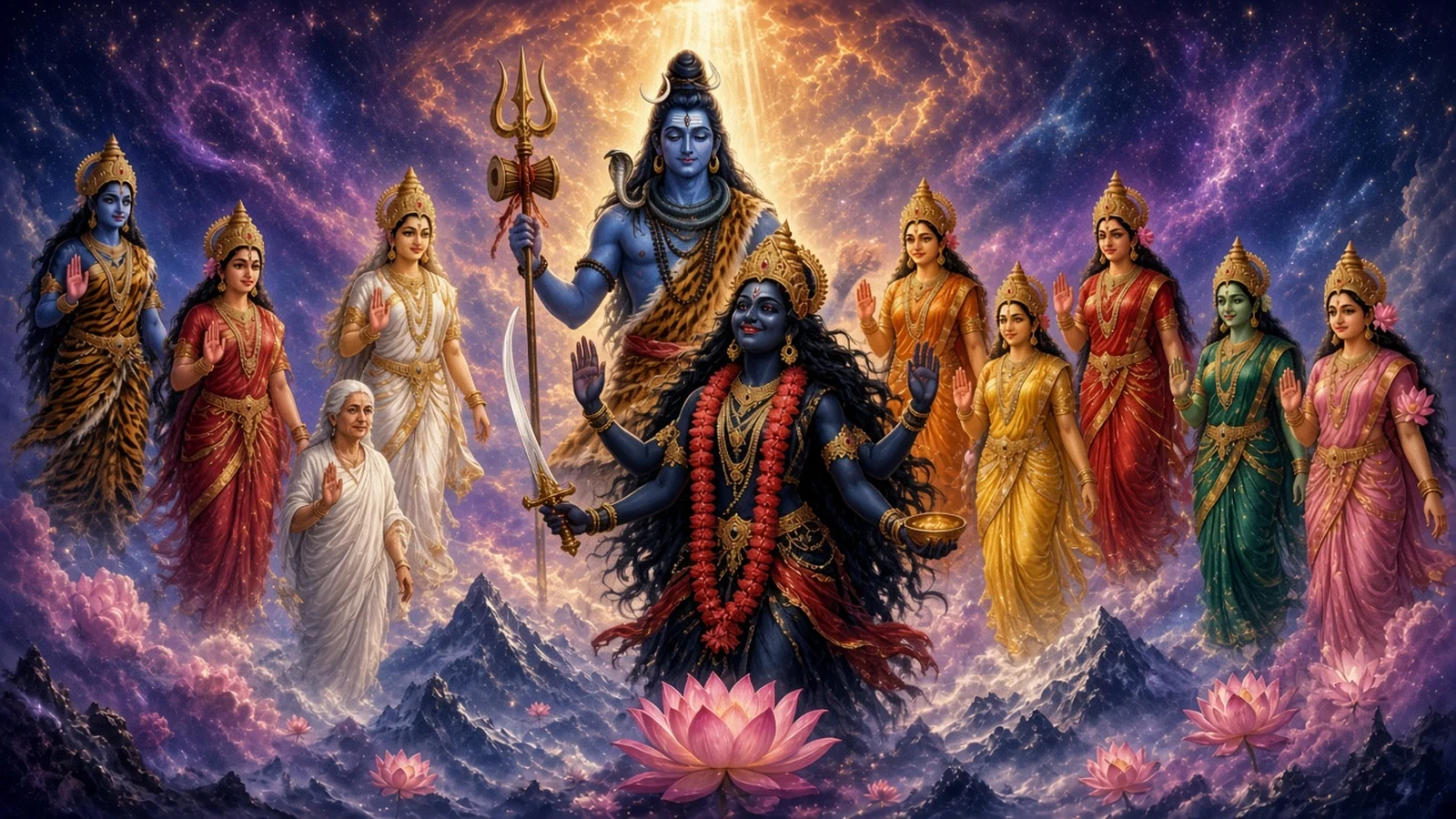
One day Lalita sat on her lion throne and gave audience to everyone. Crores of Brahmas came with their wives, crores of Vishnus with their Lakshmis, crores of Rudras with their Gauris. Her Shaktis came, Mantrini and Dandini and more than anyone could count, and gods and men and the perfected ones. When they had all bowed and taken their seats, Lalita glanced at the goddesses of speech.
Vashini and the others rose, folded their hands, and sang the thousand names they had made.
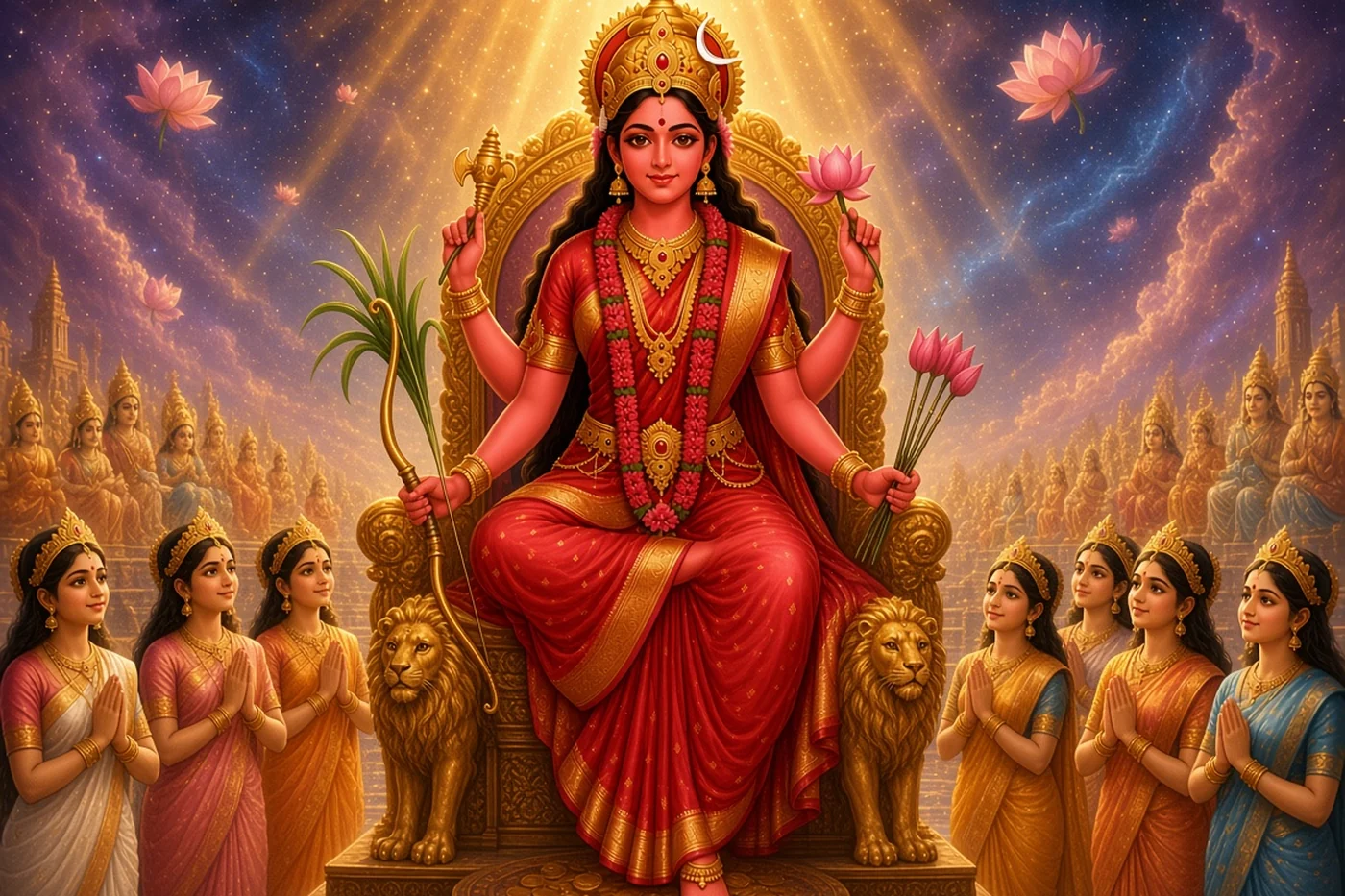
Lalita was glad, and everyone in the hall was amazed.
"The goddesses of speech made this hymn at my command," she told the gods. "Recite it always, and teach it to those who love me. Whoever sings it is dear to me."
From that day, said Hayagriva, Brahma, Vishnu and Shiva and all the Shaktis have recited it.
"Now listen," he said, and he began.
As Tirumeeyachur tells it
Lalithambigai temple, Tirumeeyachur, near Peralam, Tiruvarur district, Tamil Nadu · 1 min read
At Tirumeeyachur, a village a kilometre from Peralam in the Kaveri delta, the temple of Shiva as Meghanathaswamy keeps a shrine of Lalithambigai, and it tells its own story of the names: where they were first sung on earth, and why they were made at all.
After the war with Bhanda, the temple says, the Goddess was still furious. The demon was dead, but her anger went on. Shiva asked her to go down to earth, to take the name Manonmani and to do penance there. She came to this place, and here she grew soft and merciful again. And it was here, gentle now, that she made the goddesses of speech and asked them to praise her with a thousand names. That is why the hymn begins Shri Mata, the Mother.
Hayagriva taught Agastya the names and their greatness, and Agastya asked him where on earth he should chant them.
"Go where the Mother shows her grace under the name Manonmani," Hayagriva told him.
So Agastya came to Tirumeeyachur with his wife Lopamudra, and they sat before the Goddess and chanted the thousand names. She was pleased, and she showed herself to them in the form of the nine precious stones. Agastya answered with a hymn of his own, the Lalitha Navaratna Mala, the garland of nine gems.
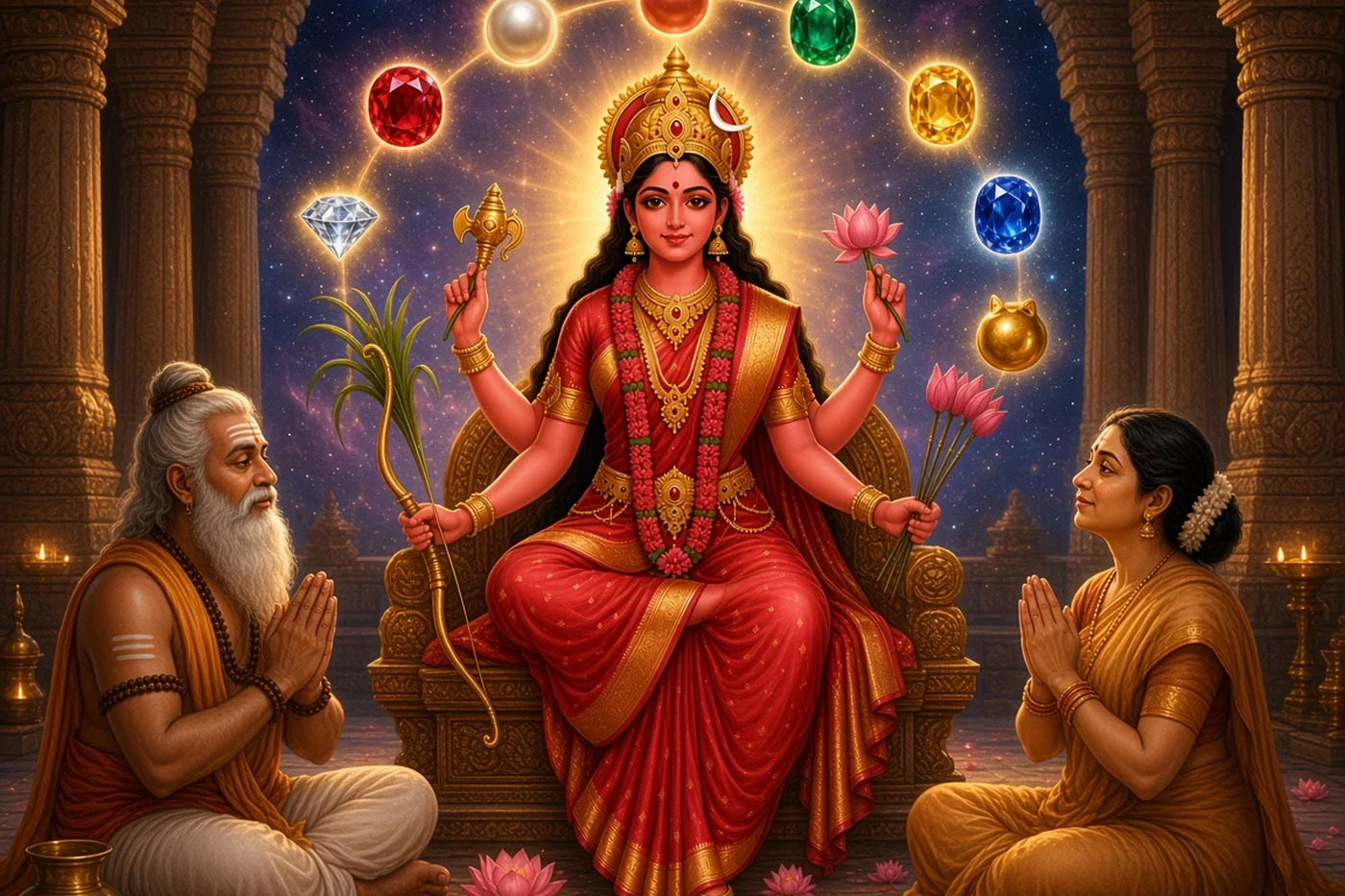
She sits there still as an empress on the Shri Chakra throne, her right leg folded over her left, her right hand raised to protect. People offer rice cooked with pirandai, a creeper the temple says Yama brought to earth, on a lotus leaf, and eat it afterwards as her blessing against illness.