As the Jagadhri play tells it
North India · the Bagar country and the road to Gajni fort · 3 min read
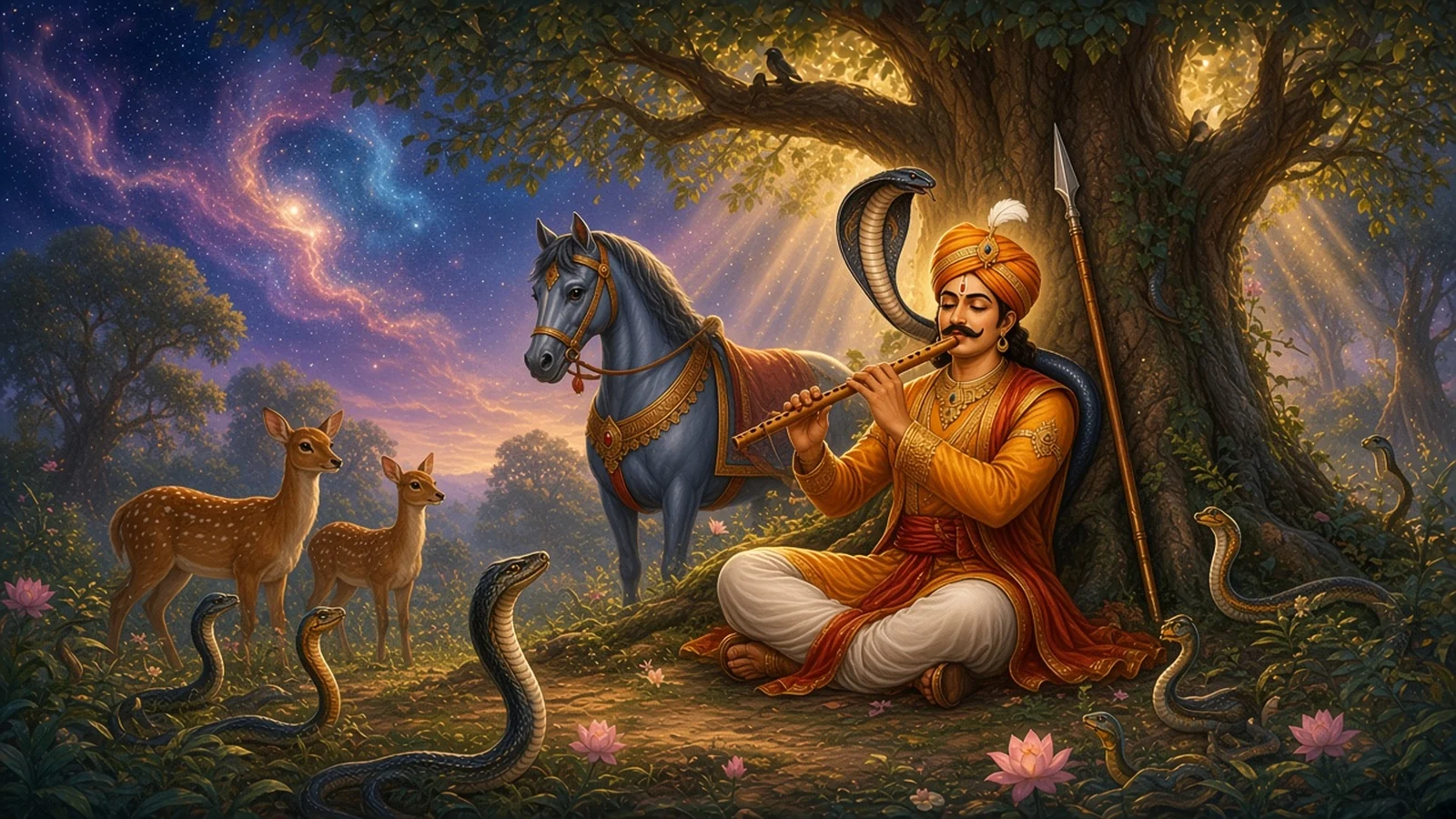
Raja Jewar of the Bagar kept the law and did no wrong, and still no child played in his courtyard. Queen Bachhal grieved like the water-bird that cries all night for its mate. "Who is to blame?" she asked him. "Fate has written it, and I cannot rub it out."
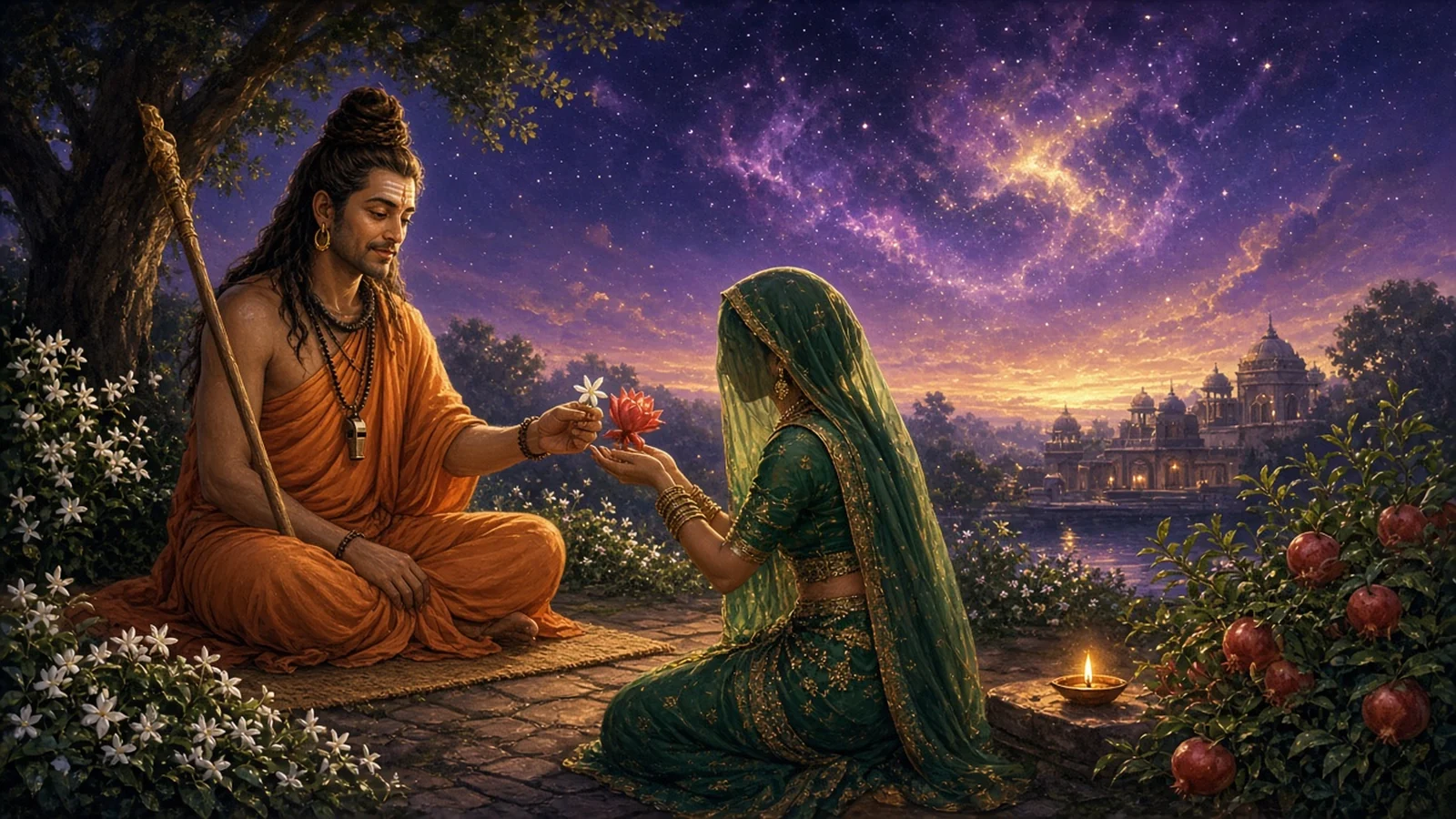
Then a yogi came and spread his mat in the palace garden, a man who shone like the sun. It was Gorakhnath. The king rode out to him with pearls and coral on a golden plate, and the queen came after with her offering. Gorakhnath only told her to go home and say God's name. Bachhal did not go home. She came back to him day after day with milk, and served him, and wept at his feet.
Her sister Kachhal watched all this. One morning, before the light, Kachhal put on her finest clothes and went to the garden first and knelt where the queen always knelt, and begged as the queen always begged. The yogi took two flowers from his wallet. "Go, lady. Two sons will be born to you. Now come here no more."
When Bachhal came later that morning with her cup of milk, he shouted at her. "I gave you two sons yesterday. Is there no end to your asking? Be off!"
"I have had nothing from you," said Bachhal. "I swear it."
Gorakhnath looked again, and saw what had been done. His anger turned. "Weep no more. Your son will be Prince Goga, brave and full of wonders from the day he is born, and kings will bow to him. As for the woman who cheated me, her sons shall have twelve years."
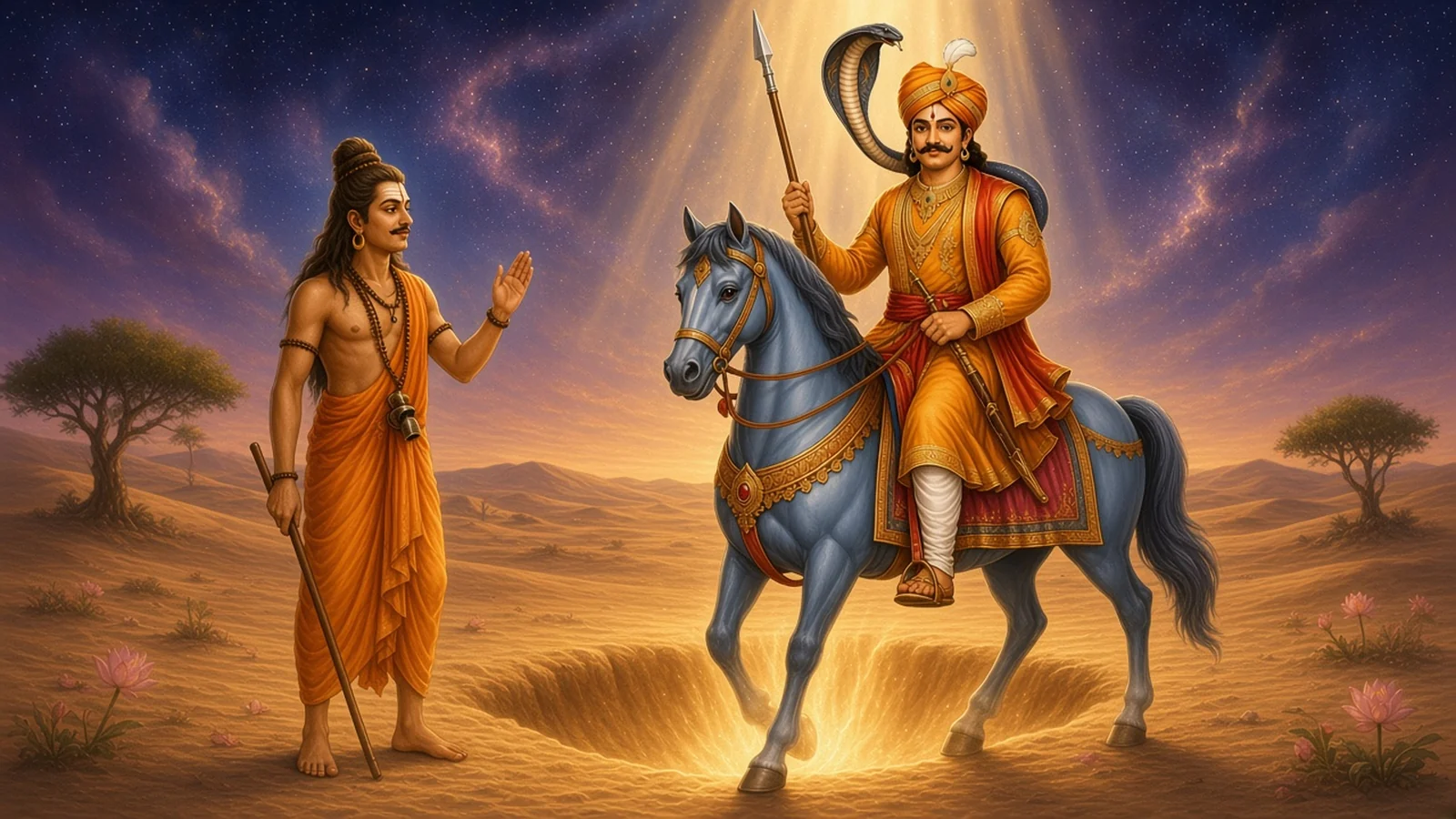
Joy did not last long in the palace. The king's sister came to him with a story: that the queen slipped out at night to feed the yogi in the garden, and the whole court was laughing at the Chauhans. Jewar took down his dagger. It would not leave its sheath, for Gorakhnath held it. So he sent his queen away instead, back to her parents in Gajni fort, in a bullock cart with a driver.
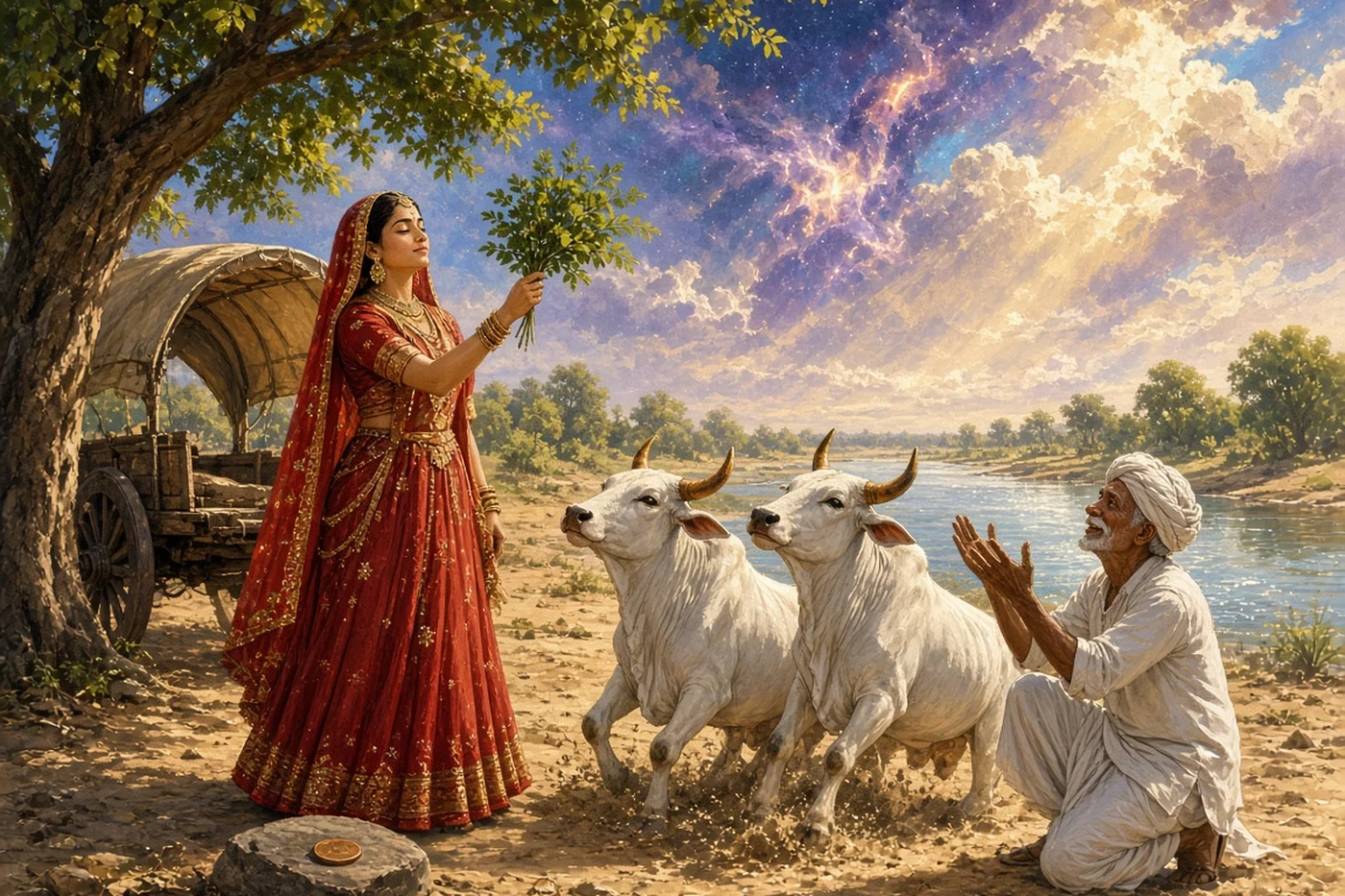
They stopped at a river in the heat of the day. The driver led the bullocks down to drink, and a snake lay on the bank. Both beasts fell and did not get up. The driver beat his head on the ground. Bachhal cried until she fainted, and in her faint she dreamed of a beautiful child who took her hand.
"Do not grieve, mother. Cut a branch from the nim tree by the cart. Lay down a coin for Gorakhnath and call on him. What is poison? It will go."
She woke, cut the branch, set down her coin and said the charms for the eight kinds of snakes. The poison left the bullocks in a moment. They lifted their heads and stood.
At Gajni her mother held her and asked why she had come uninvited. Bachhal told her. "And this is the twelfth month," she said, "and still the child is not born."
From inside her the child prayed. "Gorakhnath, my mother suffers for me. Show my father a sign."
That night Raja Jewar fell from his bed and lay senseless on the floor, and a voice told him that if he did not bring back his queen, sorrow would never leave him. His minister said the same. So the king worshipped Ganesha, set out for Gajni with elephants and palanquins, and brought Bachhal home. On the way a snake crossed the road on the left, and the priest called it a good sign. On the eighth of Bhadon, at midnight, Goga was born, and the whole Bagar sang.
As Rajasthan tells it
West India · Dadrewa in Churu district and the mound at Gogamedi · 2 min read
In Rajasthan the story is told with a fruit. Bachhal, the queen of Dadrewa, had tried everything for a child and was given nothing. She heard that Guru Gorakhnath sat in meditation on a sandy mound in the Bagar, the place that is now Gogamedi, and she went to him and served him.
"Mother," he said at last, "take this," and he put into her hand a fruit of the guggal tree. "Eat it, and you will have your son."
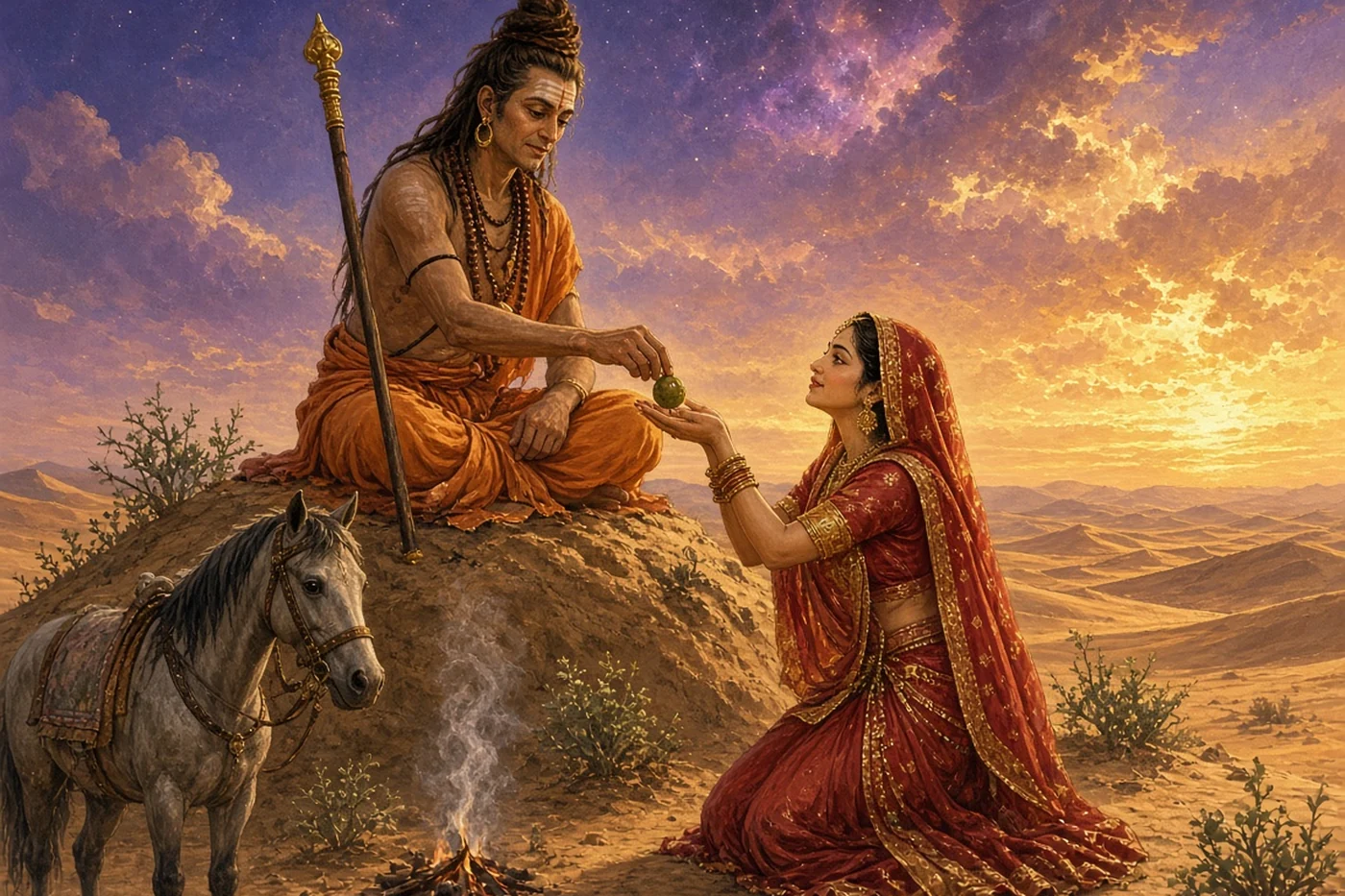
She ate it, and the child she carried was named Goga, for the guggal. Some say the boy spoke to her from the womb.
Others tell it with a trick, as the Panjab does. Bachhal's twin sister went to the saint first and was given the blessing meant for the queen. When Bachhal came, Gorakhnath gave her two sweets made of guggal instead. She shared them, and one piece went to her blue mare, who was in foal. "Your son," the saint told her, "will rule over your sister's two."
The old collectors heard yet another form of the gift. In the notes H. M. Elliot made in the 1860s, and in William Crooke after him, it is Goga himself, grown and childless, whose guardian god gives him two barley-corns: one for his wife, one for his mare. Some told Elliot the grains were given to Goga's mother instead. Either way the mare's foal was Javadia, the barley-born, the horse Goga rides to this day.
Where the mother has the gift, the rider and the horse come from one blessing. Goga was born at Dadrewa in Churu district on the ninth of the dark half of Bhadrapada, the day his people still keep as Goga Navami. At Dadrewa they show the old palace, the stable where his horse was kept, and an ashram of Gorakhnath.