As the Jagadhri play tells it
North India · from the Bagar to Dhupnagar across seven rivers · 3 min read
Far away, across seven rivers, Raja Sanja of Dhupnagar had a daughter, Siriyal, and he sent his priest out to find her a husband. The priest walked east, west, north and south for four months and came at last to the Bagar, where he put the betrothal mark on the forehead of young Goga, son of Raja Jewar. There was singing in every palace.
Then Raja Jewar died. A letter came from Dhupnagar soon after: Sanja would not make the match after all.
Goga found his mother tearing her hair. "Why are you weeping, mother? Has someone spoken evil to you?"
"Your betrothal is broken," Bachhal said. "I have no reason left to live."
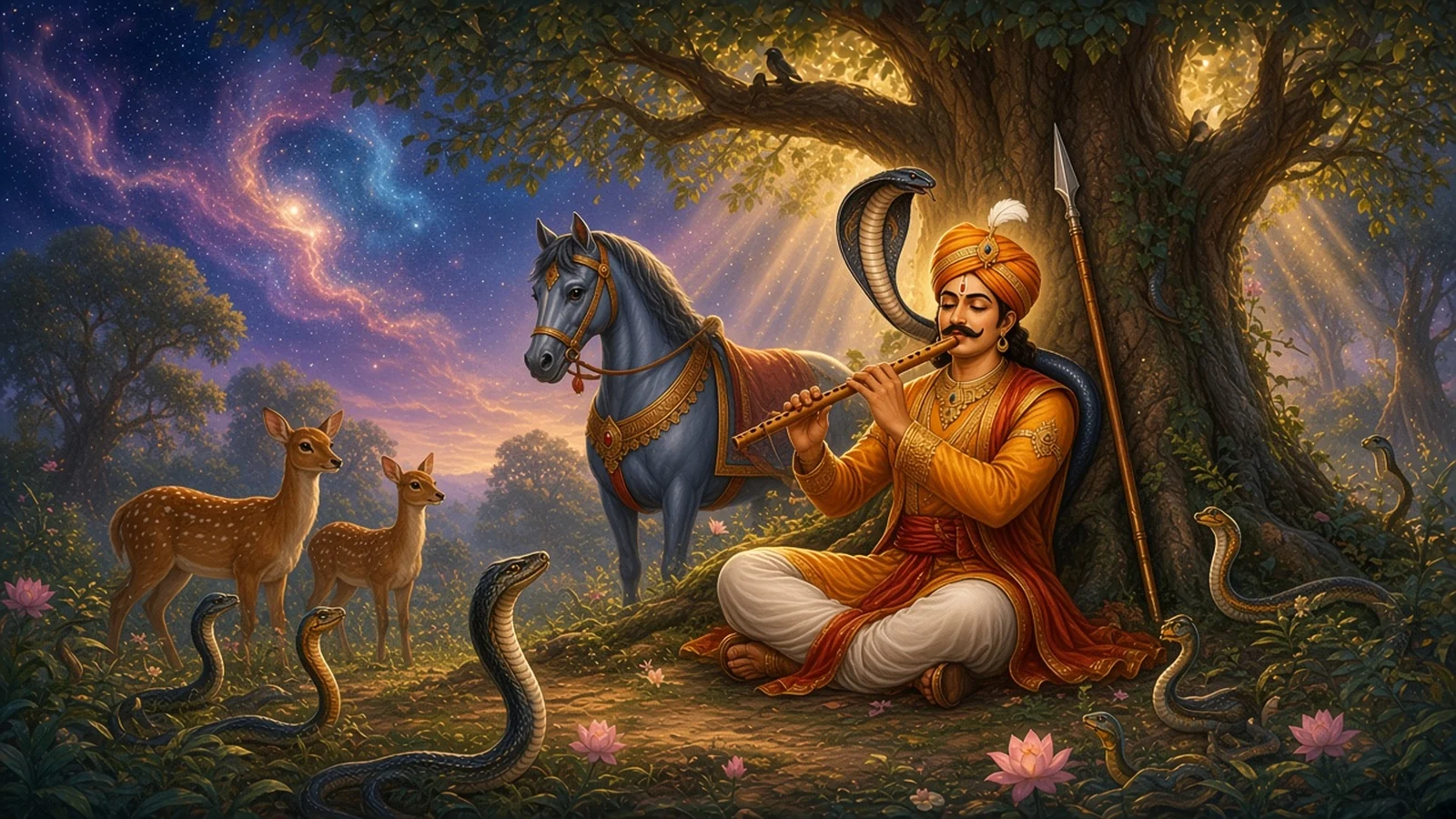
Goga said nothing. He walked into the forest, cut a reed and made himself a flute, and sat down under a tree with Gorakhnath's name in his heart. He played every mode there is. The birds and the deer came to listen. Then, one by one, the snakes of the world woke up.
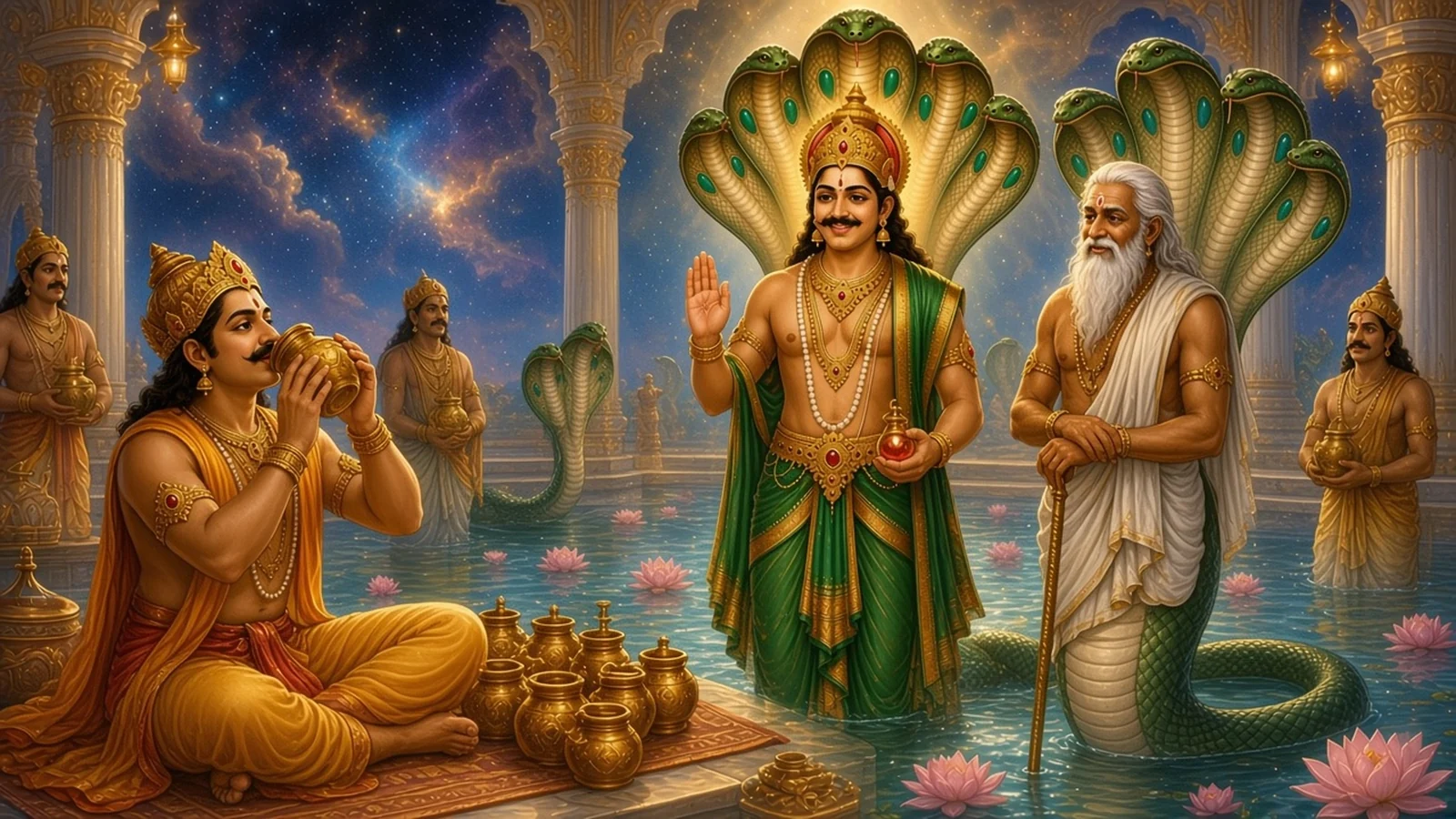
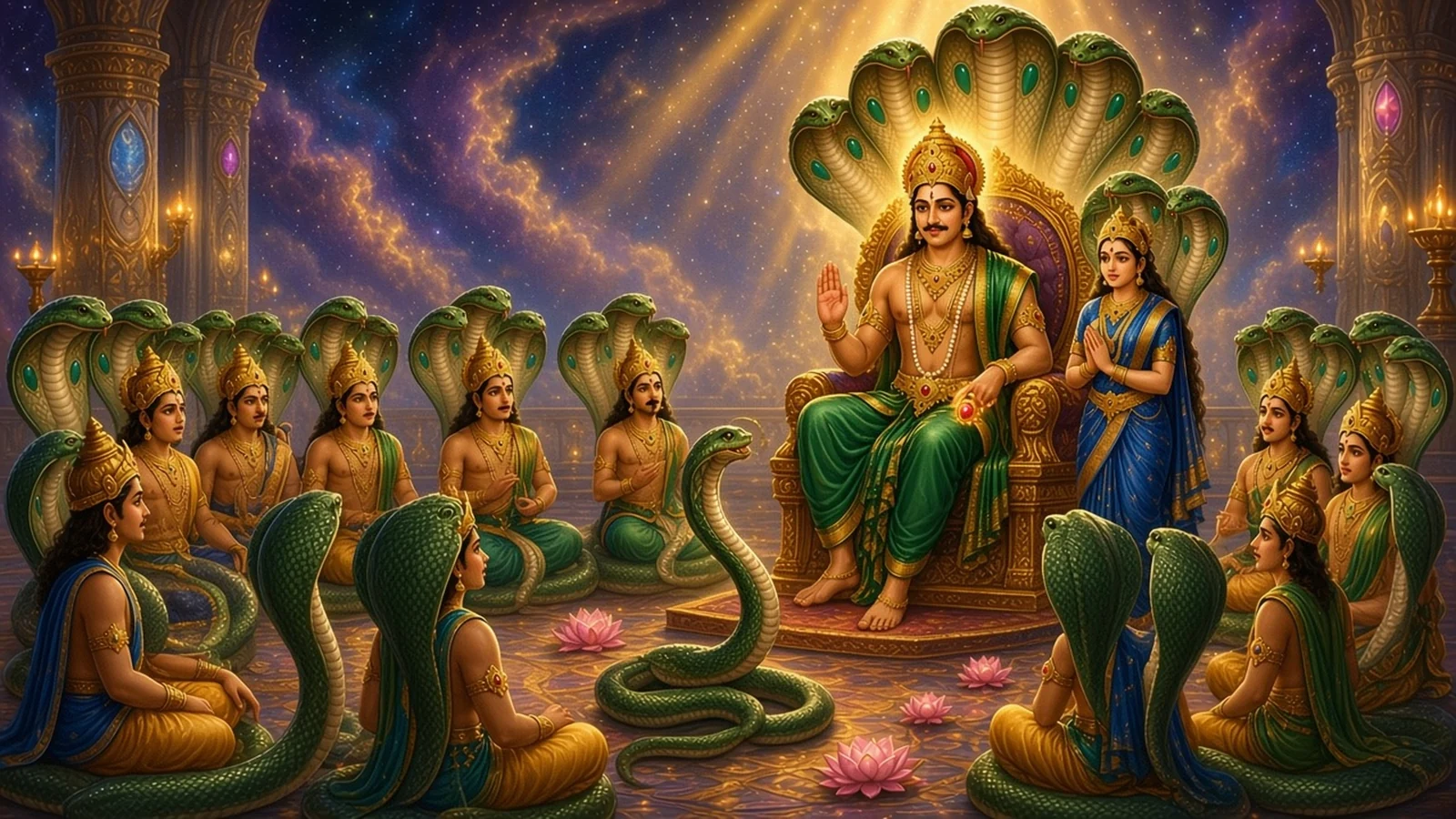
Deep below, Basak Nag, king of all the snakes, stirred in anger. "Who in the world has the power to wake the sleeping snake? Go and find out."
His servant Tatig went up and found the young man with the flute. "Who are you, and what is your caste? Speak, or I will breathe on you and burn you to ash."
"I am Goga, son of Raja Jewar. Gorakhnath gave me my name. My bride lives across seven rivers and her father has gone back on his word. I came to the forest to complain."
When Basak heard it, his anger left him. "He is Gorakhnath's dear disciple. Whatever he tells you, Tatig, do it."
So Tatig went to Dhupnagar. He laid down his snake's body and took the shape of an old Brahman, stick in hand, cloth on his shoulder, and lay quietly in the king's garden. Siriyal came into the garden with her seven companions, and had a maid hand the old man a ring. Later he slid up a branch as a snake to reach her, but she saw him and fainted with fright, and his chance was gone.
He waited. When the princess went down to bathe in the lake with her maidens, he slipped unseen into the water, and bit her on the toe.
The poison ran up through her body. They carried her to the palace and laid a shroud over her. Charmers came from every country, and none of them could help.
An old Brahman stopped a water-carrier in the street. "Why is the whole city weeping?"
"The princess has been bitten by a snake," she said.
"Tell the raja a charmer has come. Poison does not stay where I am."
Sanja sent for him at once, and Tatig was led to the bed. But before he touched her he asked for one thing: a promise, in writing, that Siriyal would marry Goga. Sanja wrote it. Then Tatig took a branch of nim, said his charms, put her toe to his mouth and drew the poison out. Siriyal sat up.
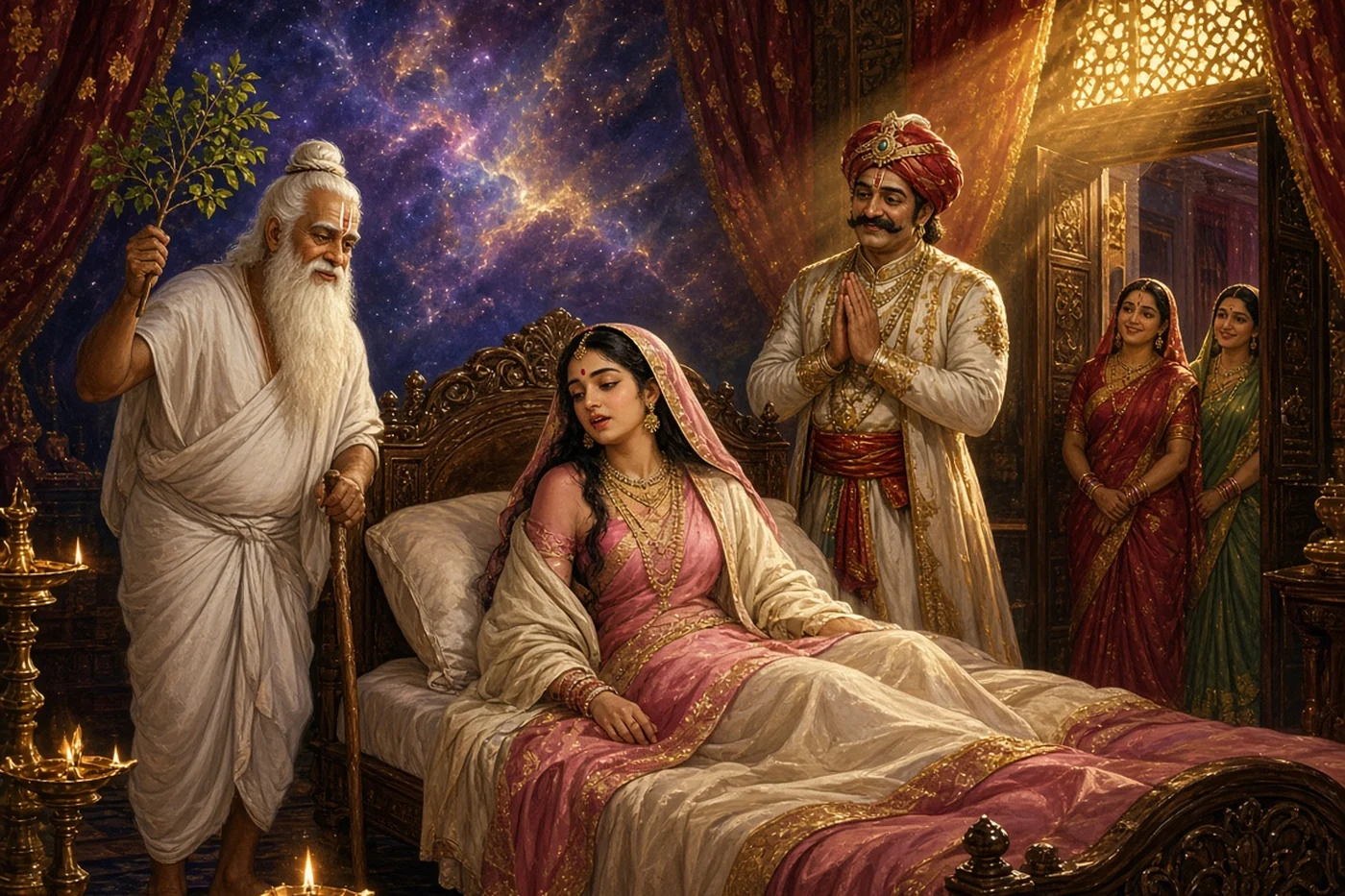
"In seven days," said her father, "the wedding."
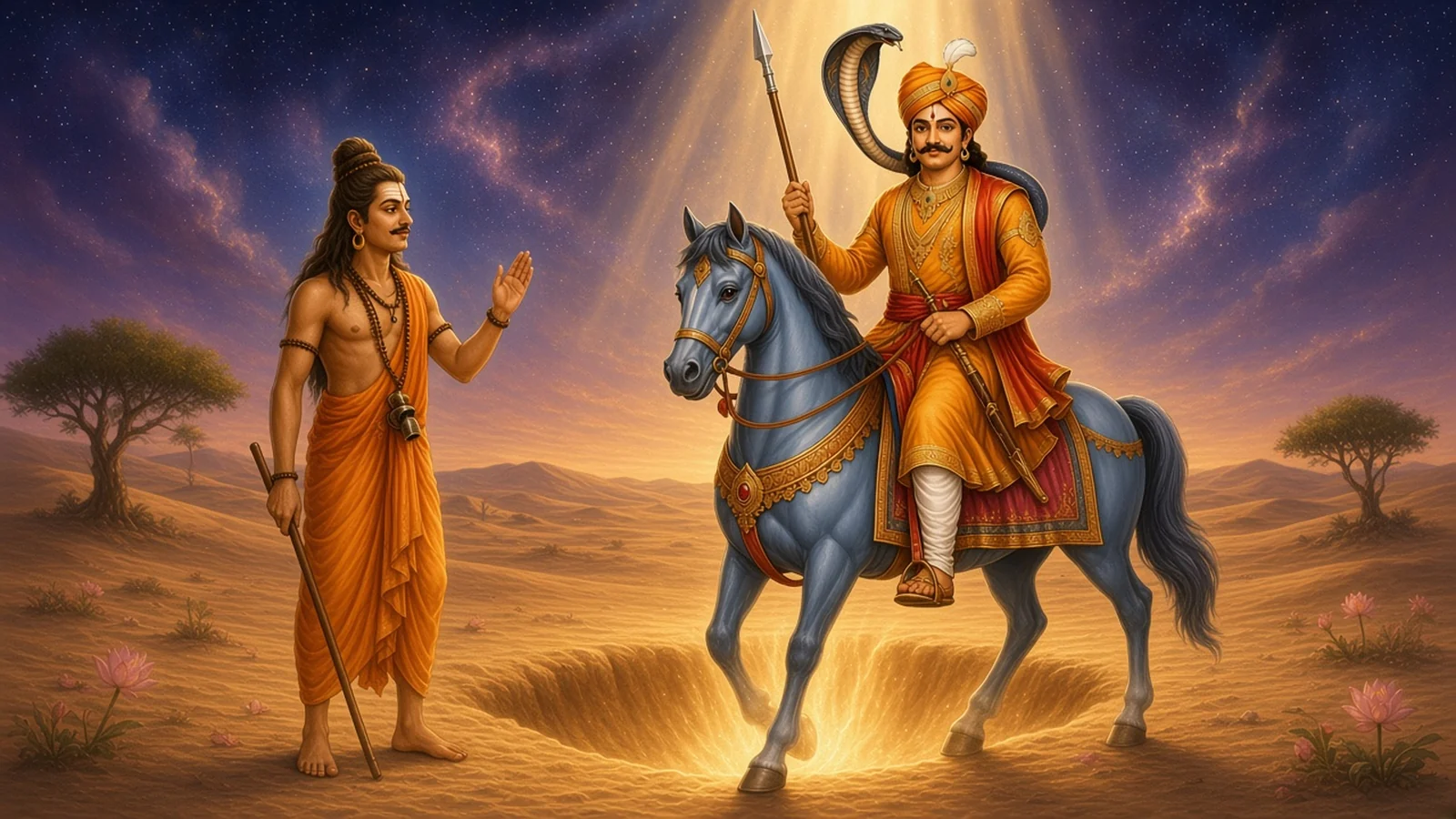
Seven days to cross seven rivers. Goga lay on the ground in despair until Gorakhnath came. "Get up, foolish boy. Bathe and dress." In the twinkling of an eye the wedding party was standing in the fields of Dhupnagar, elephants and palanquins and yogis blowing conches. Sanja, astonished, laid a plate of jewels at Gorakhnath's feet. Ganesha was worshipped, the women sang, and Siriyal wept as she held her mother. Then the saint brought her home to the Bagar and set her before Bachhal. "Here is your son's bride. Your sorrow is over."
As the epic of Pabuji tells it
West India · the holy lake at Pushkar and Pabuji's country in Marwar · 1 min read
In the desert villages of Marwar the Bhopa priests sing Pabuji's epic all night before a great painted cloth, the phad, the Bhopa pointing out each scene with his stick while his wife lifts a lamp to it. They tell the wedding as part of their own hero's story, and here Goga is called Gogo the snake god.
Pabuji, the Rathore hero, had gone to the holy lake at Pushkar to wash away the blood of a battle. As he bathed, his foot slipped and the water took him under. Gogo Chauhan pulled him out.
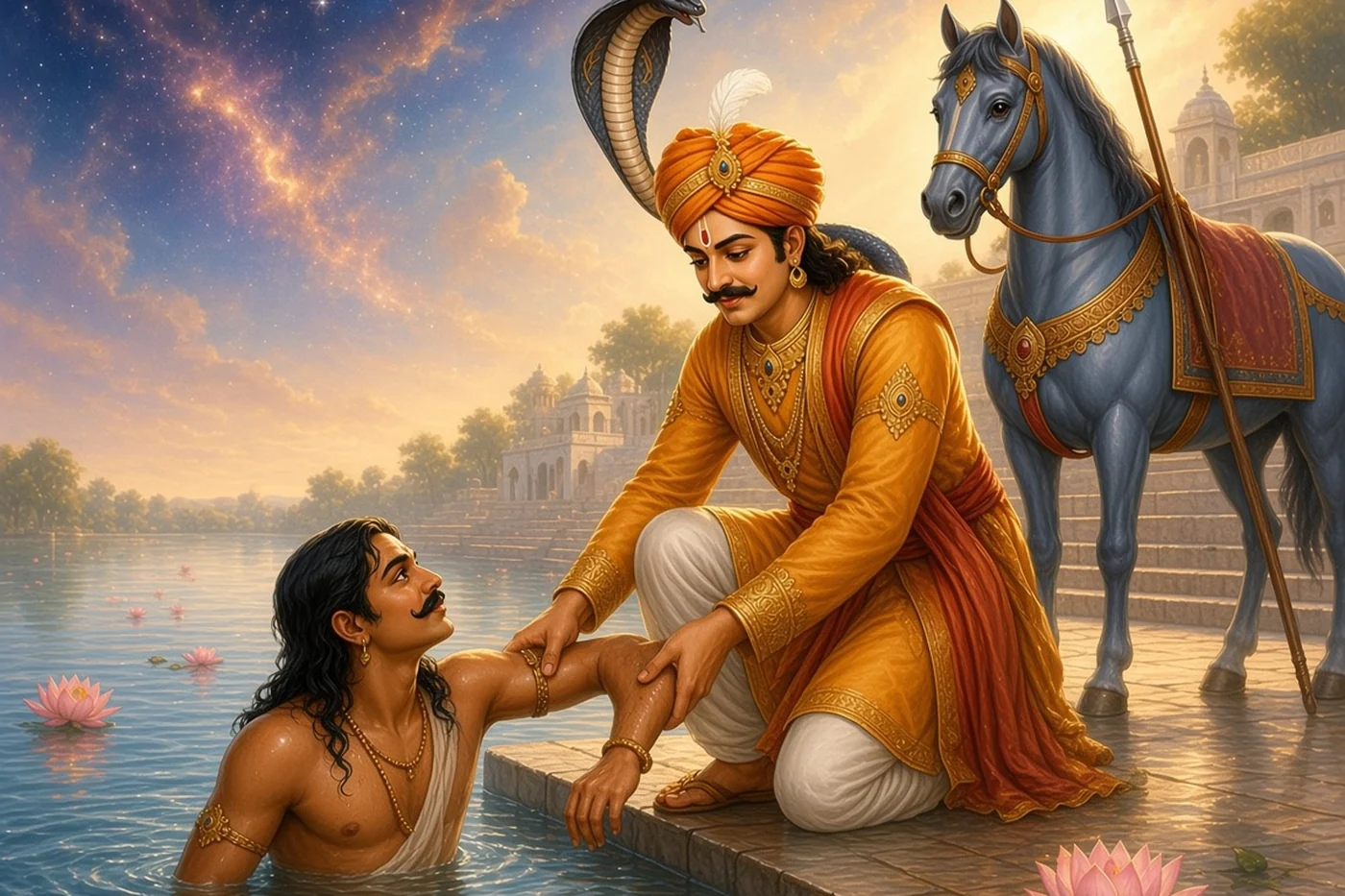
"You have given me my life," said Pabuji. "Take my niece Kelam for your wife."
Gogo accepted. But Kelam was the daughter of Pabuji's brother Buro, and her parents would not hear of it. So Pabuji thought of a plan, and Gogo agreed to it.
Gogo turned himself into a snake and hid in the garden. When Kelam came out to swing, he bit her on the little finger.
The healers came and tried everything they knew, and none of it worked. Then Pabuji spoke. "Tie an amulet on her arm in Gogo's name, and she will be well. But if it cures her, she must marry him."
They tied the amulet, and Kelam was cured, and so the wedding had to go ahead.
At the wedding Pabuji made the bridegroom a promise of his own. "I will give you she-camels," he told the bridegroom, "taken from Ravana, the king of Lanka."
The whole wedding laughed, for nobody could reach Lanka. Later, when her husband's people mocked Kelam for camels that never came, she wrote to her uncle and begged him to keep his word. That promise is the start of another long story, which belongs to Pabuji.