As the Brahmavaivarta Purana tells it
Brahmavaivarta Purana, Krishna Janma Khanda 51 · the road to Kailasa · 4 min read
Krishna tells this story in the Brahmavaivarta. Dhanvantari, he says, was a portion of Narayana, the one who rose out of the ocean of milk when it was churned. He knew every Veda and every use of mantras. His teacher was Garuda, the great eagle, and Garuda's teacher was Shiva.
One day Dhanvantari set out for Kailasa with a thousand pupils behind him, and on the road they met Takshaka. The serpent king came at them, tongue flickering, with a lakh of snakes around him, angry enough to eat them all. Dhanvantari looked at him and laughed.
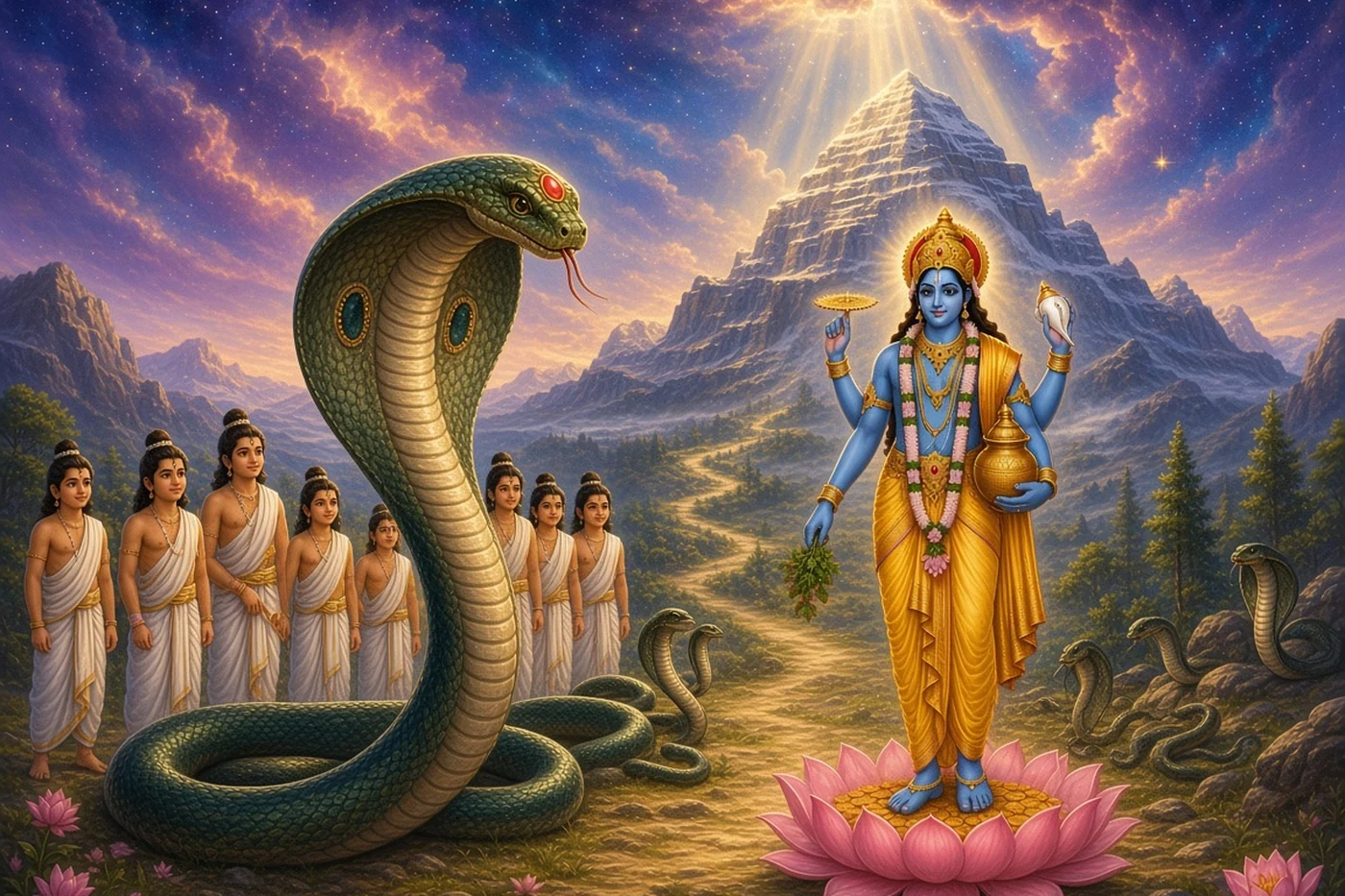
One of the pupils was a proud young man. He caught Takshaka with his hands, spoke a mantra over him, and the great snake went limp, his poison gone. The pupil pulled the priceless jewel from Takshaka's head, whirled him round and flung him far down the road. Takshaka lay in the dust as if he were dead, and his followers ran to Vasuki.
Vasuki blazed with anger. He sent out snakes beyond counting under five captains, Drona, Kaliya, Karkota, Pundarika and Dhananjaya. The snakes only breathed, and the wind of their breath laid the thousand pupils on the ground, senseless.
Dhanvantari thought of his teacher. He rained nectar over his pupils and spoke the mantras, and they sat up. Then he turned the mantras on the snakes, and the whole host fell stiff on the road, with not one left to carry the news.
Vasuki knew it all the same. He called his sister Manasa.
"Come," he said. "Save the snakes from this. Do it, and you will be worshipped in all three worlds."
Manasa laughed. "I will go. Whom I strike, who can save? Shesha taught me Narayana's own mantra, and Shiva taught me the science of mantras. Garuda is Shiva's pupil too, and I do not count him. This Dhanvantari is only one of Garuda's pupils. Why should I count him?"
She bowed to Vishnu, Shiva and Shesha, and went alone.
Dhanvantari was standing calm and smiling when she came, her eyes red. With one glance she brought every snake on the road back to life. With another, a glance of poison, she laid his pupils flat. He spoke his mantras over them, and this time they did not stir.
"Tell me, master," said Manasa, "do you know what a mantra means? How it is built? Do you know the great medicine? You are Garuda's pupil. Garuda and I had the same teacher, and I have been learning for an age."
She breathed a mantra into a lotus and threw it, and it came at him like a flame. He threw a fistful of charmed dust, and the lotus fell as ash. She hurled a spear as bright as the summer sun, and he cut it in two with the trident Vishnu had given him. She threw the serpent noose, alive with a lakh of snakes. He smiled and thought of Garuda, and the eagle was there, long hungry, and ate the noose. She threw a fistful of ash that Shiva had given her, and Garuda, keeping the physician behind him, blew it away with his wings.
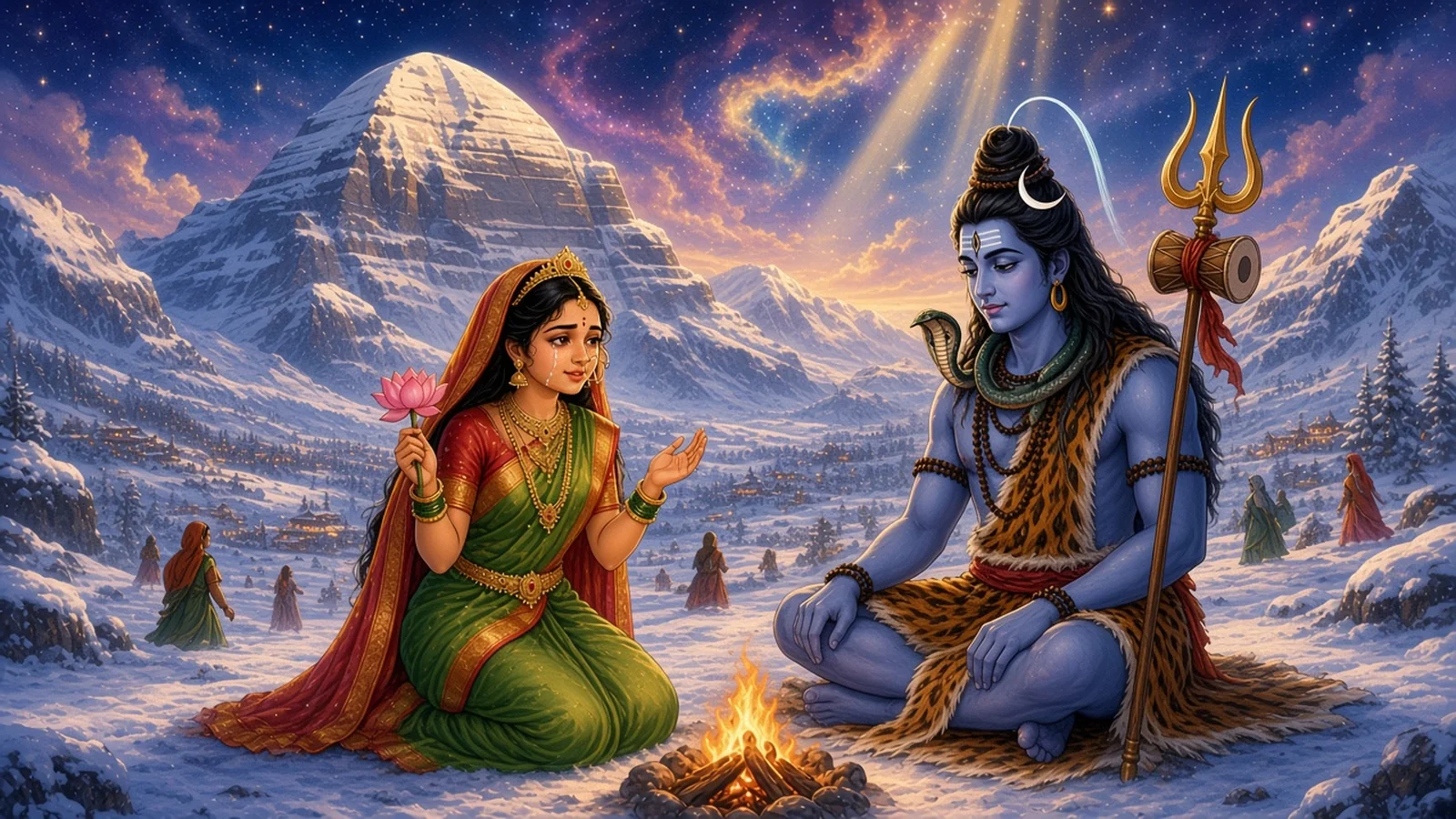
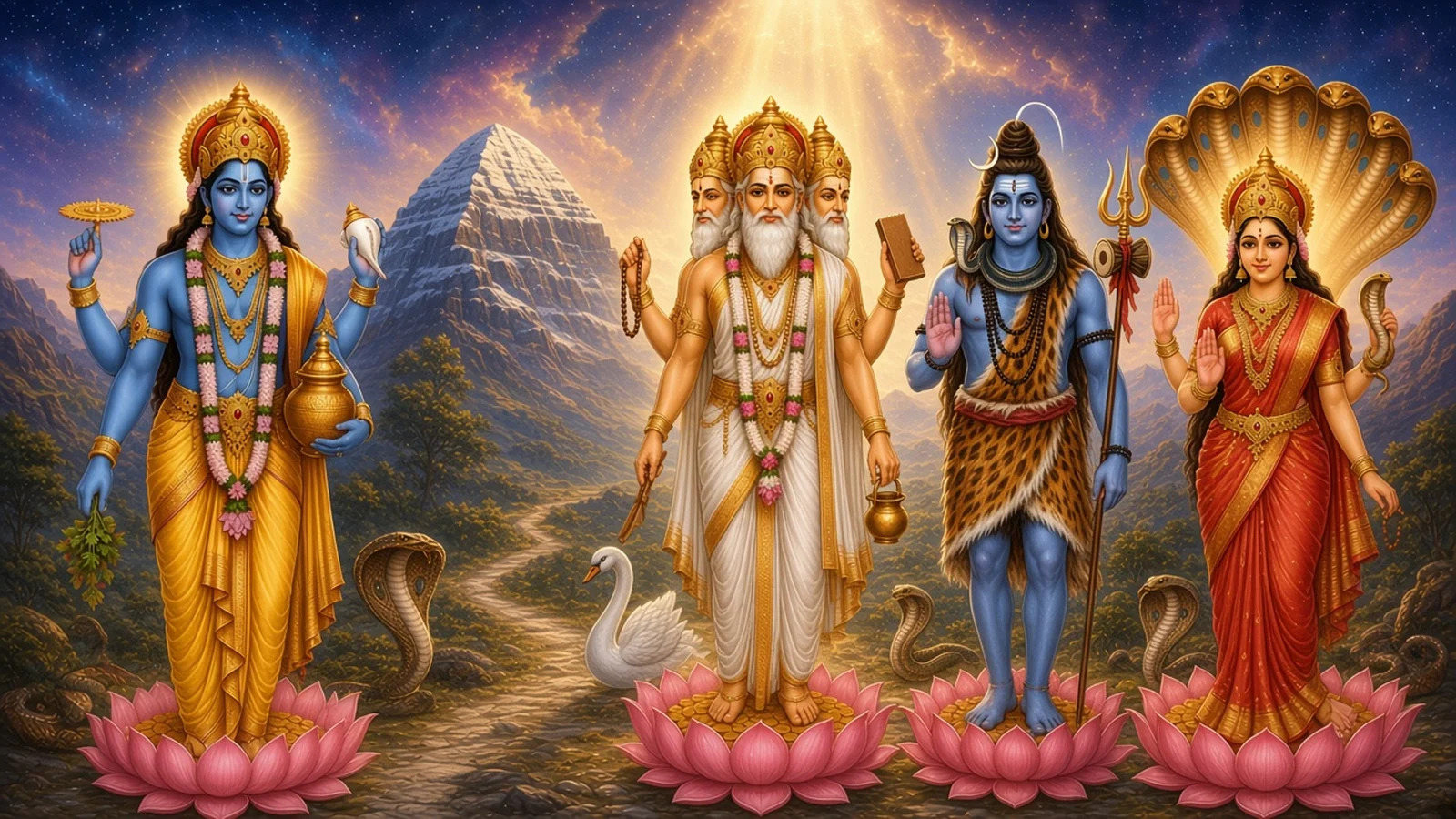
Then Manasa raised the trident Shiva had given her, the one that never misses, bright as a hundred suns, to kill Dhanvantari. At that moment Brahma and Shiva stood on the field.
They all bowed, Manasa with the trident still in her hand. Then Brahma spoke to the physician.
"This is no fair fight," he said. "With that trident she could burn the three worlds. Worship her instead. Make the sixteen offerings, meditate on her as the Kauthuma branch of the Veda teaches, and praise her with Astika's hymn. She will be pleased with you."
Shiva agreed, and Garuda said the same. So Dhanvantari bathed, and with Brahma as his priest he called her. He held a white flower and saw her in his mind, golden as the champak, smiling, riding a king of snakes. Then he praised her: honour to her who is success itself, to Kashyapa's daughter, to the mother of Astika.
Manasa was pleased. She gave him a boon and went home. The gods went home, Dhanvantari to his own house, and the snakes went off rejoicing, their hoods shining.
As Bipradas's Manasa Vijaya tells it
Bengali Manasamangal, 1495 · Champaknagar · 2 min read
In the Bengali poem of Bipradas the physician rose from the churning with a cup of amrita, and Brahma paid him for it with two gifts, a scarf of victory and a magic pouch. He would be remembered, Brahma said, as the poison doctor no one could match. Dhanvantari asked one more thing: how would he die? Only if the snake goddess stole the scarf and the pouch, Brahma told him, if the snake Udayakal bit him on the chest, and if she threw her heaviest spell. Even then a herb from the Gandhamadana hill, or the foam of the river of curd, would save him.
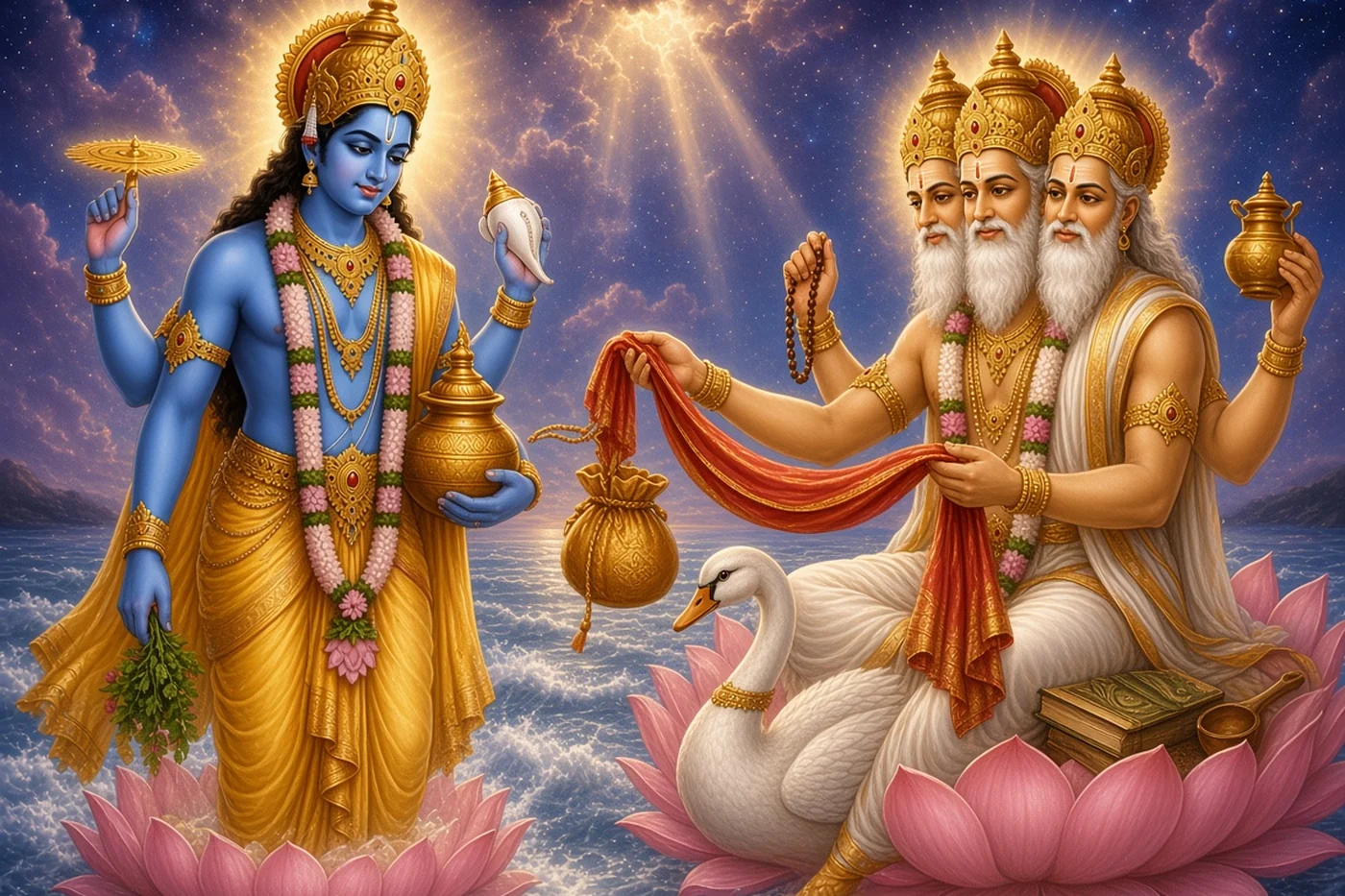
Ages later the merchant Chand of Champaknagar, at war with Manasa, sent for this Sankha Dhanvantari, and the doctor raised Chand's ruined garden again. Manasa set about him.
First she came as a flower seller with garlands of poison, asking a price no one would pay. His pupils took the garlands anyway. She complained to their master, who promised to look into it, and found his pupils lying dead beside a pool. He knew then who she was, and brought them back.
Then she came to his house as a milkmaid selling curd. His wife Kamala liked her at once and asked her name. "Kamala," said the milkmaid, and the two Kamalas became friends. A storm blew up, of Manasa's making, and the milkmaid stayed the night.
"Your husband handles snakes every day," she said. "Do you not know what keeps him safe?"
That night Kamala asked him, and Manasa, hidden in the room, heard the answer.
She came back with Udayakal, who bit Dhanvantari on the chest as he slept, and she carried off the scarf and the pouch. His pupils Dhana and Mana ran for the herb, and on the road an old Brahmin woman sat weeping that the great doctor was already dead. They threw the herb away, and found him still alive. They ran for the sea-foam, and a Brahmin pointed to smoke rising as if from his pyre. This time they did not believe it, but when the stranger asked to see the medicine they held it out, and the stranger vanished with it. Both strangers had been Manasa.
"Do not burn my body," Dhanvantari told them as he died. "Cut it in eight and bury the pieces in the quarters of Chand's land, and no snake will cross it."