As the Padma Purana tells it
Padma Purana, Srishti Khanda 33 · Atri's hermitage and the middle lake at Pushkar · 3 min read
Rama left Chitrakuta with Sita and Lakshmana and came to the hermitage of the sage Atri. He carried three griefs with him, and he named them to the old man.
"I live in the forest. My father the king is dead. Bharata is far away from me. Is there a holy place, sir, where a man is never parted from his own?"
Atri thought before he answered. "My father made such a place. It is called Pushkara. Between the mountains Maryada and Yajna lie three lakes, the eldest, the middle and the youngest, and there is a well there whose water joins the parted. Go, and give your father his pinda."
So the three travelled on, past the Riksha hills and the city of Vidisha, across the Charmanvati river, until they came down to the middle lake. Rama bathed and poured water for his ancestors. As he climbed out he saw a sage walking along the shore with his pupils. It was Markandeya, the boy to whom Brahma had once given a life as long as his own.
"I am Rama, Dasharatha's son," Rama said. "Atri sent me. Where is the well that unites?"
Markandeya showed him the well called Aviyoga, and stayed.
That evening Rama said the twilight prayers among the sages, and all the while he thought of his father and his brothers. He slept by the lake, and before dawn he dreamed that he was home in Ayodhya, at his own wedding, with his father and his mother beside him. Lakshmana, it turned out, had seen the same in the night.
In the morning the sages heard the dream and nodded. "When the fathers show themselves in a dream, they are asking to be fed. Hold the shraddha for King Dasharatha. Six of us will be your guests: Markandeya, Jamadagni, Bharadvaja, Lomasha, Devarata and Shamika. Make ready while we bathe at the eldest lake."
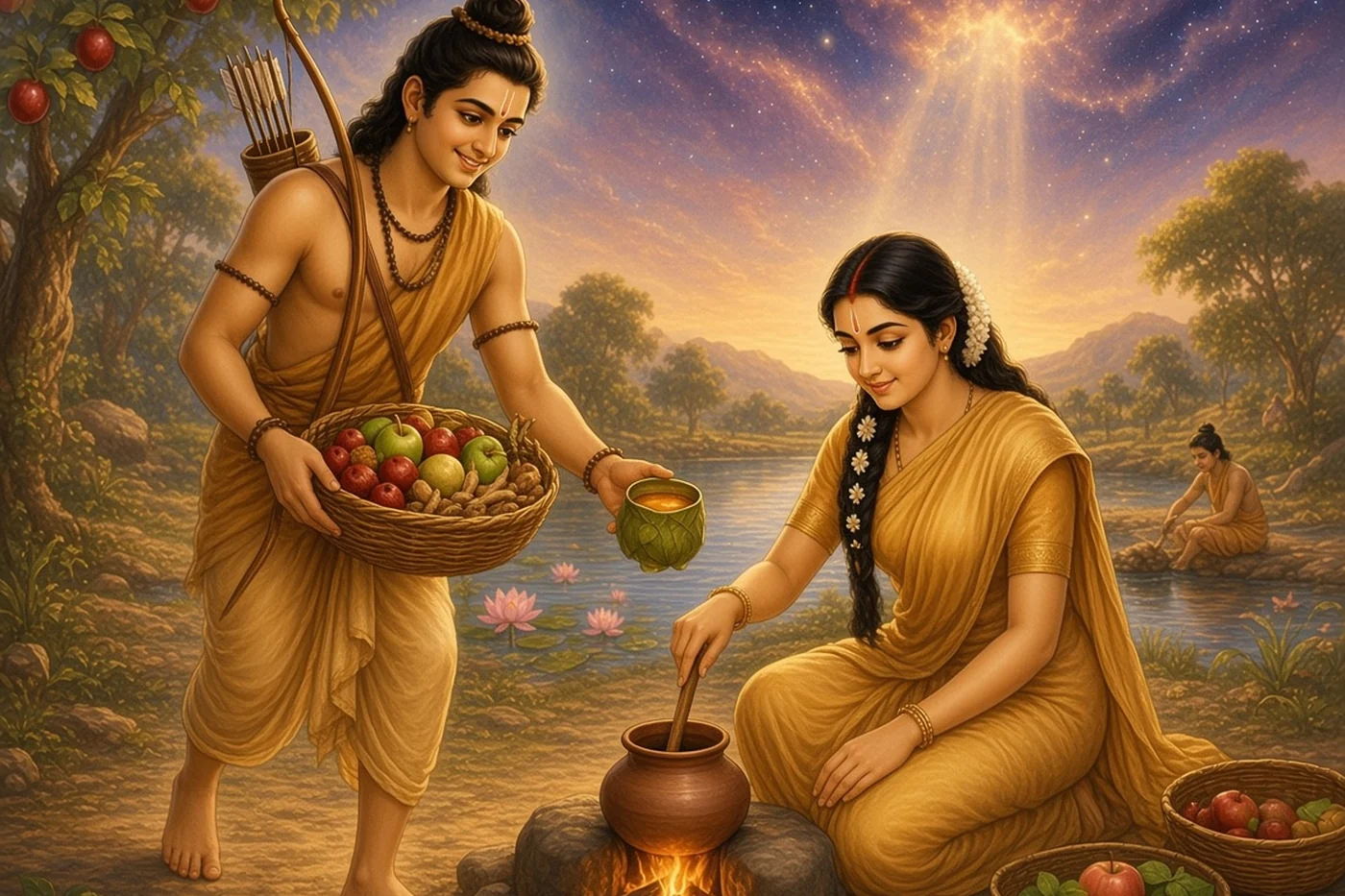
Lakshmana went into the forest and came back loaded with jujubes and amla, ingudi nuts, wood apples, roots and honey. Sita cooked it all. Rama bathed in the pool called Yoga-vapi and waited.
The sun passed noon. In the eighth hour of the day, the hour the books call kutapa, the right hour for the fathers, the six guests came walking up from the water.
Sita looked at them, and her eyes went wide. Trembling, she left Rama's side and went somewhere out of sight.
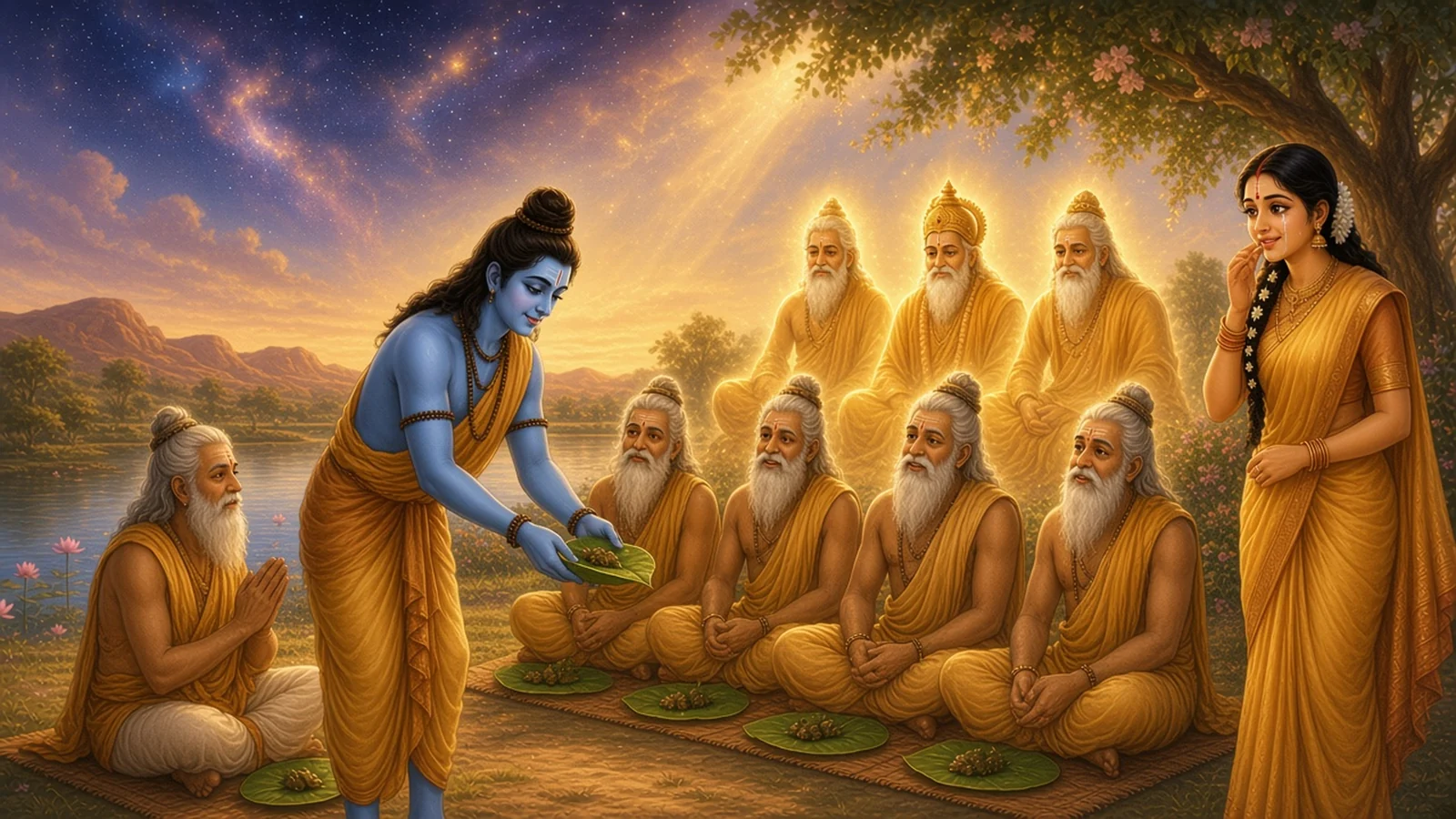
Rama fed his guests as the rules require. He made the offering to the All-gods, served the meal, laid down the pindas in their order, gave each guest what he could, and saw them off. Only then did he go looking for his wife.
"Why did you vanish when the sages came? Tell me the truth. I ask it by my life and by Lakshmana's."
Sita stood with her face lowered, and the tears came before the words.
"While you were thinking of him, the king came. Your father, in all his ornaments, and two others with him dressed the same. They were inside the bodies of the brahmins. I saw them, and I went away."
"Why go away from him?"
"Look at me. Bark cloth and a deerskin. Kaikeyi took my silks. The last time the king saw me I wore every jewel and fanned him with a fly whisk. How could I stand before him sweaty and dusty and put forest food on his leaf, food a servant's servant would not eat? It would have hurt him to see me so. I did not want to be the thing that hurt him. That is the whole truth, and I swear it by your feet."
Rama drew her onto his lap and held her. Then the two brothers ate what was left of the meal, and Sita ate after them.
As Pushkar's priests tell it: the hand in the pool
Rajasthan · Gaya Kund, also called Sudhabai, near the middle lake at Pushkar · 2 min read
The family priests of Pushkar, the tirtha-purohits, tell this at a pool near the middle lake which they call Gaya Kund. In their telling Rama has already been to Gaya.
Dasharatha had died of grief for his banished son, as the parents of Shravana Kumar had cursed him to. Rama had offered pindas at Gaya, and still his father was not set free. So when the three came to Atri, the sage sent them west, to Brahma's tirtha and its pool of Aviyoga.
They camped beside the pool. Three sages, Markanda, Makaranda and Lomasha, bathed every day at the youngest lake nearby, and Rama walked over to invite them. Lakshmana and Sita stayed behind.
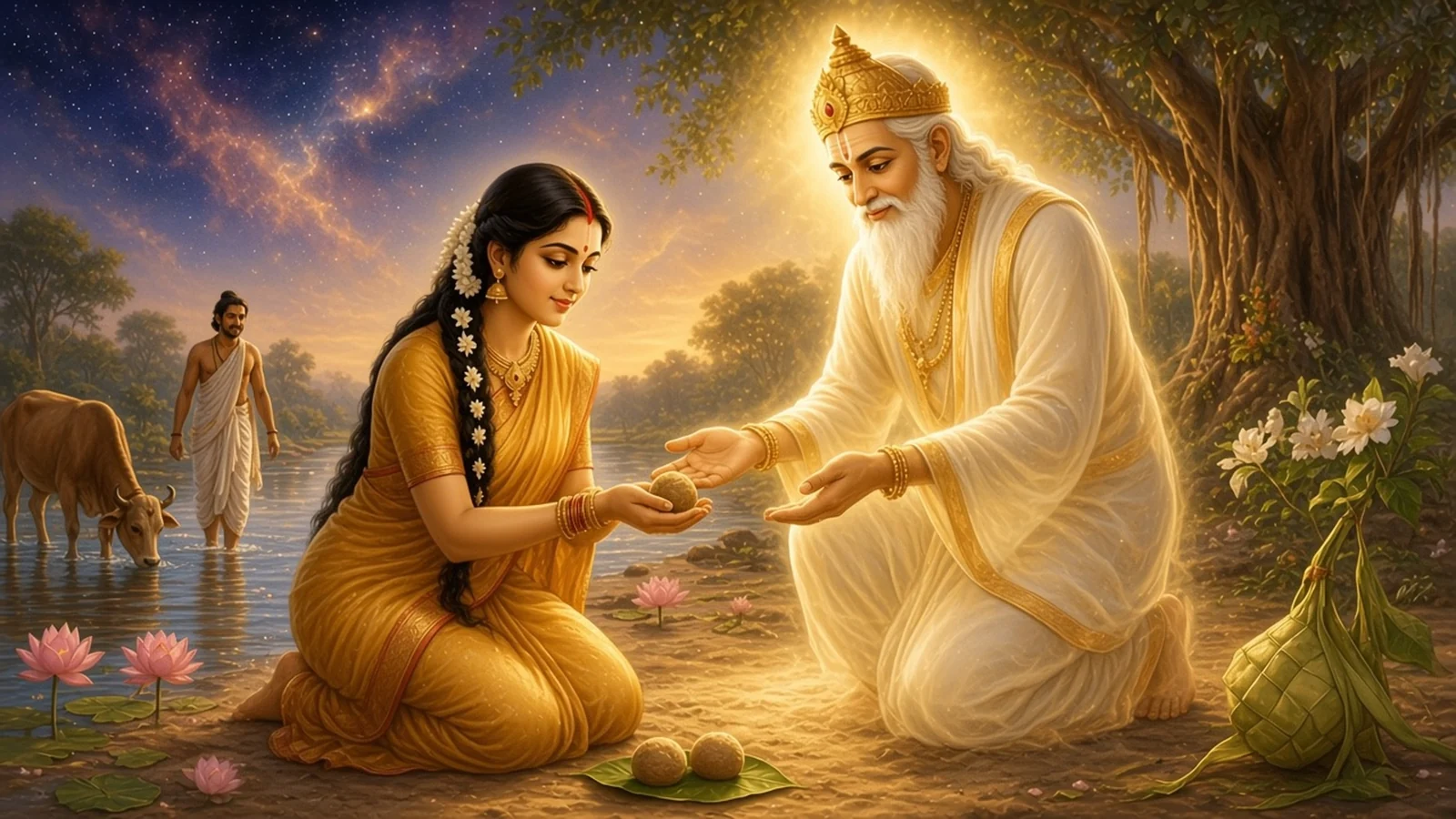
To pass the time Sita played ghodanal. She heaped up a mound of earth with a little cave for a door and pushed a ball of clay in, bit by bit, until it vanished. Halfway through the game she looked up at the water and stopped.
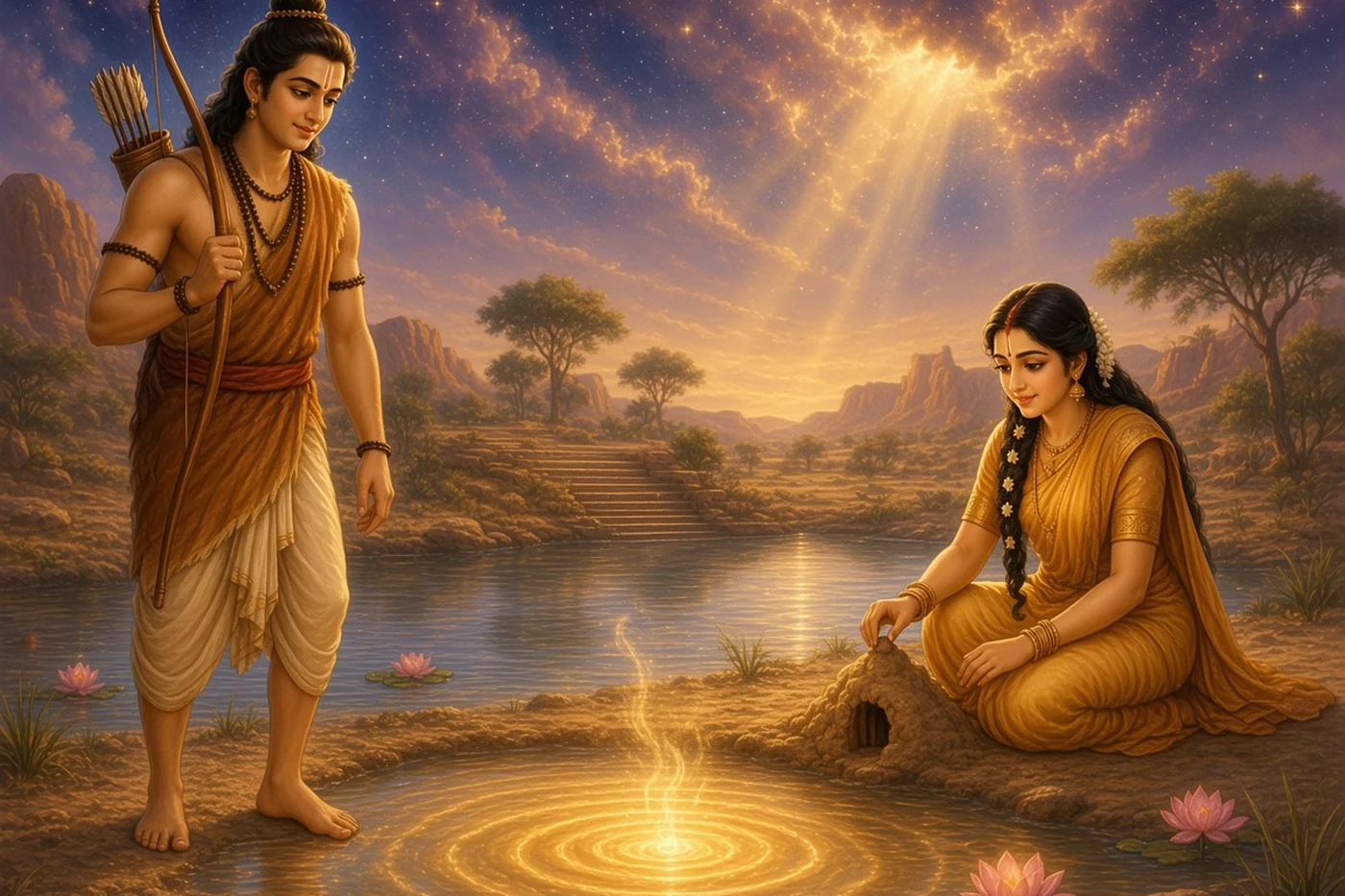
"Lakshmana, what is that?"
A hand had risen out of the pool. Lakshmana stared at it and knew it. It was their father's.
Rama came back with his guests at the hour of kutapa, and he too knew the hand at once.
"This moment has come once in the Treta age and will never come again," the sages said. "Your father is here himself, asking. Give the pinda first."
Rama shaped pindas from the sand and gave them. Then he asked what had puzzled him since Gaya.
"Gaya frees everyone. Why not my father?"
"He was cursed to die in parting from his son, and so he died. That bound him even at Gaya. Pushkar is the teacher of every tirtha. Here he goes free."
When the sages sat down to eat, the priests add, the king and his fathers could be seen behind them. The day was a Tuesday falling on the fourth of the moon, and so a fair is held at the pool on every such Mangala Chauth. On that day, they say, the priests of Gaya tell their own pilgrims that Gaya has gone to Pushkar.