As the Sonowal Kacharis tell it: Brahma taken for the fire
Upper Assam · a Sonowal Kachari village on the evening of Uruka · 3 min read
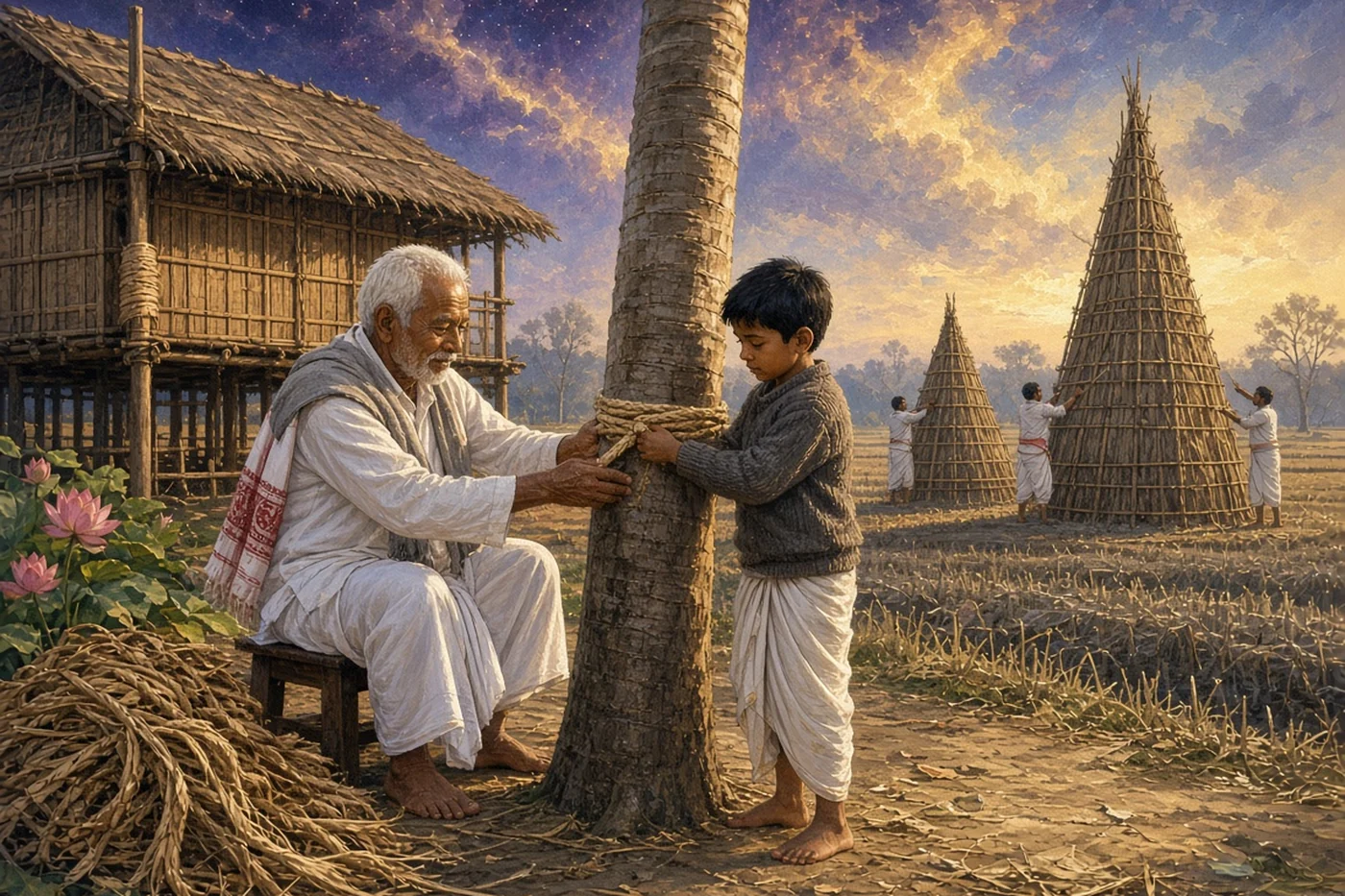
The paddy was in and the fields lay bare and grey with stubble. On the afternoon of Uruka, Bhaben's grandfather sat on a low stool in the yard with a heap of tomal beside him, the long cords twisted from straw, and showed the boy how to knot one round an areca trunk without letting it slip.
"Tighter," the old man said. "The tree has to feel it."
"Why does the tree have to feel it?"
"So the earth knows this tree belongs to a house. Now the granary."
They tied the bhoral, the raised granary on its posts, and the doorposts of the house, and the jackfruit and the mango by the pond. Out in the stubble Bhaben's uncles were finishing the mejis, two of them, a small one and a tall one, wood and bamboo and straw stacked into points against the sky.
"Why two?" Bhaben asked. "In Dibrugarh my cousin's school made only one."
His grandfather pulled the last knot and sat back down. "Then you had better hear it properly, because the answer is in the story, and the story starts a long way above our fields."
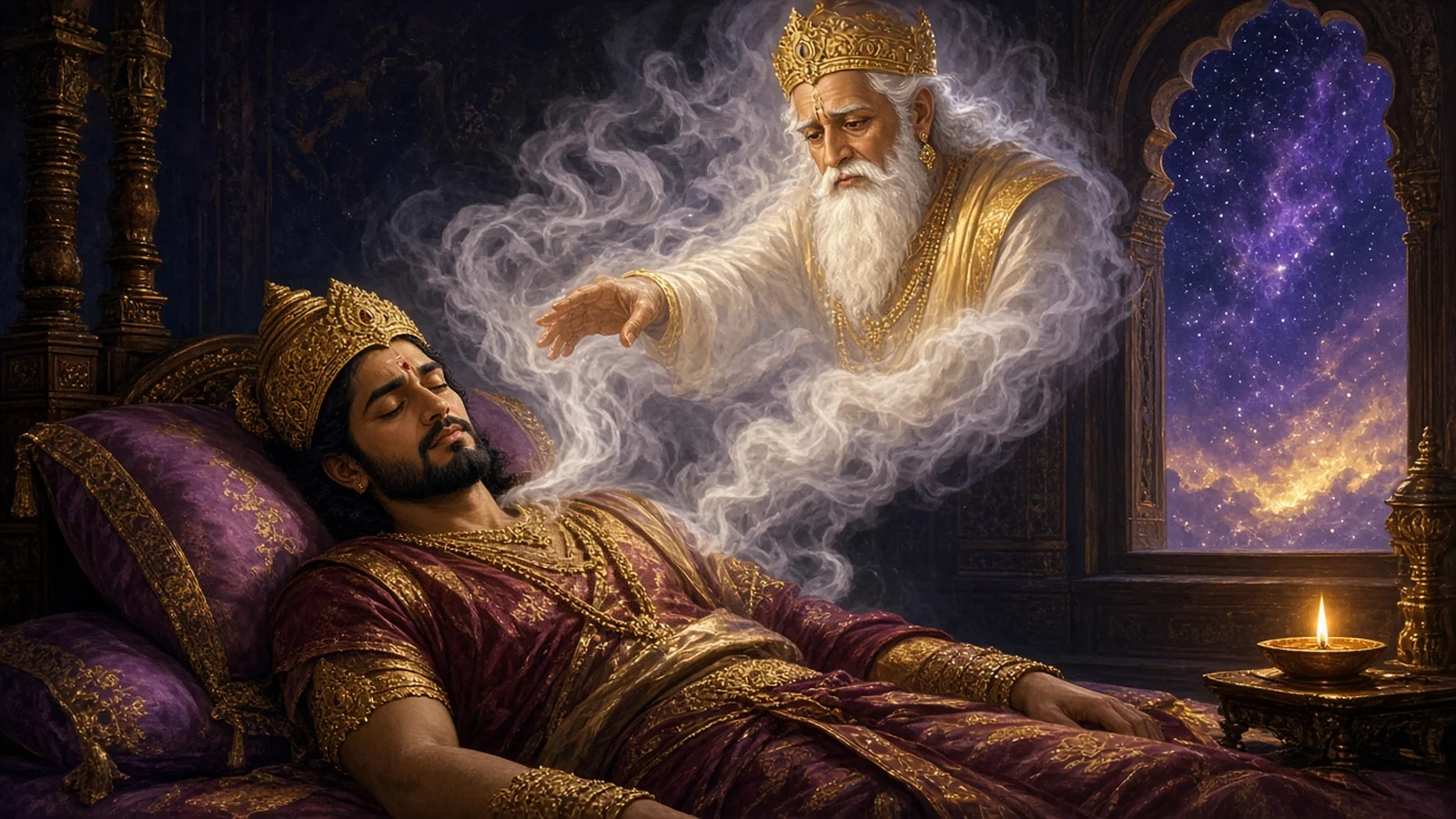
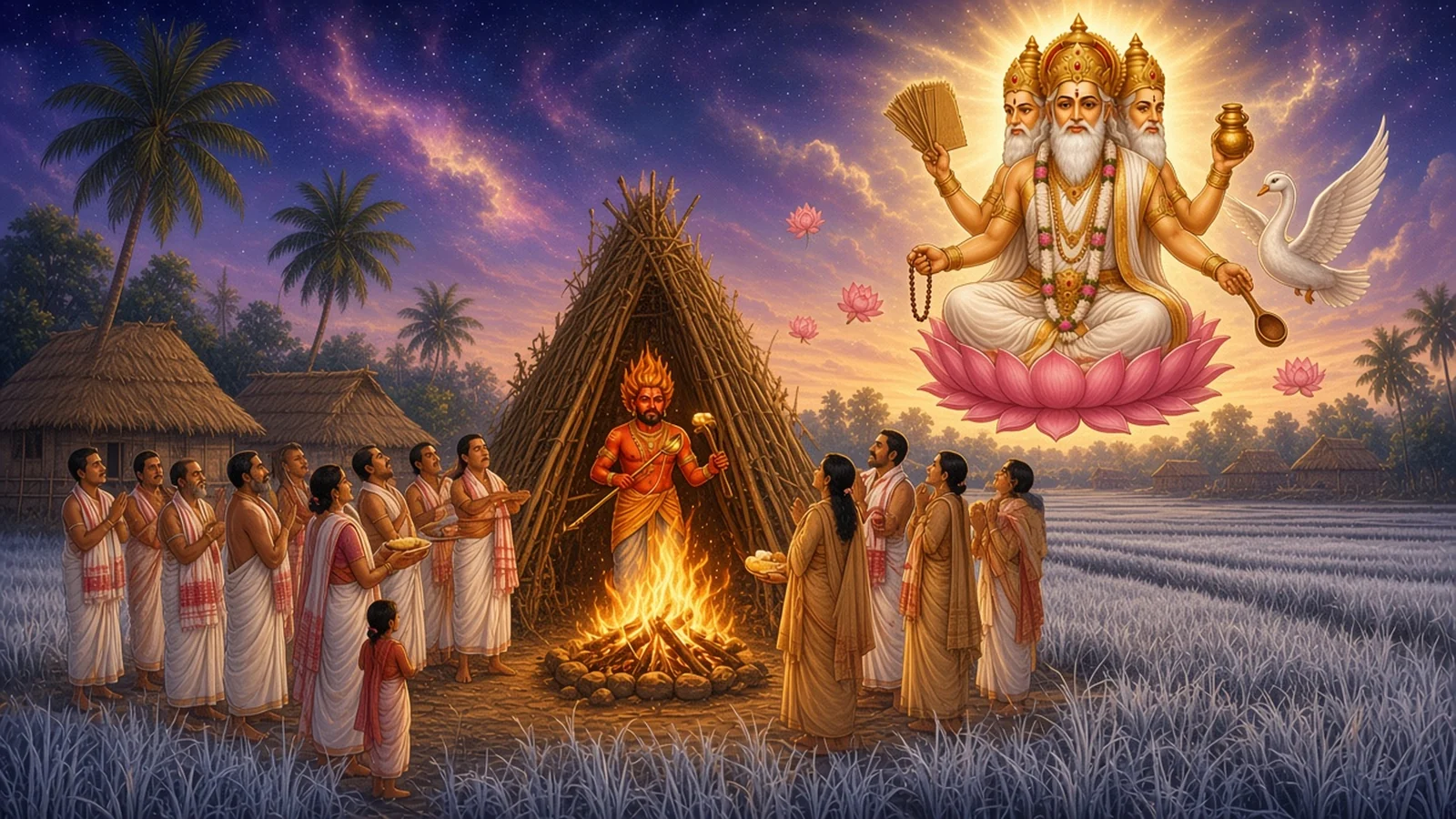
Long ago, he said, Brahma gave Vishnu a task to do on the earth, and Vishnu, who had a great deal on his mind, forgot it. Brahma waited, and nothing was done, and at last he lost patience and decided to come down and see to it himself.
The news ran ahead of him the way news does in a village. Brahma is coming. Brahma himself. The people went out to look for him, and of course none of them had ever seen Brahma, so they looked at whatever shone brightest and was most terrible to stand near.
"And they got it wrong," the grandfather said. "Shiva was about, and they thought Shiva was Brahma. And when Brahma came they did not know him at all. They thought he was Agni."
"The fire?"
"The fire. So they bowed down to the fire, and they have gone on bowing to it ever since. That is the big meji out there. We call it the Agni meji. The small one is the Gorokhiya meji, the cowherds' fire."
"But if they were wrong, why do we still do it?"
"Because the god was there all the same. A man who greets your father by your uncle's name has still greeted your family." The old man nodded at the cowshed. "And because they took Shiva for Brahma, they remembered that Shiva rides a bull. So tomorrow you will put ash on the cattle, five little spots of burnt paddy straw on the forehead. Five, mind, not four."
"And the ropes?"
"Ah. Brahma had come down angry, with a mind to put things right, and an angry god putting things right can break a great deal. So the people bound up everything they could not live without, the house, the rice, the areca trees. While the cord is on, Mother Earth will not let Brahma take them."
"Does he still come?"
His grandfather laughed. "I have tied these trees for sixty years. They are still standing. Who knows?"
He admitted, when Bhaben pressed him, that he did not know what Vishnu had forgotten. His own grandmother had never said. "Some stories lose a piece," he said, "the way a net loses a knot. You go on fishing with it."
That night the young men feasted in the bhelaghar beside the mejis and kept the fire going till late. Before light Bhaben was pulled out of his blanket and sent to the pond to bathe, shivering. Then they all went out to the stubble, and his uncle put a torch to the small meji first and then to the tall one.
The bamboo cracked and banged. The flame went up so high that Bhaben stepped back. His grandfather stood with his palms together, facing the Agni meji, and said something under his breath that the boy could not hear.
Afterwards Bhaben scooped a handful of straw ash into a leaf and went to the cowshed, and counted five, carefully, on the old cow's forehead.
As the Kacharis of Darrang and the Thengals keep it: the night the watch ended
Darrang on the north bank, and the Thengal Kachari villages of upper Assam, at the January Bihu · 2 min read
Not every Kachari village explains its fire with gods. When the missionary Sidney Endle lived among the Kacharis of Darrang, before 1911, he saw the January Bihu as the end of a long and tiring guard.
For a month or two before it, the ripening rice could not be left alone, and the boys and young men of the village watched the fields by night and by day. When the crop was cut and carried home, they were free.
For weeks before the festival they had been building. Huts went up at the field edges, roofed with jungle thatch, and beside them tall bamboos were raised, some of them flying ragged flags. Round the bamboos the boys heaped straw, thatch and anything else that would burn, until the piles stood many feet high. On the Bihu night, in Endle's account about the twelfth of January, the whole lot was lit at once, and the village danced and sang around the blaze and drank its rice beer, the zu, until the fire sank. Endle called it a harvest home, the young people's joy at being let off their watch, and he admitted that where the Bihus had first come from was obscure.
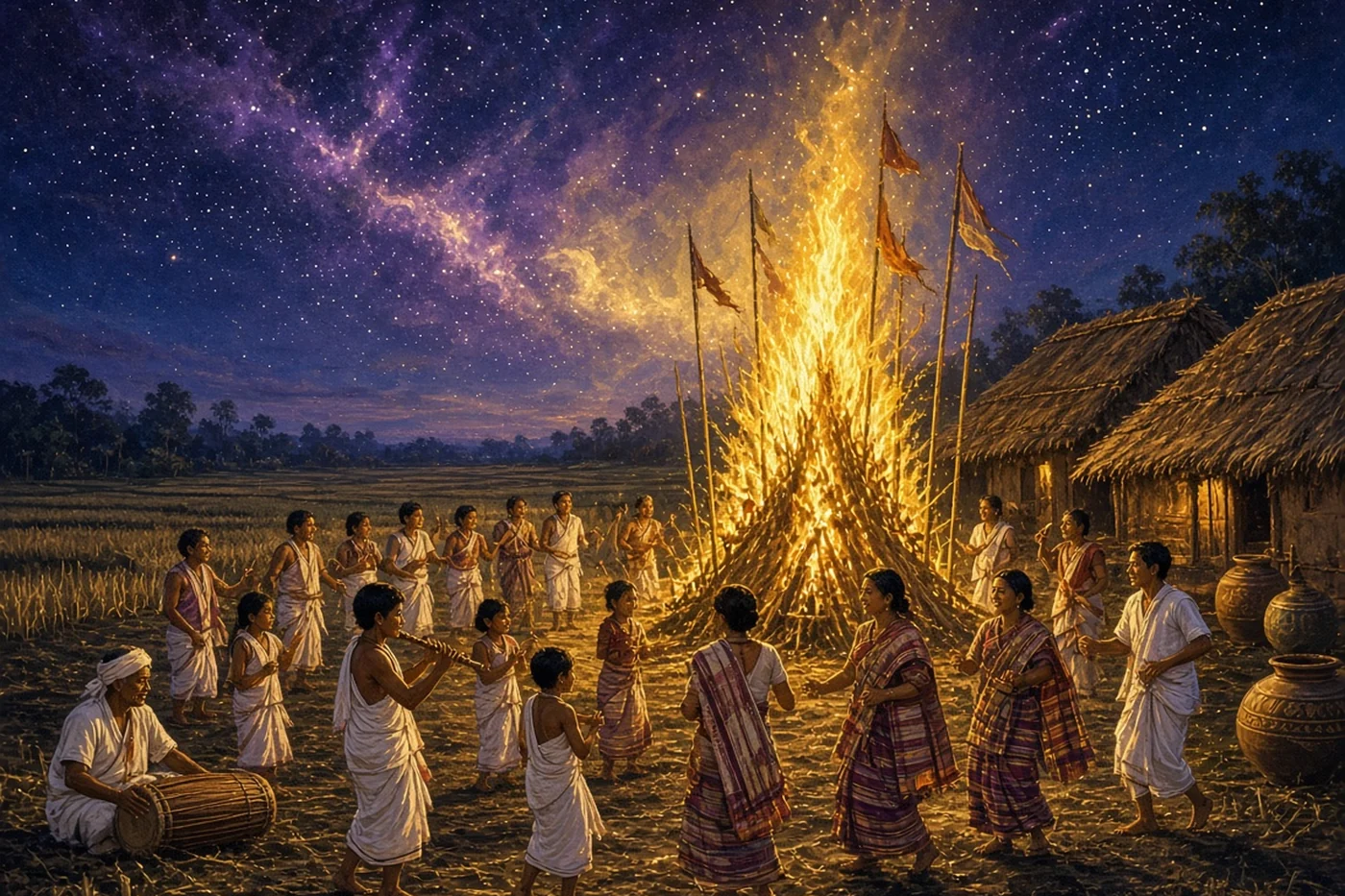
The Thengal Kacharis of upper Assam keep a version of their own. Their boys spend Uruka night together in the bhelaghar they have thatched for the purpose, and eat a feast there. Somewhere in the dark a neighbour's fence goes missing, and a hen or a duck, and nobody calls it stealing; on that one night it is the fun of the thing. In the morning the meji, a heap of wood built in the courtyard, is set on fire, and the whole village bows before it to the fire god. When evening comes, the ancestors are worshipped at home.
So the fire is the same, and so is the bow. What the fire means depends on who is standing in front of it.