As a bhopo reads the par at the fair
Rajasthan · a Raika camp on the dunes of the Pushkar fair, the week before the Kartik full moon · 3 min read
On the dunes outside Pushkar the herders had been camped for a week, their young male camels tethered in rows for the buyers. Old Bhanwar, a Raika from Pali, had sold three. Now he wanted the god thanked.
"Fetch the bhopo," he told his grandson. "The one from the houses by the railway station. Tell him the camp will pay."
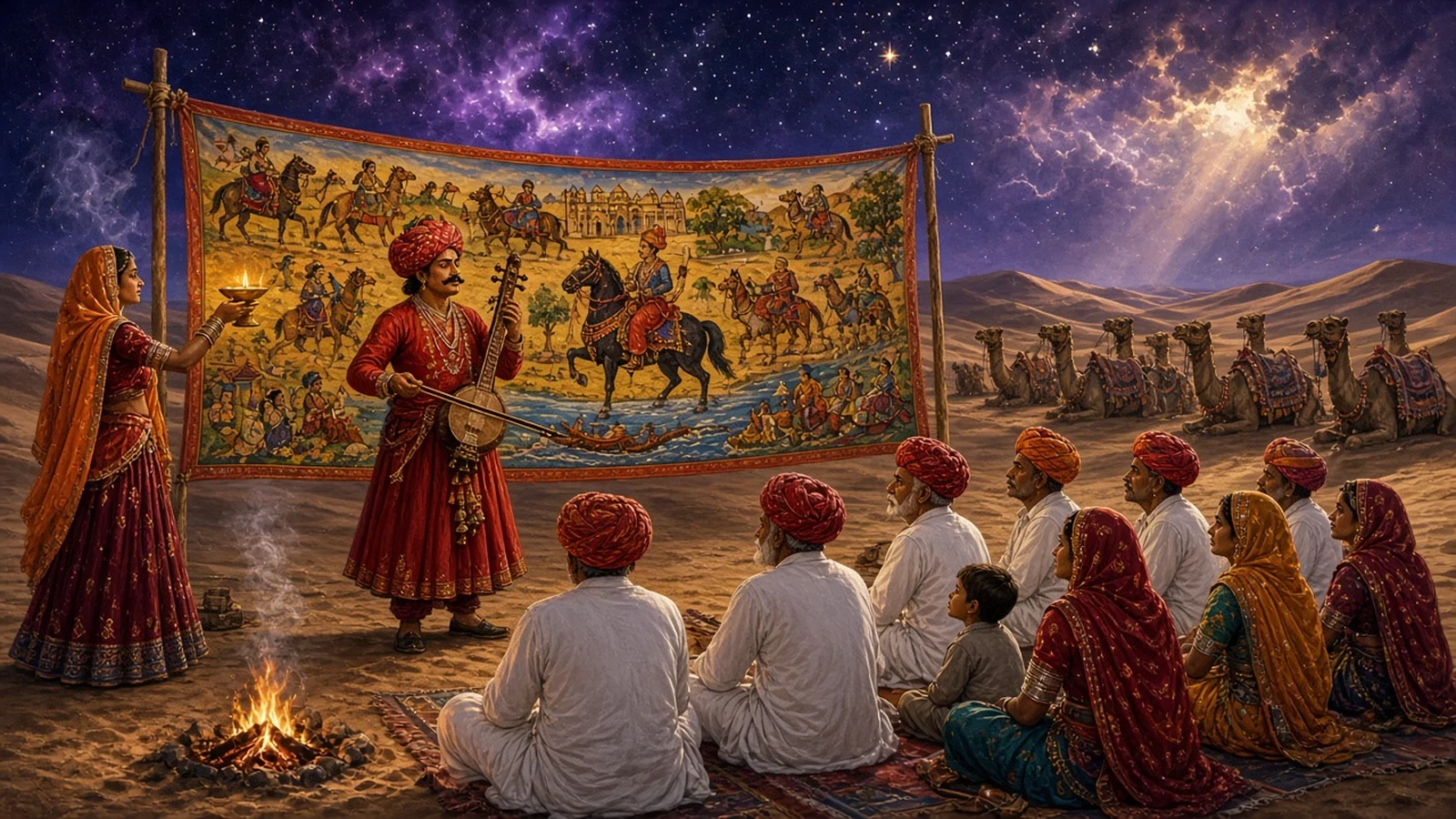
The bhopo came at dusk in his red robe, with his wife and a long roll of cloth on his shoulder. He would not untie it before dark. First the ground was swept and sprinkled, and incense lit. Then the cloth went up between two poles, fifteen feet of painted figures, with a great Pabuji in the middle on his black mare. The bhopo waved a lamp before the god and blew his conch once for every rupee the herders laid down.
"Which part?" he asked.
"The camels," said Bhanwar. "Always the camels."
The bhopi raised her oil lamp to the left end of the cloth, where a ten-headed king sat in a fort across the water. The bhopo drew his bow across his fiddle, the ravanhattho, and began.
At his niece Kelam's wedding Pabuji had promised her she-camels from Lanka, he sang, though no one in Marwar had ever seen a she-camel. The court at Kolu could not ride blind to a land beyond the seven seas, so a betel roll of five leaves was set out. Whoever took it would go ahead and spy. Harmal the Raika took it.
"Mother, I am going to Lanka," he said at home.
"Nobody who goes to Lanka comes back," said his mother.
He went anyway, dressed as a jogi. On the road his guru gave him sandals that would carry him over water, and a little drinking gourd. On the shore Harmal called on Pabuji, stepped onto the sea, and walked across.
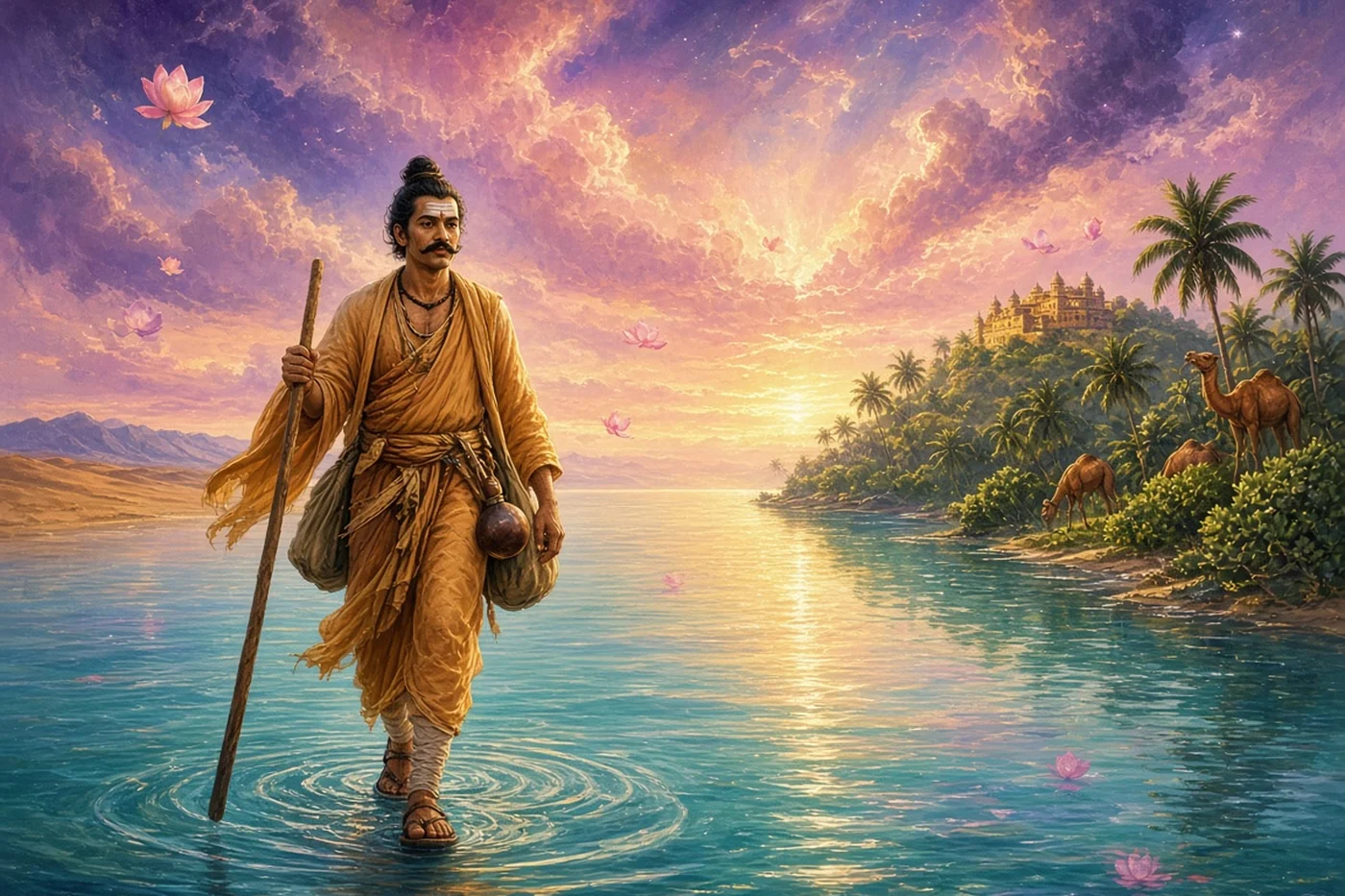
The bow found the scene on the cloth. "There. She-camels everywhere, stripping the coconut palms and browsing on cardamom."
Harmal lit his ascetic's fire in the place where the camels lay down at night. Ravana's camel men told him to move it before the camels kicked him to pieces. So he knotted the burning fire into his cloth, slung it over his shoulder and walked off. They ran after him, begging pardon, and asked to be his disciples.
"Then drink our camels' milk, guru."
"Fill my gourd and I will."
They milked camel after camel into it, and it never filled. He asked for their dung, threaded it into garlands, and it smelled of cardamom and coconut. Those garlands and a blanket of camel hair were his proof.
The grandson had pushed in close. "What did he take back?"
"Dung," said Bhanwar. "Hush."
Five months later Harmal walked home over the sea and laid the garlands down before Pabuji's court. Then the whole band rode into the water, drove off Ravana's herds, and brought them across Marwar to Kelam.
The singing went on nearly till dawn. When the bhopo rolled the cloth up again, from left to right, its edges were frayed and the paint worn thin.
"Soon this one goes into the lake to be cooled," his wife said. "Then he buys a new one from the painters."
Bhanwar looked over at the young males in their rows. "Those we sell," he told the boy. "Never a she-camel."
As the epic runs in John D. Smith's record
Marwar · Kolu, Lanka beyond the seven seas, Umarkot and Sambhar, as Parbu Bhopo sang it · 1 min read
In the version Parbu Bhopo performed for Smith, the letter comes first. A camel rider brings it to Kolu from Kelam, whose in-laws are mocking her for an uncle who promised what he cannot give. Chando reads it and shakes his head. No one knows the road to Lanka, he says, so they must send a spy. The betel roll is made at midnight, and Harmal is the one who takes it.
In Lanka the disguise nearly fails. Phatmal, one of the camel riders of Lanka, notices the jogi's fierce gaze and the knife at his waist, and goes by night to Ravana's mother, the seer. She tells him who the holy man really is. They bury Harmal in a pit nine yards deep with the stone of a wellhead on top, and when he calls on Pabuji the stone shifts aside and he climbs out. The herders fall at his feet. He stays five months, and in the sixth he longs for Marwar and walks home over the sea.
Then the warriors arm. Dhebo offers to drink the sea dry, but they race their horses across it instead. Pabuji vows to leave not one red hair of a she-camel behind, and in the battle that follows he kills Ravana with his spear.
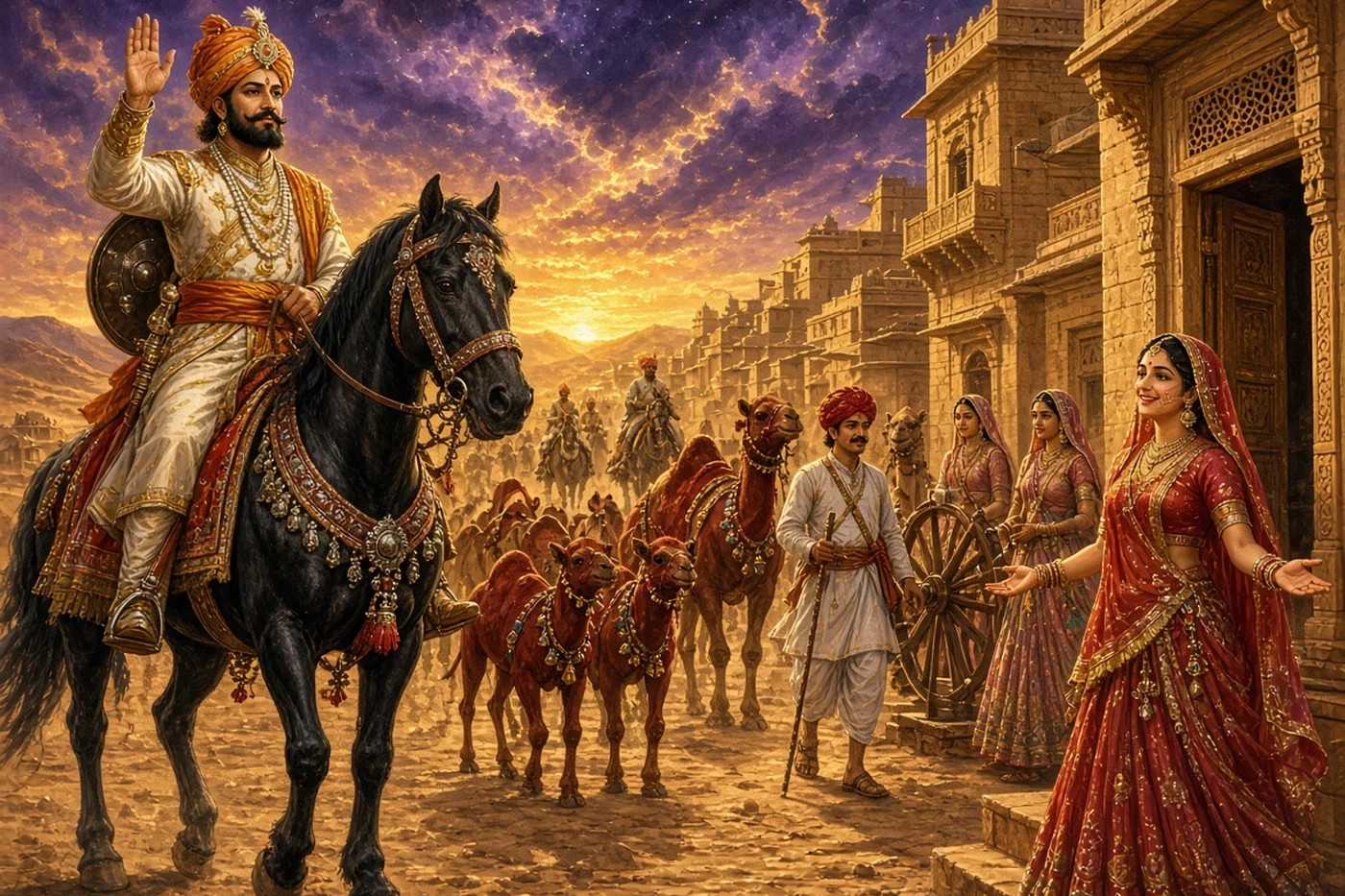
On the way home, near Umarkot, Devnarayan demands a toll of camels and drags mountains across their road. Pabuji strikes the hills with his whip and a pass opens. At last the herd comes to Kelam. She tells her husband's sisters to carry their spinning wheels away, for the she-camels' calves will sit there now.
In his own explanation Parbu added one more thing. Kelam kept a single camel, and gave the rest to Harmal and his people.