As the Mahabharata tells it
the Bhishma Parva, where the Bhagavad Gita stands · 3 min read
In the palace the blind king Dhritarashtra asked his charioteer Sanjaya what his sons and the sons of Pandu had done when they met on the field of Kurukshetra, and Sanjaya told him.
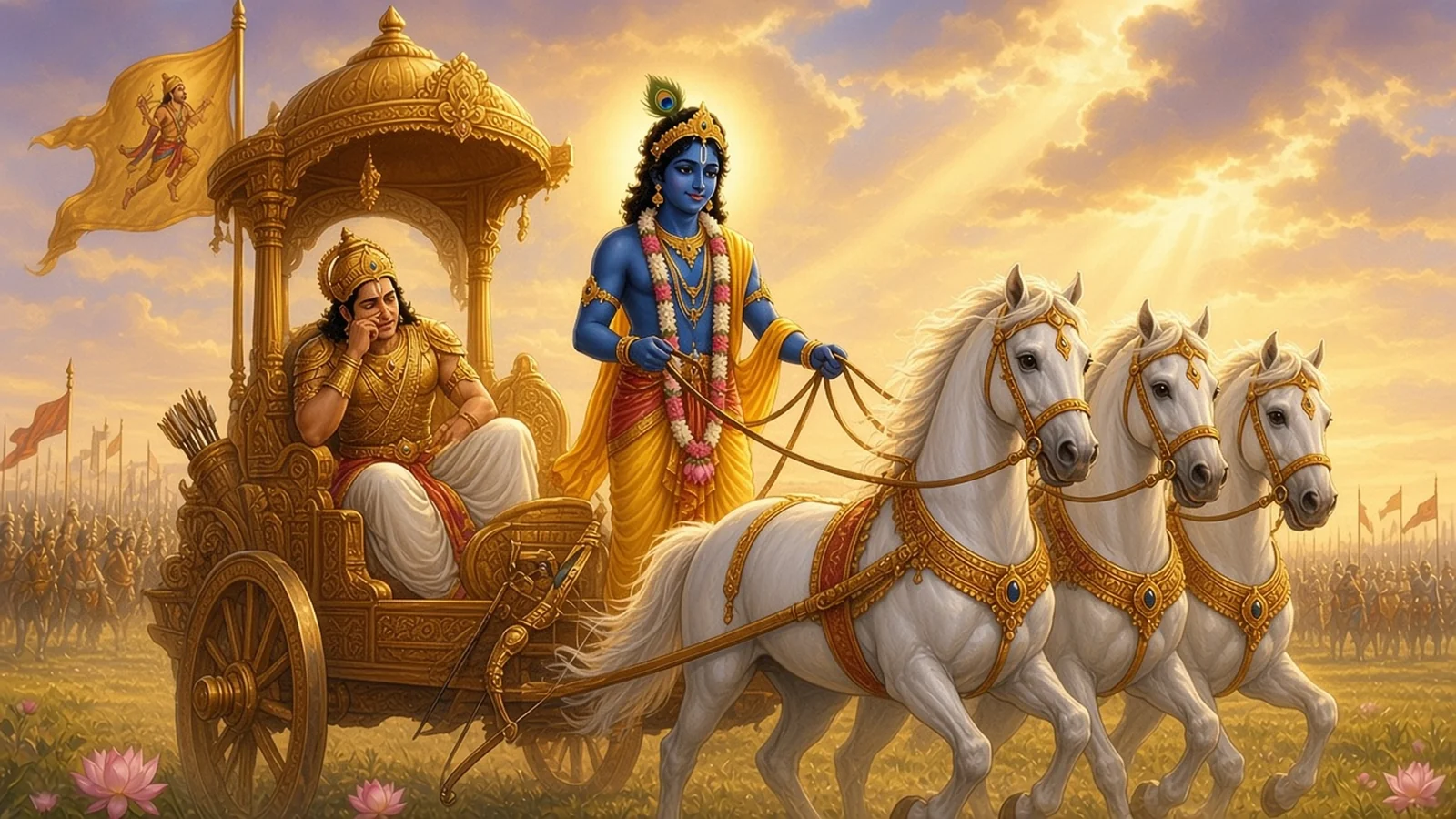
Old Bhishma blew his conch first, and it sounded like a lion. From a tall chariot yoked to white horses Krishna answered on Panchajanya and Arjuna on Devadatta, and the noise rolled through earth and sky. Arjuna, with Hanuman on his banner, lifted his bow.
"Achyuta, drive my chariot out between the two armies," he said. "I want to see the men who have come here wanting war, the ones I have to fight."
Krishna drove out and pulled up the horses in front of Bhishma and Drona. "Look, son of Pritha," he said. "There are the Kurus, all gathered together."
Arjuna looked, and saw fathers and grandfathers, teachers, his mother's brothers, brothers, sons and grandsons, friends and fathers-in-law, on both sides. His legs gave way and his mouth went dry. The Gandiva slid from his hand and his skin burned.
"I want no victory, Krishna, no kingdom and no pleasure," he said. "The people we wanted them for are standing here, ready to lose their lives. I would not kill them for the three worlds, let alone for this earth. Let Dhritarashtra's sons cut me down unarmed. It would be better."
He dropped his bow and arrows and sat down in the chariot, sick with grief.
Krishna saw the tears in his eyes. "Where has this weakness come from, at this hour of all hours?" he asked. "It is not like you. Throw it off and stand up."
"How am I to shoot arrows at Bhishma and Drona?" Arjuna said. "I ought to be bowing to them. Begging for food would be better. I no longer know what is right. I am your pupil now. Tell me plainly what to do." Then he said, "Govinda, I will not fight," and was silent.
There between the armies Krishna smiled. "The wise grieve neither for the living nor for the dead," he said. "There was never a time when I did not exist, or you, or these kings, and none of us will stop being. A man throws off worn clothes and puts on new ones; the self does the same with bodies. Your right is to the work, never to what comes of it."
Much later Arjuna asked to see Krishna as he truly was. "These eyes of yours cannot see me," Krishna said. "I will give you divine ones."
Then Arjuna saw. If a thousand suns rose in the sky together, their light might come near it. In one body stood all the gods, Brahma on his lotus, Shiva, the sages and the serpents, with no beginning, no middle and no end. Into its mouths poured Dhritarashtra's sons, Bhishma, Drona and Karna, as rivers pour into the sea.
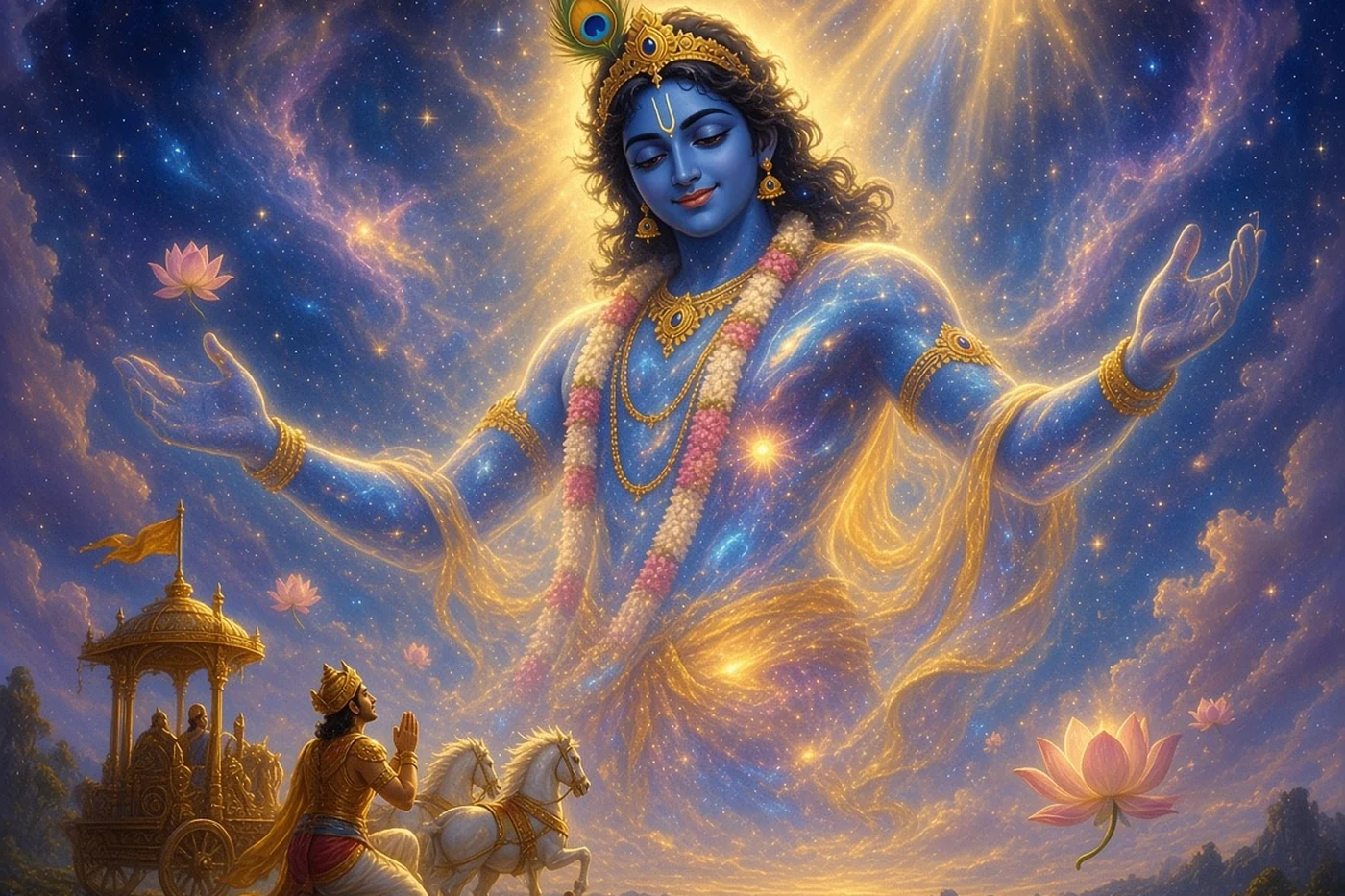
"Tell me who you are," Arjuna begged.
"I am Time, the destroyer of worlds," came the answer. "Even without you, none of the warriors drawn up on either side will live, except you and your brothers. I have slain them already. Be only the instrument, left-handed archer."
Arjuna joined his palms and asked forgiveness for every time he had called him Krishna, or Yadava, or friend, joking at play, at rest and at meals. He asked to see the old face again, and Krishna showed him the four arms, and then the familiar form of a man, and Arjuna's mind came back to him.
When the long talk was over, Arjuna spoke once more. "My confusion is gone. By your grace I remember myself. I stand firm, with no more doubt, and I will do as you say."
Across the field the great chariot-fighters saw him holding his arrows and the Gandiva again, and they raised a roar, and the conches blew.
As Kurukshetra tells it
Jyotisar, beside the Jyotisar Sarovar, Kurukshetra, Haryana · 2 min read
Kurukshetra keeps its own account of where all this happened. The people of the town hold that the battle began at Jyotisar, beside a tank now called the Jyotisar Sarovar. Here, they say, on the evening before the fighting, the chariot stopped, the bow fell and the teaching was given, and here the universal form was seen. The name is read as jyoti, light, and sar, essence.
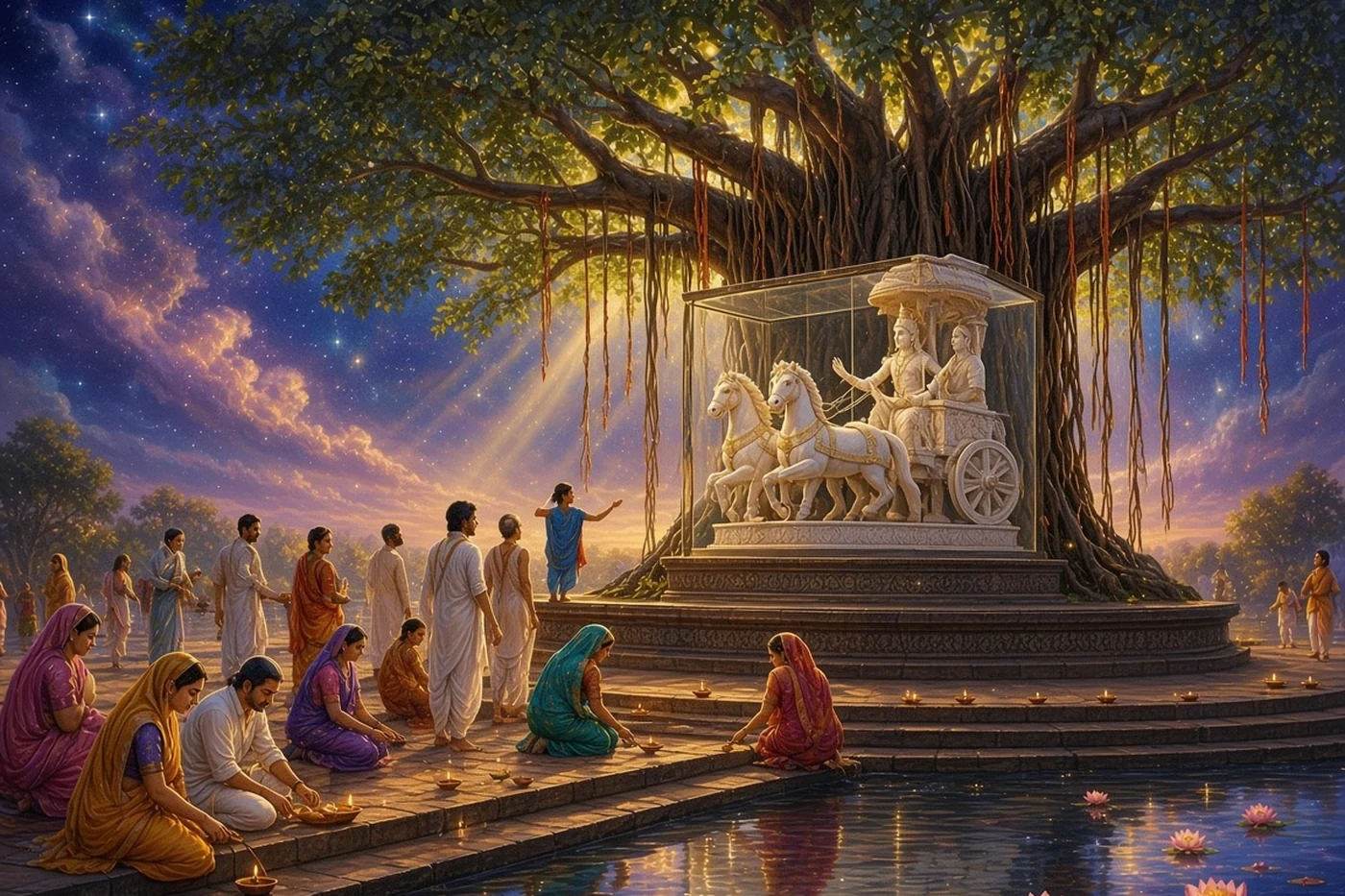
A banyan stood over the chariot, in this telling, and heard every word. The tree on the raised platform today is held to be its offshoot, and devotees call it the witness of the Gita. India's national tourism site calls it five thousand years old.
For a long time the spot was lost. Temples rose and fell here, and of one of them only a single carved stone of the ninth or tenth century still sits on the platform. Adi Shankaracharya, walking north to the Himalaya, is said to have known the place and named it again. Nearby stands an old Shiva temple where the Kauravas and the Pandavas are said to have prayed before the war, and in 1850 a king of Kashmir built another temple of Shiva at the tank.
In 1924 a king of Darbhanga raised the stone platform that rings the tree. In 1967 the Shankaracharya of the Kanchi Kamakoti Peetha set beneath it a chariot of Krishna teaching Arjuna, turned to face east. That chariot, in marble, now stands behind glass, and pilgrims tie red threads on the low branches when they make a wish. Each evening a show of light and sound tells the story again in the dark, and since 2021 a forty-foot Virat Swaroop in eight metals has stood near the tank.
The Kurukshetra Development Board tried for years to raise seedlings from the old tree's seeds, and every attempt failed. In 2025 a batch of saplings finally came up, to be planted at holy places across India and abroad. On the evening of Gita Jayanti lamps are lit and offered at Jyotisar, as they are at the Brahma Sarovar.