As Palani tells it
Palani sthalapurana · Sivagiri and Sakthigiri · 3 min read
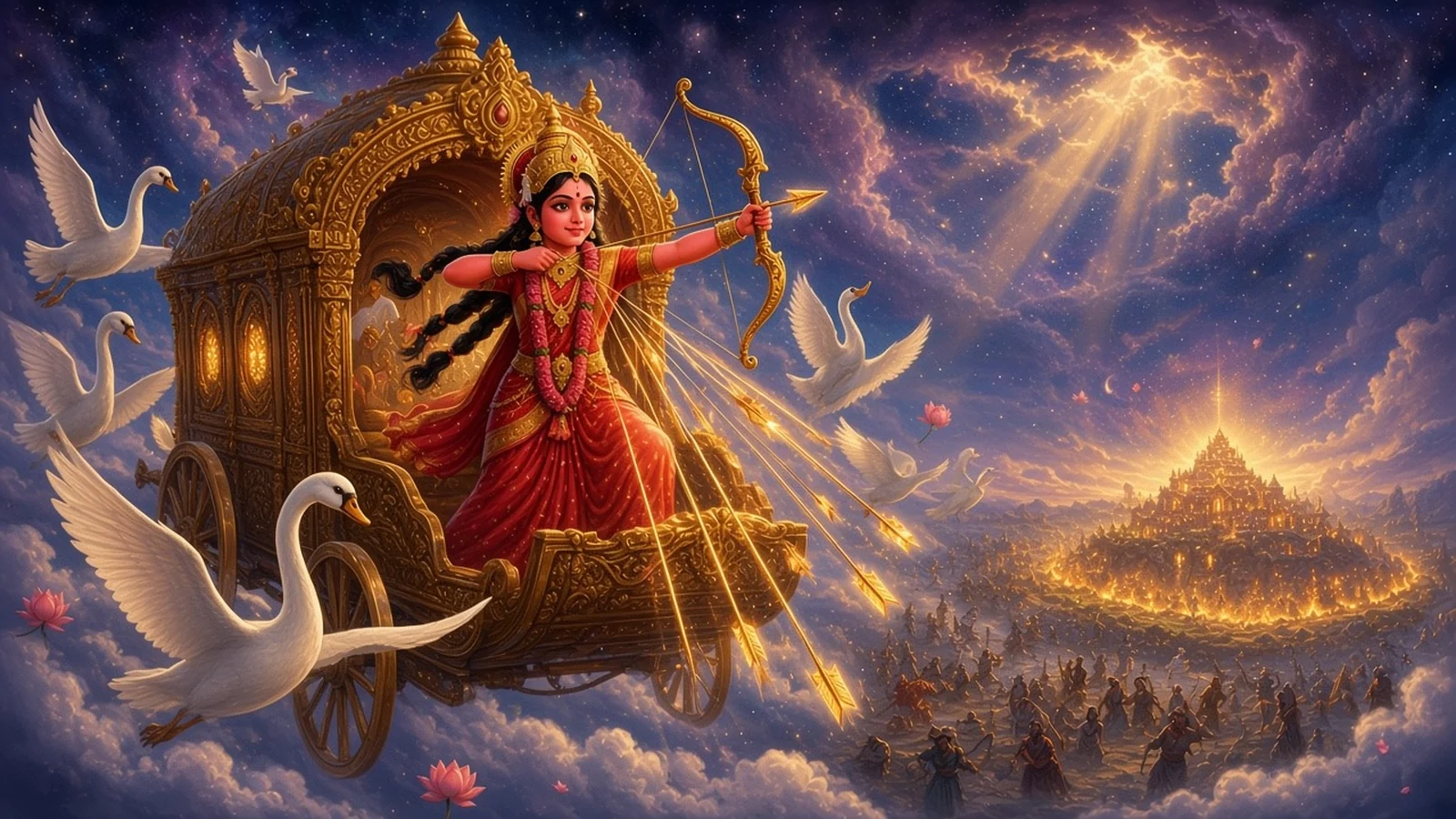
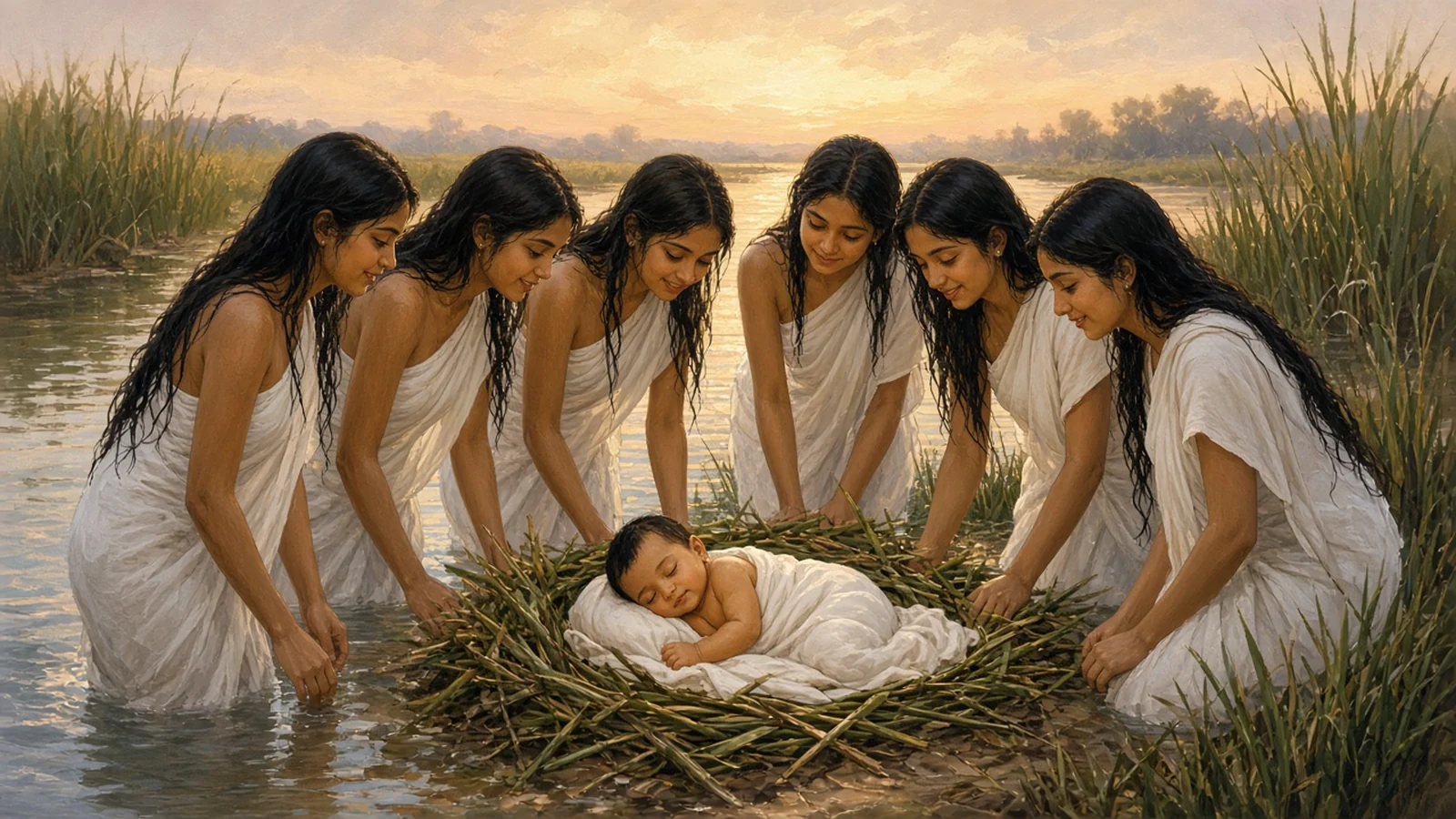
When Shiva married Parvati on Kailash, the whole world came north to watch, and the earth tipped. Every god, every sage and every king stood on one mountain, and the south rose up empty. So Shiva sent the sage Agastya south to put the weight right, and with him he sent two hills, Sivagiri and Sakthigiri, his own hill and the Goddess's, to be set down in the Tamil country.
Agastya was a small man and the hills were hills. He left them in a forest on the way and went on to his own mountain, Podhigai, and when he had settled there he sent for his disciple.
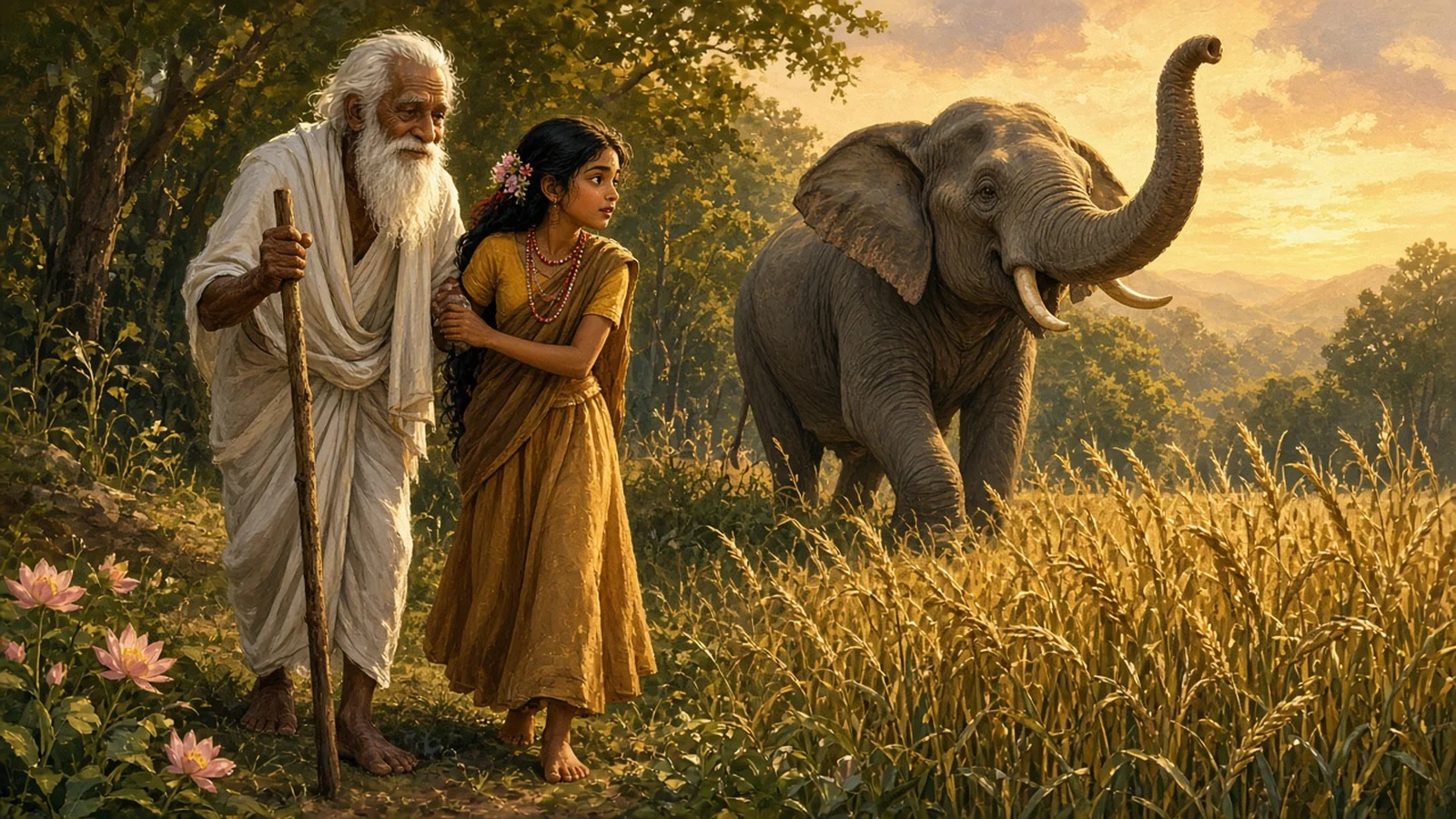
Idumban was an asura. He had taught Surapadman and his brothers once, and when Murugan ended that war he and his wife Idumbi had gone into the forest to live quietly, and there Agastya had taken him as a pupil.
"Two hills," said Agastya. "In the forest where I left them, in the north. Bring them to me."
"Two hills, master. On what?"
"On yourself."
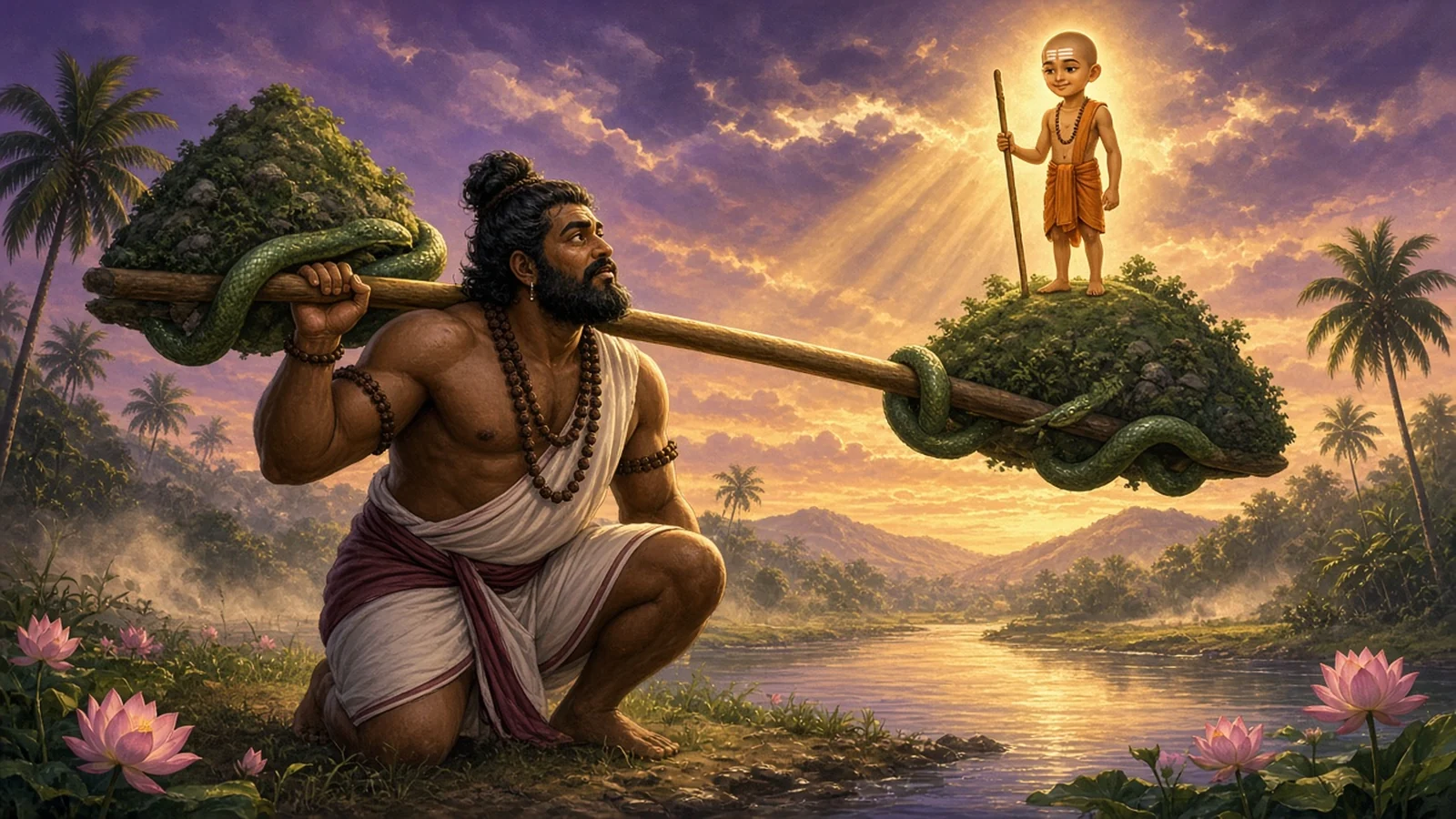
Idumban went north. He found the hills where they lay, and he looked at them for a while, and then he made the thing nobody had made before. For a pole he took the staff of Brahma. For ropes he took two serpents and bound one hill to each end. Then he bent his back, got the pole across his shoulders, and stood up, with a mountain swinging on either side of him. That was the first kavadi.
He walked south for a long time. The country changed under him, and the hills swung, and at last, in the Tamil country, he came to a place by a river that pleased him and set the pole down to rest.
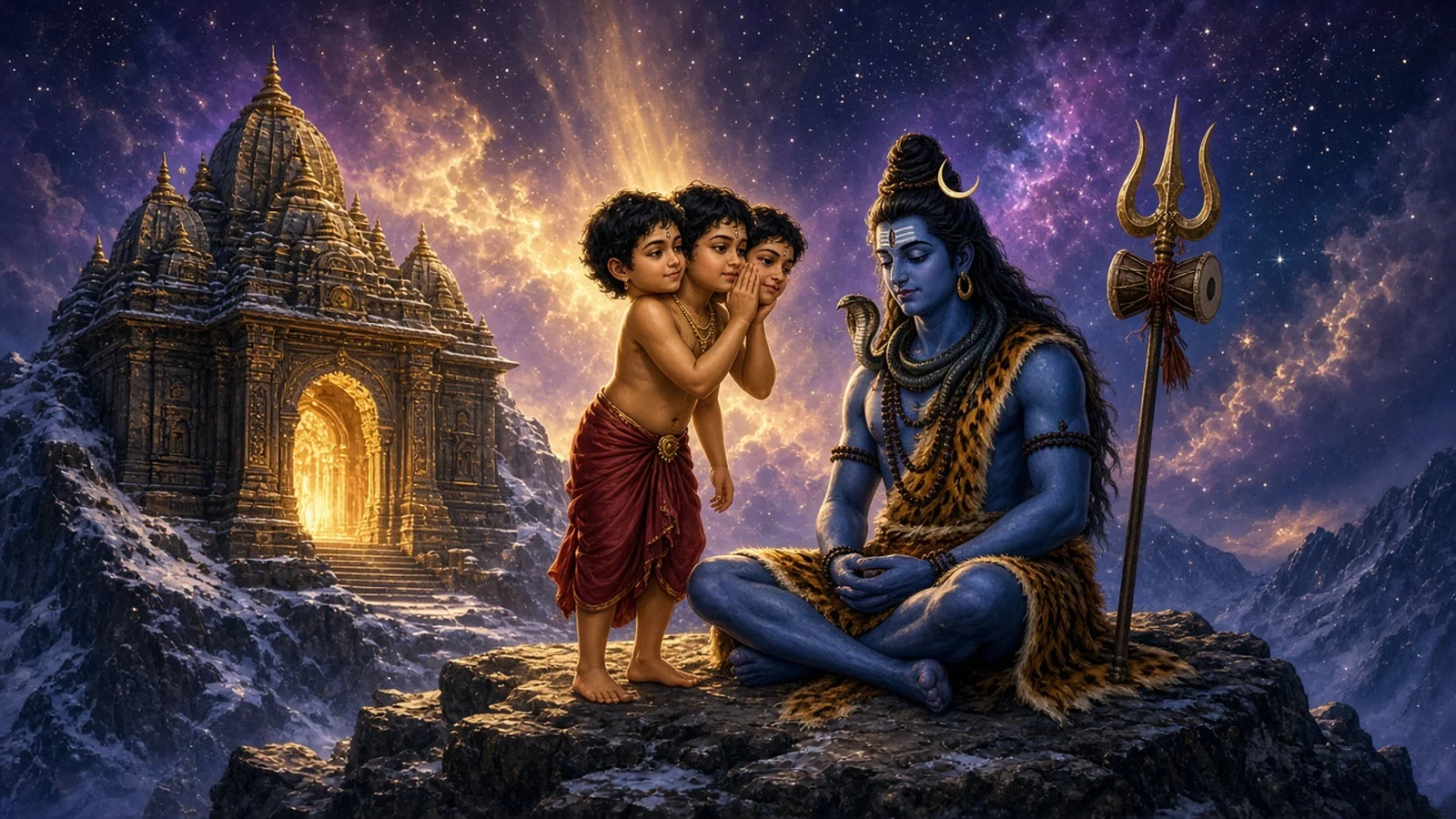
Murugan was there before him. He had left Kailash in his anger after Ganesha won the fruit of wisdom, with his head shaved and nothing but a loincloth and a staff, and he had come to this same place to stand alone. He looked at the two hills and liked them.
When Idumban had rested he put his shoulder to the pole again. One end came up. The other would not move.
He went round to see what had caught it, and on top of Sivagiri stood a boy. A thin boy, bald, in a scrap of cloth, holding a stick, looking down at him.
"Come off that," said Idumban. "It is mine to carry."
"It is mine to stand on," said the boy. "I was here first."
"Do you know who sent me? Agastya himself. Get down before I pull you down."
"Pull, then."
Idumban climbed. He was an asura and the boy was a child, and he did not hold back. But every blow he landed went into the hill and not into the boy, and every blow the boy gave landed. At the end of it Idumban lay on the slope of Sivagiri, dead.
Idumbi came, and knew what had happened at once, and wept over him. Agastya came, and knew who the boy was, and bowed.
"Lord," he said, "he was doing my errand. He did not know you. Give him back to her."
So Murugan gave him back. Idumban got up, saw whom he had fought, and fell at his feet, and asked for two things.
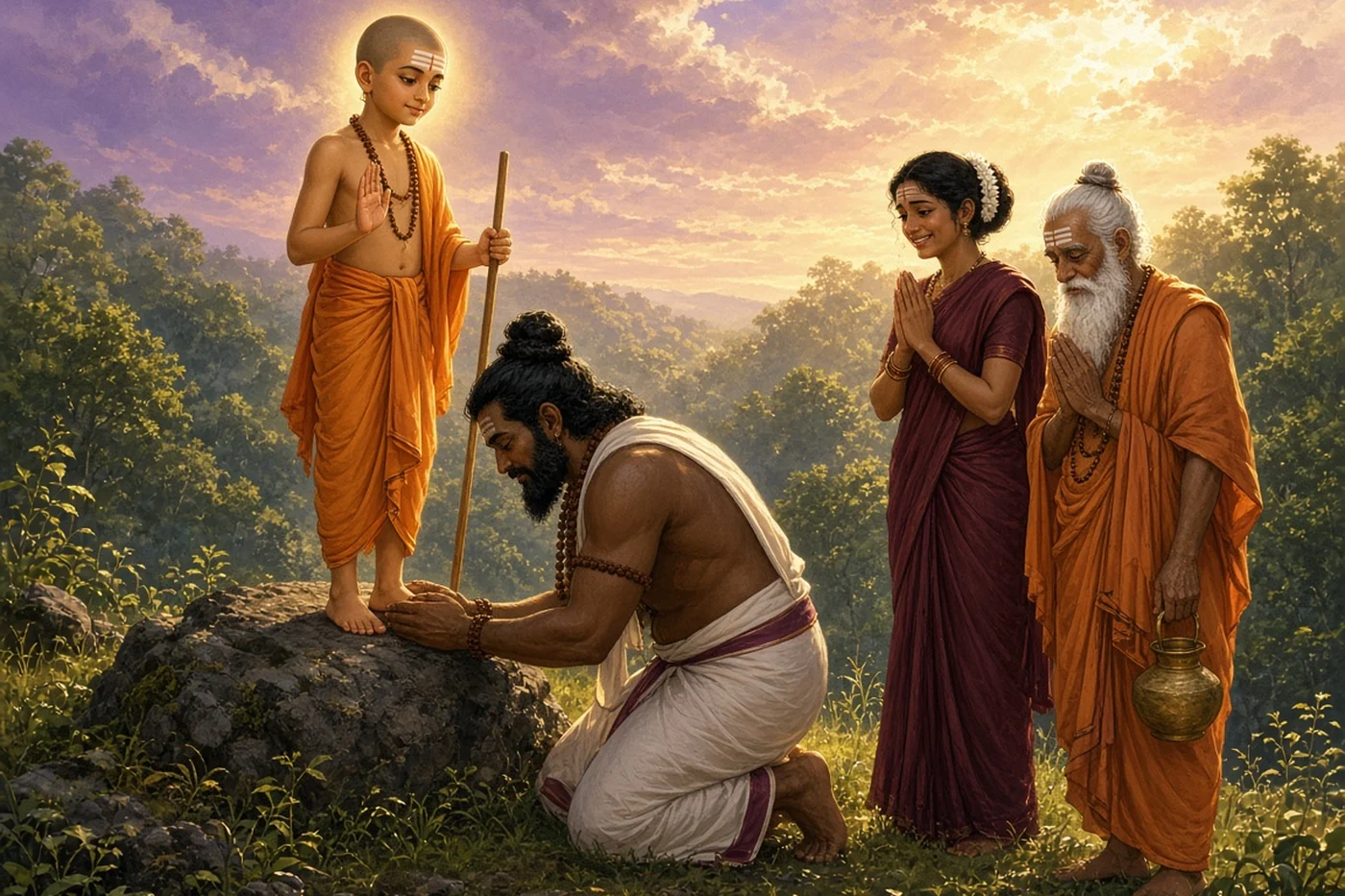
"Let me stand at your gate," he said, "for ever, and let everyone who comes to you pass me first. And whoever carries a kavadi on his shoulders to your hill, as I carried these, let him have what he came for."
"Both," said Murugan.
The hill stayed where it had been put down, and the boy stayed on it. That is Palani. Halfway up the steps a shrine to Idumban stands beside the path, and pilgrims stop there and make their offering before they climb the rest of the way to the god. The hills he brought from the north are still his two hills, Sivagiri with the temple on it and Sakthigiri beside it, and on Thaipusam thousands of kavadis go up past his door.
As the Tamil world tells it: the kavadi crosses the sea
Batu Caves, Malaysia · Tank Road, Singapore · 2 min read
A hundred and thirty years ago a Tamil of Kuala Lumpur went looking for a hill.
His name was Thamboosamy Pillai. He had been born in Singapore in 1850, schooled at the Raffles Institution, and had made his way in Malaya as an interpreter and a lawyer's assistant, and when he came to Kuala Lumpur and found it full of Tamils from the estates and the railway, he built them a temple to Mariamman. Then, with his friend Kanthapa Thevar, he climbed a limestone hill north of the town and went into the great cave in its side.
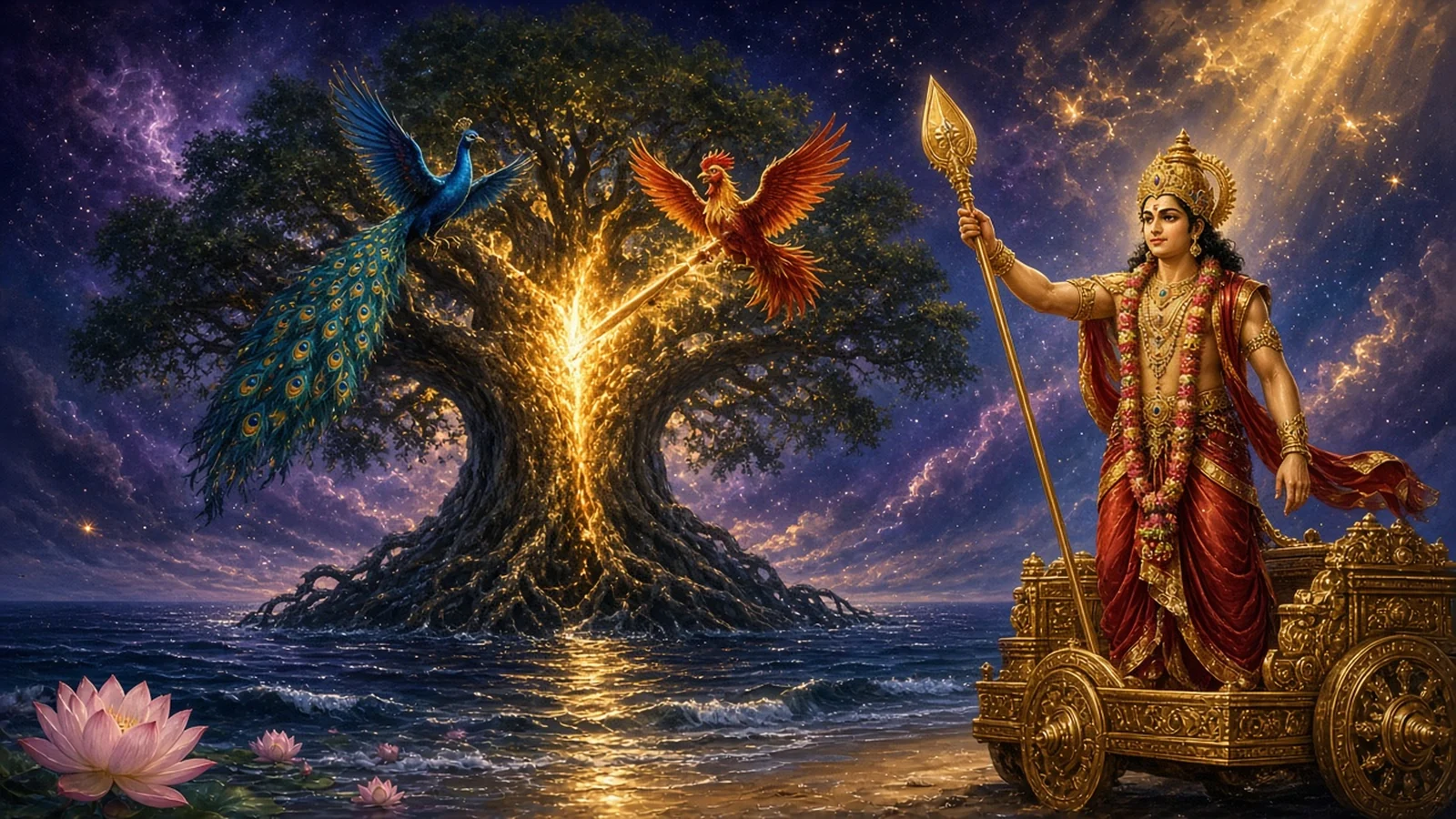
The mouth of that cave, seen from within, is the shape of a vel's blade. He understood what that meant. He set a vel there, high above the ground, and the Tamils of Malaya began to climb to it every Thaipusam, as their fathers had climbed Palani. The usual histories say the first festival was in 1892; the New Straits Times says 1889.
Wooden steps were built in 1920, and in 1940 the two hundred and seventy-two concrete steps that pilgrims climb today. In 2006 a golden Murugan nearly forty-three metres high was raised at their foot.
Every Thaipusam the silver chariot leaves the Mariamman temple in the city in the dark, carrying Murugan with Valli and Deivanai, and travels the thirteen kilometres to the caves. The kavadi bearers bathe in the river at the foot of the hill, have their frames fixed, and take the right-hand side of the stairs, because a kavadi is heavy and its bearer must stop to breathe. In 2023 more than a million people came in a day. In 2025 the temple counted one million eight hundred thousand over the days of the festival, and the footwear left behind at the bottom of the steps weighed between two and three tonnes.

Singapore kept the same day in its own shape. The Chettiars built their temple to Murugan on Tank Road in 1859. On the eve of Thaipusam the god goes out in a silver chariot to visit his brother Ganesha at the temple on Keong Saik Road and comes home in the evening.
On the day itself the kavadi bearers set out from the Sri Srinivasa Perumal Temple on Serangoon Road and walk about four kilometres through the city to Tank Road, barefoot, with milk pots on their heads, with vels through their cheeks, with frames of peacock feathers held on their bodies by spikes, and with drummers at their side since the city allowed the music back along the route in 2016. At the end the milk is poured over the vel, ash is given, and the kavadi comes off. For a week afterwards a small puja is made at home to Idumban, the first man who carried one.
The heritage board of the city records why: the bearer is doing what Idumban did. Two hills, one pole, and a god waiting at the top.