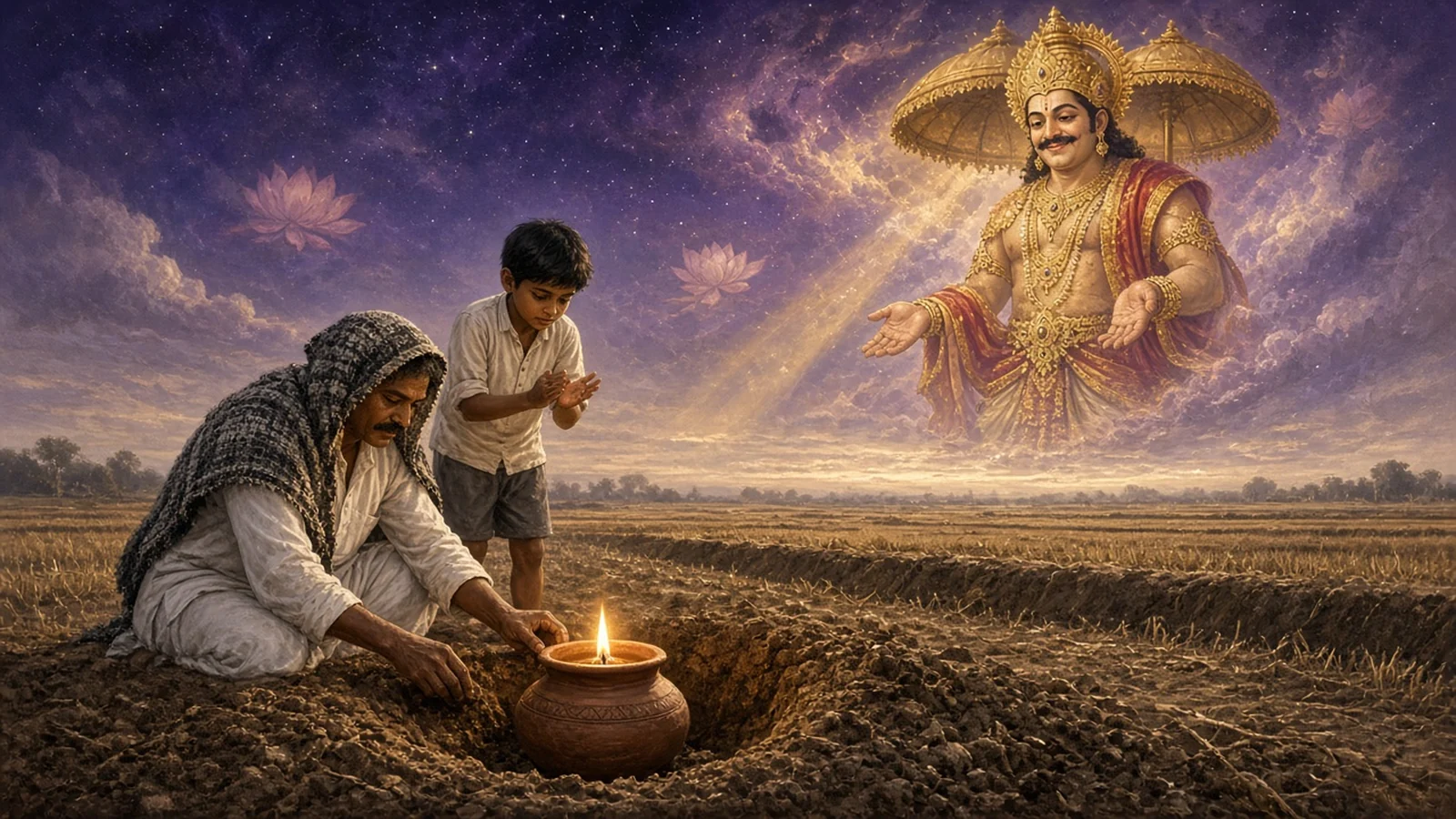
In the paddy fields at dusk
Tulu Nadu · a farming house in Dakshina Kannada, on the evening of Bali Padyami · 3 min read
The cattle were done by noon. Prakash and his cousin had washed them in the stream and brought them back shining, and his mother had put turmeric and a red mark between their horns and a garland of marigolds round every neck. Now they stood in the shed, chewing, wearing their flowers as if they always had.
"Go and cut the branch," said his grandfather. "Haale. Not too thick. It must have two good forks, three if you can find them."
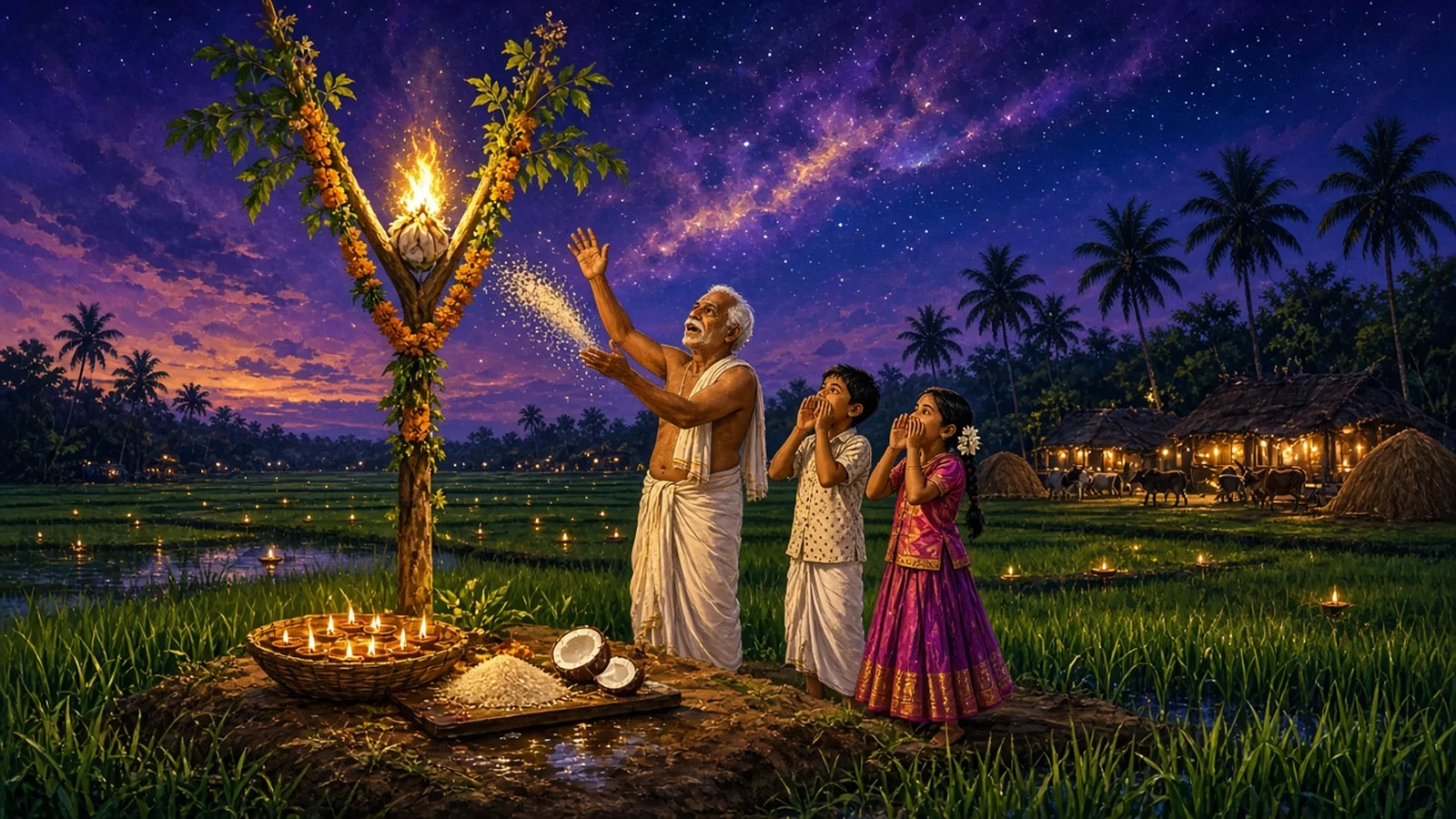
They found it on the slope behind the well, a straight young branch with a fork at the top like an open hand. The grandfather trimmed it to the height of a boy's shoulder and tied two sticks across it, and the women wound it with marigolds and wild flowers. At the very top he bound a wad of old cloth and soaked it in coconut oil from the kitchen.
"Why does it have to stand in the field?" asked Prakash's little sister, Shwetha.
"Because that is where he looks first. A king who ruled this land wants to see the paddy."
"Where has he been?"
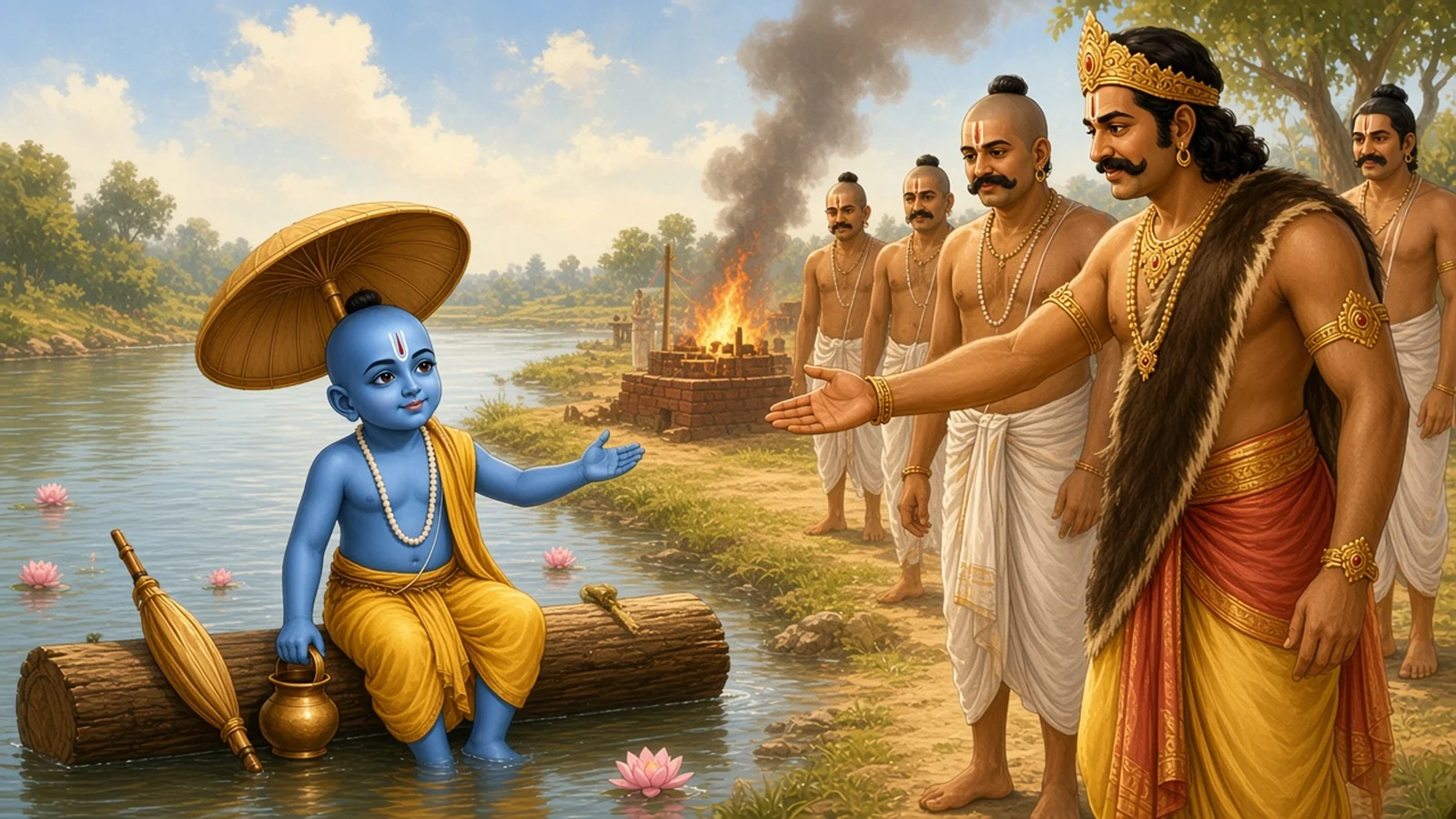
"Down below, where Vamana sent him. Once a year he is allowed up to visit."
At dusk they carried the pole out to the bund at the corner of their own field and pressed it into the wet earth. Meanwhile the women went through the farm with a basket of small clay lamps: the yard, each window, the threshold, the cowshed, the edge of the manure heap, the foot of every straw stack. When they had finished the whole place was a scatter of small flames.
At the foot of the pole the mother laid a washed plank, and on it a winnowing tray of lamps, a heap of beaten rice and a split coconut. The grandfather lit the cloth at the top and it caught with a soft rush of fire.
He stood in front of it with a fistful of rice and called out over the dark fields, naming Balindra and bidding him come back to the land that had been his. Then he threw the rice at the flame. The children cupped their hands round their mouths, as he had shown them, and cried, "Koooo!"
Three times he called, three times the rice flew and three times they cried. Then he sang in the old Tulu the long list of things that cannot happen, and Prakash knew the first of it by heart: when the black stone bears fruit and the white stone flowers, come then, Balindra.
"But stones don't flower," said Shwetha.
"No," said her grandfather. "So he will have to keep coming."
When the flame burned low they took lamps to the cattle shed and held them up.
"Look," the grandfather told the cows, quite seriously. "Look at the lamps. He has come."
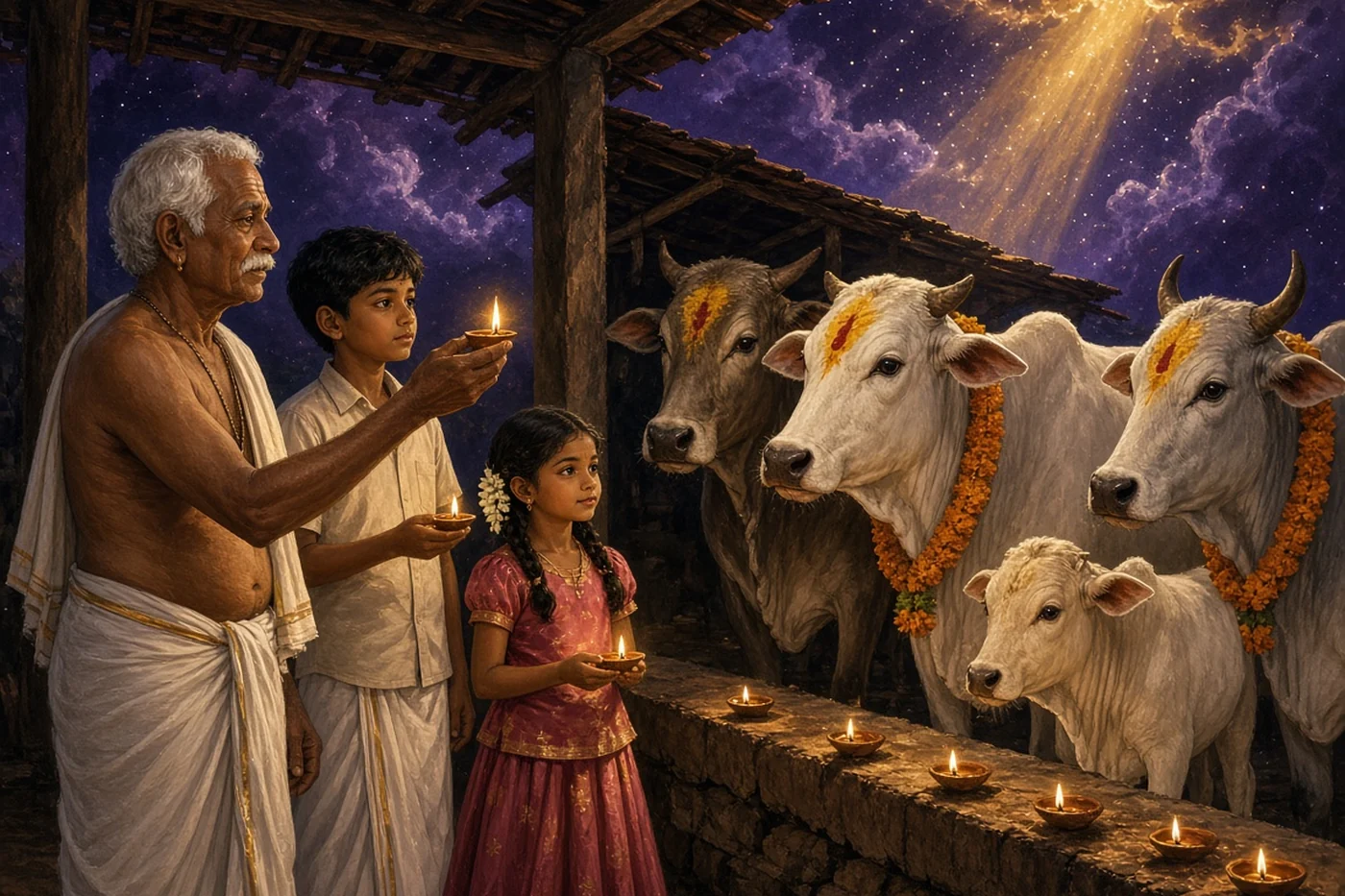
The cows were given beaten rice and a dosa each, and the family went in to eat. There was fish curry, because there always was on this night, and everyone had put on their best clothes, because Balindra should see a house that was doing well.
"In my father's time," said the grandfather, wiping his hands, "the whole village did this at the big house. A tree twenty feet tall, with a crown of seven points on top, and a conch and a drum before the head of the house called. Now every house does its own."
"Is ours good enough?" Shwetha asked.
He looked out of the door at the little lights all over the farm. "He'll see it," he said.
As the Malnad and the plains keep it
Karnataka · a farmhouse in the Malnad hills, and the villages of the plains · 2 min read
Up in the Malnad hills the big bath pot had been scrubbed and filled on the eve of the festival, and by Padyami morning the oil baths were over and the work had moved to the cowshed. Savitri washed it out at first light while her husband took the cows down to be bathed. When they came back she garlanded each one, and laid in the shed a mat she had plaited from the green stems of kanchikaddi and brahmadande, as her mother-in-law had shown her.
"Do they eat with us today?" her son asked.
"Before us," she said, and set aside a share of the festival kadubu for each cow before anyone in the house had touched it.
Her sister had married into a village on the plains, and there, Savitri knew, the morning went another way. The women gathered fresh cow dung and built Bali a fort beside the tulasi platform, ring inside ring, with a tall shape in the middle that was Balindra himself and a tiny Ganapati of dung at the gate to guard him. Small dung figures sat at the threshold to keep out what should be kept out.
In the Malnad house the evening came on with the cows walking home in their own dust, the hour the old people call godhuli. Savitri lit the lamps before Balindra, and her husband said the Sanskrit verse his father had said, saluting Bali as Virochana's son and the Indra of a world still to come. Then he took a lamp and walked out to the edge of their field, and other lamps came out along the hill as the neighbours did the same.
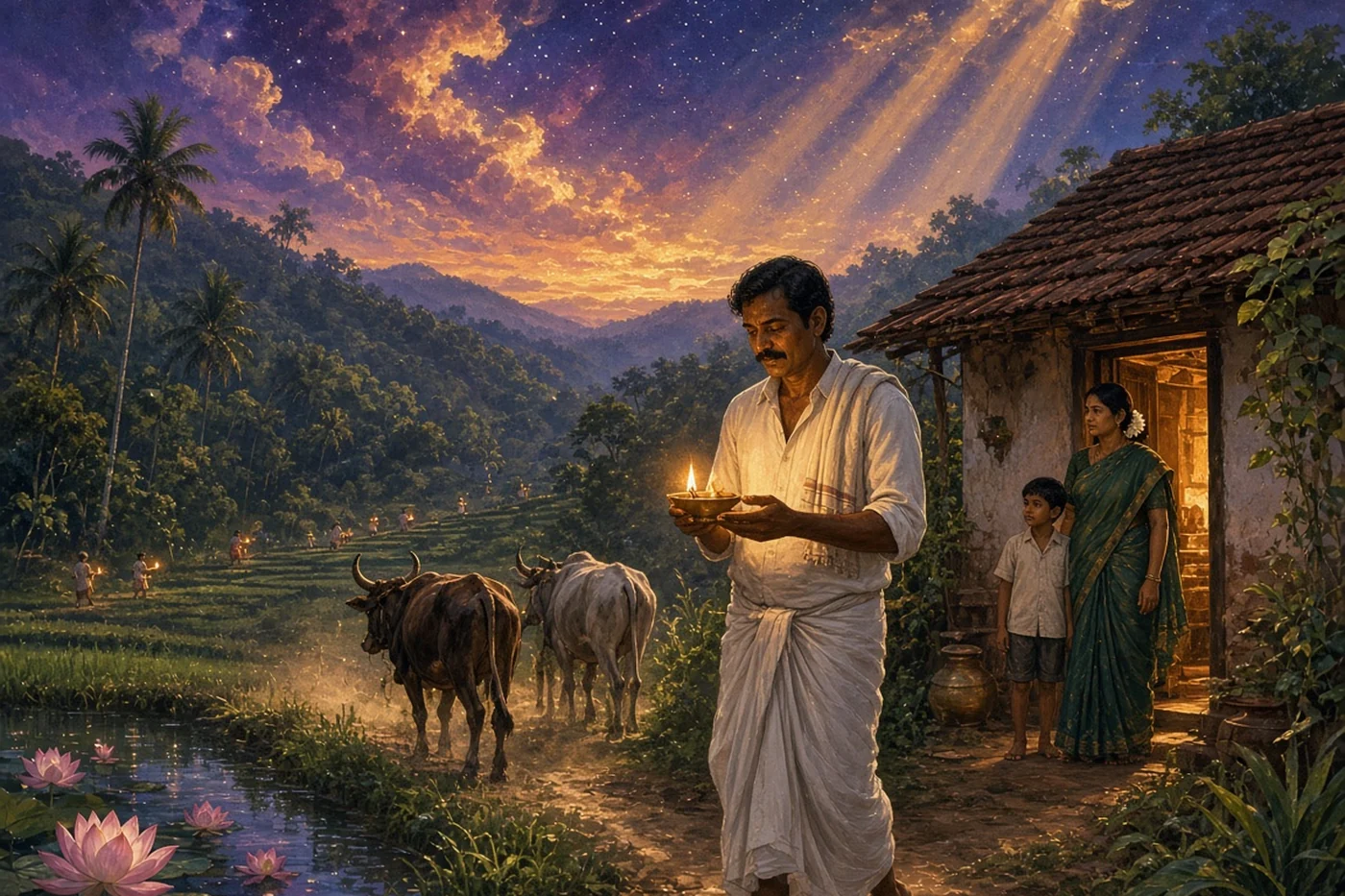
Later they heard singing from the lane. A party of young men had come with a lamp from the village temple, going from house to house as they would for three nights, the antige pintige singers. Savitri's son ran for rice, a few coins and sweets, and they sang one more verse in thanks before they moved on to the next door.
"Is that for Bali too?" he asked.
"Everything tonight is for Bali," she said.