As the Bhagavata tells it
Bhagavata Purana 8.16 to 8.18 · Kashyapa's hermitage · 4 min read
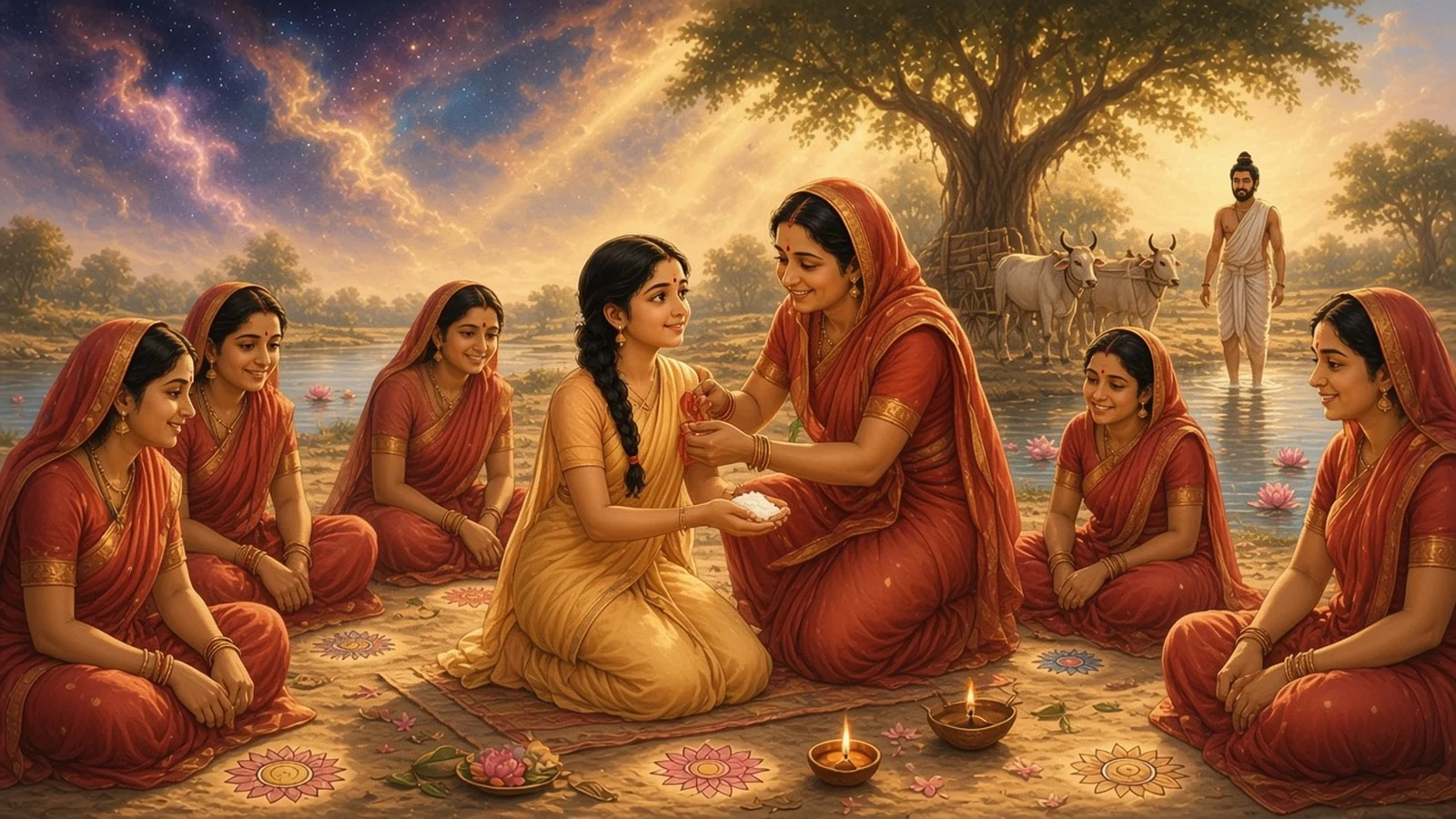
When King Bali drove the gods out of heaven, their mother Aditi grieved as if no one were left to protect her. Her husband, the sage Kashyapa, was deep in a long meditation, and the hermitage had gone cheerless.
When at last he came out of his trance, he saw it at once. He sat down beside her.
"What has gone wrong in this house?" he asked. "Has a guest come to our door and gone away unwelcomed? Has the fire gone without its offering?"
"Nothing like that," said Aditi. "The fires are tended. The guests are fed, and the servants, and the beggars at the gate. It is my sons. The Daityas have taken everything from them, their wealth and their beauty, their good name and their home. You are wise. Tell me how they can have it back."
Kashyapa smiled. "How strange the Lord's illusion is," he said. "Still, there is one who can help you. Worship Vasudeva, who lives in every heart. Brahma once taught me a vow for that, and I will teach it to you."
It was the vow of milk. For twelve days in the bright half of Phalguna, Aditi was to take nothing but milk. On the dark night before it began she rubbed her body with earth a wild boar had turned up and bathed in a running river.
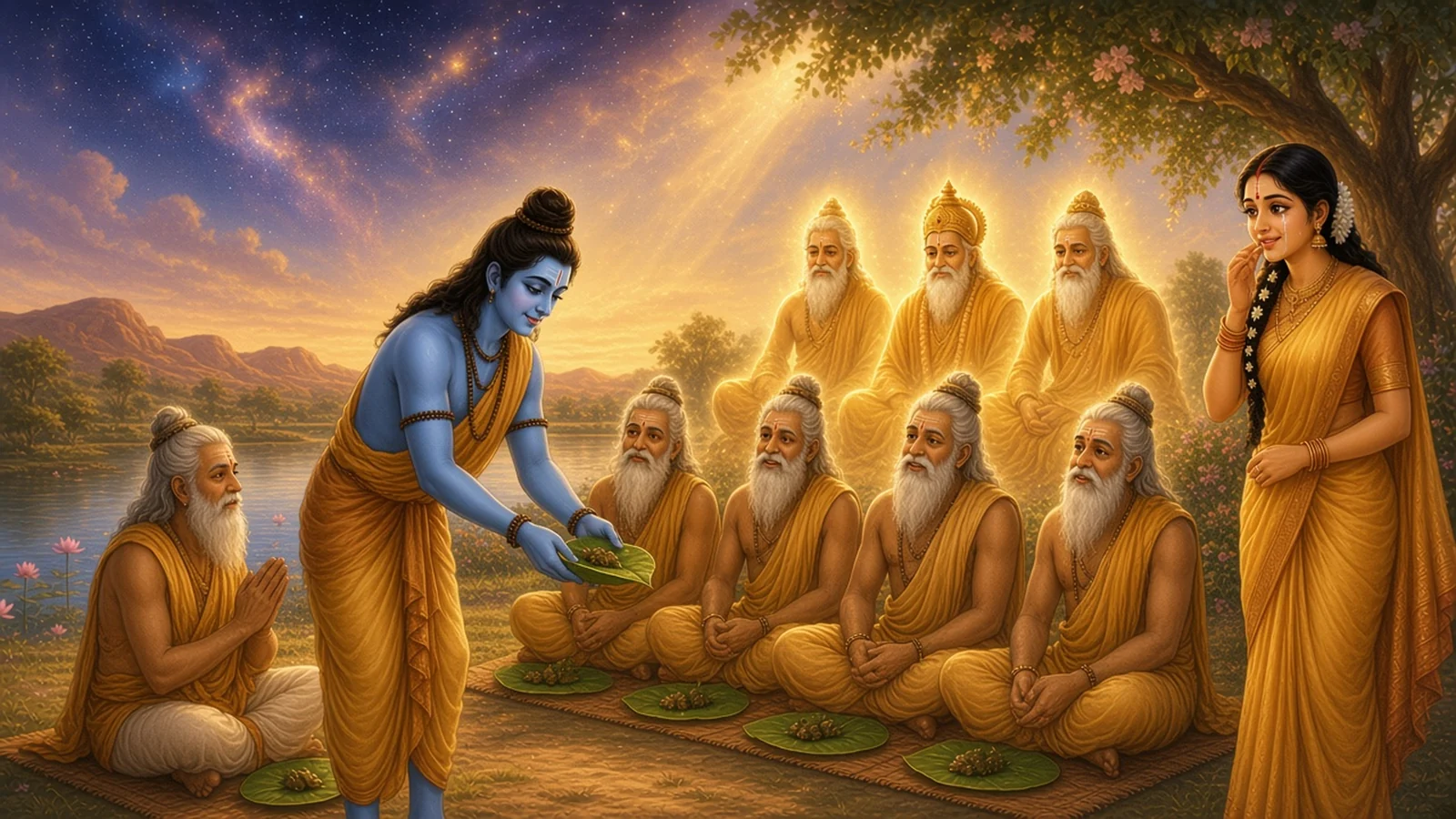
Every day after that she bathed the image of the Lord in milk, offered rice boiled in milk into the fire, repeated his twelve syllables a hundred and eight times, and fed brahmins. She slept on the ground and spoke of nothing idle. On the thirteenth day the image was bathed in milk, curd, ghee, sugar and honey, and everyone who came was fed, the poor and the blind among them, with singing and drums.
Aditi kept it all, her mind on the Lord and nothing else.
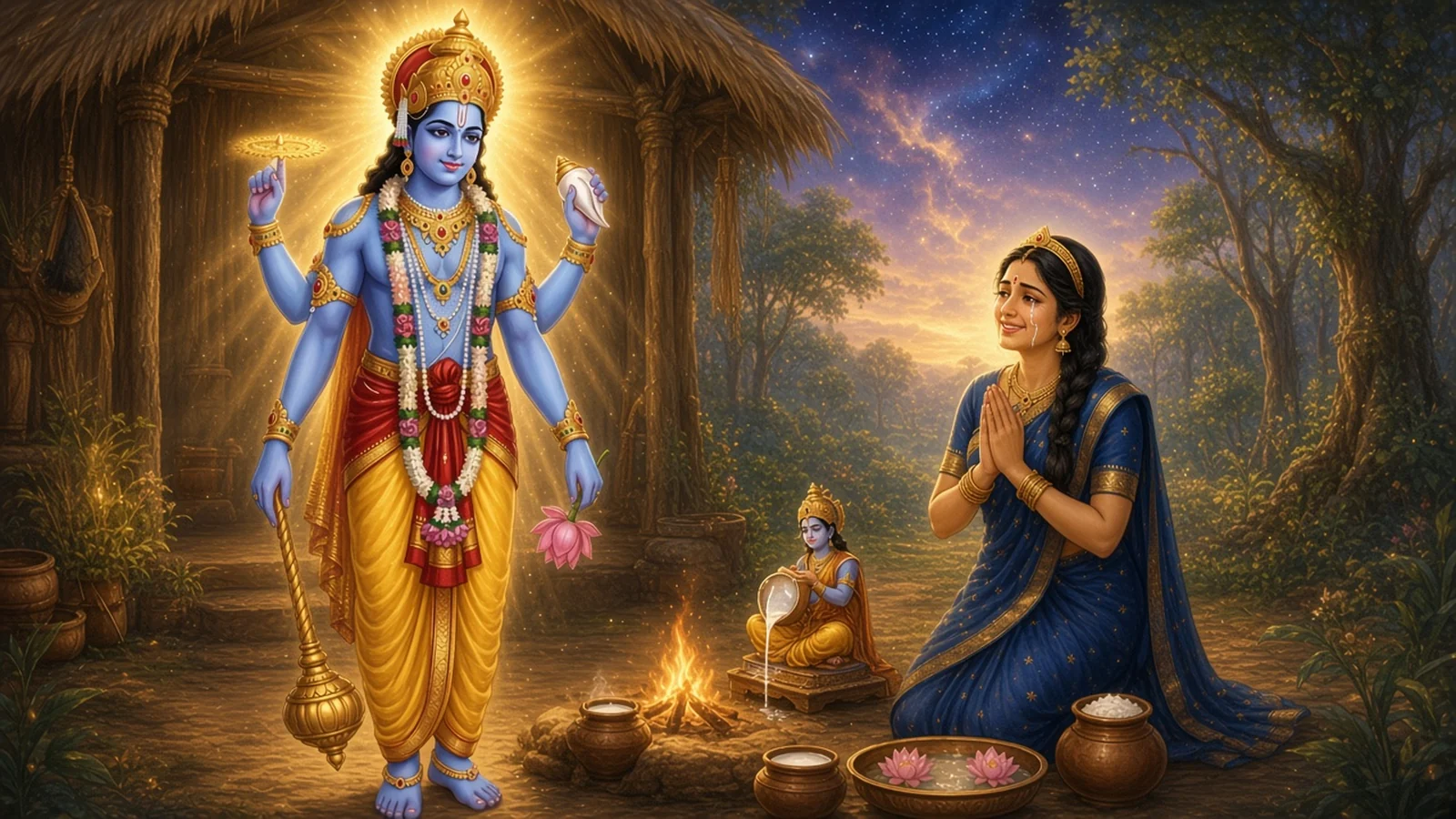
On the last day he stood before her, four-armed, in yellow silk, with the conch and the discus, the mace and the lotus. She fell full length at his feet. Then she stood with joined hands and could not say a word. Tears ran down her face and she shook. When her voice came back, it trembled.
"Lord of every sacrifice, shelter of the poor," she said. "Be kind to my family."
"I know what you want," said the Lord. "Your sons home in heaven, and their enemies' wives in tears. But the Asura chiefs cannot be beaten now. The brahmins protect them, and force would bring no one happiness. Yet your vow has pleased me, and worship of me is never wasted. I will be born as your son, to protect your other sons."
Then he set her two conditions. "See me living in your husband, and serve him. And tell no one, even if they ask. A secret kept is a secret that works."
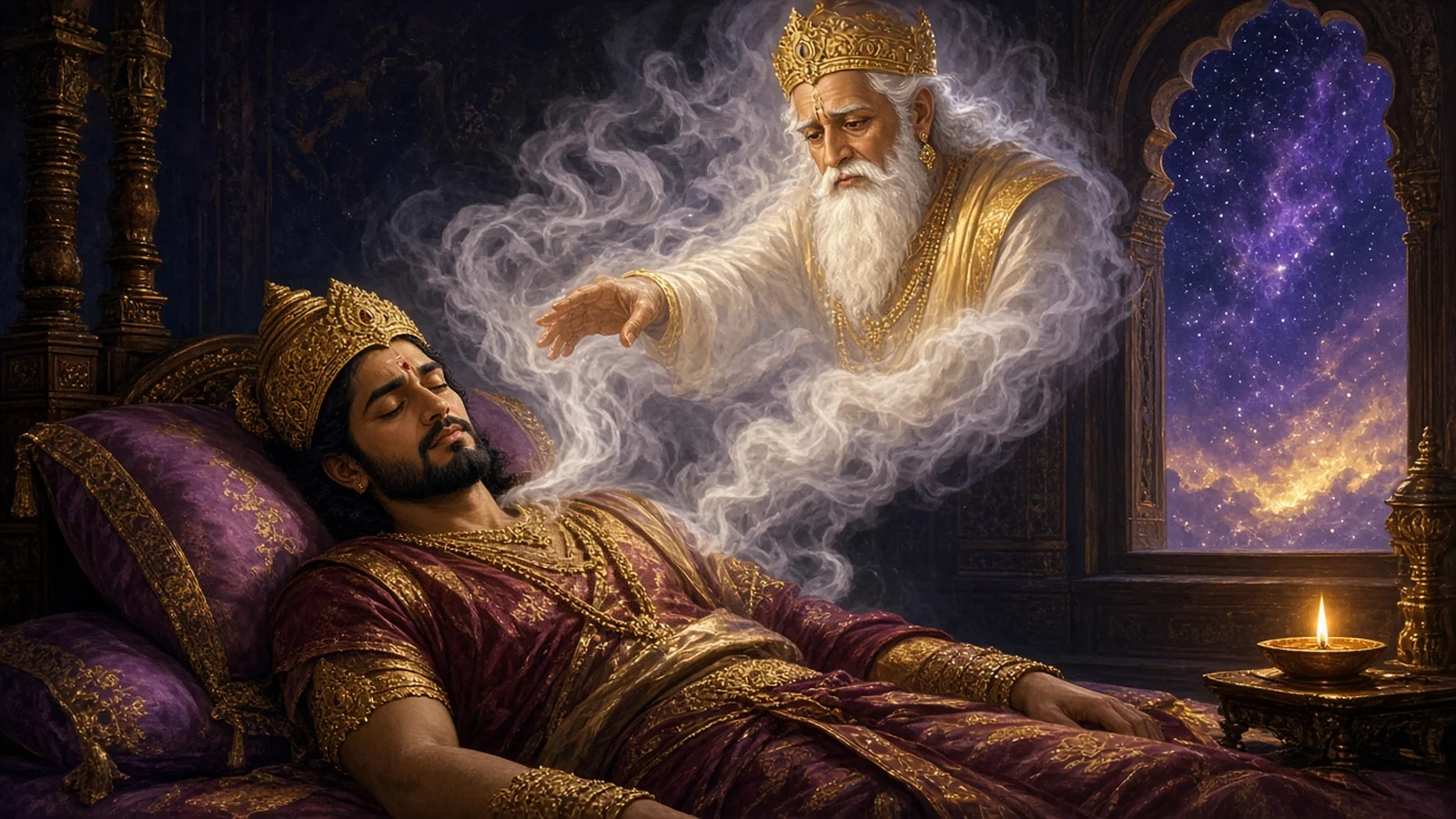
He vanished. In his trance Kashyapa felt a part of the Lord enter him, and as fire is drawn out of wood by rubbing, he passed it on to Aditi. Brahma knew at once, and came to praise the child in her womb.
He was born on the twelfth day of the bright half of Bhadrapada, under the star Shravana, at noon. Drums and conches sounded in the sky and flowers fell on Aditi's house. She looked at her son: dark, four-armed, lotus-eyed, the Kaustubha gem at his throat. Kashyapa cried out, "Victory! Victory!"
Then, while his parents watched, the child changed his form the way an actor changes costume, and became a dwarf, a brahmin boy.
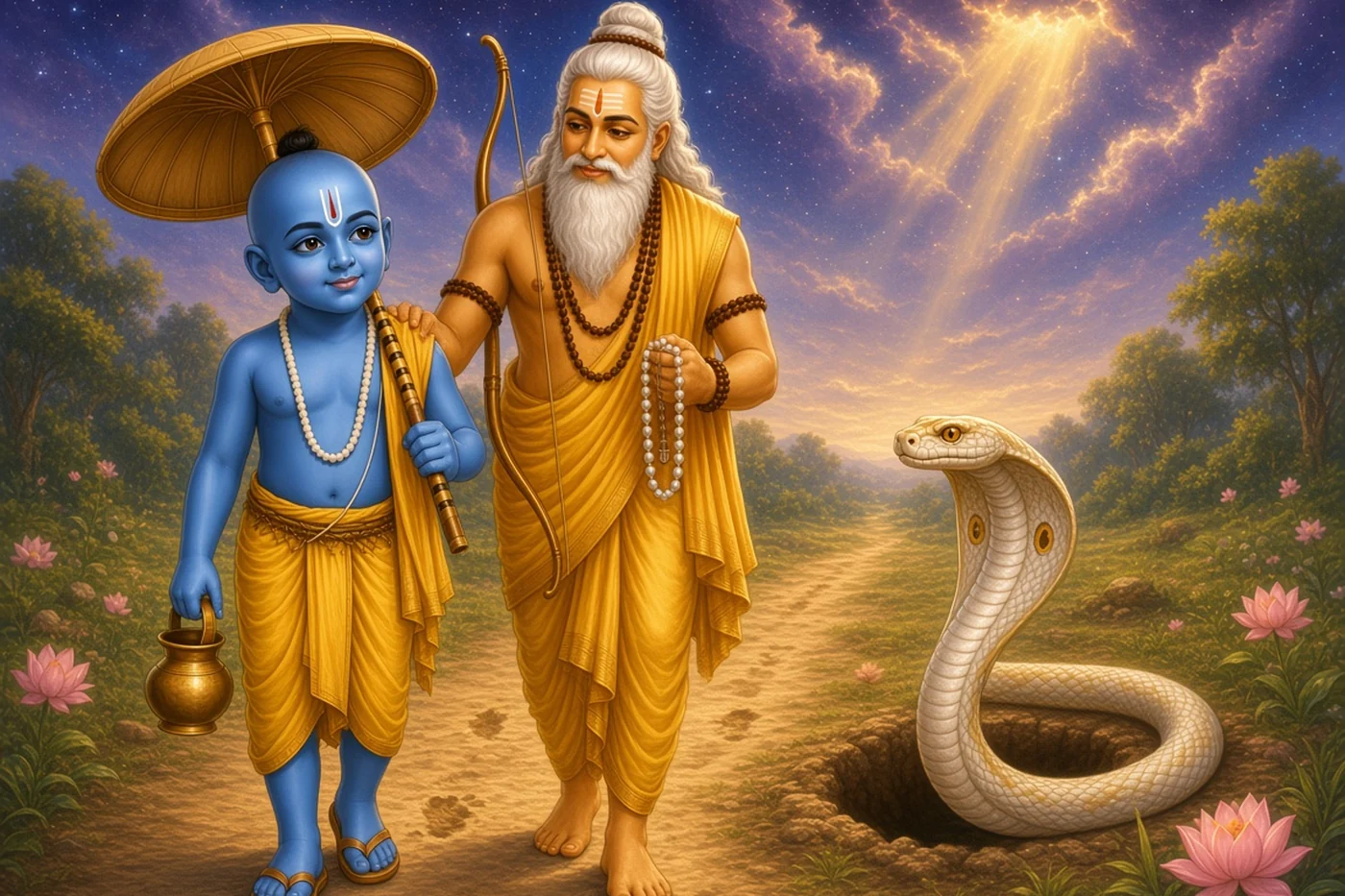
Every god brought a gift for his thread ceremony. The Sun spoke the Gayatri to him. Brihaspati gave the sacred thread and Kashyapa the belt of grass. The Earth gave a deerskin, the Moon a staff, his mother a cloth, and the lord of heaven an umbrella. Brahma gave a water pot, the seven sages kusha grass, and Sarasvati a string of beads. Kubera gave a begging bowl, and Bhavani, Shiva's wife, put the first alms into it.
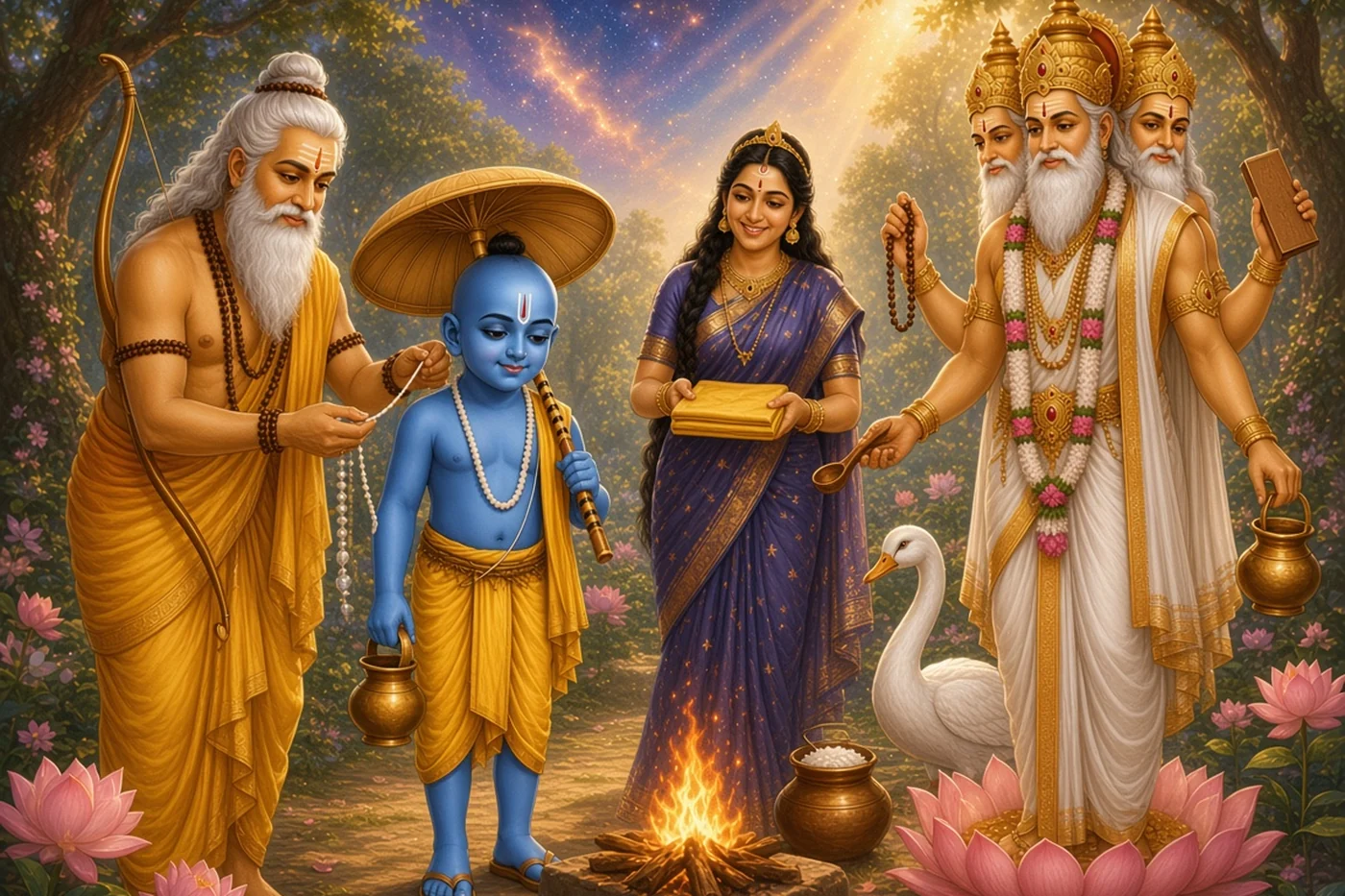
The boy lit his own fire and made his offering. Then he heard that King Bali was holding horse sacrifices on the Narmada, and he set out. The ground sank a little under every step he took.
As the Vamana Purana tells it: the forest of Aditi
Vamana Purana 25 to 30 · Aditivana, Kurukshetra · 2 min read
In the Vamana Purana it is Indra who brings his mother the news. Bali holds the three worlds, he tells her, and she answers plainly. "You cannot kill him, my son, not with every god and storm god behind you. Only the thousand-headed one can. I will ask your father."
Kashyapa took the gods and Aditi to Brahma's hall, where the Vedas were being chanted. Brahma told them their wish would be granted, and sent them north, to a place on the shore of the Ocean of Milk called Amrita, the deathless. There Kashyapa kept a vow of a thousand years, in silence, and sang his hymn to Narayana, and the Lord answered him.
"Be born from Aditi," Kashyapa asked, "so that Indra may call you his younger brother." Aditi asked it too, and the Lord agreed.
They went home to Kashyapa's hermitage in Kurukshetra, and there Aditi went on alone. For ten thousand years she kept silence and lived on air. The forest where she sat, the Purana says, has been called Aditivana, Aditi's forest, ever since.
The Lord came to her there and told her to ask.
"Give Indra back the three worlds," she said. "It is not the lost throne that hurts. It is the share of the sacrifice taken from him."
"I will come into your womb," he said.
"How could I carry you, when everything is inside you?"
"I will carry you and myself," said the Lord. "You will feel no pain."
Soon the mountains began to tremble and the seas to rise. Where Aditi walked, the ground pressed down under her feet, and from that day the Asuras' splendour began to fade. In the tenth month he was born, and Brahma and the sages brought their gifts: Brahma a black deerskin, Brihaspati the thread, Marichi a staff of palasha wood, Vasishtha a water pot, Pulastya two garments.
Then the dwarf, with matted hair, staff, umbrella and water pot, set out for Bali's sacrifice. The earth shook though he stepped gently, and his footprints sank into trenches. Brihaspati walked beside him as his guide and slowed his pace, half in play. The great serpent rose from the world below to help him on his way, and the place where it came up is still called Ahivila. Whoever sees it, the Purana says, never fears a snake.