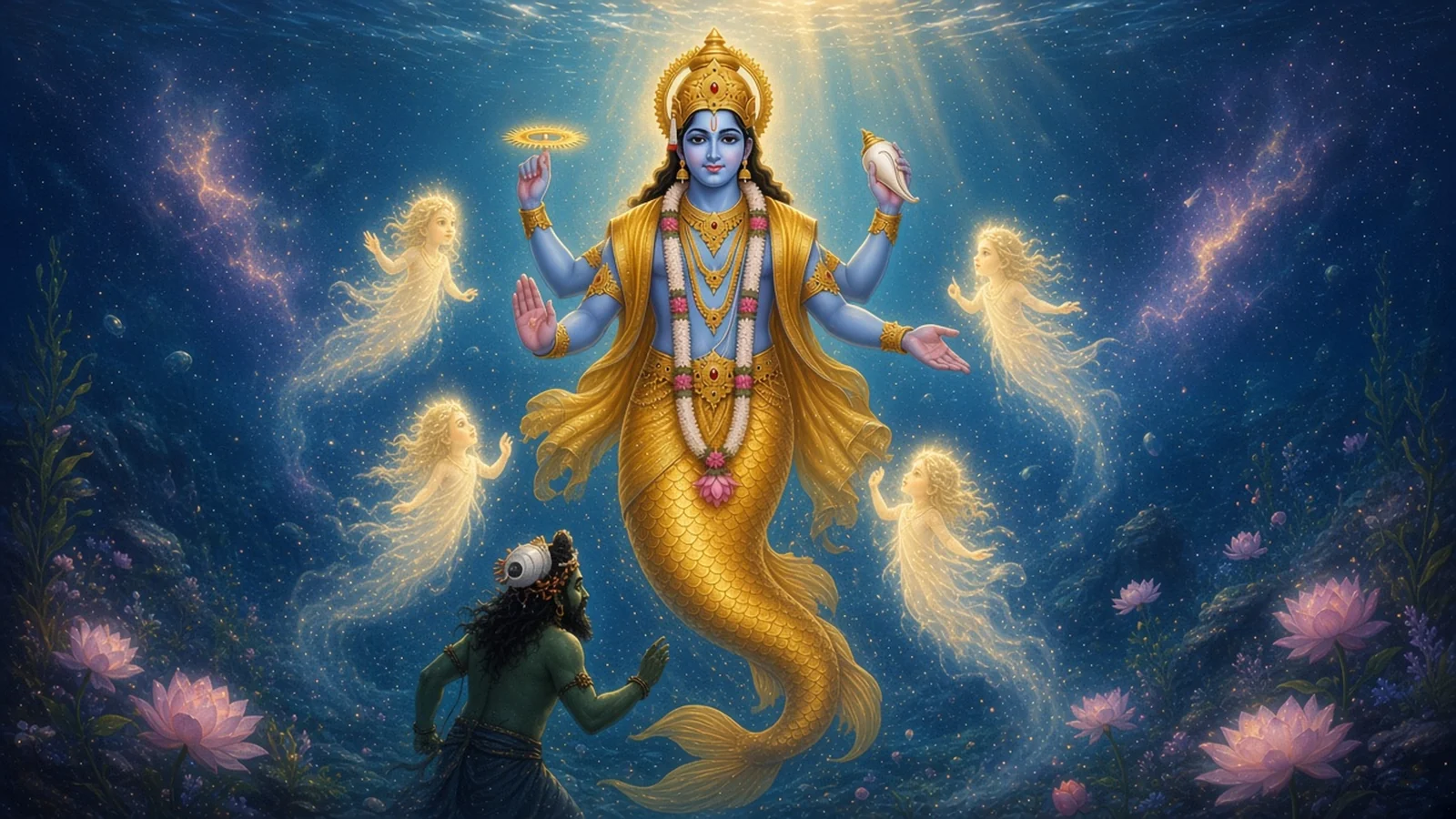
As the Matsya Purana tells it
Matsya Purana 1 to 3, 9, 52 and 58 · the Naimisha forest and the flood · 3 min read
In the Naimisha forest, when a long sacrifice was over, the sages sat with the bard Suta and asked him for stories they had heard before and never tired of.
"Tell us how Brahma made the world," they said. "And tell us why Vishnu took the shape of a fish."
"Then hear the Matsya Purana," said Suta. "It is not mine. Vishnu spoke it himself, in the form of a fish."
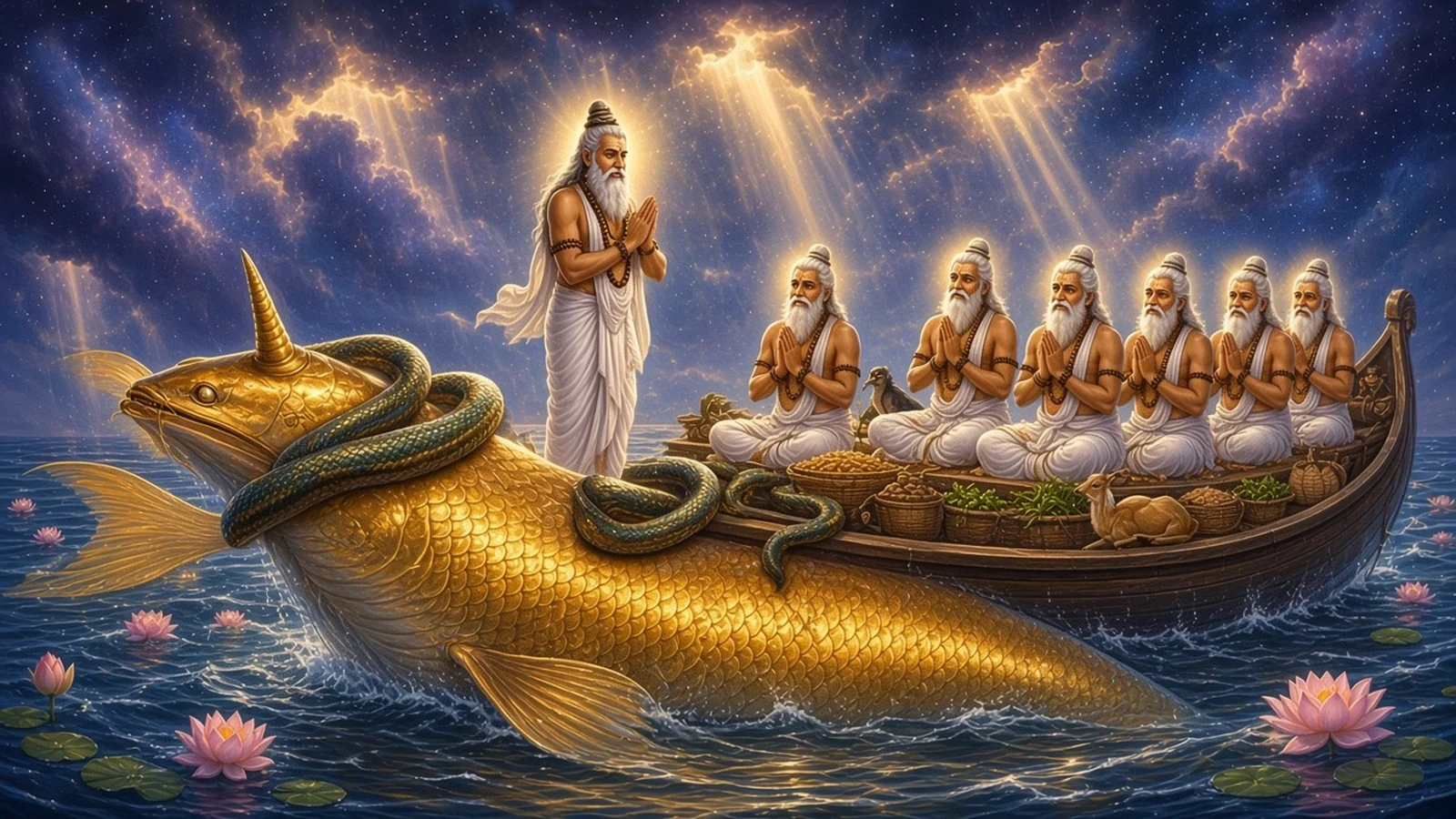
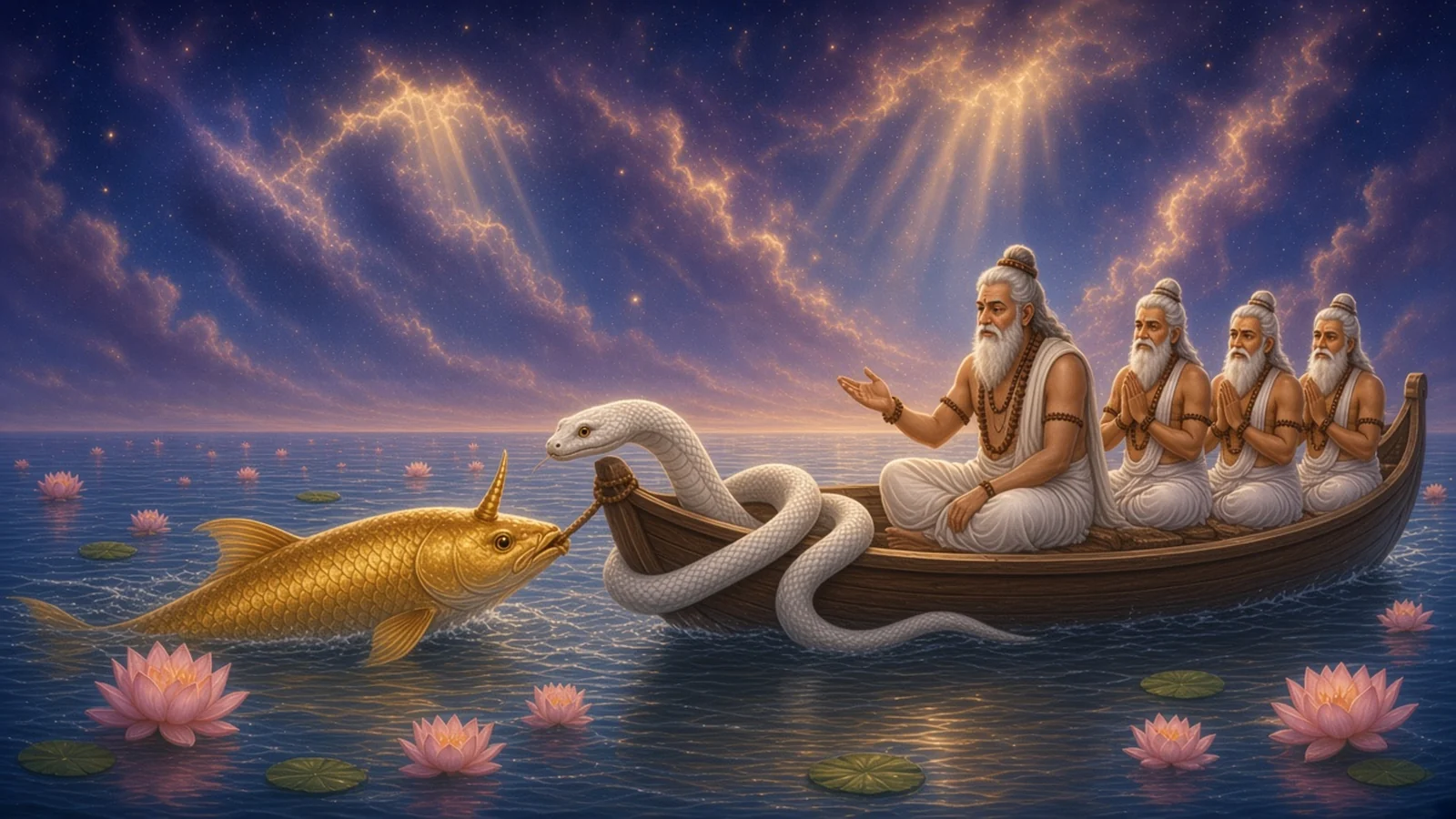
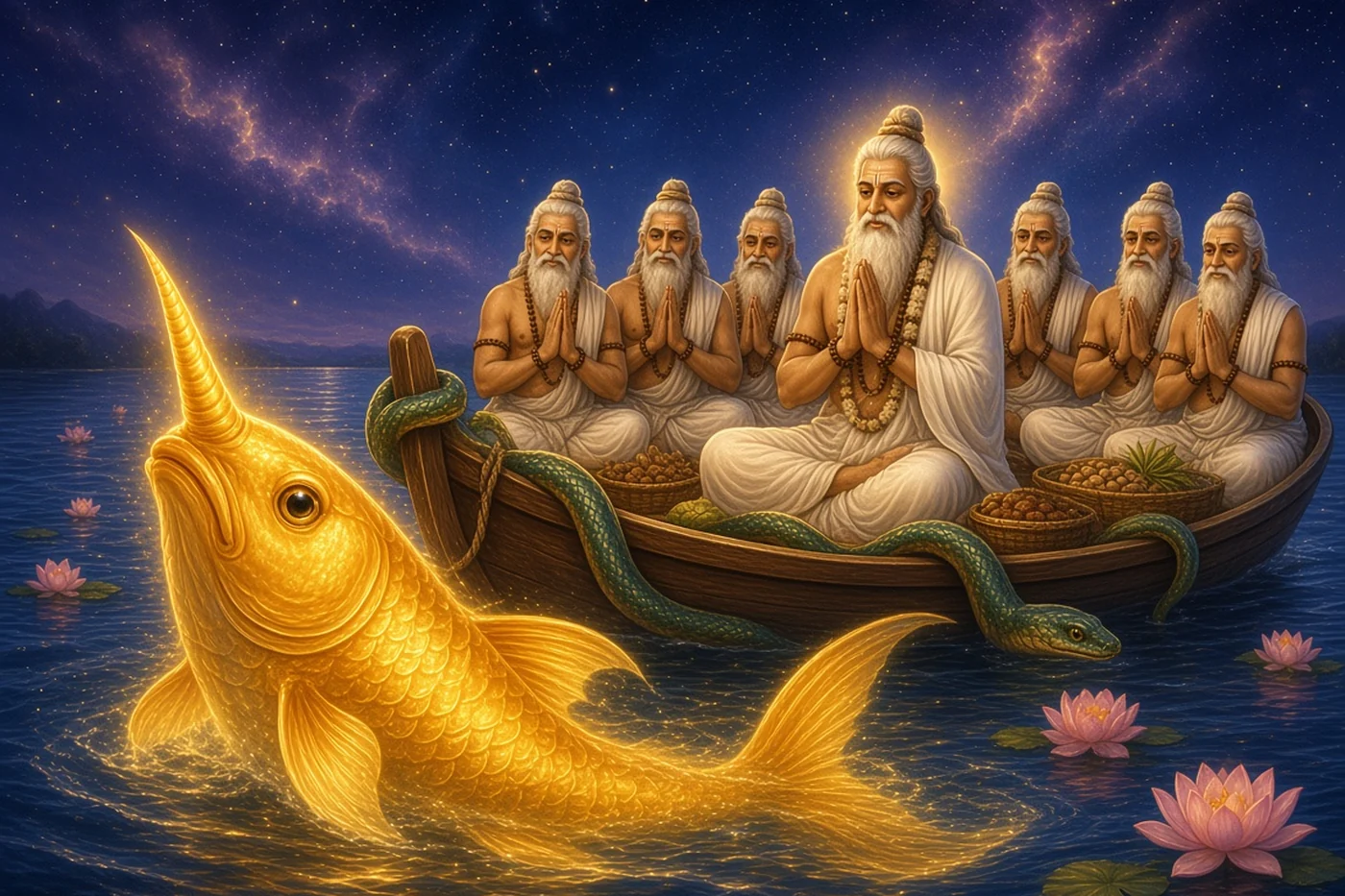
He told them of King Manu, of the fish that grew until it filled the ocean, of the fire and the rain at the end of the age, and of the boat tied to the fish's horn with the serpent Shesha for a rope. Then he came to the part they had really asked for.
The boat rode on water that had no edges. Everything else was gone. Manu sat in the boat, the fish lay vast and horned in the water before him, and Manu began to ask.
"Lord, tell me how the world ends and how it begins again. How did men come to be? What is the age of a Manu? Tell me about the great men of old, and how large the world is. Tell me the ways of giving, the path of duty and the rites for the ancestors. Tell me about the classes and the stages of life, the sacrifices, and the greatness of the gods."
The fish began at the very beginning.
"In the great dissolution," it said, "everything lay in darkness, as still as a sleeper in a trance. Nothing could be known and nothing could be named. Then the Self-born appeared, wishing to make a world. First he made the waters, and he set a seed in them. The seed became an egg of gold, and after a thousand years it shone brighter than ten thousand suns. He entered the egg, and because he fills it he is called Vishnu."
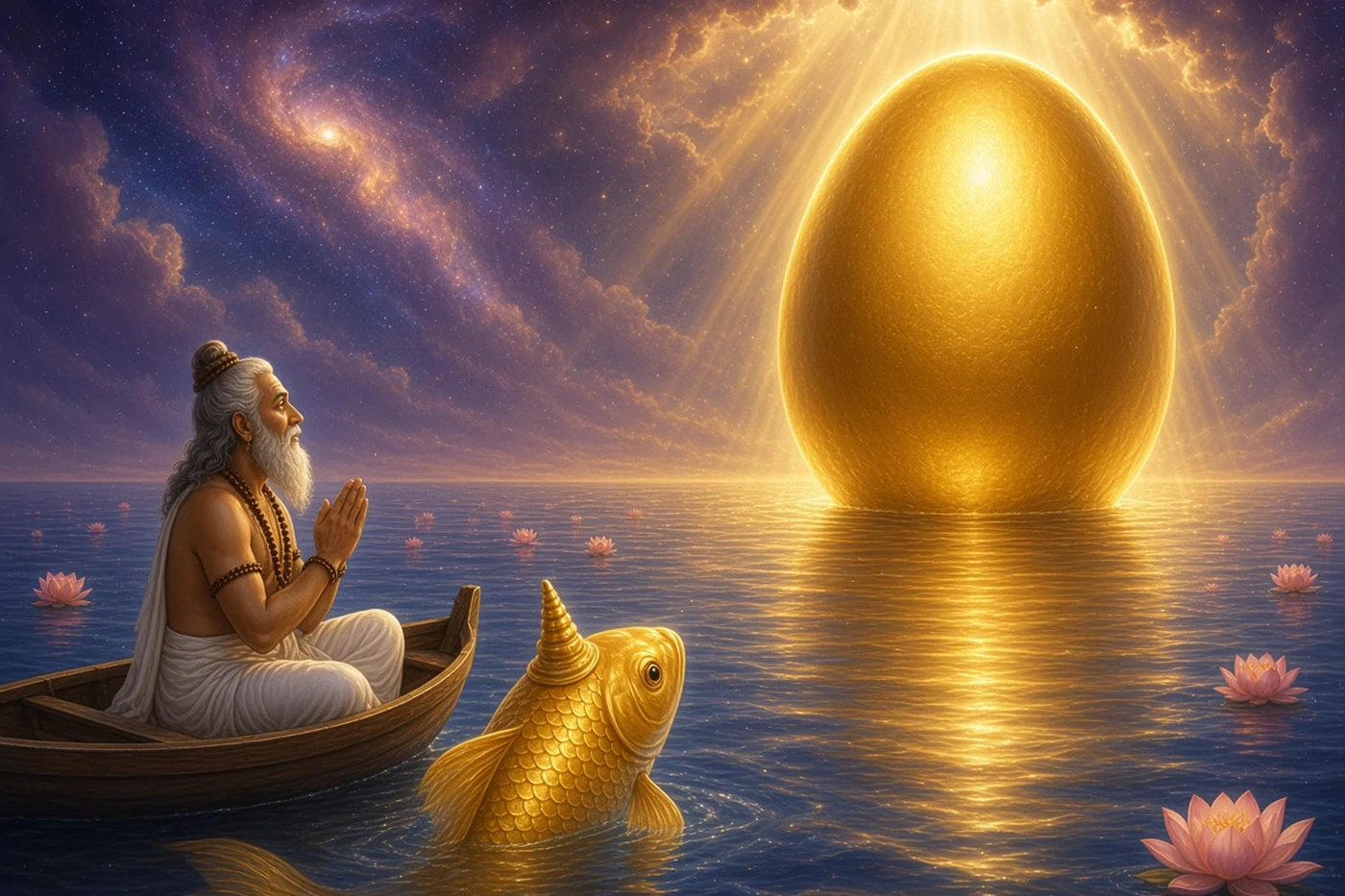
The fish told how the sun came out of the egg first, and so is called Aditya, the first one. It told how the egg split, its upper half becoming the sky and its lower half the earth, and how the quarters got their names: east where the sun stood, south on Brahma's right hand, north on his left, west behind his back. Then came Meru and the clouds, the rivers and the ancestors, the Manu and the seven seas.
"And how did Brahma make the world?" asked Manu. "Why does he have four heads?"
So the fish told him of Brahma's long penance, of the Vedas that came to him in it, and of the ten sages born from his mind.
The questions did not stop. When the fish had told of the first creation and of the kings who came after it, Manu asked about the Manus of the ages before his own.
"Listen, king," said the fish, and told him.
He asked about duty, and the fish explained the way of action and the way of knowledge. He asked how a new tank or well should be consecrated, a grove planted or a temple dedicated, and the fish, lying in the water, told him that too.
The Matsya Purana is made of those answers. Suta gives each one to the sages as the fish's own words, chapter after chapter, and when the Purana lists all the Puranas it describes itself the same way: the one the Lord told to Vaivasvata Manu, in the form of a fish, at the beginning of the age. Its opening verse asks for the blessing of those words, spoken by the fish whose tail, as it rose from the depths, flung the seven seas up against the sky.
As the Bhagavata tells it
Bhagavata Purana 8.24.45 to 58 · on the flood · 2 min read
In the Bhagavata it is the king who speaks first, and he does not ask how the world was made. He asks for a teacher.
Satyavrata had just tied the boat to the golden fish's horn with the serpent Vasuki. The flood was all round them, and the seven sages sat with him in the boat. He folded his hands.
"We have been lost in ignorance for longer than anyone can remember," he said, "and by your grace we meet those who love you, and through them we come to you. You are the teacher of all teachers. Ignorance burns away near you the way dross burns out of gold in a fire. All the gods and gurus together could not give a ten-thousandth part of the grace you give. A man who follows a worldly teacher is a blind man led by the blind; such a teacher can show him only money and pleasure."
He looked out at the fish in the dark water. "You see in every direction. You are the friend in the heart, the self, the giver of knowledge, and we do not see you only because our minds are full of wanting. I come to you for shelter. Cut the knot of wanting in my heart."
The fish answered as it swam, pulling the boat through the dark water. It taught him the Sankhya, the knowledge that tells the self apart from what is not the self, and it told him the Puranas and the sacred collections, and in all of them it explained itself. The king and the sages sat in the boat and listened, and by the end they had no doubts left.
The night of Brahma ended, and the fish gave the Vedas back to the waking creator. As for Satyavrata, the Bhagavata says, he is the one who was born again as the son of Vivasvat, the Sun, and he is the Manu of this age, called Shraddhadeva.