Festival · The fourth night of every waning moon, kept for Ganesha the remover of troubles, with a fast that ends only when the moon comes up
Sankashti Chaturthi
Sankashti Chaturthi is the fourth day after every full moon, twelve or thirteen times a year, when those who keep it fast for Ganesha from sunrise until the moon rises and break the fast only after pouring water to it. Each month's Sankashti carries one of Ganesha's names. When it falls on a Tuesday it is Angaraki, the Sankashti that Mars won from Ganesha, and Maharashtra's temples overflow; in the north the one in Magha is Sakat Chauth, kept by mothers for their children with sesame and jaggery.
When is Sankashti Chaturthi in 2026? Ganadhipa Sankashti, in Margashirsha, is Friday 27 November 2026. In 2026: Saturday 26 December 2026. The fourth of the waning half of every lunar month, on the day the Chaturthi is current at moonrise; Angaraki when that day is a Tuesday, Sakat Chauth when the month is Magha.
Also calledSankashti ChaturthiSankashta ChaturthiSankatahara ChaturthiSankashtahara ChaturthiSankat ChauthSakat ChauthTilkuta ChauthAngaraki ChaturthiAngarkiSankashti
In short
What is Sankashti Chaturthi?
The fourth day after every full moon, kept for Ganesha as the remover of troubles. Those who keep it fast from sunrise and eat only after the moon rises and they have poured water to it.
When is the next Sankashti Chaturthi?
Friday 27 November 2026, Ganadhipa Sankashti, with moonrise at 8:18 pm in Delhi; then Saturday 26 December 2026. In 2027 there are twelve, from Sakat Chauth on Monday 25 January to Thursday 16 December.
What is Angaraki Chaturthi?
A Sankashti that falls on a Tuesday, the day of Angaraka, the planet Mars, whom the Ganesha Purana makes its winner from Ganesha. It is said to count for a year of Sankashtis. The only one in 2027 is Tuesday 22 June; in 2028 there are two, on 8 August and 5 December.
Why is the fast broken only after seeing the moon?
Because the Ganesha Purana makes it part of the vow. After the Moon's curse Ganesha tells him that on the dark Chaturthi he is to be worshipped and seen at his rising, or the vow is in vain, and wears him on his forehead as Bhalachandra.
How is Sakat Chauth different?
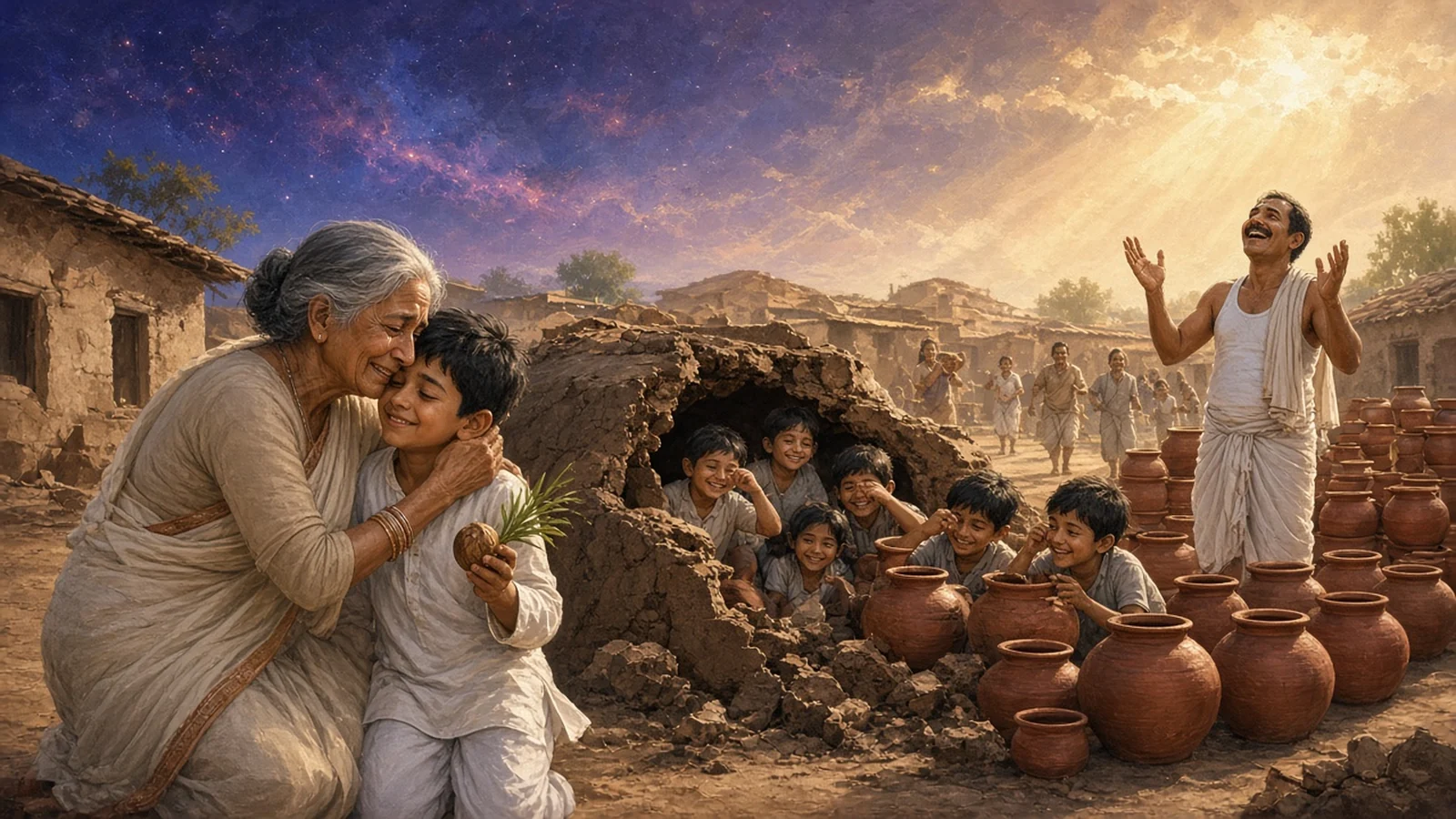
It is the same night in Magha, kept in the north by mothers for their children, with Sakat Mata worshipped beside Ganesha, tilkut of sesame and jaggery as the offering, and the story of the potter's kiln.
Next, in 2026Friday 27 November 2026
Prime godGanesha
with 3 more
WhereMaharashtra above all, and coastal Karnataka; Tamil Nadu as Sankatahara Chaturthi; the Hindi country for Sakat Chauth in Magha; Ganesha's temples everywhere
How longOne day, from sunrise to moonrise, broken in the evening after the moon is seen
The fourth of the waning half of every lunar month, on the day the Chaturthi is current at moonrise; Angaraki when that day is a Tuesday, Sakat Chauth when the month is Magha
Why it is kept
Twice a month the moon is four days from full or new, and the fourth night of the waning moon belongs to Ganesha in his gentlest office, as the one who takes trouble away. The name comes from sankashta, trouble. Those who keep it eat nothing through the day, worship him in the evening, and then wait, sometimes until after ten at night, for the moon to clear the rooftops so that they can pour water to it and eat. It comes twelve or thirteen times a year.
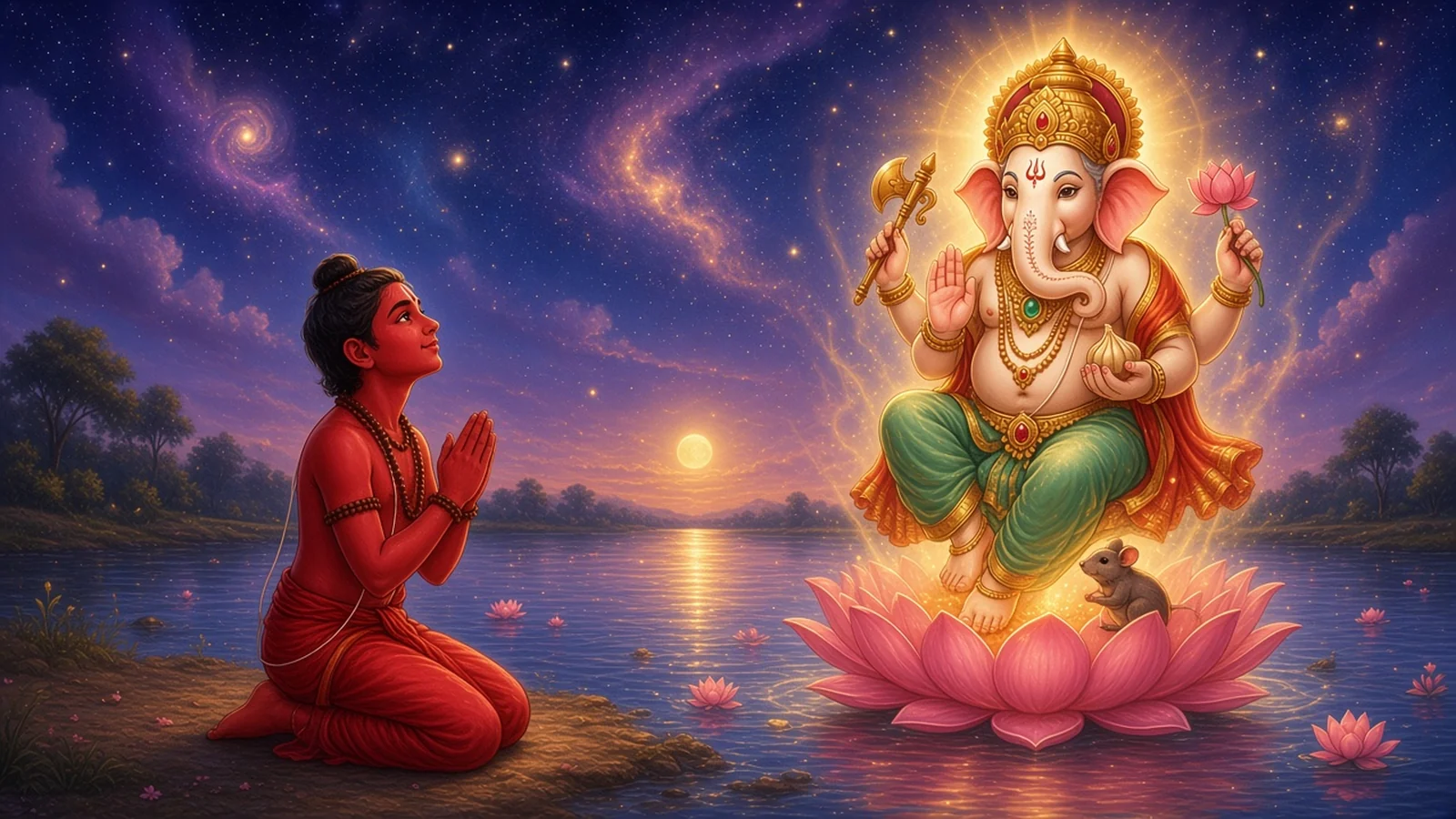
The fast is kept so that Ganesha will remove whatever stands in the keeper's way, and the vow's books are full of people it helped: Parvati, who kept it four months and saw her son Skanda come home in the fifth; Damayanti, searching for Nala; Rukmini, waiting for Pradyumna. The Tuesday Sankashti has a story of its own. A boy red as a hibiscus, raised by the Earth, learned Ganesha's mantra from the sage Bharadvaja and repeated it on the Narmada for a thousand years; when Ganesha came to him at moonrise on a Chaturthi, he asked that the day free its keepers from every trouble, and was named Mangala and Angaraka, the planet Mars. The Red Planet's Boon tells it, with the Angaraki of Mumbai and Theur.
The red boy meditates on the bank of the Narmada, and Ganesha comes to him at moonrise
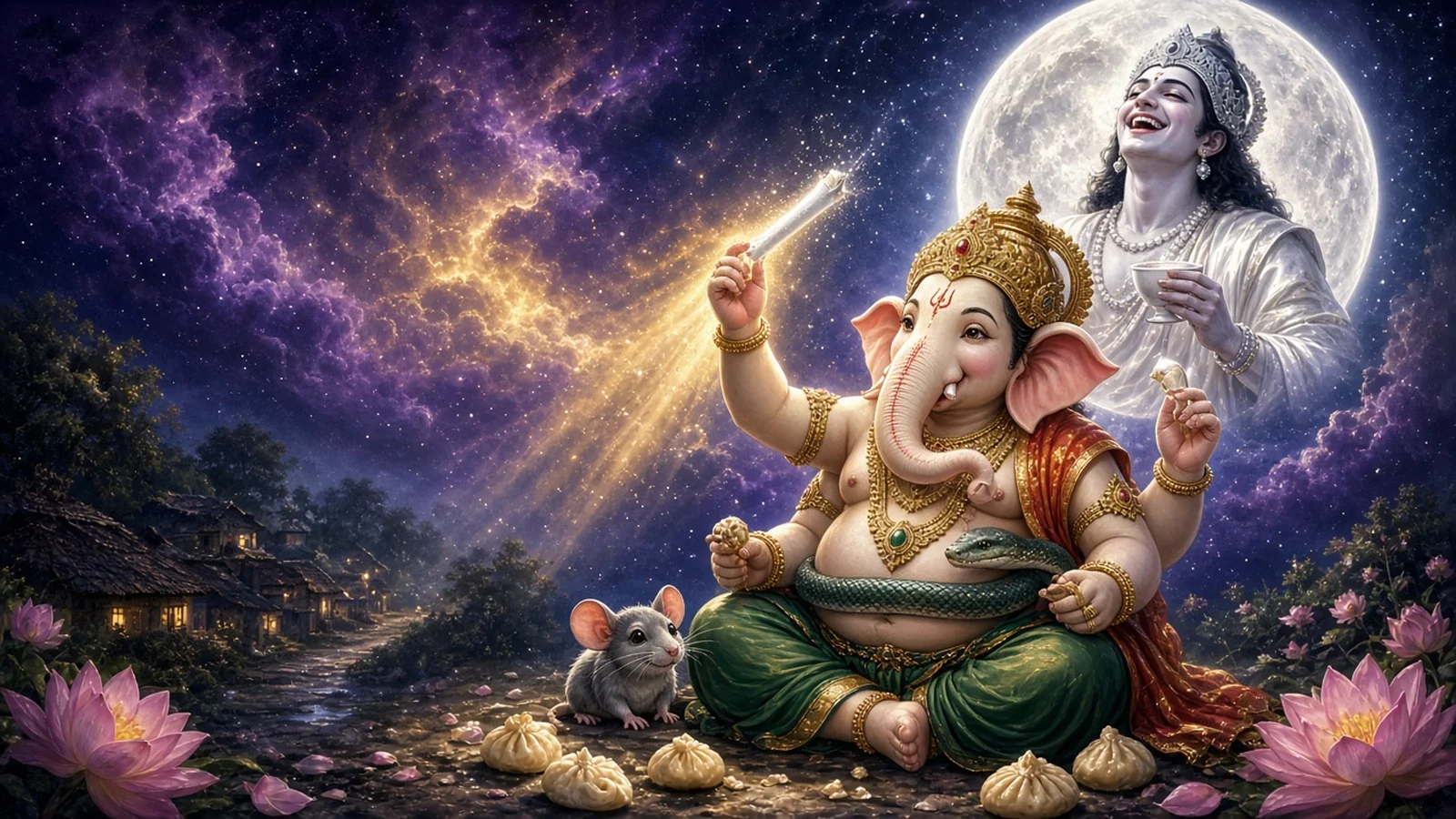
The moon is in it because of an old quarrel. The Moon laughed at Ganesha and was cursed, as The Moon Who Laughed at Ganesha tells. In the Ganesha Purana, when the curse is softened, Ganesha takes the Moon onto his forehead and adds that on this dark Chaturthi the Moon must be worshipped and seen at his rising or the vow is empty. In the north, on Sakat Chauth, mothers keep the night for their children and tell of an old woman's only son sent into a burning kiln, in The Potter's Kiln.
Bhalachandra: Ganesha wears the crescent Moon at his crown as the Moon bows before him
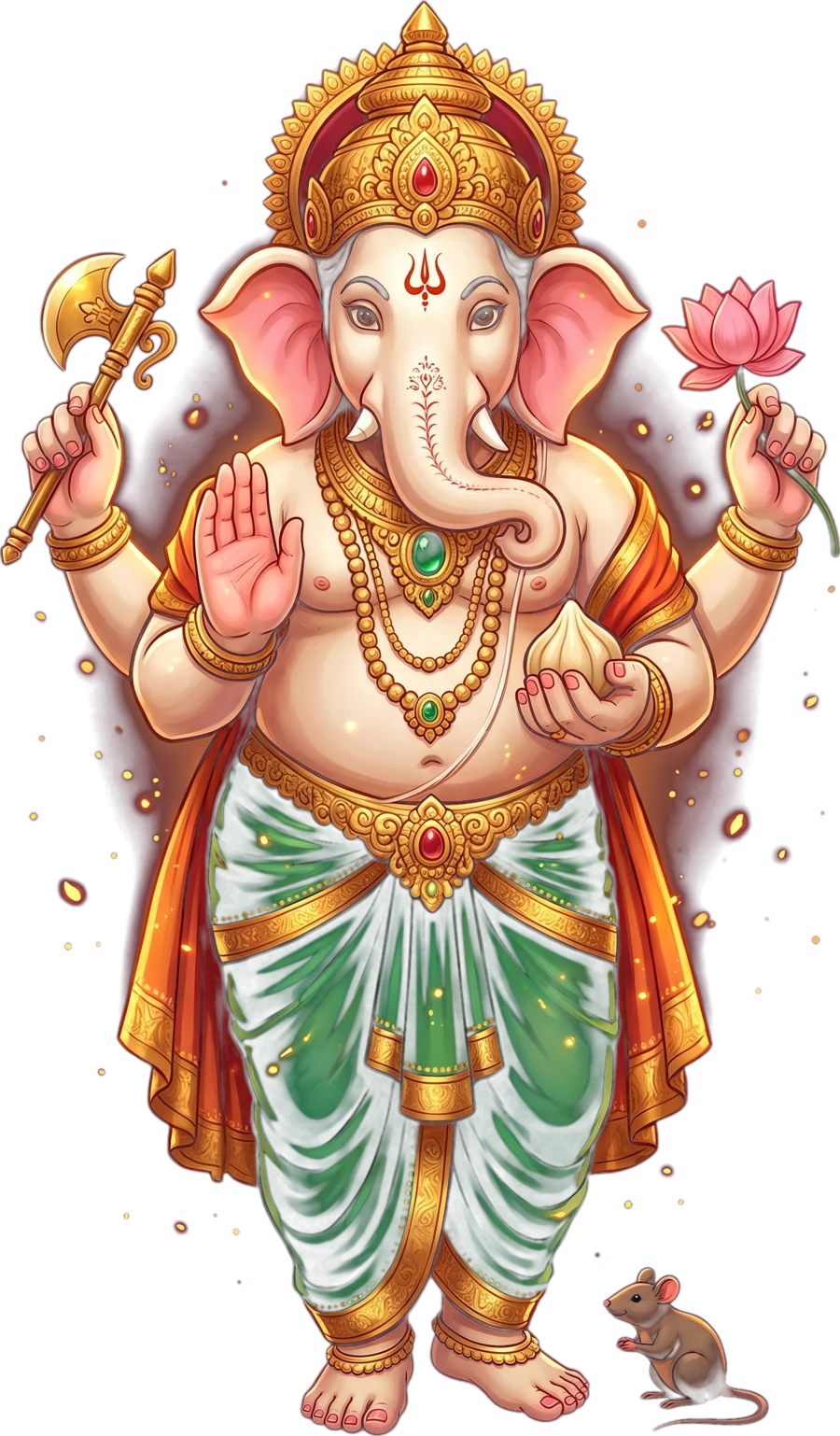
Sankatahara, the one who takes troubles away, and Vighneshvara, lord of obstacles. Every Sankashti is his, under a different name each month, Lambodara in Magha, Krishnapingala in Ashadha, Vakratunda in Kartika; he is worshipped at moonrise with twenty-one shoots of durva and modaks, and every one of the sixteen offerings in the Ganesha Purana's rite ends with the plea to keep trouble away.
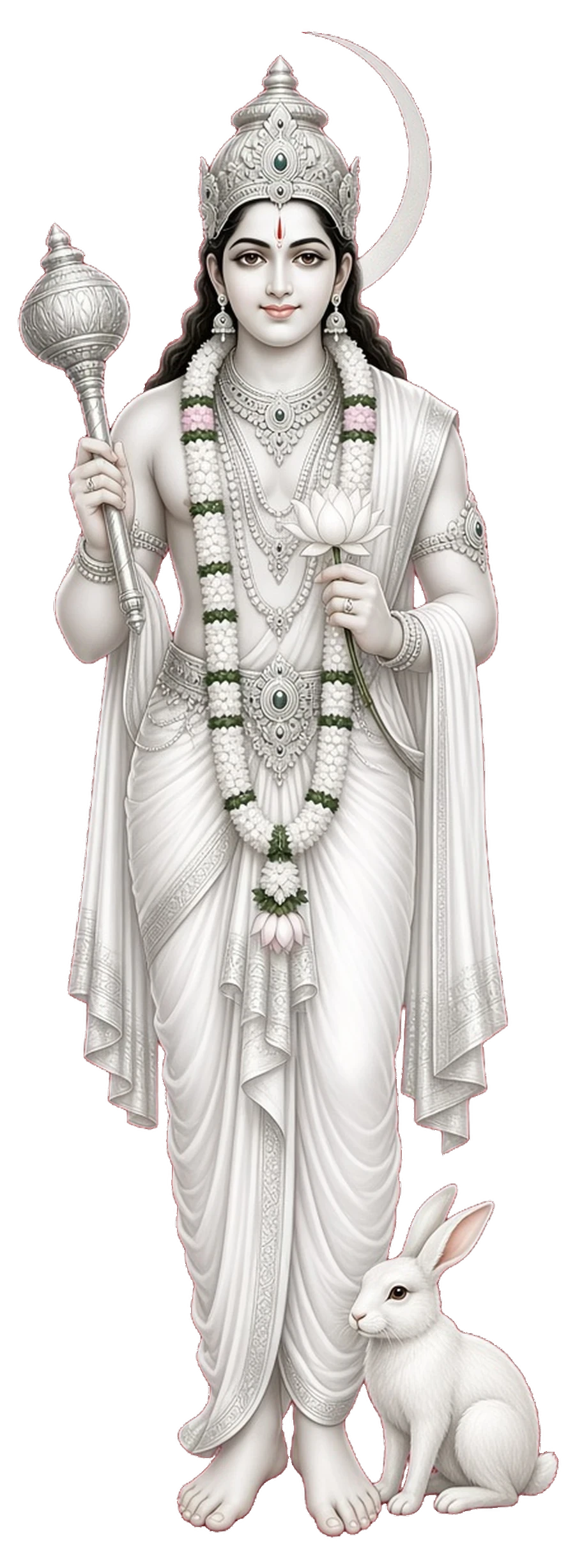
The moon the fast waits for. In the Ganesha Purana, after the curse that is lifted, Ganesha tells the Moon that on the dark Chaturthi he must be worshipped and seen at his rising or the vow is in vain, and keeps him on his forehead as Bhalachandra; the arghya of water, milk and sesame poured to him is the last act before the keeper eats.
S
Sakat Mata
The goddess of the north's Sakat Chauth, worshipped with Ganesha by mothers for the safety of their children, sometimes drawn on the wall for the evening puja. The old woman of the potter's kiln is her devotee; her temple stands in Sakat village in Alwar district, Rajasthan.
A
Angaraka (Mangala), the planet Mars
The red son of the Earth who, in the Ganesha Purana, repeated Ganesha's mantra for a thousand years and was given the Chaturthi joined with his day. A Sankashti that falls on a Tuesday, his day, is Angaraki, and is said to count for a whole year of Sankashtis.
From sunrise to moonrise
1
Morning
Krishna chaturthi, from sunrise
the vowthe sesame bath
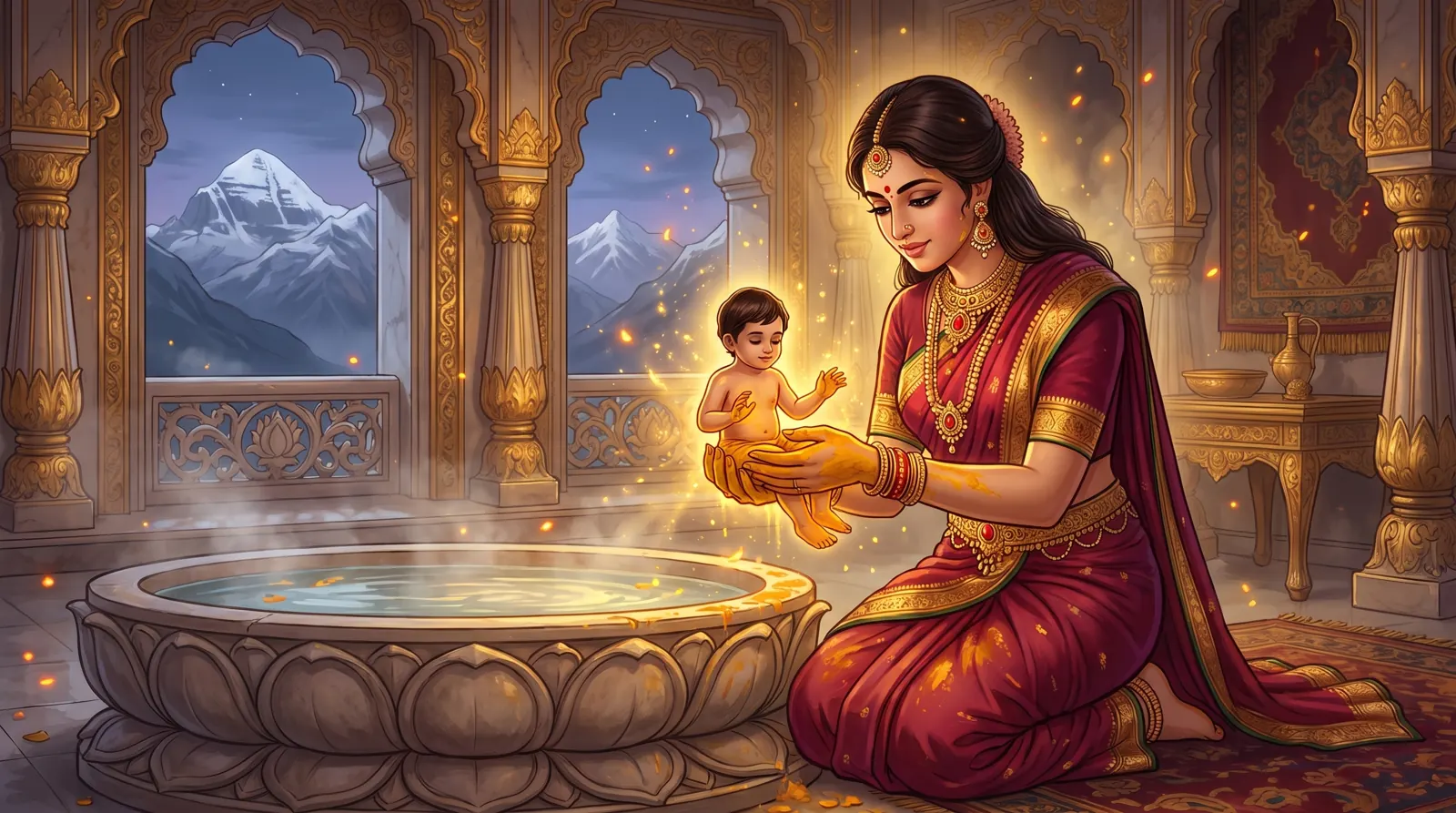
The keeper bathes, in the Ganesha Purana's rite with herbs and white sesame, and makes the vow before Ganesha. From then until the moon is up there is no grain: many take only water, fruit, or the fasting foods of the region, sabudana khichdi, potato and peanuts in Maharashtra, sweet potato and water chestnut in the north, and mothers on Sakat Chauth often go without water. On an Angaraki the temples open before dawn; Siddhivinayak in Mumbai opens its doors at half past one in the morning.
Morning of the vow: after her sesame bath, a keeper makes the vow before Ganesha
Ganesha is set up on a low stool, as an image, a picture, or in the north a lump of clay with a betel nut, and worshipped with red flowers, hibiscus in Maharashtra, twenty-one shoots of durva grass and modaks or laddus; many recite the Ganapati Atharvashirsha. The month's katha is read. On Sakat Chauth the offering is tilkut, roasted sesame pounded with jaggery, and the women hear the kathas of the potter's kiln and the two sisters-in-law; in many homes a son cuts a goat made of tilkut with a blade of durva and the pieces are shared.
Sakat Chauth at dusk: a clay Ganesha with a betel nut, tilkut, and an elder woman telling the katha
Krishna chaturthi, at the city's moonrise · Monday 25 January 2027
chandra arghyaBhalachandra
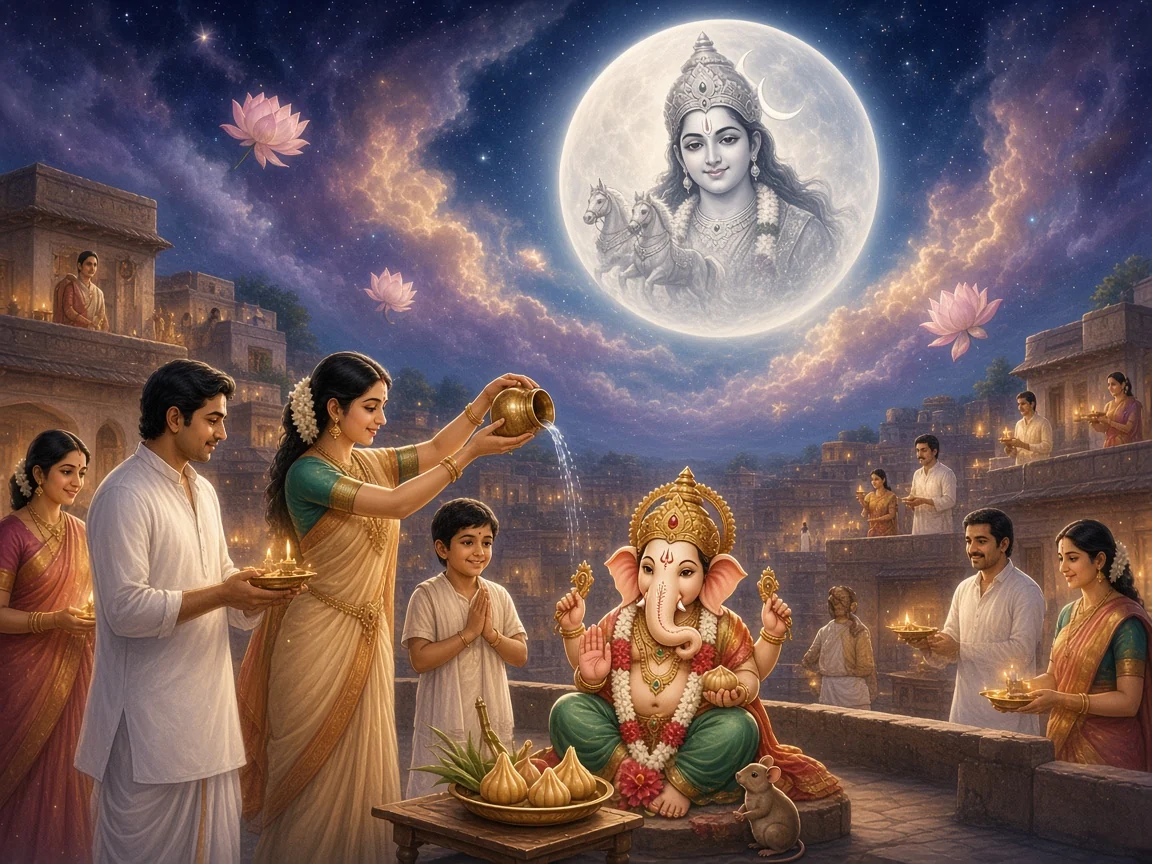
Everyone waits for the moon, which on this night of the month rises two to four hours after dark: at 9:16 pm in Delhi and 9:36 pm in Mumbai on Sakat Chauth, 25 January 2027, and at 9:57 pm in Delhi on the Angaraki of 22 June 2027. When it is seen, water is poured to it from a copper pot or a lota, with milk, sesame, rice, red sandal or flowers in it; the Ganesha Purana has the offering made seven times. If clouds hide it, the arghya is poured towards it at the time the almanac gives.
The moon is up: water with milk, sesame and flowers poured to it from a copper lota
Only after the arghya does the keeper eat, beginning with the offering itself: a modak, a piece of tilkut, a sesame laddu. In the north the baya, a share of the offering, goes to the mother-in-law for her blessing. At Theur, after moonrise on an Angaraki, Chintamani is carried round the village in procession and the villagers serve a meal to everyone who has come.
The fast is broken with a modak, and the baya goes to the mother-in-law for her blessing
Here the Sankashti is kept every month by vast numbers, and the Angaraki is the day of the year for Ganesha after his own festival. At Siddhivinayak in Prabhadevi the queues start the night before at Ravindra Natya Mandir; in August 2025 the trust ran darshan from 1:30 am to 11:50 pm, with free buses from Dadar, free tea and separate lines for men, women and the old, and expected five to six lakh people. At Theur, one of the eight Ashtavinayaka temples, the Chintamani of the Ganesha Purana's story is bathed at dawn, the Chinchwad Devasthan performs the mahapuja, those fasting are given khichdi, and the god goes out in procession after moonrise.
The northSakat Chauth
Across Uttar Pradesh, Bihar, Rajasthan, Madhya Pradesh, Delhi and Haryana the Magha Sankashti, in January, is Sakat Chauth, also Tilkuta Chauth, Sankat Chauth and Maghi Chauth, kept by mothers for their children and often without water. A chowk is drawn in the courtyard, Ganesha is set up as clay and a betel nut on a wooden plank, Sakat Mata is worshipped with him, the elder women tell the kathas, and the tilkut is shaped into laddus, a little mountain, or a goat that a son cuts with a blade of durva, which the tellers explain as the gentle stand-in for an animal offering of long ago. Among the Dogras of Jammu the day is Bhugga, and sesame and jaggery are given away with radishes.
Coastal Karnataka and Tamil NaduSankashtahara and Sankatahara Chaturthi
In Mangaluru and Udupi an Angaraka Sankashtahara Chaturthi brings crowds to Sharavu Mahaganapati and the city's temples from the morning, with garike (durva) and hingara, areca flower, for Ganesha, ganahoma, the appa offering, sesame balls and chakkuli; many fast until they have seen the moon. In Tamil Nadu every Sankatahara Chaturthi is an evening of abhishekam for Vinayagar, with milk, curd, tender coconut, sandal and turmeric, and garlands of arugampul.
Ganesha's devotees everywhereThe monthly vow
Anyone may keep it, man or woman, and many keep every one for years, some for the four months the Ganesha Purana prescribes, some for a lifetime. The sick and the pregnant keep it with fruit and water.
The Ganapatyas of MaharashtraThe god's own day
For the Ganapatya line of Morya Gosavi and the Chinchwad Devasthan, which runs the temples at Theur, Morgaon and Siddhatek, the Sankashti is the god's own monthly day; Morya Gosavi is remembered as visiting Theur on every one.
Mothers in the northSakat Chauth
The Magha Sankashti belongs to mothers, who fast for their children's long life and safety and end the katha asking Sakat Mata to keep every child as she kept the old woman's son.
How it is kept
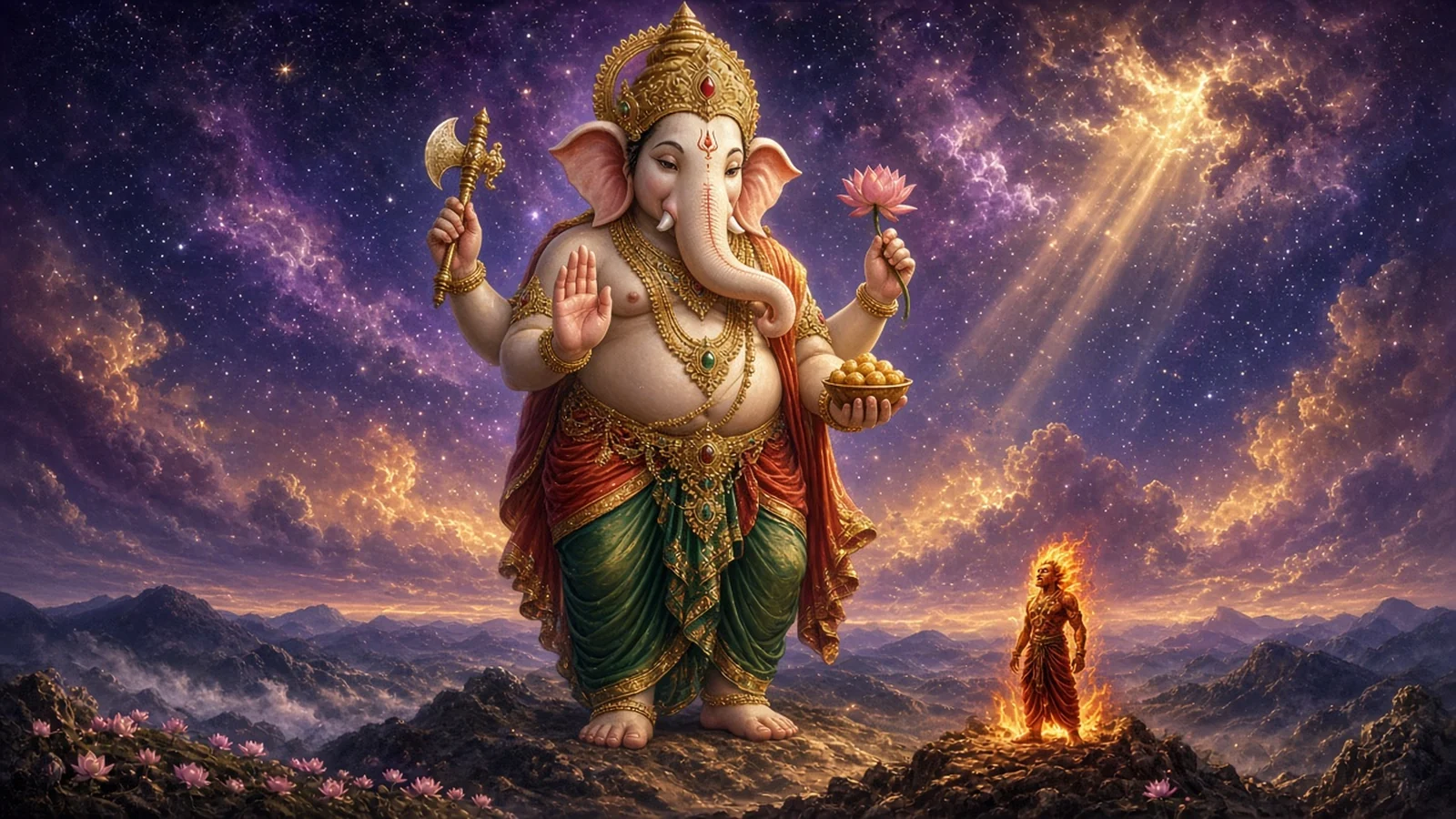
The keeper bathes in the morning and goes without grain until the moon. In the evening Ganesha is worshipped with red flowers, twenty-one shoots of durva, the grass that cooled him in The Demon of Fire, and modaks, and the month's katha is read; each Sankashti has its own name of Ganesha and its own story. When the moon is up, water is poured to it with milk, sesame and rice, and only then does the fast end, with the offering eaten first.
Evening worship: red hibiscus, twenty-one shoots of durva and modaks before Ganesha
The Angaraki, one to three times a year, is the great day in Maharashtra, when Siddhivinayak opens before two in the morning and Theur fills. In the north the Magha Sankashti becomes Sakat Chauth, with tilkut for Ganesha and Sakat Mata, kathas told by the elder women, and in many homes a goat of sesame and jaggery cut by a son with a blade of grass. The Kartika Sankashti is the same night as Karva Chauth, kept by wives for their husbands and broken, like this one, by the moon.
Angaraki before dawn: the calm queue outside Siddhivinayak in Mumbai
In the old texts
The Ganesha Purana gives the vow at length in its Upasana Khanda. Chapter 60 tells how Angaraka won the Tuesday Chaturthi, chapter 61 why the Moon must be seen, chapter 69 the rite, with sixteen offerings each ending in the plea "keep my trouble away", twenty-one names for the twenty-one durva shoots, modaks of mung and sesame, three arghyas and the Moon's seven, and chapter 70 the gods and heroes who kept it before. The Narada Purana's chapter on the Chaturthis gives the Samkashta vow for the dark Chaturthi of Magha: a fast until moonrise, a clay Ganesha, modaks and sesame with jaggery, and an arghya to the Moon as "the representative of Ganesha"; its translator notes that Maharashtra keeps it every month. The month names are counted two ways: Drik Panchang's northern reckoning calls the January Sankashti Magha's, while Maharashtra's almanacs call the same night Pausha's. The kathas of Sakat Chauth belong to the north's women and are in no Purana.
Where this page comes from. Written by Devalok from the Ganesha Purana (Upasana Khanda 60, 61, 69 and 70, read in the Sanskrit), the Narada Purana (Purva Bhaga 4.113), the Sakat Chauth kathas as Drik Panchang, Ved Path, Bhaktise, Dainik Jagran and Bhakti Bharat carry them, the reports of the day from Mumbai, Theur, Uttar Pradesh, Mangaluru and Tamil Nadu, and the Drik Panchang calendars for 2026 to 2028, as recorded in the Devalok Lore. Our own words throughout.