The potter, the old woman and her only son
Told across the north · the Sakat Chauth katha · 3 min read
There was a potter in a king's town who made the pots for the palace, and one winter his kiln stopped working.
He stacked the raw pots the way his father had taught him, packed the dung cakes and straw around them, sealed the mouth with mud and lit it. Days later he broke it open and the pots came out grey and soft, crumbling under his thumb. He tried again. He tried a third time. The clay stayed clay.
He went to the king, because the king's pots were in it. The king sent for his priest, and the priest went away and thought, and came back with an answer from a darker time than ours.
"Each time the kiln is lit," he said, "a child must go in with the pots. Then they will fire."
The king gave the order. Every house in the town would give a child in turn, one for each firing. Door by door the turn came round, and door by door the town went quiet.
At the edge of the town lived an old woman who had one son. He fetched her water and her firewood, and he was all that stood between her and a lonely old age. When the potter's men came to her door, the day of her turn was the fourth night of the waning moon in Magha: Sakat Chauth, the day she had fasted for Sakat Mata every year of her life.
She did not cry where they could see it. She heated water and bathed the boy. She put into his hand the betel nut she had kept for the goddess, and a little twist of durva grass, folded and tied.

"Hold these and do not let go," she said. "When they shut you in, say Sakat Mata's name, and Ganesha's. Keep saying them. Do not be afraid."
"Will you be there?" the boy asked.
"I will be sitting with the goddess," she said. "All night. I will not get up."
They took him away. They set him among the stacked pots, packed the fuel round, sealed the mouth and put fire to it. The boy shut his eyes and said the names, over and over, while the heat climbed.
At home the old woman drew the goddess on the wall, set down her lamp, her sesame and her betel nut, and sat. She did not eat. She did not drink. When the moon came up late and cold over the rooftops she poured water to it, and then she sat down again and went on asking.
The kiln that had needed many days to fire, when it fired at all, was done by morning.
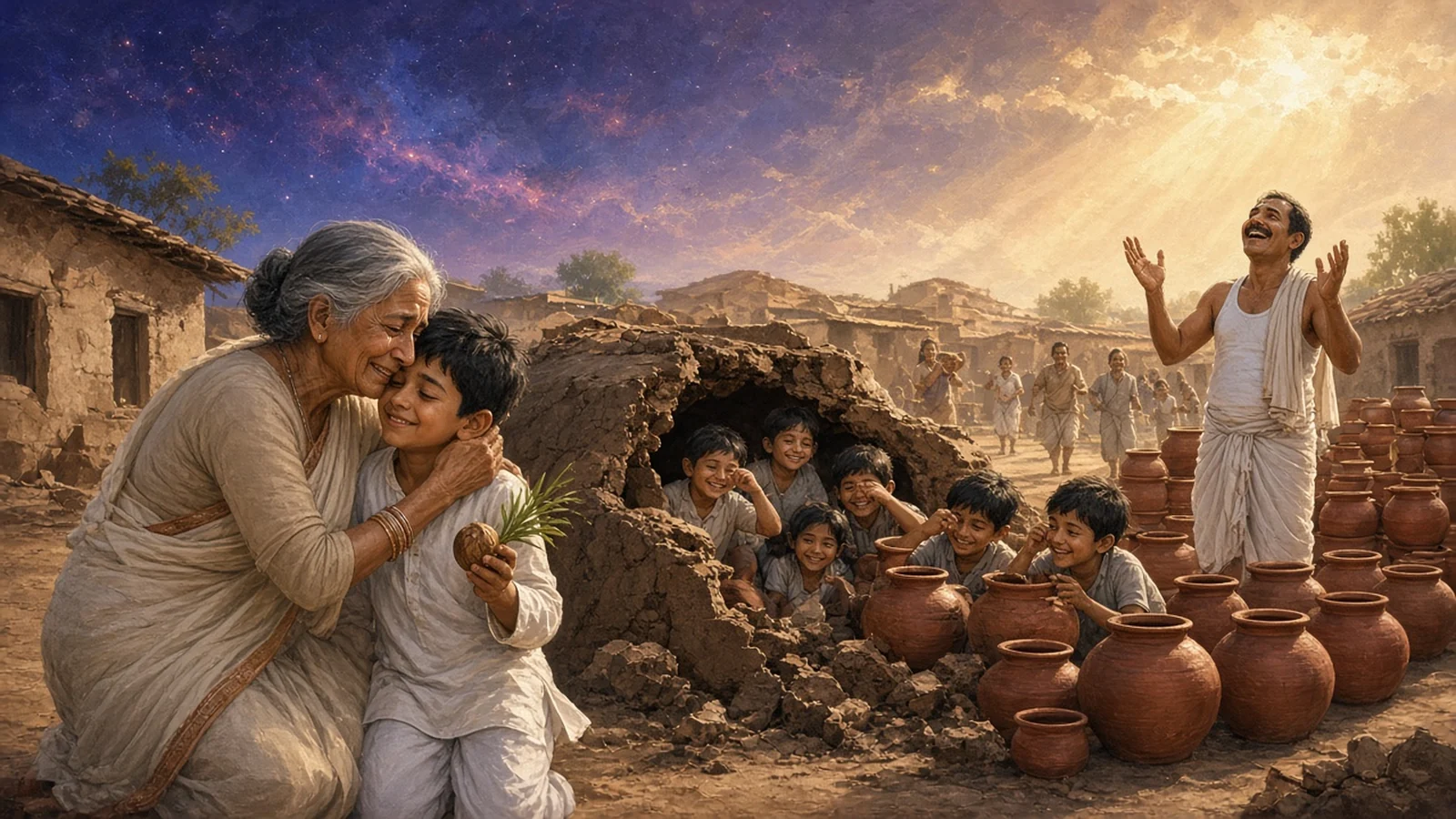
The potter came at first light to break the seal, dreading what he would find. The pots stood in their rows, red and ringing when he tapped them. In the middle of them sat the old woman's son, rubbing his eyes, without a mark on him.
"I was cold," the boy said. "The whole night, I was cold."
Then the potter heard other voices. The children who had gone into the kiln before him, house by house and firing by firing, were climbing out from among the pots as well.
The town came running, and the king behind it. He asked the old woman what she had done, and she told him: she had kept Sakat Chauth, and sent her son in with the goddess's betel nut and Ganesha's name. The king ended the offering that same morning and had it called through the streets that every house should keep the fast.
The women who tell it still end it the same way, with sesame in their hands. "Sakat Mata, as you kept that old woman's son, keep ours."
The two sisters-in-law
Told across the north · the second katha of Sakat Chauth · 2 min read
Two brothers lived in one lane. The elder had grown rich. The younger cut wood in the forest and sold it in the market, and some days it sold and some days it did not.
The younger brother's wife kept every Sankashti for Ganesha, and to make ends meet she swept and ground grain and scrubbed pots in her sister-in-law's big house.
On Sakat Chauth she worked there all day, and in the evening she held out her hand for her wages.
"Not today," said the elder. "Today is the puja. Come for it tomorrow."
She walked home with nothing. Nobody had bought her husband's wood either, and when he came in and found the stove cold he beat her for it. She lay down hungry on the night of her fast.
Late in the night someone knocked, and she thought she was dreaming.
"Open the door," said a voice.
"It is open," she said. "We have nothing worth locking up."
"I am hungry."
"There is bathua on the stove from this morning. Eat that."
He ate all of it, and then asked where he might relieve himself. Too tired to argue, she waved a hand at the four corners of the room and the doorway. When he asked what he should wipe himself with, she said, "My forehead, for all I care," and went back to sleep.
At dawn the four corners of the hut glittered. The doorway was heaped with gold. When she put a hand to her forehead it came away covered in jewels.
She ran to borrow her sister-in-law's scales to weigh it all. The elder had smeared the pan with something sticky, and when the scales came back with gold clinging to them she wanted the whole story, and got it.

The next Sakat Chauth the elder did everything the same. She told her husband to beat her, and he did. She cooked bathua and left it on the stove. The guest came, ate, asked his questions, and she gave the same answers. In the morning her house was full of filth, and no amount of washing would shift it.
The pandits told her to share what she had with her sister-in-law, half and half. She did, and the stink stayed, until she fetched the one necklace she had kept back and gave that up as well.