As the Kolkata bazaar tells it: the emperor's tax year
West Bengal · a shop in Hatibagan on the first of Boishakh · 4 min read
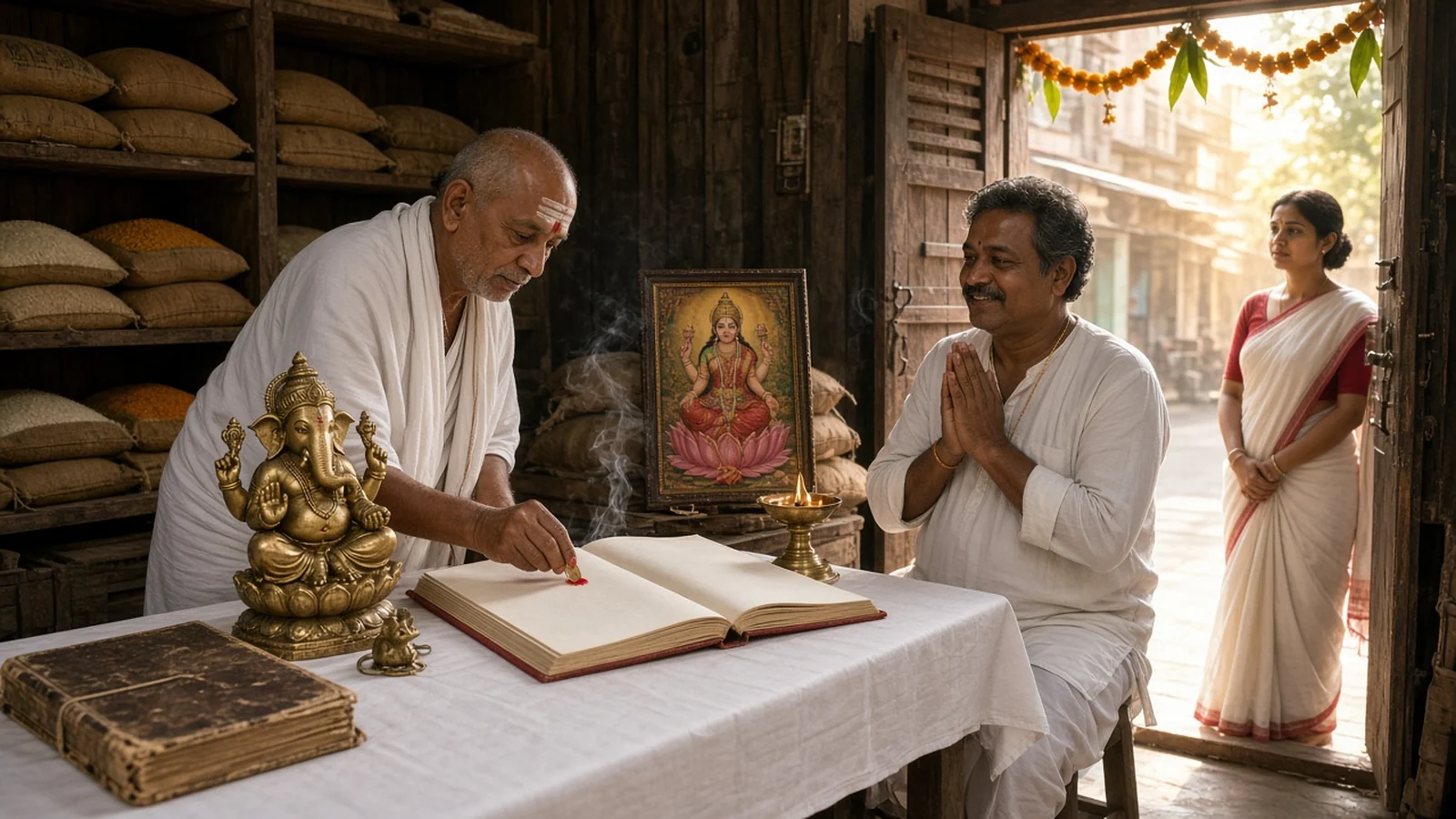
The shop had been washed before dawn, and the shutters were up by the time the sweet-seller's boy came past with the first trays. Marigold hung over the door with a string of mango leaves, and on the counter, on a clean cloth, lay a ledger bound in red with white pages that nobody had written in. Beside it stood the small brass Ganesha who lived on the shelf all year, with a picture of Lakshmi behind him and the new almanac still in its wrapper.
The shopkeeper's daughter had come home from her college hostel for the day. She stood in the doorway in the sari her mother had bought in the Chaitra sale, white with a red border, and watched the priest arrive with his bag.
The priest did not take long. He sprinkled the water, lit the lamp and the incense, offered a flower to Ganesha and then to Lakshmi, and spoke the words under his breath. Then he opened the red book, dipped a coin in vermilion and pressed its print onto the first page, and wrote above it the names of Ganesha, of Durga and of Lakshmi. The old ledger, its spine broken from a year of use, he closed and set to one side.
"Nothing goes on that page but the gods," he said to the girl, who was looking. "The accounts begin on the next."
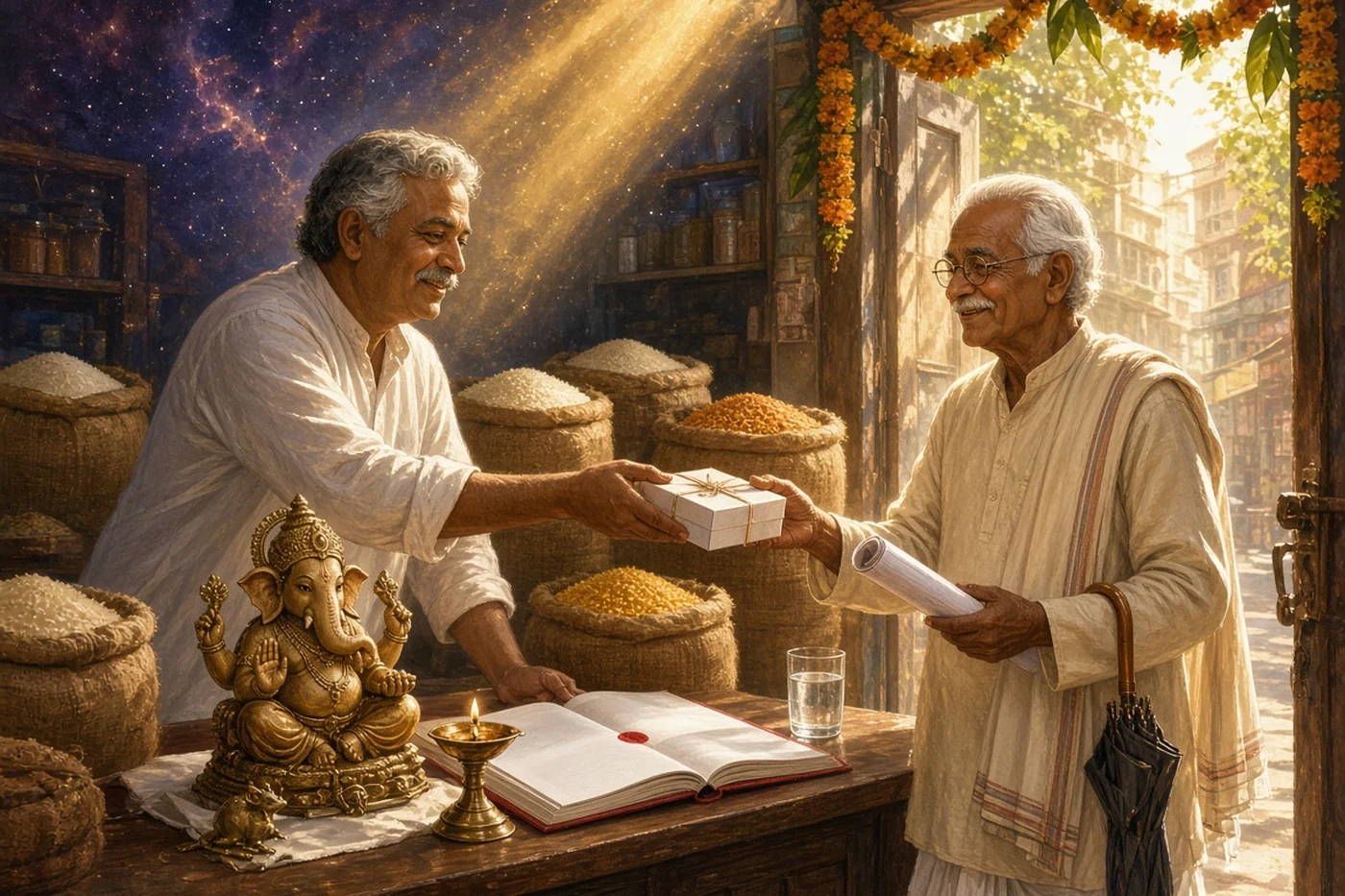
The first customer was a schoolteacher who had bought his rice here for thirty years. He put a folded note on the counter, more than he owed, and would not take the change.
"For the book," he said. "Let it start with something in it."
The shopkeeper touched the note to Ganesha's feet and wrote the first line of the year. Then he gave the old man a box of sweets, a calendar with the shop's name printed across the bottom, and a glass of water, and they talked about the heat.
When the shop was quiet again the girl sat on the sack of lentils by the counter.
"Baba, why today? The Marwari shops in Burrabazar open their books at Diwali. Here it is the middle of April and forty degrees, and we start a year."
"Because of a farmer and an emperor," her father said. "Sit, I will tell you the way my father told me, and you can ask your professors what they think."
"Akbar's officers collected the land tax by the Hijri calendar, the moon's calendar, which is eleven days shorter than the sun's. So the tax day crept forward every year. In thirty years it had come round a whole year early, and the collector was at the farmer's door asking for the share of a harvest that was still standing green in the field. Abul Fazl, who wrote the emperor's history, says so himself.
"Akbar had at his court a scholar from Shiraz, Fathullah, an astronomer who had already been set to clean up the empire's accounts. The emperor told him to make a year that followed the sun but kept the count of the Hijri. So in March of 1584 the Tarikh-e-Ilahi was proclaimed, and it was counted not from that day but backwards, from the emperor's accession in the Hijri year 963. That is why our year is 1434 and not 2027: it still carries the moon's number, and walks at the sun's pace. And because the first Muharram of 963 had fallen in Baishakh, Baishakh became the first month of the year."
"And the ledger?"
"The ledger is the tax. In Bengal the dues were cleared on the last day of Chaitra, and on the first day of Baishakh the zamindar sat in his courtyard, the tenants came with what they owed, and he fed them sweets. They called it the Punyaha, the auspicious day. The traders copied their landlords. Close the old book, open the new, feed everyone who comes to settle. The zamindars are gone, and the Punyaha went with them. The haal khata stayed, because a shop needs a day to be forgiven its debts."
The girl looked at the red book with the coin's print drying on it.
"So Ganesha is sitting on an emperor's revenue ledger."
"Ganesha sits wherever someone begins something," said her father. "Go and get the next box of sweets. The whole lane will be in by evening."
As Dhaka's Tanti Bazar tells it: the king of Gauda
Bangladesh · a jeweller's shop on the fourteenth of April · 3 min read
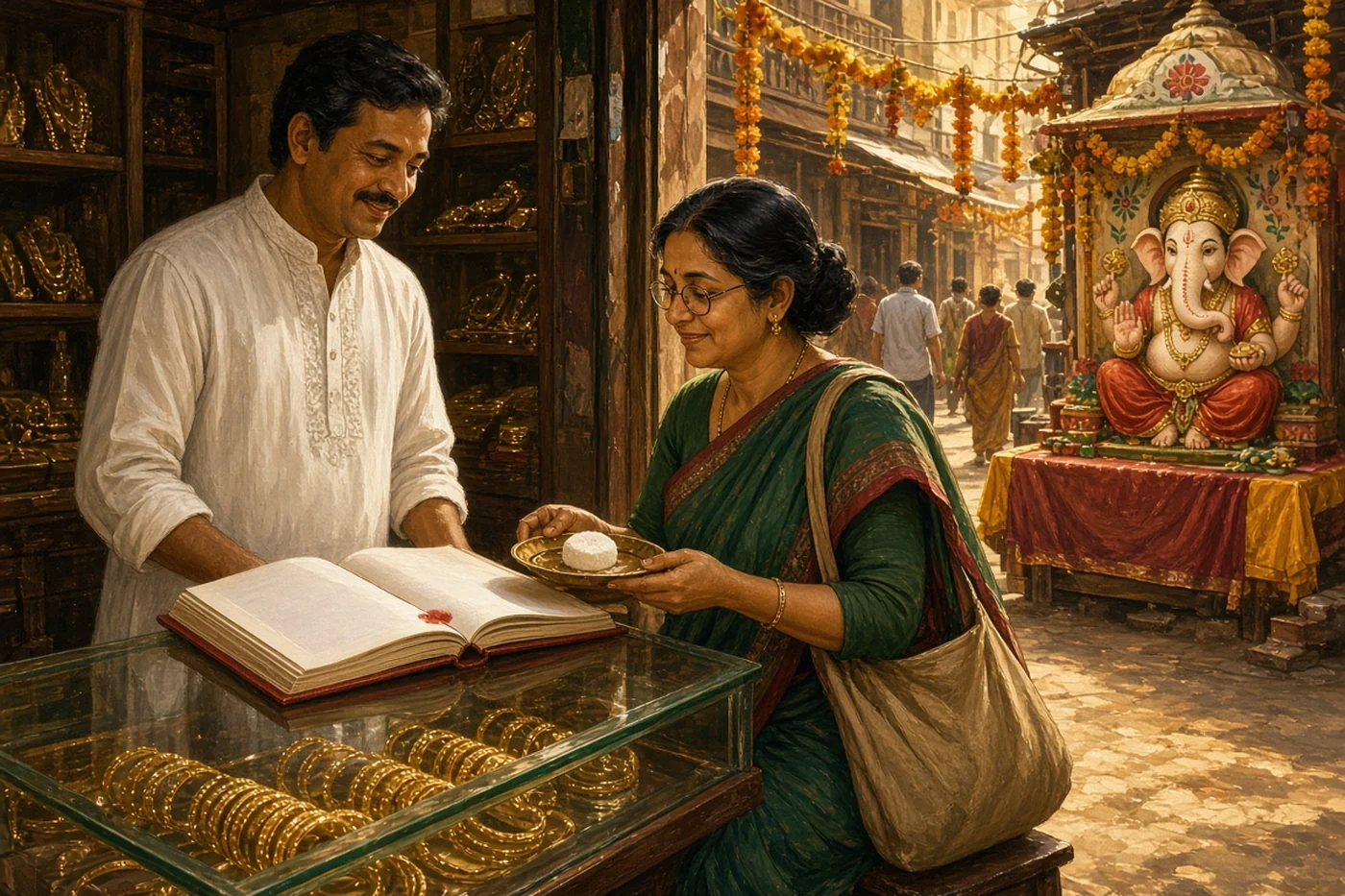
In Tanti Bazar in old Dhaka, where the jewellers' shops are so narrow that two customers fill them, Ganesha's worship is set up in the middle of the street on the morning of Pohela Boishakh, on a stage hung with cloth, and the whole lane keeps the day together. The Hindu shops hold their puja before the new book. The Muslim shops open theirs after a milad, with Bismillah written on the first page, and feed sweets to the same customers.
The jeweller had printed invitation cards this year, and one of them had gone to a history teacher who bought her daughter's bangles there. She came in the afternoon, ate her sandesh, and looked at the new ledger lying open on the glass.
"Your grandfather would have told me this book is Akbar's," she said.
"He did say so. The year is the emperor's, he said, made for his tax."
"Then let me tell you the other story, since you have fed me." She set down her glass. "A thousand years before Akbar, Bengal had a king of its own. Shashanka of Gauda, whose capital was Karnasuvarna, up the river in what is now Murshidabad. He was the first man to rule all of Bengal as one country. He worshipped Shiva and put Shiva on his coins, and he fought Harsha, the great king of the north, to a standstill."
She took a second sandesh. "Some of our historians say that when he was crowned he began a new count of years, and that this is the count we are still keeping. Work it out: take our 1434 from the English 2027 and 593 is left, and 593 is where his reign begins. And there are two old Shiva temples, Nitish Sengupta says, that carry the word Bangabda, the Bengali year, and they are older than any Mughal."
"So the emperor stole the year?"
"Nobody says stole. Perhaps he found a year that was already here and gave it a Persian name and a purpose. Sengupta himself admits nobody knows. He thinks it may have been Husain Shah, the sultan who ruled from Gaur a hundred years before Akbar, who first tied the moon's year to the sun's for his revenue. Shamsuzzaman Khan says the Punyaha, the rent day with the sweets, was begun by Murshid Quli Khan, the nawab, carrying out Akbar's policy long after Akbar was dead. And Amartya Sen, who likes Akbar, writes that the Tarikh-e-Ilahi hardly left the court and was dropped when the emperor died, and survives only in traces, here, in a Bengali shop's ledger."
The jeweller laughed. "And the villages say it was Bikromaditto."
"The villages say that about every calendar in India. Ours starts in 593 and not in 57 before Christ, so if it was a Vikramaditya it was our own one, and his name was Shashanka."
The teacher paid for the bangles in full, which she did not usually do, and he wrote it as the day's first entry, under the Bismillah.