As the Bhagavata tells it
Bhagavata Purana 8.8 · 3 min read
The ocean of milk had been giving up its treasures one by one. The wishing cow came up first, and the sages took her for the ghee of their fires. A white horse came up, and Bali asked for it. The king of elephants came up with four tusks, and after him the Kaustubha gem, the Parijata tree and the dancers of heaven. Then Lakshmi rose, brighter than lightning, walked down the line of gods and demons with a garland in her hands and chose Vishnu. That is her own story, and the Lore tells it elsewhere.
After her came Varuni, the lotus-eyed goddess of wine, and the asuras asked for her and were given her.
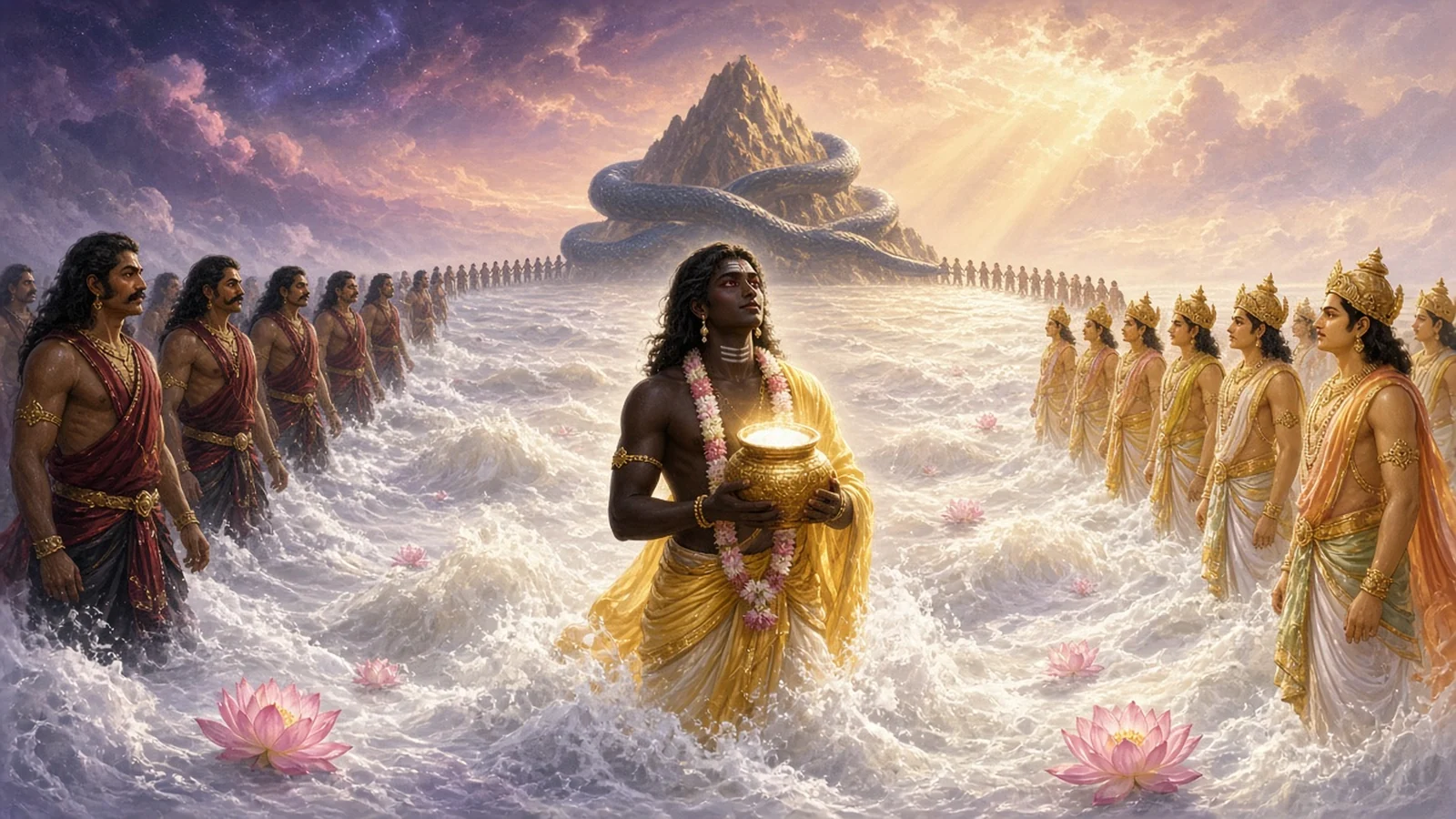
Then both sides took hold of the serpent rope again. The mountain turned, the sea foamed and thundered, and something new began to rise through the white water.
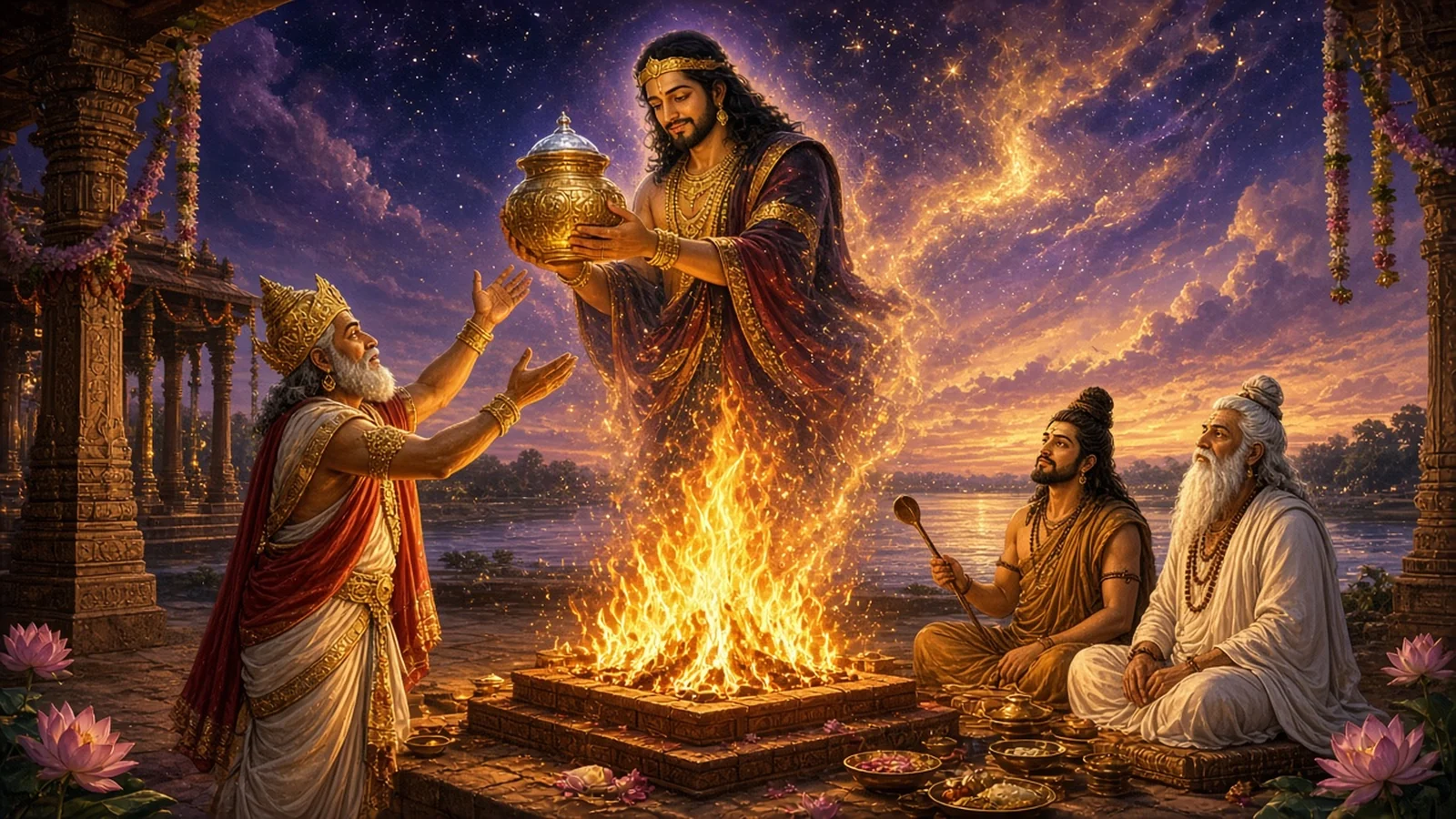
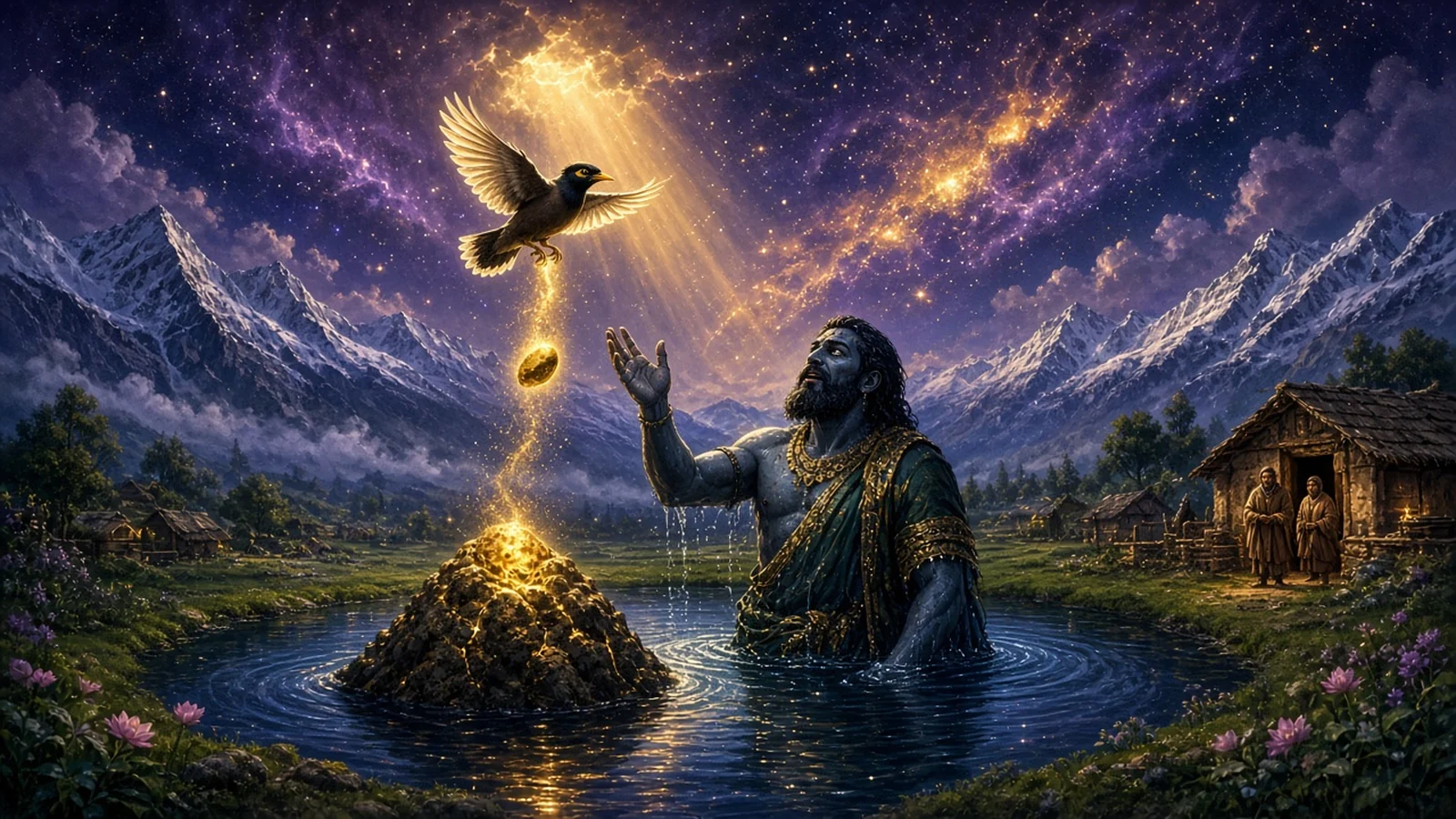
It was a man. He was young, hardly more than a boy, and dark, almost black, and his eyes had a redness in them like the sky at dusk. His arms were long and strong, his chest was broad, and his neck carried three lines like the ridges of a conch shell. He wore yellow silk. Pearls hung at his ears, bracelets on his wrists, a garland of flowers round his neck. And in his two hands he held a pot, and the pot was full to the brim.
"Who is that?" said Bali.
Nobody answered him. Every eye on both shores was on the pot.
The Bhagavata says who he was. He was Dhanvantari, a portion of a portion of Vishnu himself, and he carried in his head the whole science of healing, every disease and its cure. Because he was a god he had a right to a share of every sacrifice men offered. And he carried in his hands the amrita, the drink that ends death, the thing the whole churning had been for.
The gods moved towards him. The asuras moved faster. Before anyone could speak they had torn the pot out of his hands and were running up the beach with it.
"It is ours!" they shouted back. "We held the head of the snake and breathed its fire. We pulled as hard as you. The nectar is ours."
The gods stood at the water's edge with nothing. They had made a truce with their enemies for this. They had dragged a mountain into the sea for it and watched Shiva drink the poison it threw up. Now a boy had carried it out of the water for them and a crowd of asuras had carried it off.
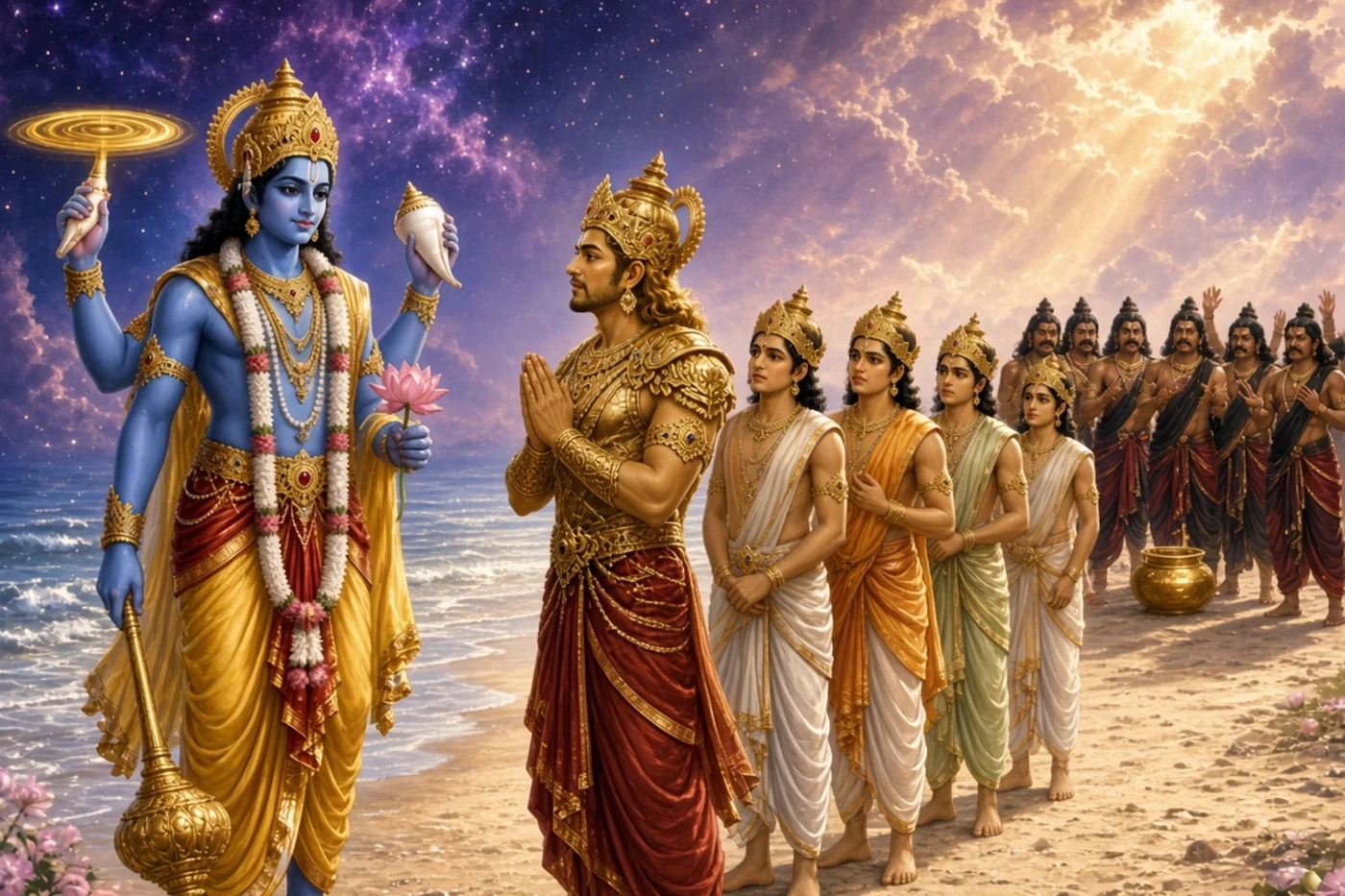
They turned to Vishnu, and Indra spoke for them.
"Lord, it is gone. They have the pot, and we have the empty sea."
Vishnu did not look troubled. "Let them hold it a little while," he said. "I will set them quarrelling over it by my own power. While they fight for the first mouthful, I will take it back. Wait."
It went as he said. The asuras stood round the pot on the sand and could not agree who should drink first. The strong ones shouldered to the front. The weak ones, who had no hope of a first drink, began to argue for fairness.
"The gods pulled too," one of them said. "They should have a share. It is only right."
He did not care in the least about the gods. He wanted the strong ones delayed, and they were. The argument went round and round, and the pot the physician had carried up out of the sea stood on the sand with nobody drinking from it.
Then a woman came walking down the beach, and every asura there forgot that the pot existed. But that is Mohini's story, and it is told in its own place.
The Bhagavata says no more about Dhanvantari in this chapter. He had done what he rose to do. The nectar reached the gods in the end, and the physician's share of the sacrifice, the thing the text names beside his pot, waited for him in another age.
As the Harivamsha and the physicians tell it: the king's son of Kashi
Harivamsha 29, Vishnu Purana 4.8, Sushruta Samhita 1 · 2 min read
The Harivamsha has him rise differently. In its telling he comes up out of the vessel of amrita itself, stands dripping before Vishnu, and is given a name on the spot: Abja, the one born of water.
Abja knew what he wanted. "Lord, I came out of the water in front of you. Make me your son. Give me a share of the sacrifice and a place in the world, as the other gods have."
Vishnu would not give it. "The shares of the sacrifice were divided long ago, among the gods and the great sages, and nothing can be given that the Veda does not name. You were born after the gods. You cannot be counted with them."
Abja waited.
"But listen," Vishnu said. "Your name will be known in the world. In the second age of Dvapara you will be born again, and your powers will be yours in the womb. The twice-born will worship you with offerings and vows. And the science of life, Ayurveda, you will divide into eight parts for the diseases of that age. That is your share."
Then he was gone, and the water-born god waited for his age.
In the second Dvapara there ruled in Kashi a king called Dirghatapas, of the old line of Suhotra, and he had no son. He gave himself to austerity and prayed to the god of the water.
The god appeared. "Ask."
"A son," the king said. "A son whose name will be known."
So Abja was born in the palace of Kashi and named Dhanvantari, and there was no disease he could not cure. He went to the sage Bharadvaja and learned the whole science of life from him, and then did what Vishnu had foretold: he divided it into eight branches, surgery and the ailments above the collarbone, the medicine of the body, the troubles of the mind, the care of children, poisons, long life and vigour, and taught them to his pupils. His son was Ketumat, Ketumat's son Bhimaratha, and Bhimaratha's son Divodasa, who became king of Varanasi. The Vishnu Purana gives the same line and calls the childless king Dirghatamas.
The old book of surgery that bears Sushruta's name opens in that city. Seven pupils, Aupadhenava, Vaitarana, Aurabhra, Paushkalavata, Karavirya, Gopurarakshita and Sushruta, come to the ashram of Divodasa, king of Kashi, whom they call Dhanvantari, and bow.
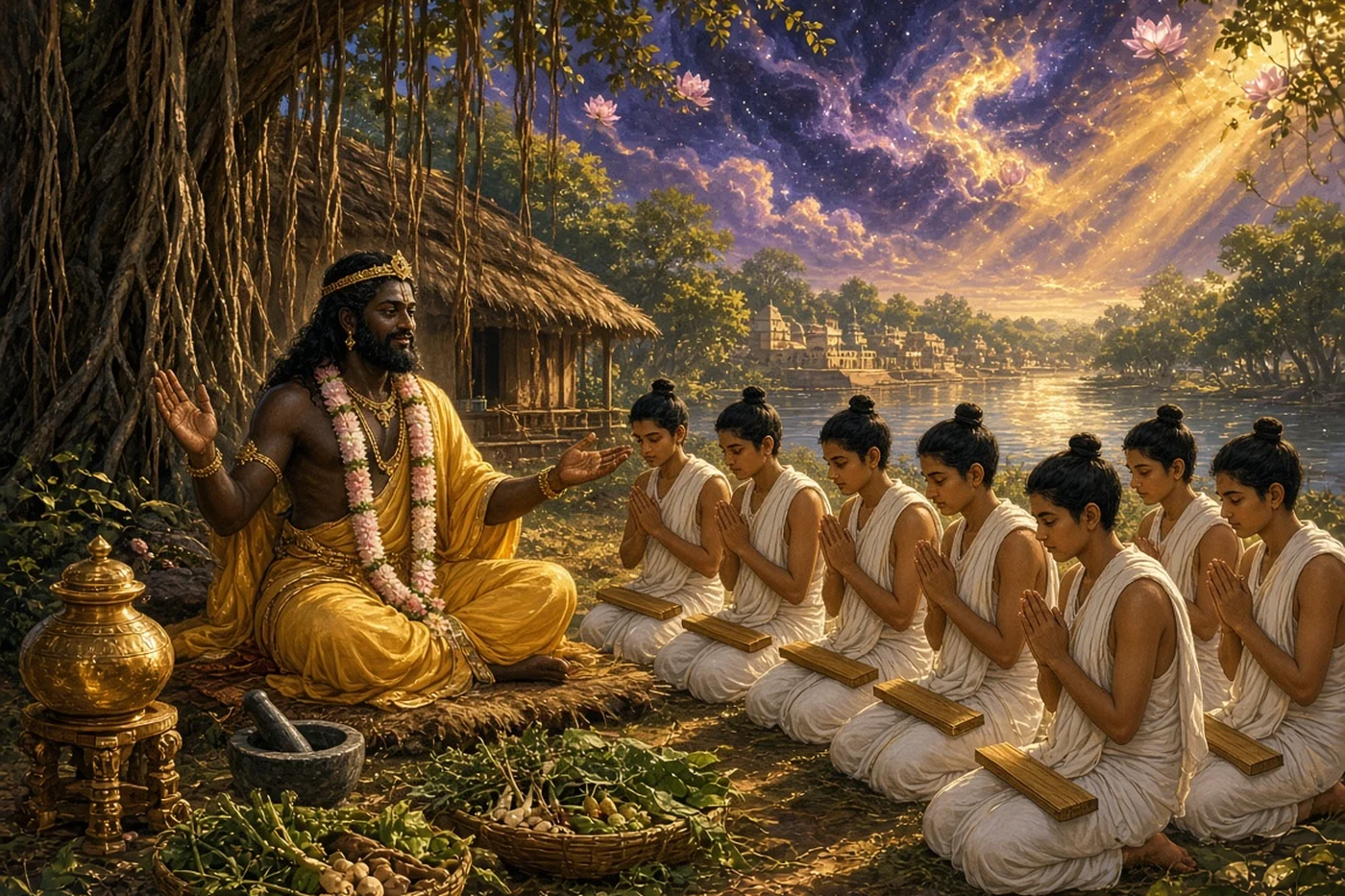
"People suffer in body and mind, and from what comes at them from outside," they say. "Teach us Ayurveda, so that we can help them."
"You are welcome," he answers. He tells them that Brahma made this science in a hundred thousand verses, that it passed from Brahma to Prajapati, from Prajapati to the Ashvins, from the Ashvins to Indra, and from Indra to himself. "I have come down to the earth again to teach it," he says. Then he names the eight branches, and the pupils ask him to begin with surgery.