As the Nilamata Purana tells it
Kashmir · the lake Satisara and the peak Naubandhana · 4 min read
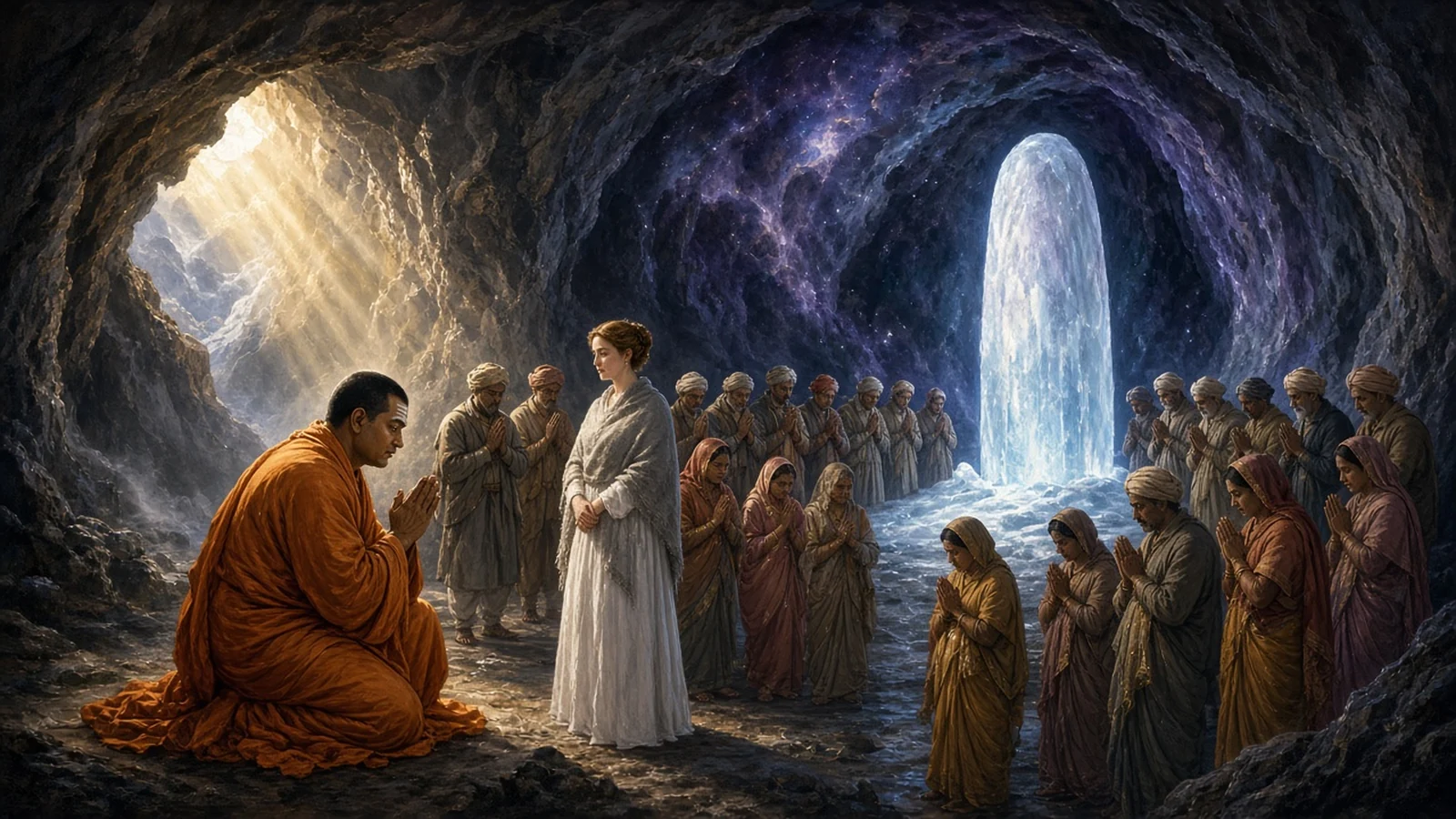
Before there was a Kashmir there was a lake. It filled the whole valley between the mountains, and it was called Satisara, Sati's lake, after the Goddess. The Nagas, the serpent people, lived in it under their king Nila, a son of the sage Kashyapa.
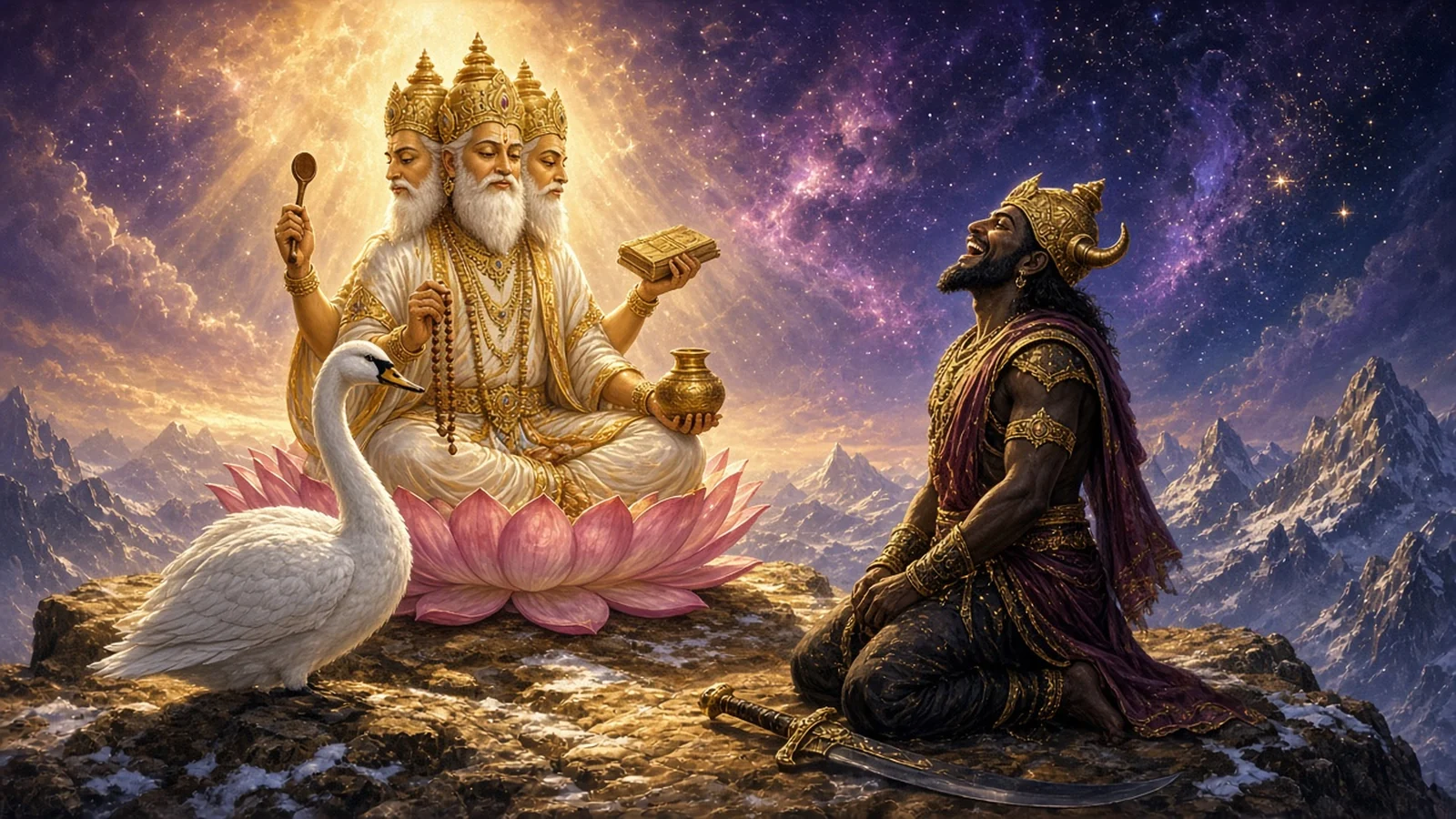
A demon child was born in those waters, the son of a demon called Sangraha, and the Nagas took him in and reared him. They called him Jalodbhava, the one born from water. He grew, and did penance to Brahma, and Brahma gave him what he asked: that he could not be killed in water. After that Nila could not hold him. He began to eat men. He emptied the Madra country, and Gandhara, and the hill lands, and the countries of the Shakas and the Khasas, until the shores of the lake were silent.
Kashyapa was travelling the holy places of the land in those years, and Nila came to him at Kanakhala and bowed and sat at his feet. "Father," he said, "come north with me. There are holy rivers in the Madra country and the Himalaya that you have not bathed in." So they went north together, across the Yamuna and the Sarasvati, through Kurukshetra, and came to the Madra country and found it empty: no smoke, no cattle, no one in the fields.
"This was a rich country," said Kashyapa. "Where are its people?"
Nila told him. "I raised a demon in the lake, and he has eaten them. He has boons from Brahma and I cannot stop him. Stop him, father."
Kashyapa went up to Brahma's world by his own power, and Nila with him, and they told the gods what Jalodbhava had done. Brahma said, "We will go to Naubandhana, the peak above the lake, and deal with him there."
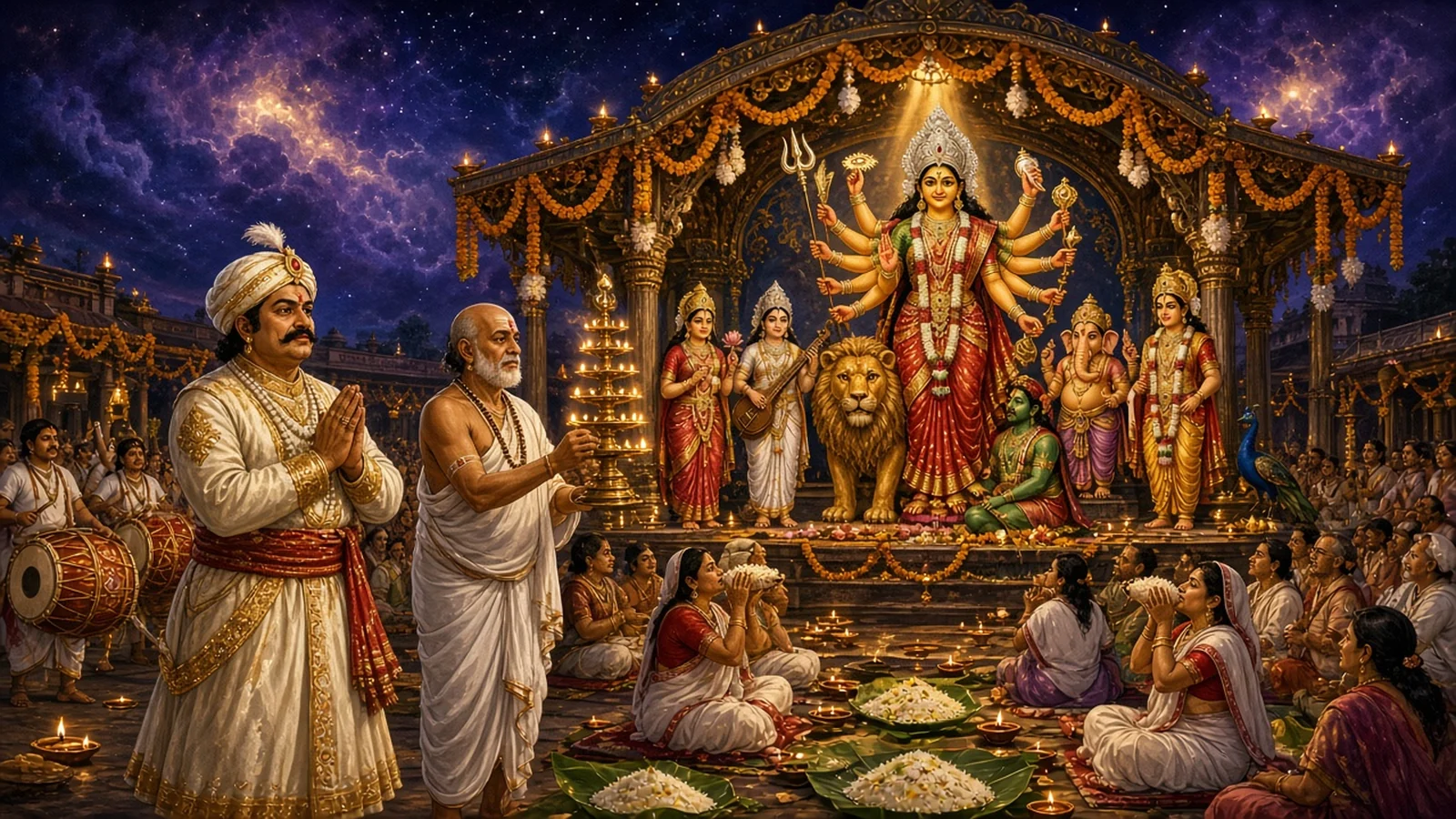
The gods came down to the mountain. Vishnu came on Garuda, Shiva on his bull with Parvati beside him, Brahma on his swan, and the Nagas on clouds. Indra came, and the sages, and the rivers of India each on her own mount. Brahma, Vishnu and Shiva took the three peaks of Naubandhana and looked down at the water.
Jalodbhava heard them. He knew the boon he carried, and he stayed where he was, deep under the lake, and would not come up.
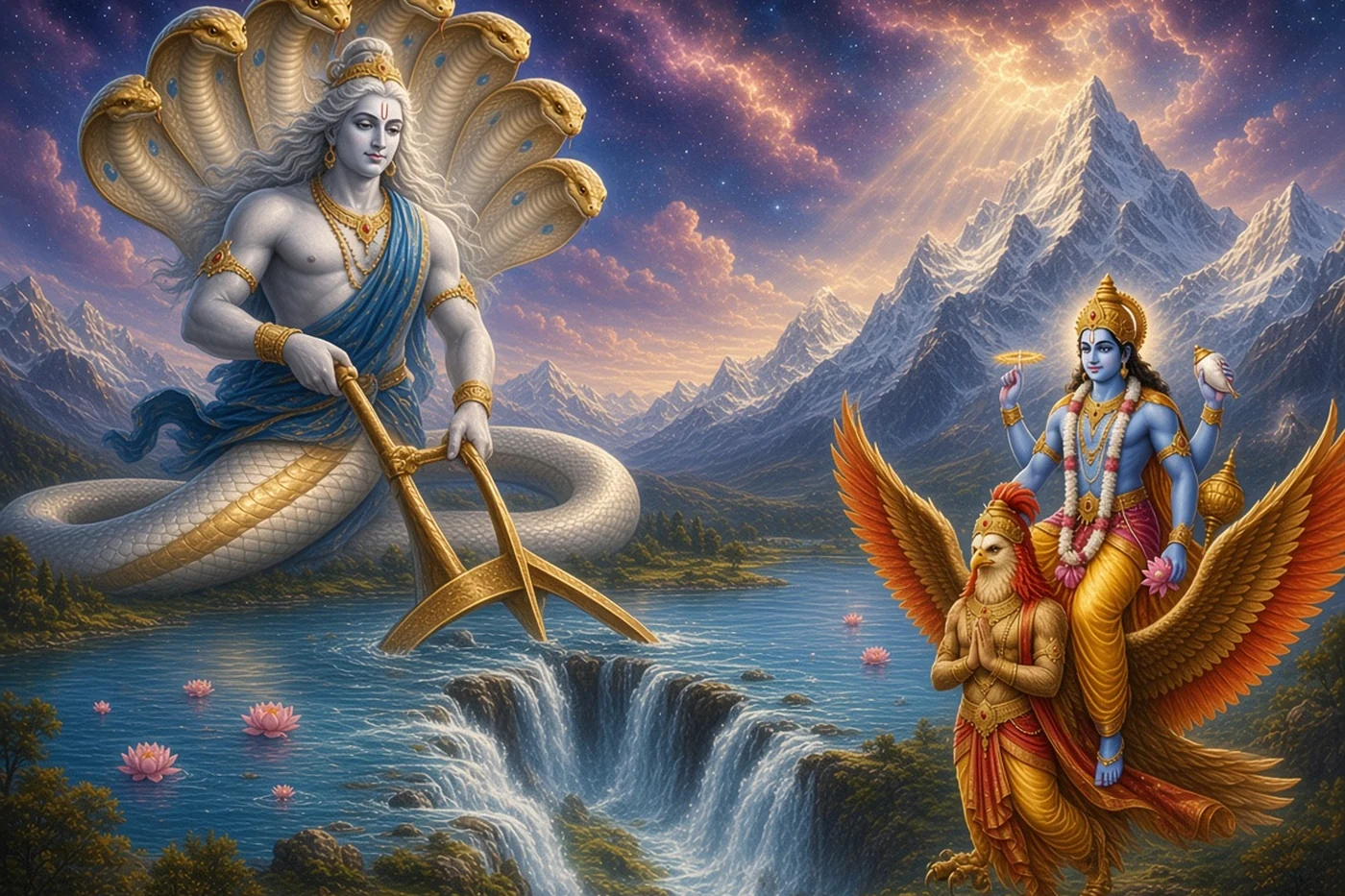
Vishnu turned to Ananta, the great serpent. "Break the mountain," he said. "Let the water out, and he will have no water to hide in."
Ananta grew until he filled the sky, and drove his plough into the wall of the Himalaya, and the mountain split. The lake went out through the gap with a roar, and the valley floor came up out of it, dripping. Jalodbhava rose with the falling water and filled the valley with darkness so that nothing could be seen. Shiva took the sun and the moon in his hands and held them up, and there was light again.
Then Vishnu fought him. The demon changed his shape as he fought, and tore up trees and the tops of hills and threw them, and Vishnu met every form with another. At the end he loosed the discus and took the demon's head off, and Brahma on his peak was glad.
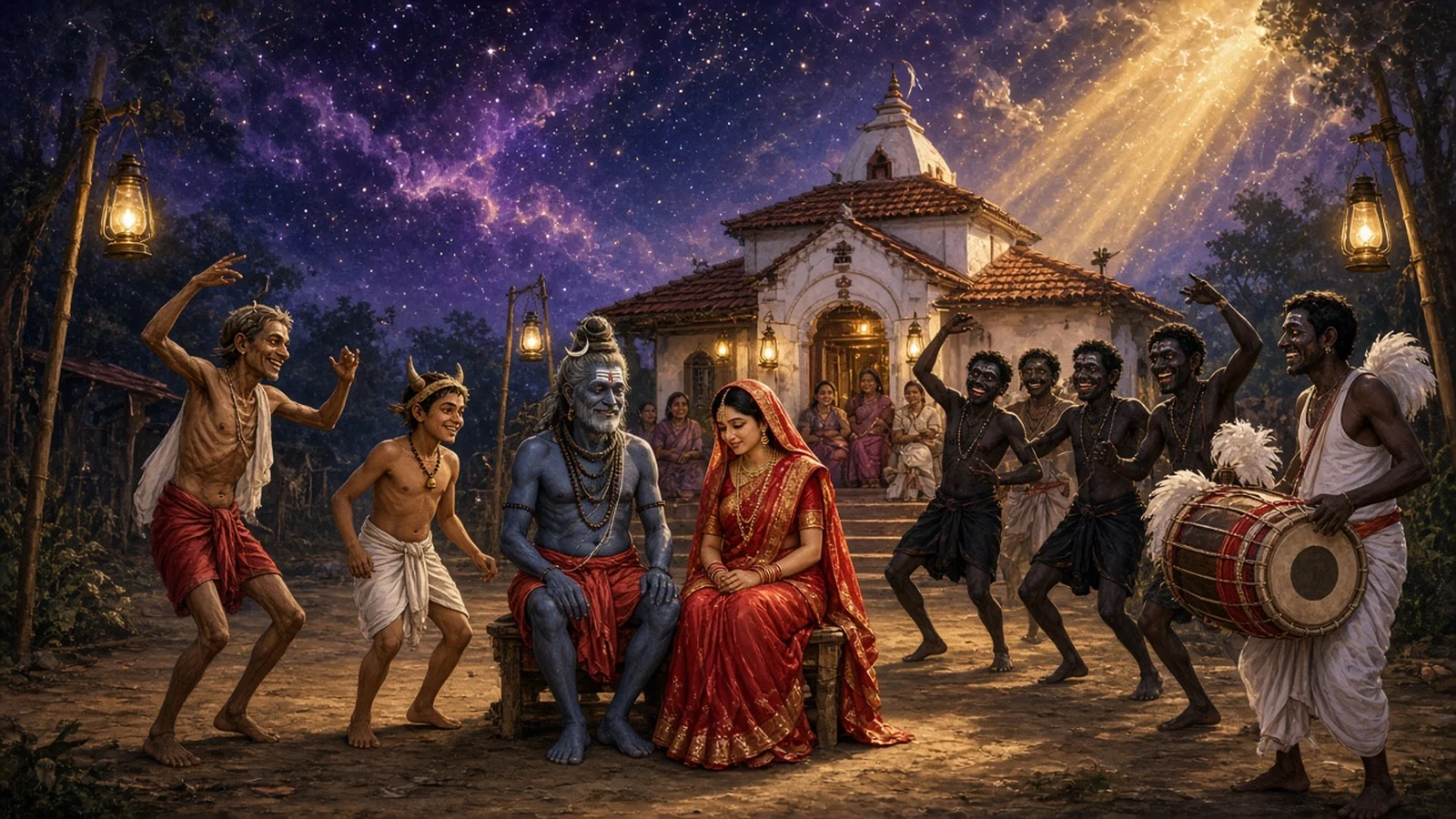
The discus did not stop. Drunk with the demon's blood it went wheeling over the new land, and Shiva caught it and held it. Vishnu laughed. "Give it back."
"What will you give me for it?" said Shiva, and they laughed together, and the spot where they stood joking is remembered.
The gods named the three peaks after themselves and built hermitages in the new country. Kashyapa wanted the Nagas and men to share it, but the Nagas refused, so he gave half of every year to the Pishachas, the goblins, and men lived in the valley only in summer and went down to the plains for the winter. So it was for four ages, until a Brahmin named Chandradeva stayed through a winter, learned the rites of the land from Nila himself and taught them to men, and men have lived in Kashmir the whole year since. The country took its name from the sage: Kashyapa's land, Kashmira.
As Hari Parbat tells it: the myna's pebble
Kashmir · Srinagar · 2 min read
When Kashyapa had let the great lake out, Srinagar's own story says, one pool of it stayed behind, in the low ground where the city now stands, and a demon stayed with it. Most call him Jalodbhava; some say there were two, the brothers Tsand and Mond, one hiding in the water by the hill and the other above the Dal gate. The people who had come to farm the new land could not go near the water for him, and he came out at night for them.
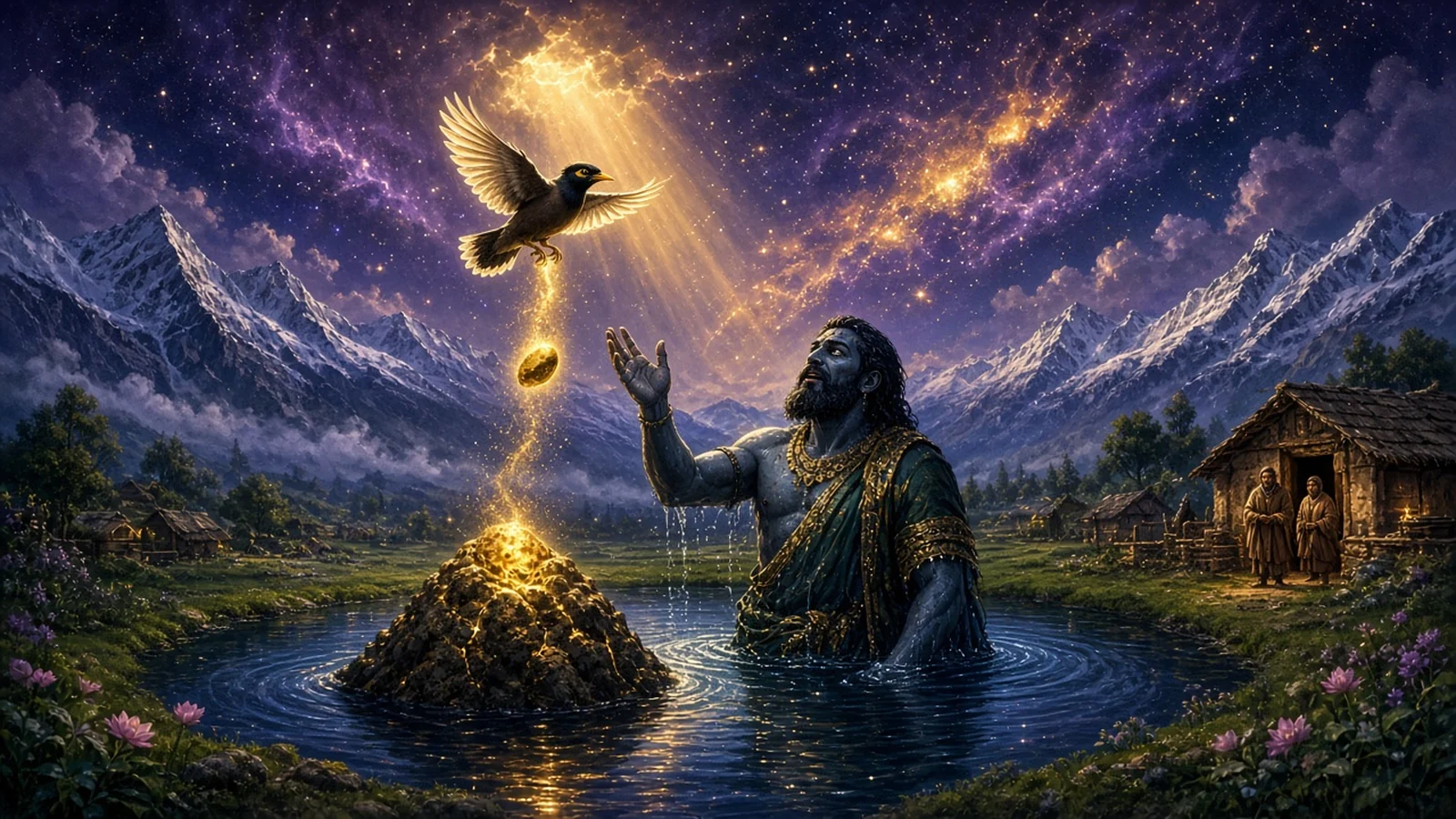
They prayed to the Goddess. She did not come as a queen with a sword. She made herself small, a haer, a myna, the brown bird with the yellow eye that sits on every roof in the valley, and flew away over the mountains to Sumeru, the mountain at the centre of the world, and picked up a pebble in her beak. She flew back with it and hovered over the pool. The demon looked up. She let the pebble fall.
It struck him, and it did not stay a pebble. It grew as it lay on him, into a stone, into a boulder, into a hill, and it pressed him down into the earth and kept him there, and it is there still. It is the hill at the edge of Srinagar that the Kashmiris call Hari Parbat, the myna's hill, after the bird. The Pandits call it Sharika Parbat, for the Goddess, because sharika is the myna in Sanskrit, and she did not leave. She took the hill for her home, so that the demon under it could never rise.
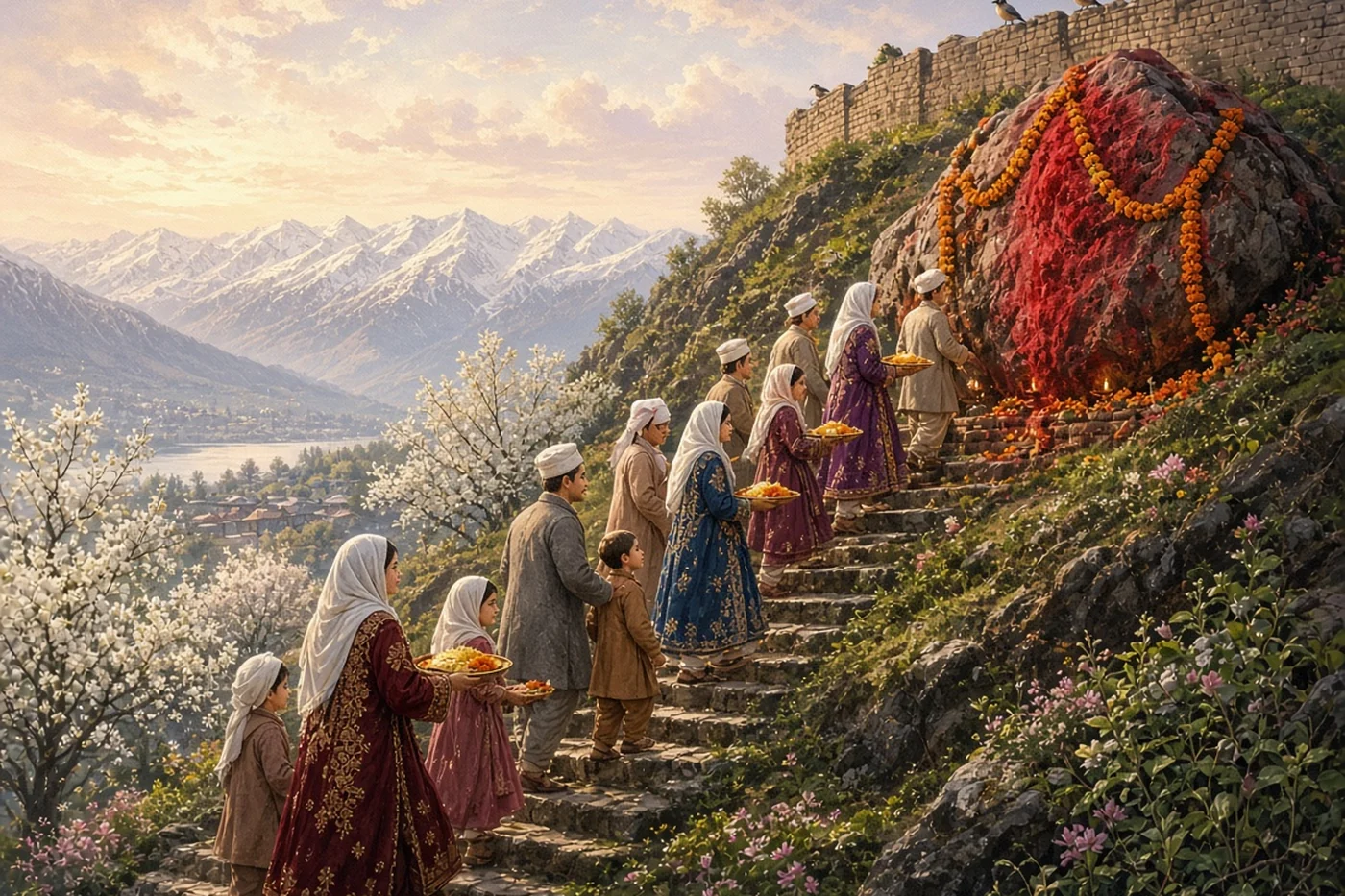
On the western face of the hill there is a rock, and in the rock a pattern of circles and triangles with a point at the centre, which no one carved. It is her Shri Chakra, her seat, and the Pandits worship her there as Sharika, Jagadamba, the mother with eighteen arms. The rock is red with centuries of sindoor, and a hundred and eight steps lead up to it from the courtyard called Deviangan.
The day she settled on the hill, the first day of the bright half of Chaitra, is the day the Kashmiri Pandits begin their year. Before the troubles of 1990 the whole community of Srinagar bathed before dawn that morning, put on new clothes and climbed to the rock with cooked yellow rice for her. It is Navreh, and wherever Pandits live now, the thali is still laid the night before and the walnuts still go into the river.