As Paithan tells it
Maharashtra · Pratishthana, now Paithan, on the Godavari · 3 min read
Pratishthana stood on the bank of the Godavari, and at its edge was the potters' quarter, where the wheels turned all day and the kilns smoked all night. A potter there had taken in a woman with a newborn boy. She said little about the child's father. When the potter's wife pressed her, she said only, "He is a king, but not a king of men. His people live under the river."
The boy grew up among the pots. While the other children ran about, he sat with the wet clay and shaped things: a horse, a bullock, an elephant with its trunk raised, a soldier with a spear. He gave them to the children, and they called him the clay boy. When the children played at kings he was always the king, and when they quarrelled he judged between them, and even the grown men said his judgments were fair.
Word of him went up the roads to Ujjain, where Vikrama ruled. A traveller told it at court as a joke: a potter's boy on the Godavari who sits in judgment like a king. Vikrama did not laugh. He sent a messenger to Pratishthana. "The king of Ujjain commands the boy to come and bow before him."
The boy heard him out and shook his head. "I have pots to fire," he said. "Tell your king I bow to no one in Ujjain."
So Vikrama came himself, with elephants and horses and foot soldiers, and camped across the river. The people of Pratishthana shut their doors. The potter went to the boy, white in the face. "Child, what have you done? That is an army. We are potters."
"Then we will do what potters do," said the boy. "Bring me clay. All of it."
All that day and all that night the potters' quarter worked. The boy shaped soldiers, hundreds of them, each a hand high, with shields and spears, and horses for them to ride, and elephants, and set them in rows along the riverbank to dry. The potter's wife wept over them. "They are toys," she said. "He will die, and we will die with him."
The boy's mother said nothing. She took a small sealed pot from the bottom of her chest, the only thing she had brought with her to the potters' quarter, and gave it to her son. "Your father's people left this with me for the day you would need it," she said. "Today is that day."
Before dawn the boy walked along the rows and sprinkled the nectar from the pot over the clay. Where the drops fell the clay stirred. The little soldiers stood up and grew, and the horses shook their manes, and the elephants lifted their trunks and trumpeted, and by the time the sun came up over the river an army stood on the bank that had not been there the night before.
Vikrama's men crossed the ford and met it. The clay soldiers did not bleed, and did not tire, and did not fall. By noon the army of Ujjain was running back up the road it had come by, and Vikrama with it.
The people of Pratishthana came out of their houses. They tied cloth to bamboo poles and raised them at their doors and windows, and the boy walked home through a street of flags. They crowned him there, in the potters' quarter, and called him Shalivahana, and he counted his years from that day.
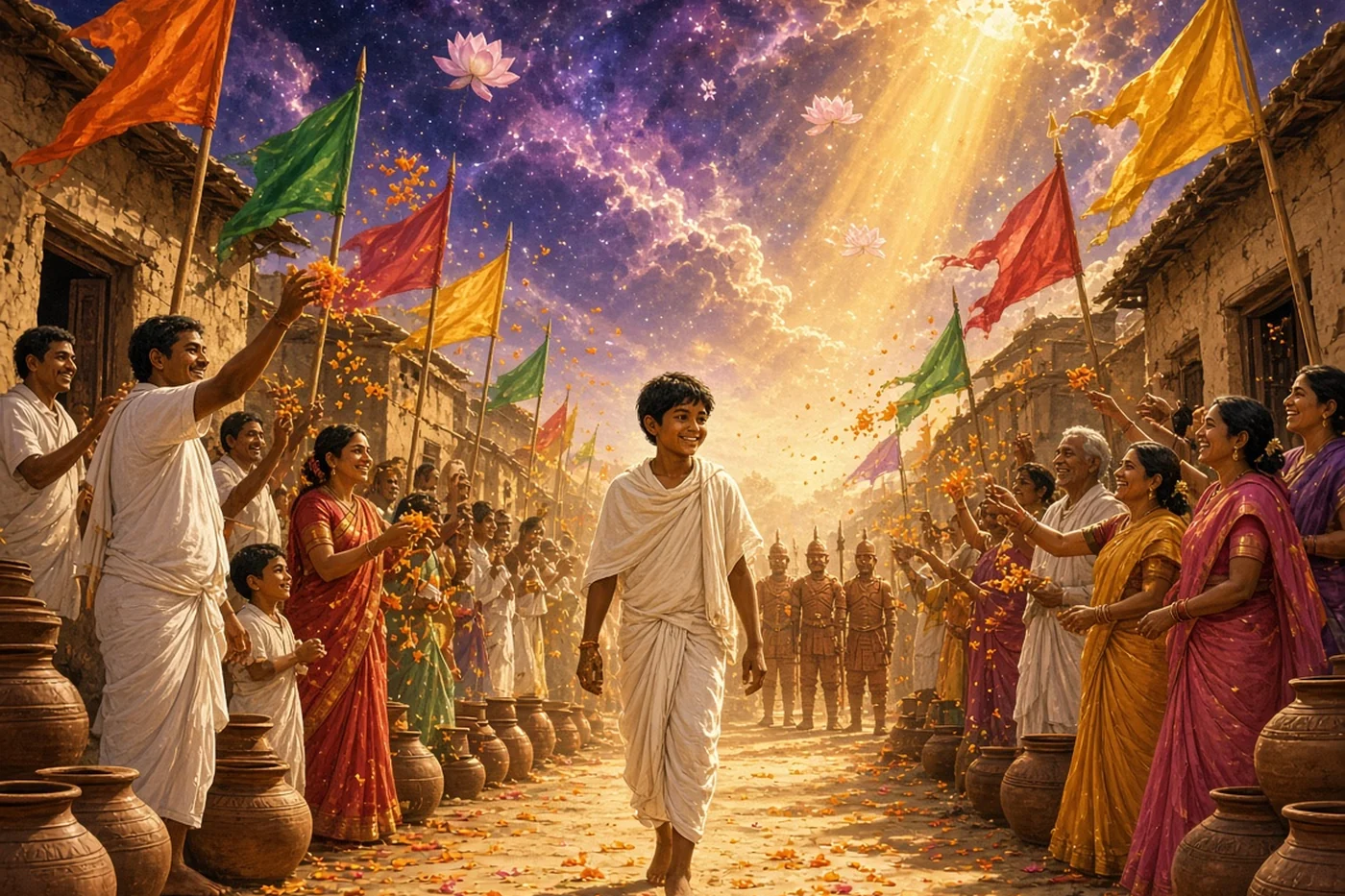
That was the first day of the bright half of Chaitra, Paithan says, and the pole with the cloth on it is still raised on that morning. It is the gudi, the flag they raised for him.
As the Jain chroniclers tell it
Western India · Pratishthana and Ujjain · 2 min read
The Jain writers of the west kept a different account of the boy's birth. A Brahmin widow, they say, was visited by Shesha, the king of the serpents, and bore his son. Before he left her Shesha said, "If trouble comes, remember me." She could not raise a child in her own house, so she went to live with a potter, and the boy grew up at the wheel, and made clay animals for the children of the lane, and took his name from them.
The children played at court with him on a mound for a throne, and his judgments were so fair that people brought him real cases. The fame of the potter's boy reached Vikramaditya in Ujjain. In one of the chronicles the king had a vetala, a spirit, who told him that the child who would take his place had already been born, and he sent the spirit to find the boy. In another he simply heard of the judge among the pots and understood what it meant. Either way he marched on Pratishthana with his whole army.
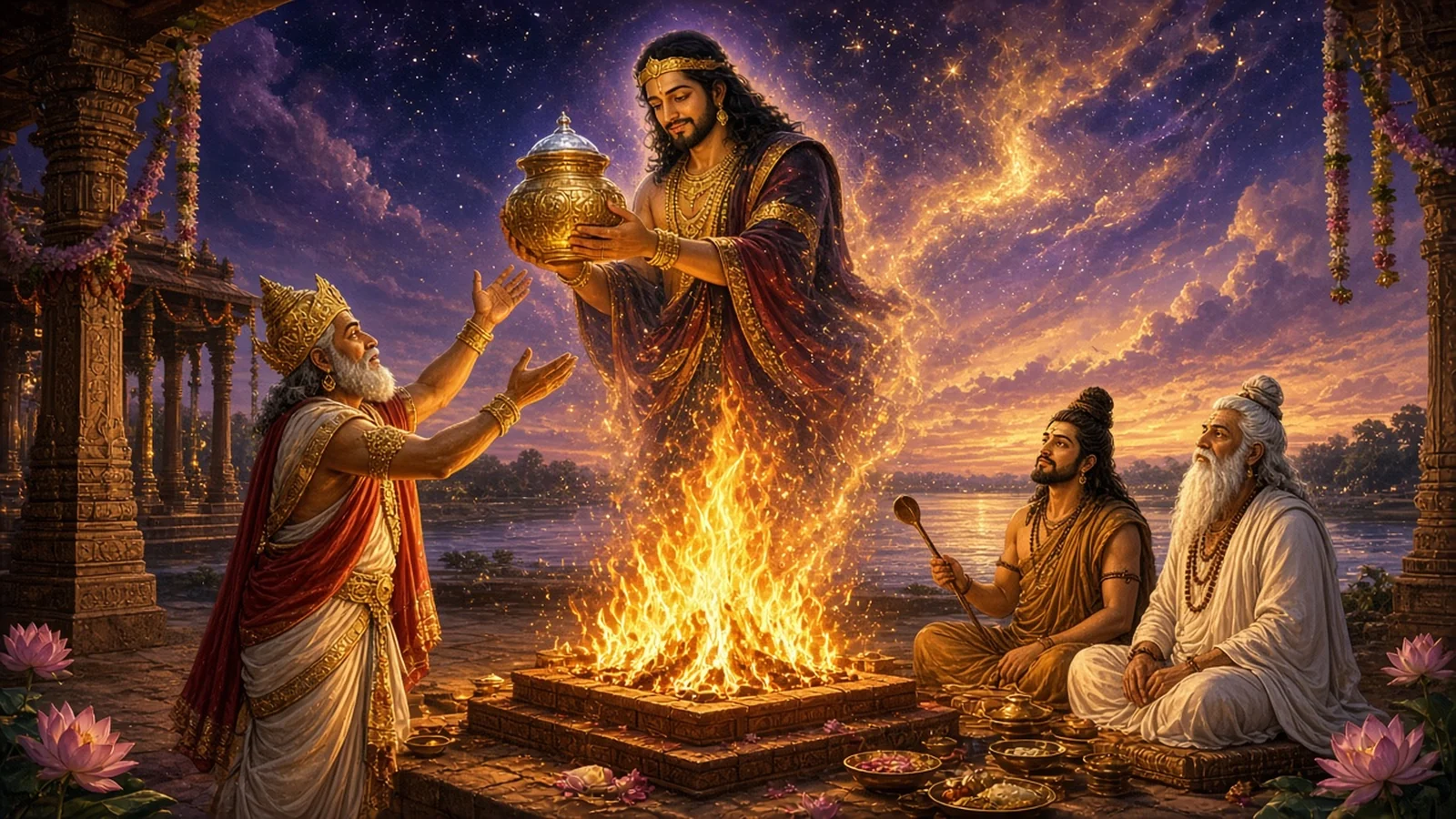
The boy was not afraid, but his mother was. She remembered the serpent king, as she had been told to, and Shesha came up out of the earth and gave her a pot of nectar. "Pour it on what your son has made," he said.

The boy had made horses, elephants and soldiers of earth, a whole army of them, drying in the sun. The nectar woke them. They fought the men of Ujjain and beat them, and Vikramaditya fled home to his own city. Some of the chroniclers say he was killed by an arrow from the boy's bow; others say he made peace and gave the boy his daughter. All of them say that Satavahana, as they call him, ruled at Pratishthana afterwards, began a new count of years from his victory, and became a follower of the Jina.
They tell more of him. His commander Shudraka won him half his wars. He gathered the poets who wrote in Prakrit, and the seven hundred verses of Hala are still read. And when the monk Kalakacharya came to Pratishthana and found the day of the Paryushana fast clashing with the king's own festival, he moved the fast by a day for King Satavahana's sake, and the Jains have kept it on the new day ever since.