As the grandmothers tell it: the waist chain
Kerala · the Vishukkani morning · 3 min read
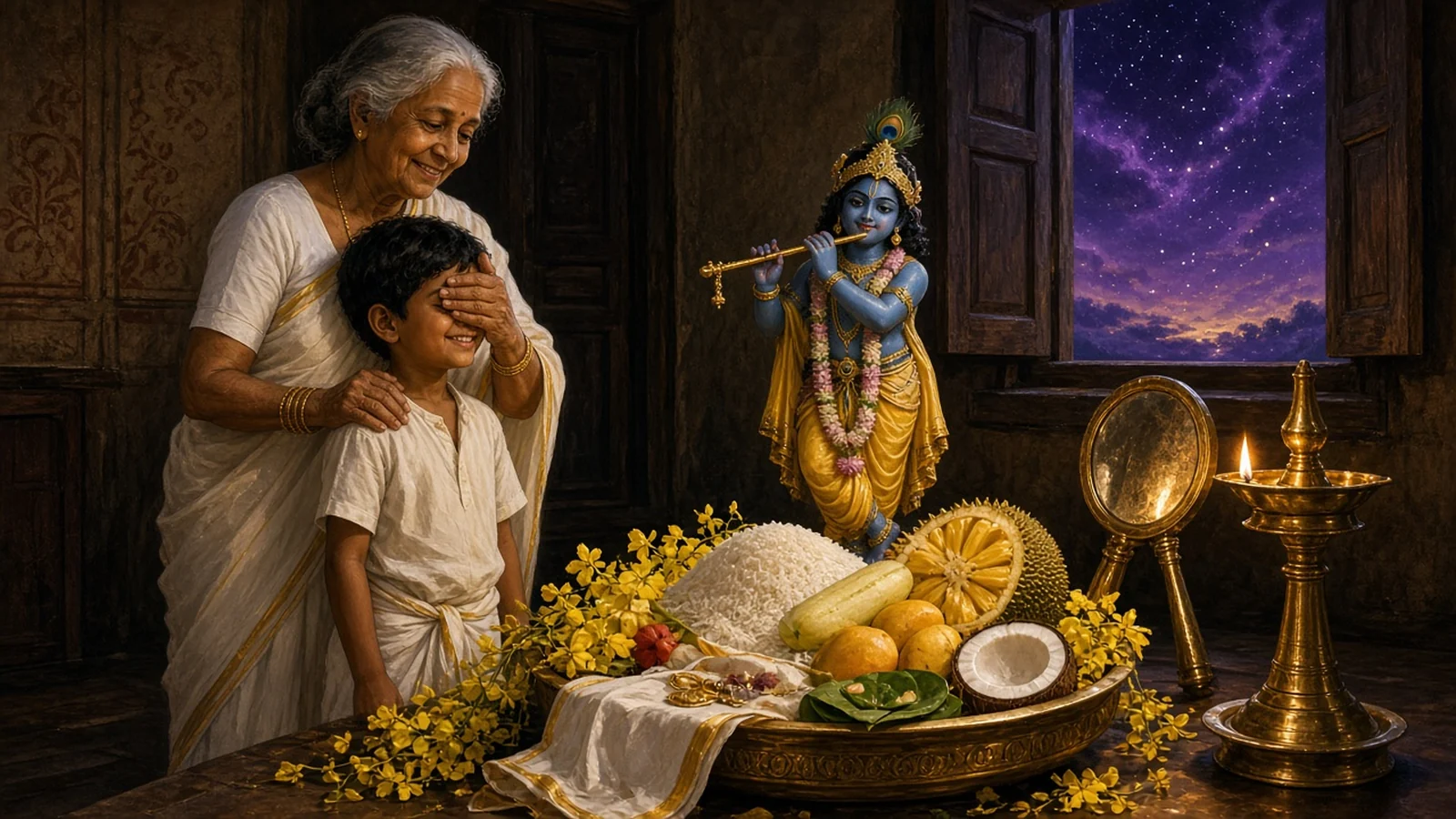
The night before Vishu the grandmother shut herself in the room with the lamp and would not let anyone in.
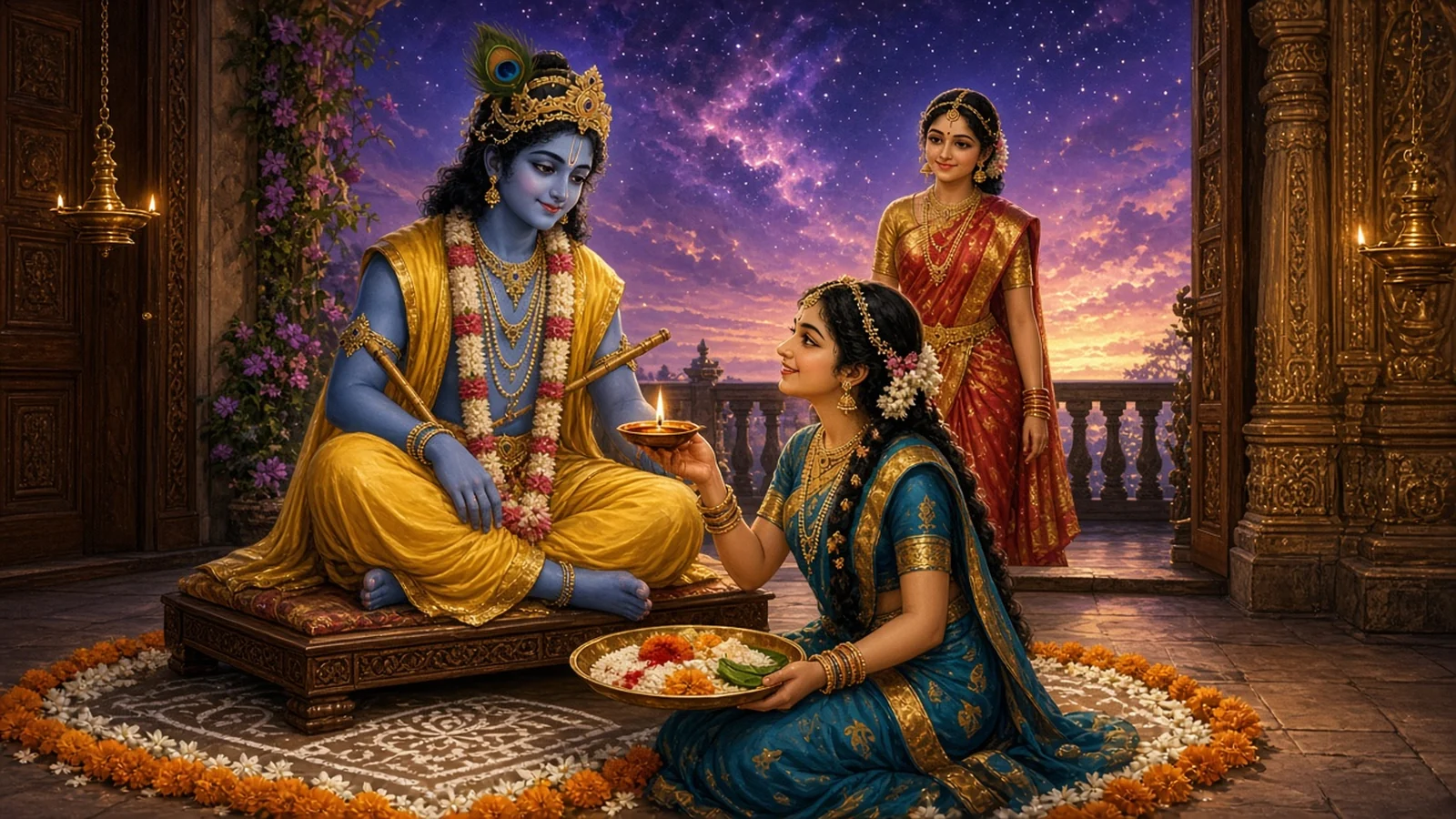
She set the bell-metal uruli in front of Krishna's image and filled it with rice. Round it she laid the things of the house and the season: a golden cucumber, a cut jackfruit, mangoes, a coconut split in two, betel leaves and arecanut, the new cloth folded, her gold bangles, a few coins, the Ramayana, and the long-handled mirror, the valkannadi, propped so that it would catch the lamp. Last of all she tucked sprays of konna into every gap until the whole tray was yellow. Then she covered it with a cloth and went to bed.
She was up again before four. She lit the lamp, pulled the cloth away, and looked for a long moment at Krishna in the light. Then she went to wake the boy.
"Keep your eyes shut," she said. "Shut, I said. Give me your hand."
She led him through the dark house with her palm over his eyes, and stood him in front of the lamp.
"Now look."
He saw the flame first, then the small smiling face behind it, then the gold of the flowers all round, and his own face in the mirror among them. Outside, somebody's crackers went off and a dog began to bark.
She put a coin into his hand and closed his fingers over it. "That is your kaineettam. Keep it, and the year will keep you."
He turned the coin over. "Ammoomma, why must the konna be in it? There are flowers in the yard all year."
"Because the konna is Krishna's," she said, and sat down on the step. "Listen."
"There was a boy once, in a village not far from here, as poor as a bird. His mother told him stories of Krishna every night, Krishna in Ambadi, Krishna stealing butter, and he loved that child more than anyone. Every day he went to the little temple near his house and asked for one thing only. Not rice. Not a new cloth. He asked to see Krishna, just once, with his own eyes.
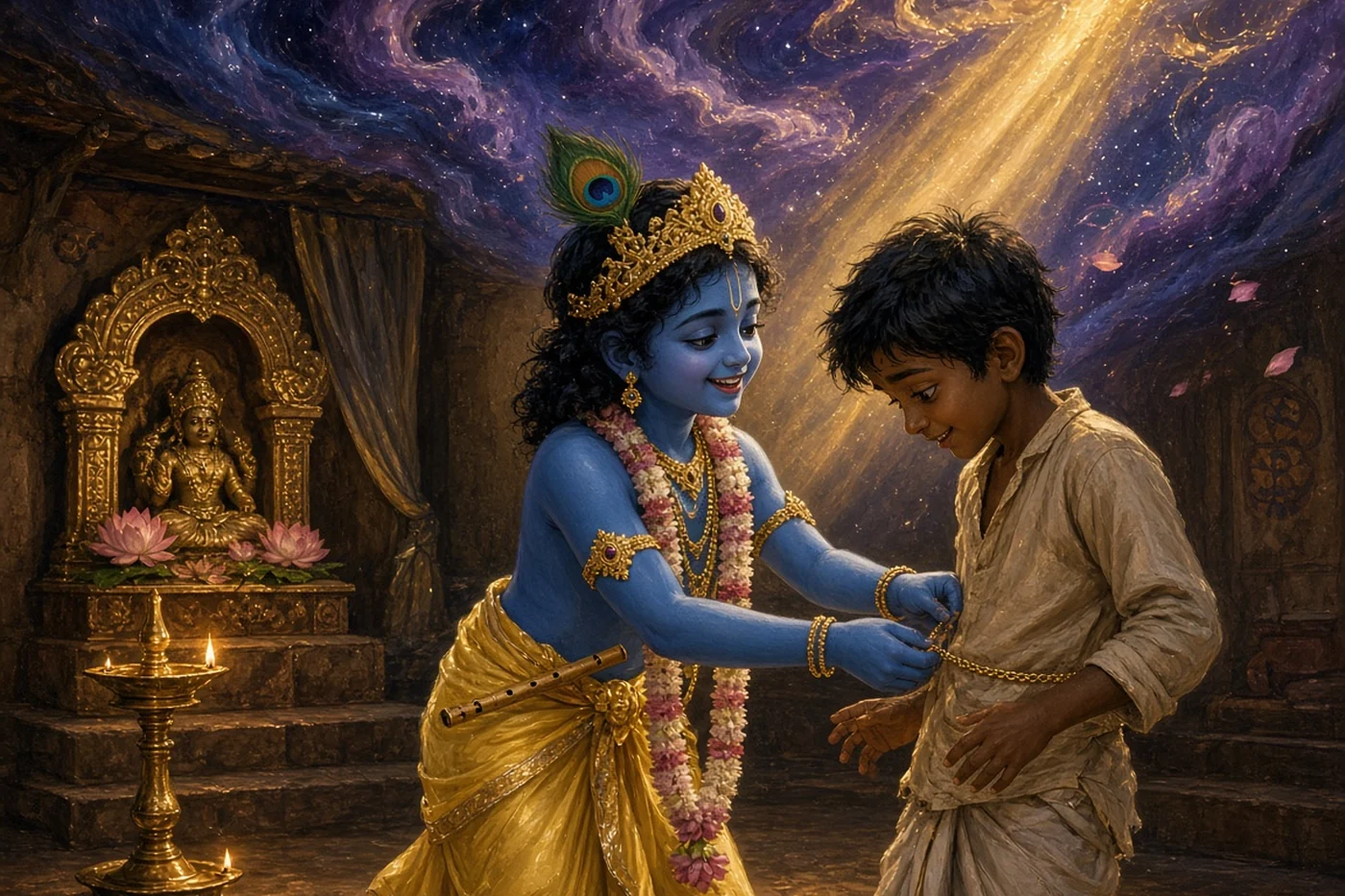
"One evening he did. The boy was alone in the temple and a child his own age was standing in front of the shrine, dark as rain, with a peacock feather in his hair. The boy ran and threw his arms round him.
"'What else do you want?' said Krishna.
"'Nothing,' said the boy. 'I have seen you.'
"Krishna laughed, and took off the chain of gold he wore round his waist, the aranjanam, and tied it round the boy's waist, and was gone.
"In the morning the priest opened the shrine and the chain was missing from the image. The whole village came running. They found the boy in his mother's yard with his hands over his waist, and they saw the gold, and they shouted the word. Thief.
"'He gave it to me,' said the boy. 'Krishna gave it. He asked me what I wanted.'
"Nobody believed him. His own mother did not believe him. She slapped him, pulled the chain off him, and threw it as far as she could, and it caught on a branch of a tree at the edge of the yard, a tree that had never flowered in anyone's memory.
"By morning that tree was gold from top to bottom. Every branch hung with yellow, and the chain was gone into the flowers. The village stood under it and nobody said anything, and the boy's mother took him by the hand.
"That was the first konna. That is why it flowers now, at Vishu, when nothing else does, and why it goes into the kani before anything else. Krishna put his own gold on a tree so that a poor boy would not be called a thief."
The boy looked at the tray again. The flame had steadied and the mirror held it.
"Did Krishna come back for the chain?"
"He has it," his grandmother said. "Look at the tree outside."
The other telling: the chain lost among the flowers
Kerala · as Amar Chitra Katha and others tell it · 2 min read
Some tell it differently, and in their telling nobody is given anything. The chain is lost.
A boy who loved Krishna was allowed to help at the temple. Before the morning pooja he took the dried garlands off the image and swept the old flowers out of the shrine, and one morning, in the dark, the gold aranjanam came away with the dead flowers and went out with them into the heap.
When the priest came to dress the image he stopped.
"Where is the waist chain?"
"I only took the flowers," said the boy.
"You only took the flowers. And the gold walked away by itself."
The temple filled up. People who had known the boy all his life looked at him sideways, and someone said what they were all thinking. The boy stood in front of the shrine with the broom still in his hand and cried, and said to Krishna under his breath, "You know I did not. You saw."
Nothing happened that day. The boy was sent home, and the chain was not found in the flower heap or anywhere else.
The next morning the priest opened the shrine and stood still a second time. In front of the image lay a heap of fresh konna flowers, bright yellow, though no one had brought any. In the middle of the heap lay the gold chain.
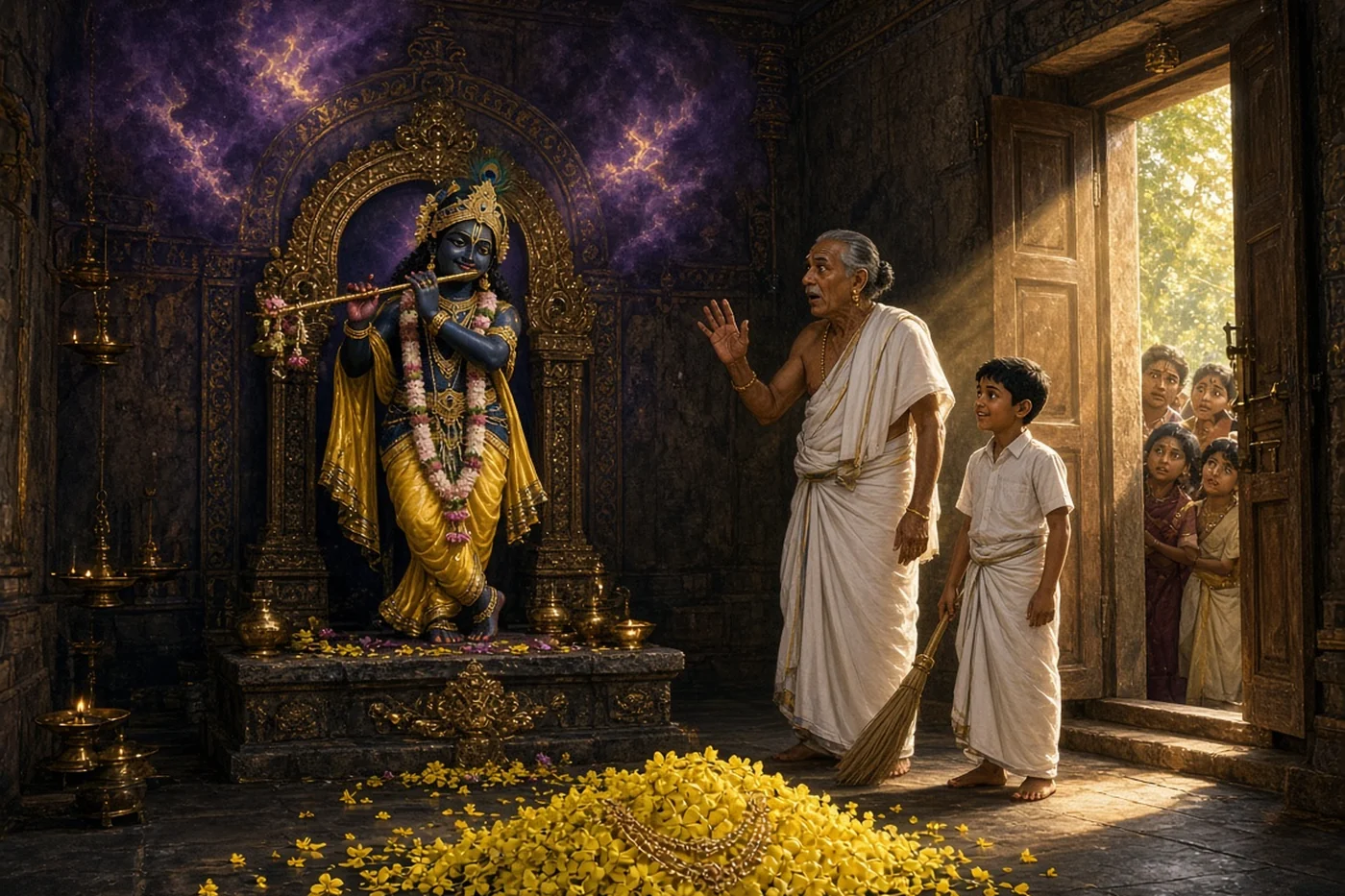
"Who put this here?" the priest said, and nobody had.
They understood then that Krishna had gone and fetched his own chain back and laid it where the boy would be cleared, and had covered it in gold of another kind, to say that a child's love was worth more to him than the ornament. The boy was called back to the temple. And the konna, which had carried the chain, is set before Krishna every Vishu.