As Tulsidas tells it
Ramcharitmanas, Bal Kand, dohas 141 to 152 · 3 min read
Shiva told it to Parvati on Kailasa, and the sage Yajnavalkya told it to Bharadvaja, and Tulsidas wrote it down as the first of the reasons why the Lord was born in Ayodhya.
Svayambhuva Manu was the first of men and Shatarupa his wife the first of women, and from the two of them the human race came. The Vedas still praise the way they lived. They ruled a long age and raised their children, Uttanapada, whose son was the boy Dhruva, Priyavrata, and Devahuti, who married the sage Kardama and bore Kapila.
Then Manu grew old. He saw his hair had gone white, and a thought came to him that would not leave.
"I have ruled," he said to Shatarupa. "I have had sons and daughters. I have done every duty a king has. And I have never once given myself to the Lord. My life has gone into the world's business."
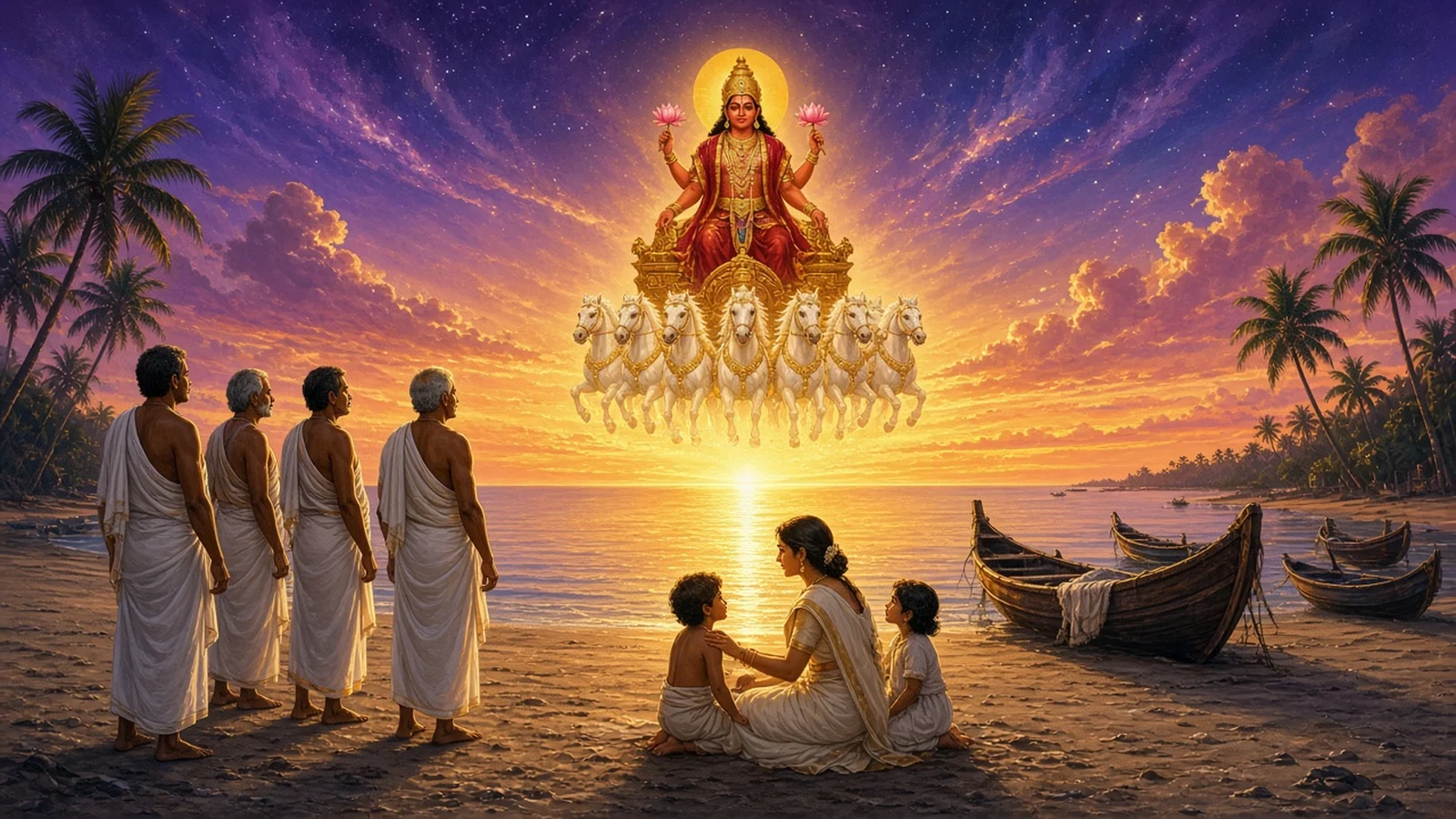
He put the crown on his son's head, whether the son wanted it or not, and the two of them walked out of the city into the forest of Naimisharanya, where the sages live. They bathed in the Gomati. The sages there knew them and came out to meet them, and the king and queen sat among them, listened to the Puranas, and thinned their bodies with fasting.
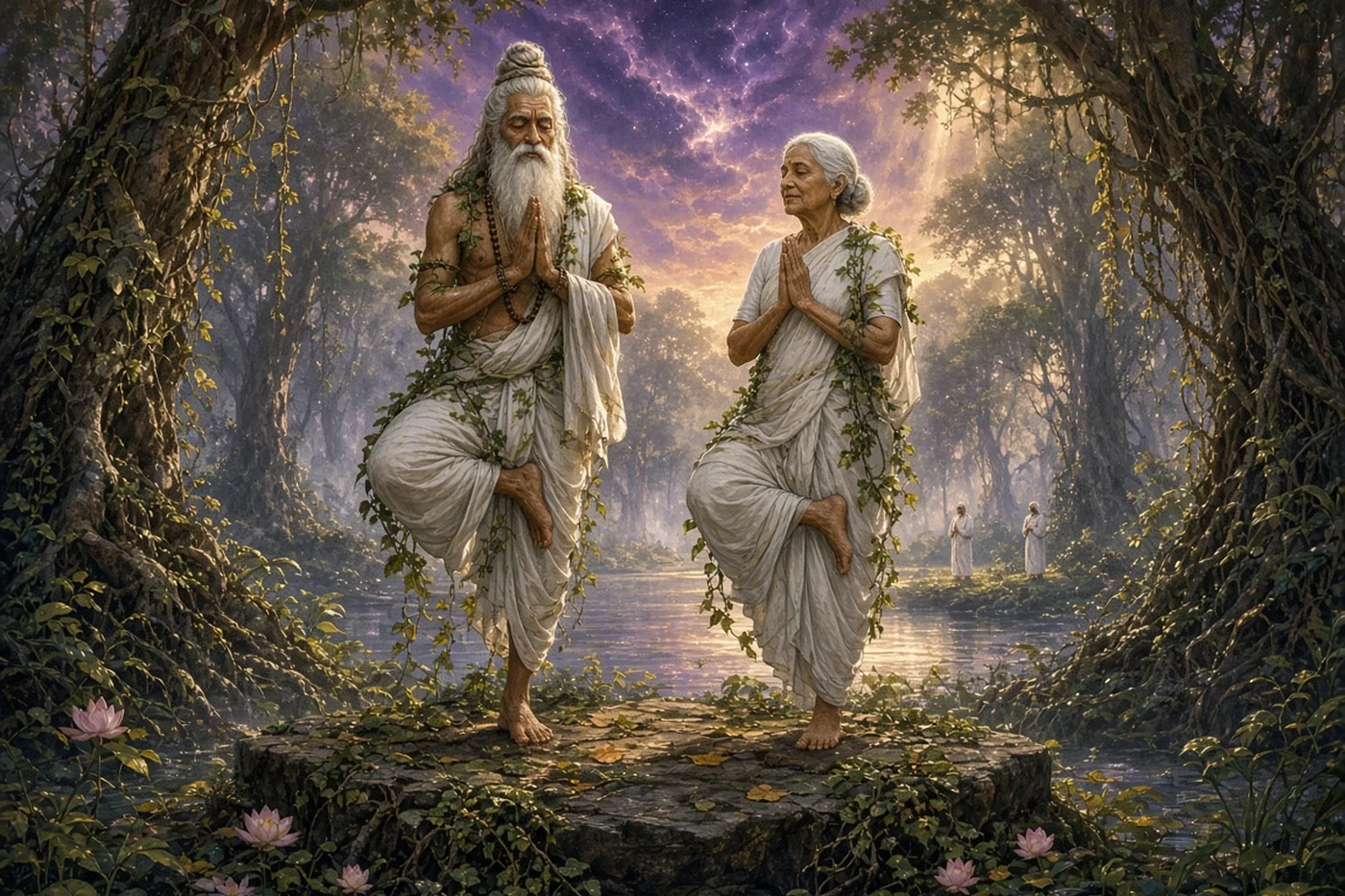
Their prayer was the twelve syllables, Om namo bhagavate Vasudevaya, and the Lord they prayed to was the one whose form has no form. For a while they ate roots and leaves. Then they gave those up and lived on water. Six thousand years passed on water. Then they gave up water and lived on air, and seven thousand years passed on air. Then they gave up even that, and stood for ten thousand years on one foot, not breathing. Brahma came and offered them a boon, and Shiva came, and Vishnu came in his own form, and they did not open their eyes. Their bodies were bone and skin, and they felt no pain.
At last a voice spoke out of the sky, the voice they had waited for. "Ask."
The old king and queen bowed to the sound as if their bodies were young again. "We have one wish," Manu said. "To see you. The form that Shiva holds in his heart, that the sages seek and the Vedas call unspeakable. Show us that, and we are paid."
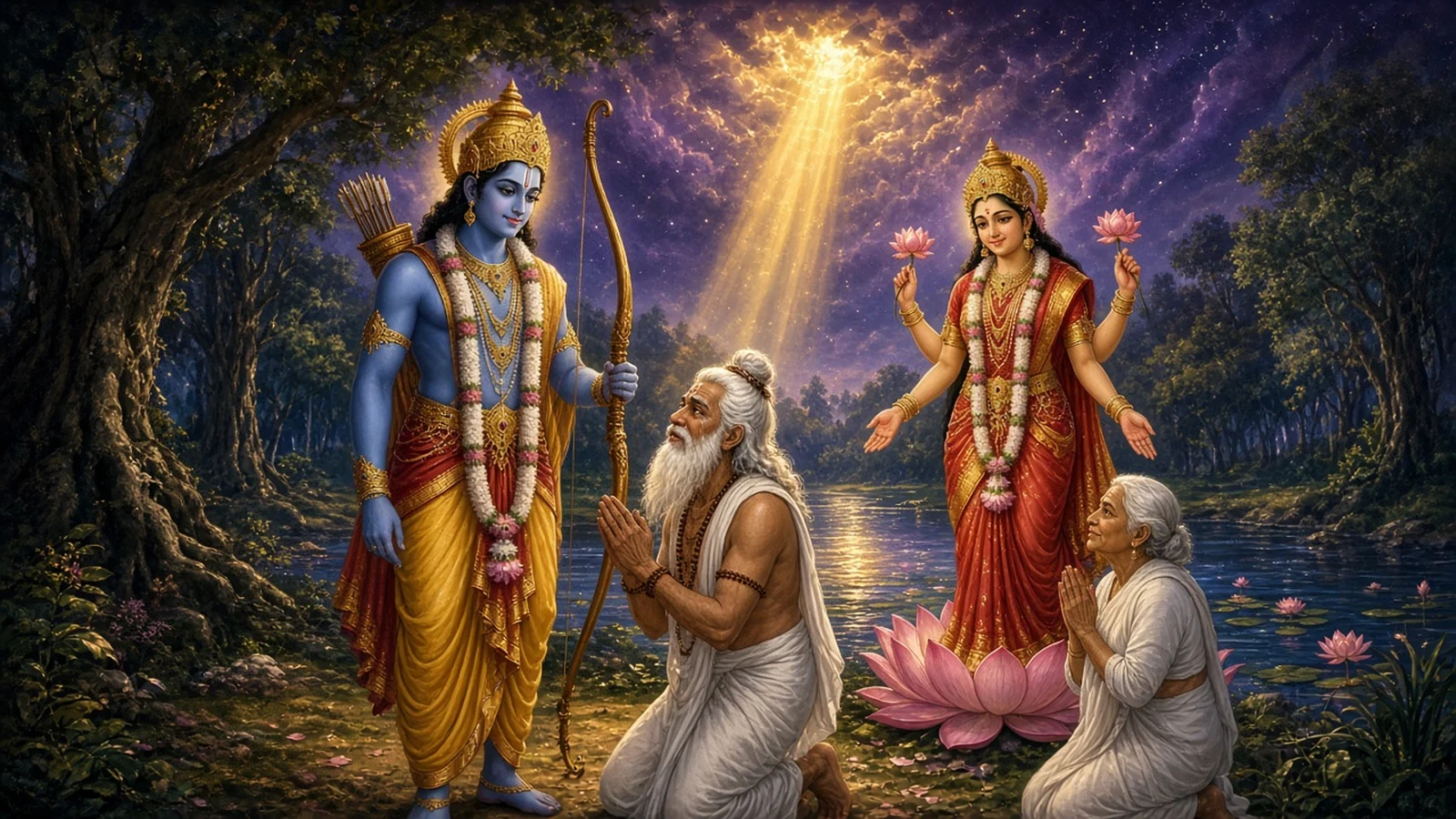
And the Lord came down and stood before them, dark blue, with lotus eyes and a face like the moon in autumn, a crown on his head, earrings, a garland, the bow and the quiver, yellow silk, and at his left the Goddess, Lakshmi, whom the poet calls the root of the world. The two of them fell at his feet and could not get up. He lifted them with his own hands.
"Ask what you want," he said. "Nothing is hard for me to give."
Manu found his voice. "Lord, I will ask what a father asks. Give me a son like you."
The Lord laughed. "Like me? Where shall I find another like me? There is none. So I will come myself, and be your son."
Shatarupa asked for less and for more: devotion, love for his feet, true knowledge, and a life that pleased him. He gave it all.
"Go now to Indra's city," he said, "and enjoy its pleasures for a time. Then you will be born again as the king and queen of Avadh, and I will come to your house as a man, with my brothers, and do the deeds that make devotees glad for ever. You will have your son."
He vanished. In time Manu and Shatarupa were born again as Dasharatha and Kausalya, and the child the queen bore at noon on the ninth of Chaitra was the son she had asked for in the forest.
As Valmiki tells it: the boon Ravana forgot to finish
Valmiki Ramayana, Bala Kanda 15 to 17 · 2 min read
Valmiki knows nothing of Manu's vow. His reason for the birth is a mistake made by a demon.
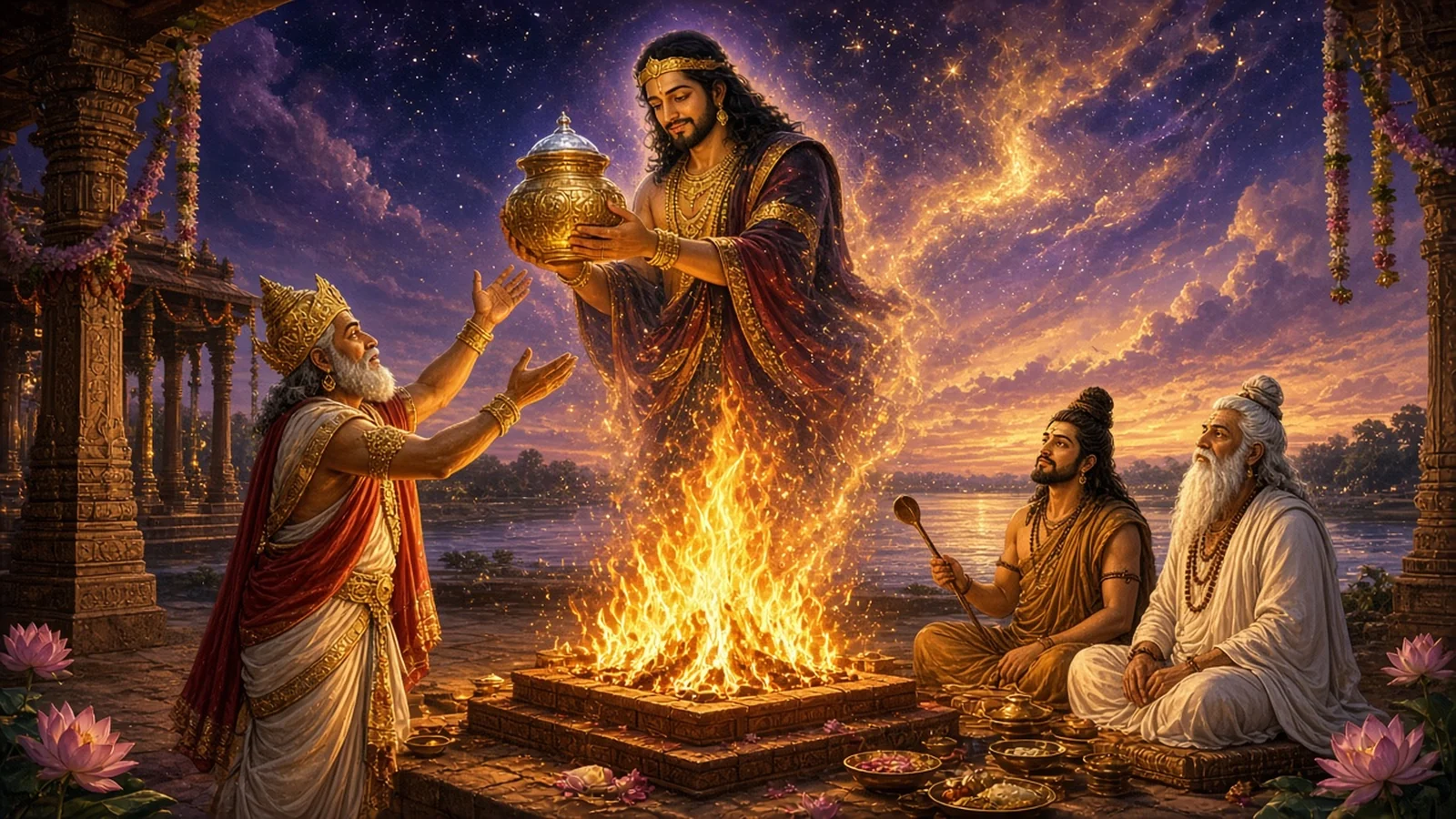
While Rishyashringa poured the offerings of the rite for a son into Dasharatha's fire, the gods gathered above the altar to take their shares, and they used the moment to go to Brahma with a complaint.
"Ravana is destroying us," they said. "He torments sages, yakshas, gandharvas, even the Brahmins. Indra cannot stop him, nor the sun, nor the wind, nor the sea. And we cannot touch him, because of the boon you gave him."
"I remember the boon," said Brahma. "He asked to be safe from gods, from gandharvas, from yakshas and from rakshasas, and I granted it. He did not name men. He thought men beneath his notice. There is the remedy: a man can kill him."
The gods were glad, and gladder still when Vishnu came riding on Garuda, with the conch, the discus and the mace in three of his hands, in robes the colour of ochre.
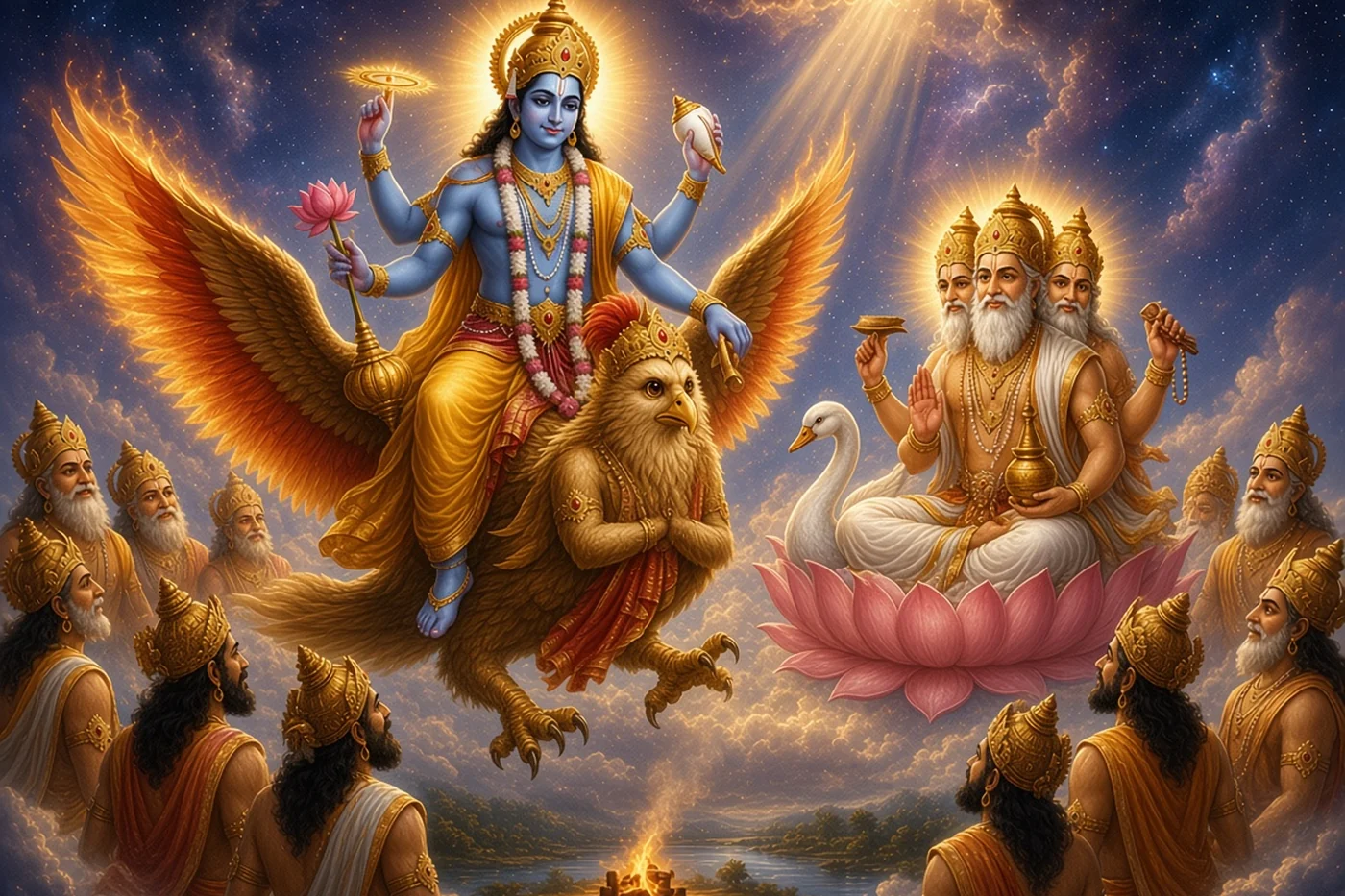
"Be born as a man," they begged him. "The king of Ayodhya, Dasharatha, is making a sacrifice for a son at this moment. His three queens are modesty, fortune and fame in the shape of women. Be born to them, and kill Ravana."
"Do not be afraid," said Vishnu. "I will kill Ravana in battle, with his sons and his ministers and his army and his kin, and I will live among men for eleven thousand years." He thought where to be born, and chose Dasharatha, and made himself into four so that each queen's child would be a part of him.
Then Brahma turned to the gods. "He goes down as a man. He will need help. Father sons on the apsaras and the gandharva women and the she-bears and the monkeys, sons who can take any shape and are as strong as you are." And they did. Indra fathered Vali, the sun Sugriva, and Vayu, the wind, fathered Hanuman. Brahma said he had already made the bear Jambavan from a yawn. The monkeys spread through the forests and mountains of the south and waited there, without knowing what they were waiting for.