As Kerala tells it
Kerala · told on Vishu morning · 3 min read
In the days when Ravana ruled Lanka, the people of Kerala say, the sun did not rise where it should.
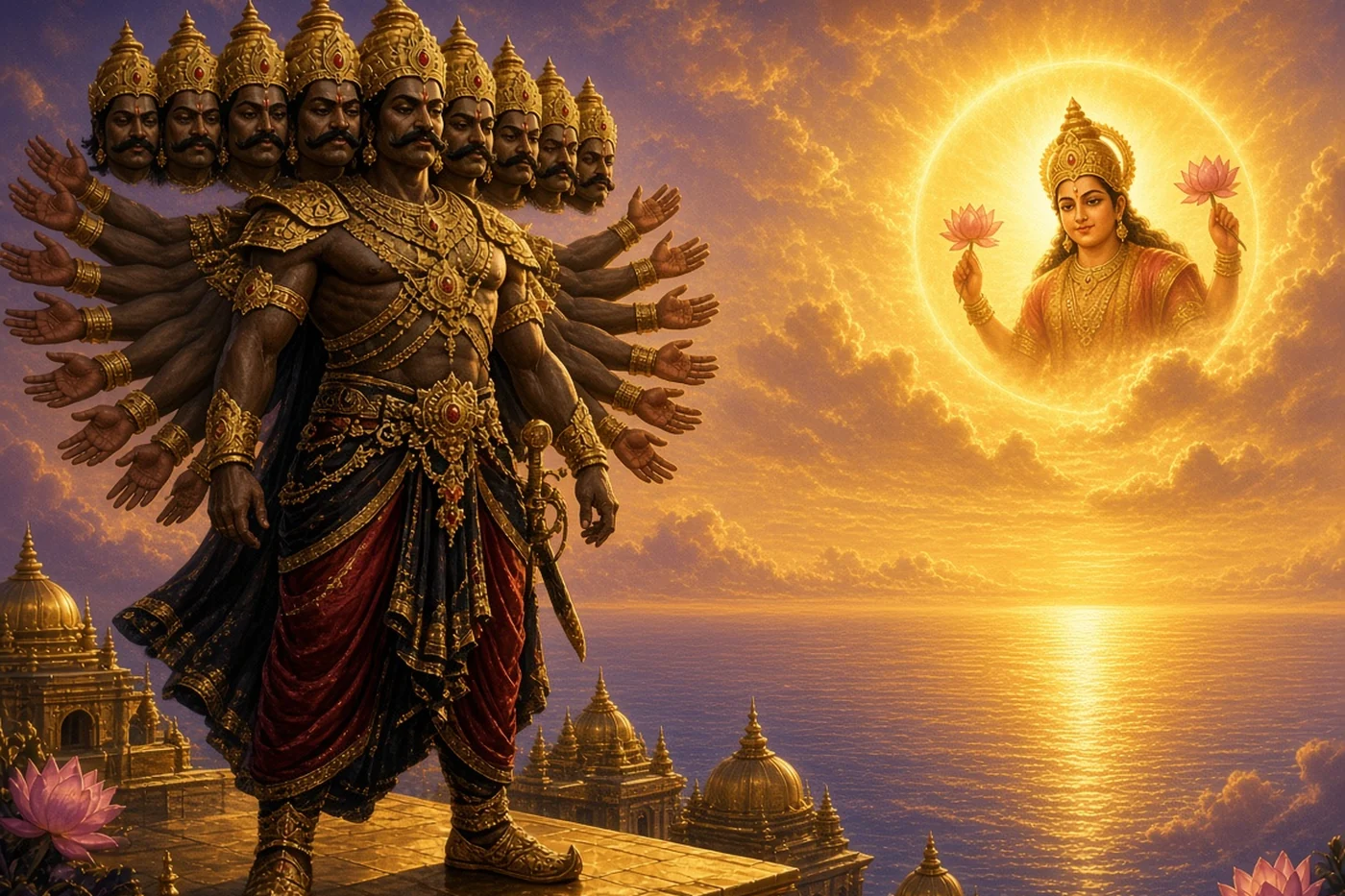
Ravana had ten heads and twenty arms, and a promise from Brahma that no god and no demon could kill him. He had beaten Kubera and taken his flying palace. He had fought Yama and walked away. The gods kept out of his sight. Only one of them still came to his door every morning without asking, and that was Surya, the sun.
Each day Surya rose in the east, and his first light fell straight on Lanka, on the gold roofs of the palace and into the eyes of its king. Ravana did not like it. Some say it was the glare on his gold; some say it was simply that nothing was allowed to stand above him.
"Who gave you leave to look at me?" he said one morning, standing on his terrace with his arms raised against the light. "Everything from this sea to the mountains bows to me. You alone climb over my head as if I were a stone in a field."
"I have risen in the east since before there were kings," said Surya. "I rise over everyone."
"Not over me. Rise where you like, but not above Lanka."
The sun did not answer, and the next morning he came up as he always had. So Ravana went up to the roof himself, and when the sun's rim showed over the sea he set his twenty hands against the light and pushed. He could not stop the sun. But he could turn him. From that day, they say, the sun came up to one side, at a slant, and crept across the sky crooked, so that his light reached Lanka only sideways and never full in the king's face.
Nobody else had been asked. In every country the mornings came up lopsided. The shadows lay the wrong way, the farmers who set their sowing by the sunrise could not tell one season from the next, and the old people said that the day and the night had lost their balance and would not be equal again until the sun was free.
Years passed. Then Rama came.
Ravana had carried Sita away to Lanka, and Rama followed her with the monkey army, built a bridge over the sea, and fought the king of Lanka in front of his own gates. Ravana fell at last with Rama's arrow in his chest. That night nobody in Lanka slept, and in the other countries nobody knew yet what had happened.
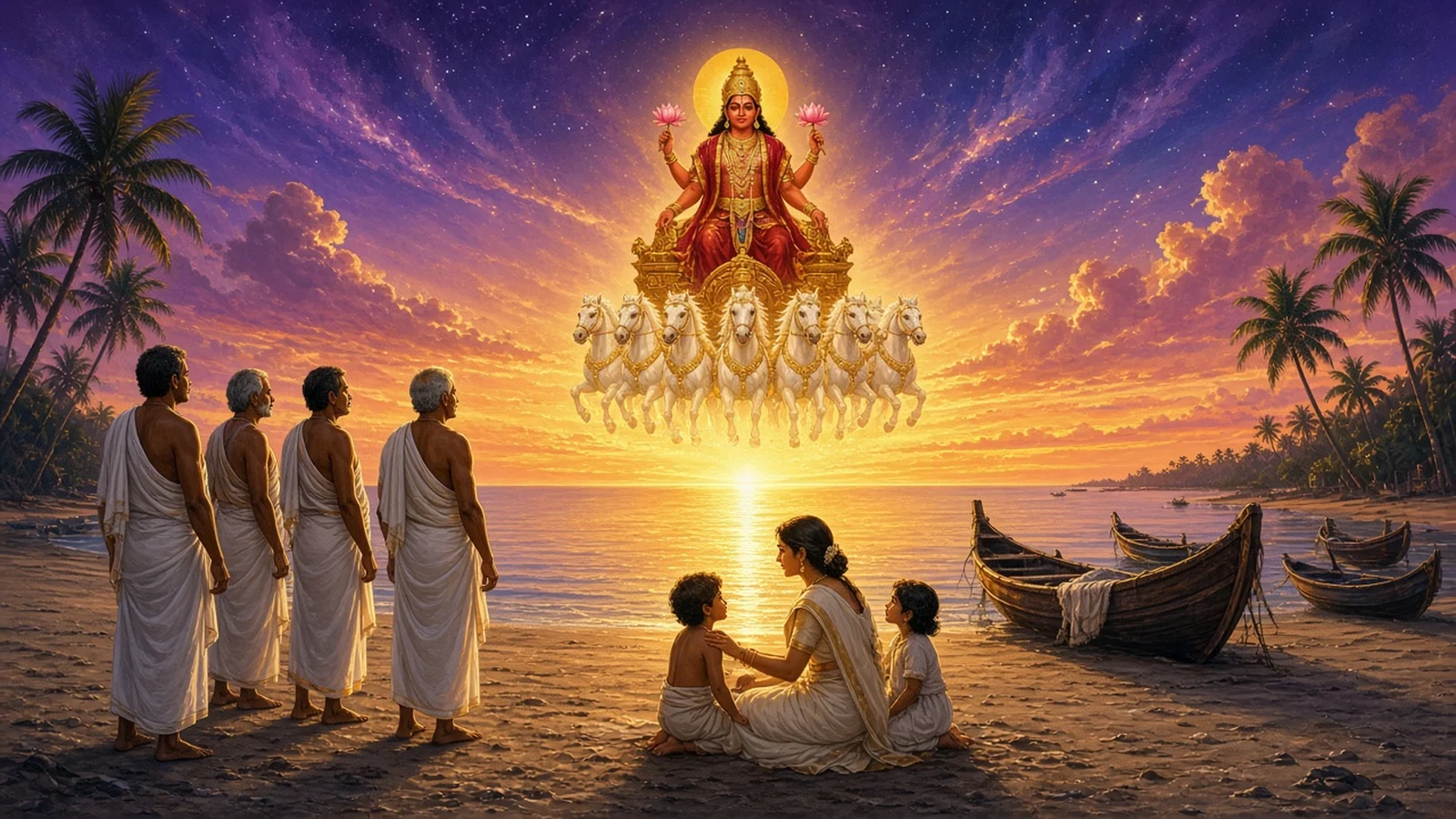
Before dawn the fishermen were on the shore, as they always were, and they stood and waited the way people wait for a thing they have stopped expecting.
The rim of the sun showed over the water. It showed exactly in the east, where the oldest of them said it had risen when they were boys. It came up straight, and climbed straight, and the light fell on every roof and every field at once.
"Look," a woman said to her children, and turned their faces towards it. "He has come back to his place."
That morning, the tellers of Kerala say, was the first Vishu. Vishu means equal, and on that day the day and the night were the same length, and the sun stood where he belonged. So before dawn on Vishu the eldest in the house lights a lamp and lays out the tray of good things, and leads the children in with their eyes shut, so that the first thing they see in the new year is light, standing straight.
As the Ramayana tells it: the sun before the last fight
Valmiki Ramayana · Aranya Kanda 32, Yuddha Kanda 105 and 108 · 2 min read
Valmiki's Ramayana has no morning when the sun rose crooked. But it knows a Ravana who put his arms against the sun.
When Shurpanakha came to Lanka with her face cut, she found her brother on his throne, and the poet stops to say who this is. Ten necks and twenty arms. Scars on his chest from Indra's thunderbolt and from the tusks of Indra's elephant. The one who beat Kubera and took the Pushpaka from him, who tore up Indra's garden Nandana, who stopped the sages' sacrifices. And, the poet says, the one who with his arms forestalled the rising of the moon and the sun.
He had earned it. For ten thousand years he had stood in penance and offered Brahma his heads one by one, and Brahma had given him this: no god, no demon, no spirit could kill him in battle. Only a man was left out of the promise, because Ravana had not thought a man worth naming.
Years later that man stood on the field at Lanka, tired, with Ravana's chariot in front of him and the gods watching from the sky. The sage Agastya came down from among them.
"Rama," he said, "listen. There is a secret that gives victory. It is the Heart of the Sun. Praise him, the lord of the worlds, whom gods and demons both bow to. He is awake when every creature sleeps. He is the seasons and the rain and the light. Whoever sings this in trouble will not come to grief. Say it three times with your mind on him, and you will kill Ravana this very hour."
Agastya went back up to the gods. Rama rinsed his mouth three times, turned his face to the sun, and said the hymn. His grief went out of him. He picked up his bow and looked at Ravana.
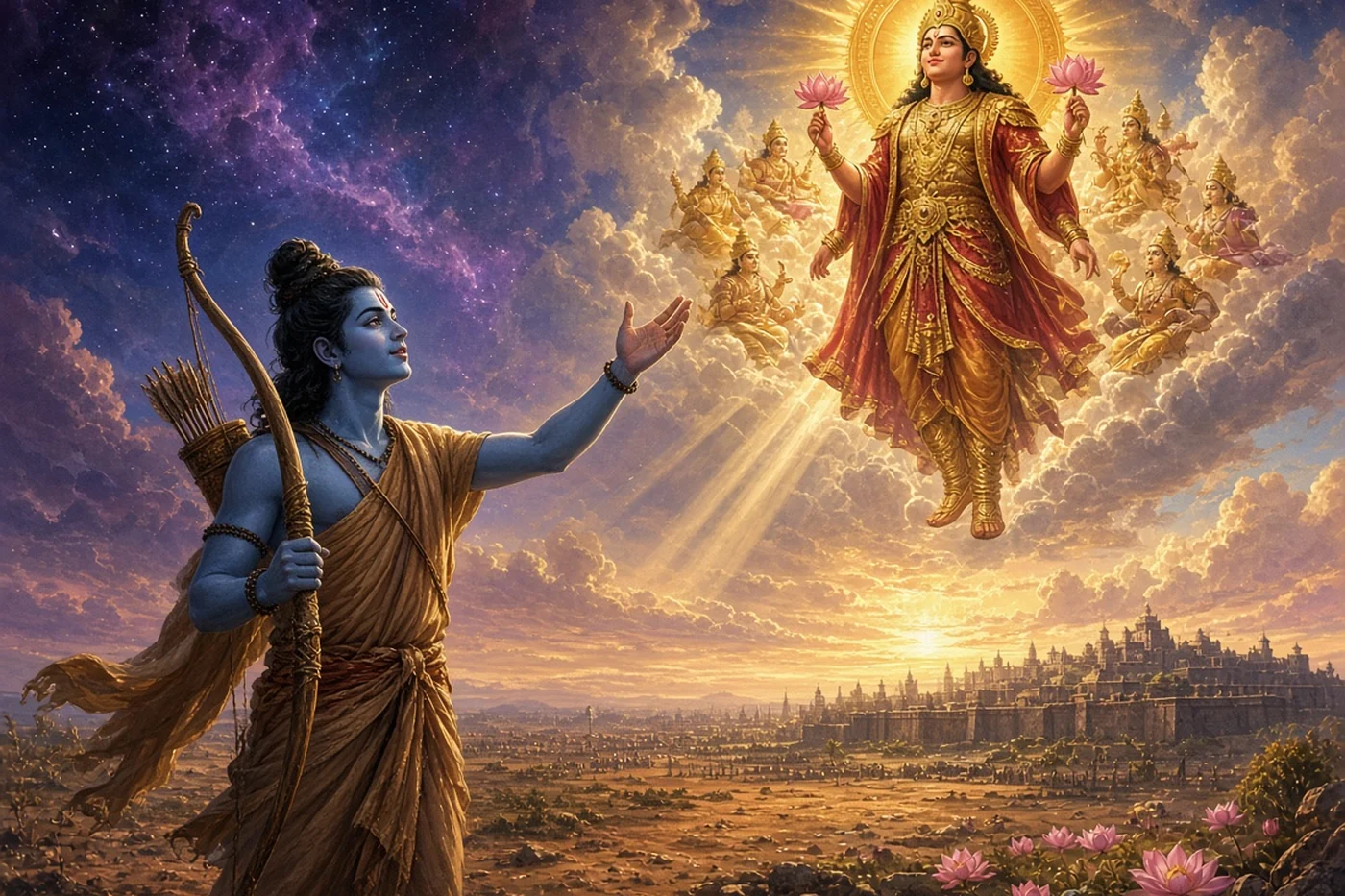
And the sun, standing among the gods with a glad heart, saw what was coming, and spoke one word to him. "Hurry."
Matali, Indra's charioteer, told Rama the time had come. Rama took the arrow Agastya had given him, the one Brahma had made for Indra, with the wind in its feathers, fire and sun in its point, the weight of Meru and Mandara in its shaft. He said the words over it and let it go. It struck Ravana in the chest, tore through his heart, and came back clean to the quiver.
Ravana fell from his chariot the way Vritra fell under Indra's bolt. Then the drums of the gods sounded in the sky, flowers came down on Rama's chariot, the quarters grew bright, the earth stopped shaking, the wind blew soft, and the sun shone steady.