As Valmiki tells it
Valmiki Ramayana, Bala Kanda 8 to 18 · 4 min read
Dasharatha, king of Ayodhya, had everything a king could want except the one thing he wanted. He had three queens, Kausalya, Sumitra and Kaikeyi, and no son. He was growing old, and the thought burned in him day and night.
"I will perform the horse sacrifice," he said at last to his ministers. "Let the gods give me sons." He sent Sumantra, his charioteer and oldest counsellor, to bring the priests, Vasishtha first among them, and told them his grief. They approved. "Let the horse go free," said Vasishtha. "Build the ground on the north bank of the Sarayu. You will have sons."
Then Sumantra took the king aside. "There is an old story I heard from the sage Sanatkumara," he said. "In the forest lives a young sage named Rishyashringa, the son of Vibhandaka, who has never seen a woman or a city. King Romapada of Anga brought him out of the forest when his kingdom was dying of drought. The rain came the day he arrived, and the king gave him his daughter Shanta. Sanatkumara said it would be Rishyashringa who gives you your sons."
So Dasharatha went to Anga himself and came back with Rishyashringa and Shanta.
For a year the horse wandered, and no king dared to stop it. In spring the sacrifice was held on the Sarayu, flawless from the first rite to the last, with Rishyashringa among the priests and Vasishtha beside him. When it was over the king gave away the whole earth to his priests, and they gave it back and took cows and gold instead.
"One thing more," Dasharatha said to Rishyashringa. "The rite for a son."
"I know it," said the sage. "It is in the Atharva." And he began the Putrakameshti, the sacrifice of the wish for a son.
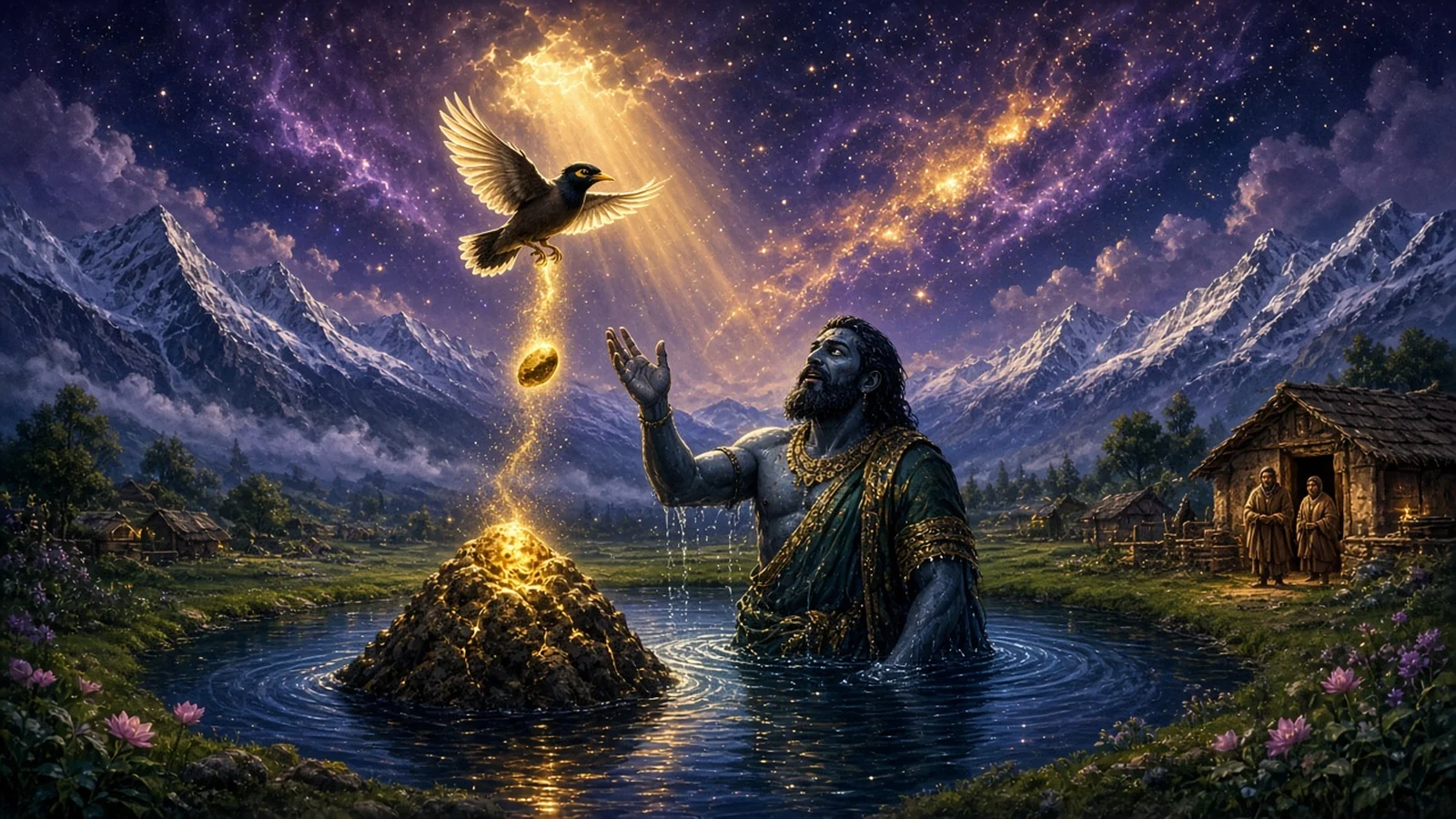
What happened above the fire the king did not see. The gods had come for their shares of the offering, and while they stood there they complained to Brahma of Ravana, the demon king of Lanka, who tormented the three worlds because of a boon Brahma himself had given him.
"He asked to be safe from gods, gandharvas, yakshas and demons," Brahma said. "He did not ask to be safe from men. He thought men too small to mention. A man can kill him."
Just then Vishnu came on Garuda, and the gods asked him to be born as a man, the son of Dasharatha of Ayodhya by his three queens. Vishnu agreed.
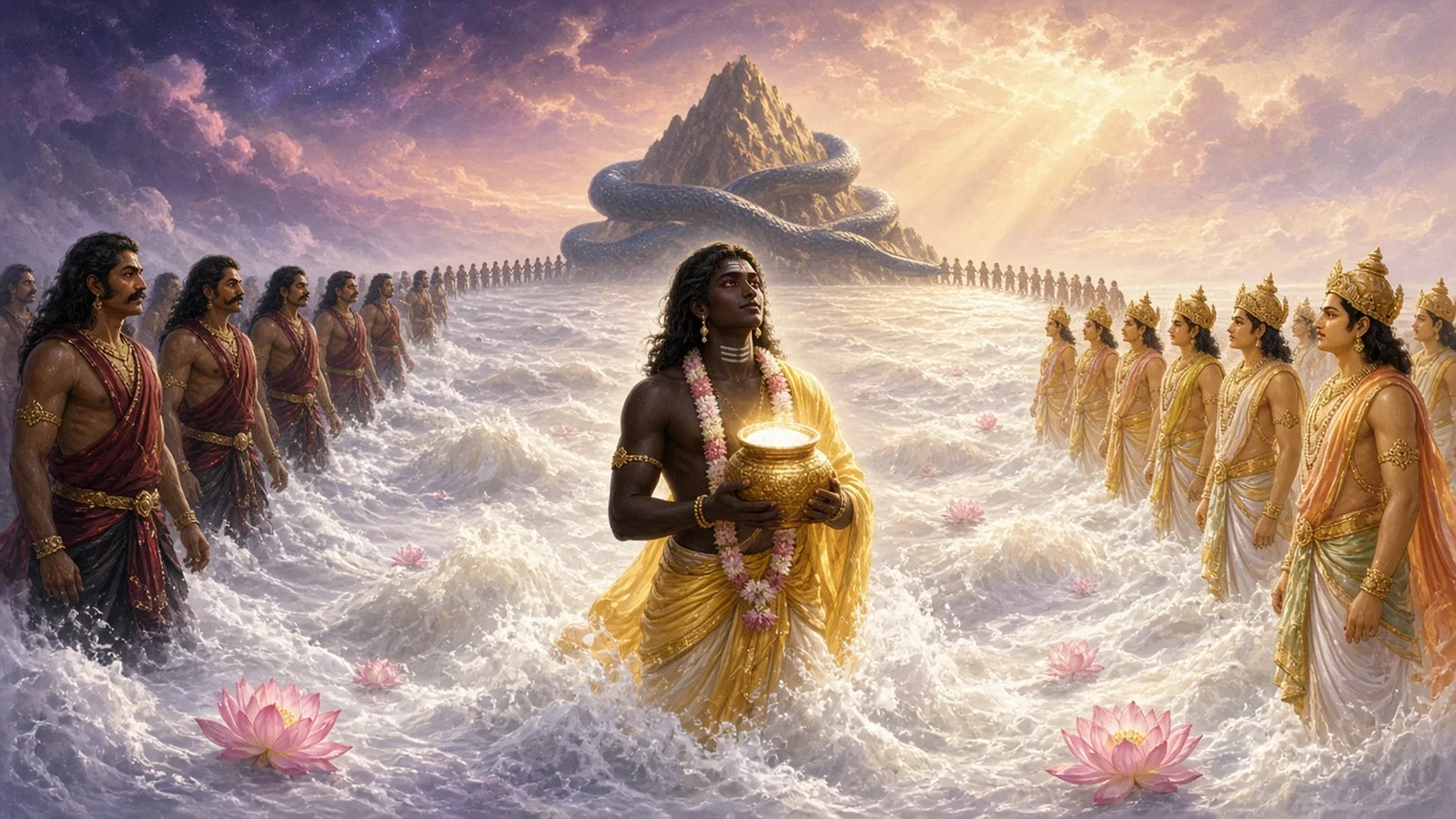
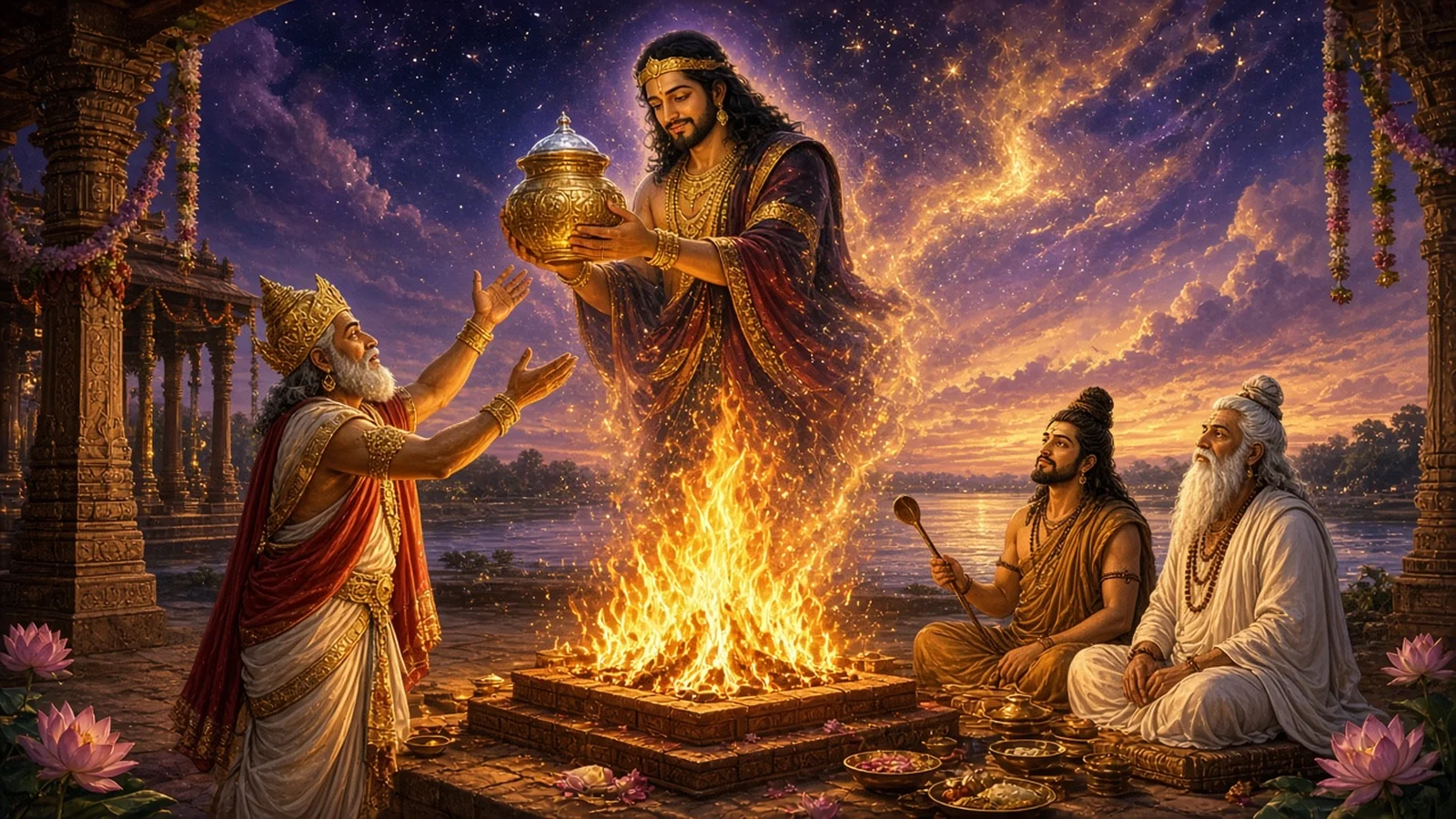
Below, the fire roared, and out of it rose a being as tall as a hill, dressed in black and red, with a voice like a drum, and in his two hands a golden vessel with a silver lid. He held it carefully, as one holds a child.
"I am sent by Prajapati, the lord of this sacrifice," he said to the king. "Take this payasam. The gods have made it. Give it to your queens and tell them to eat it, and they will give you sons."
Dasharatha took the vessel on his head, walked round the being in reverence, and the being went back into the fire.
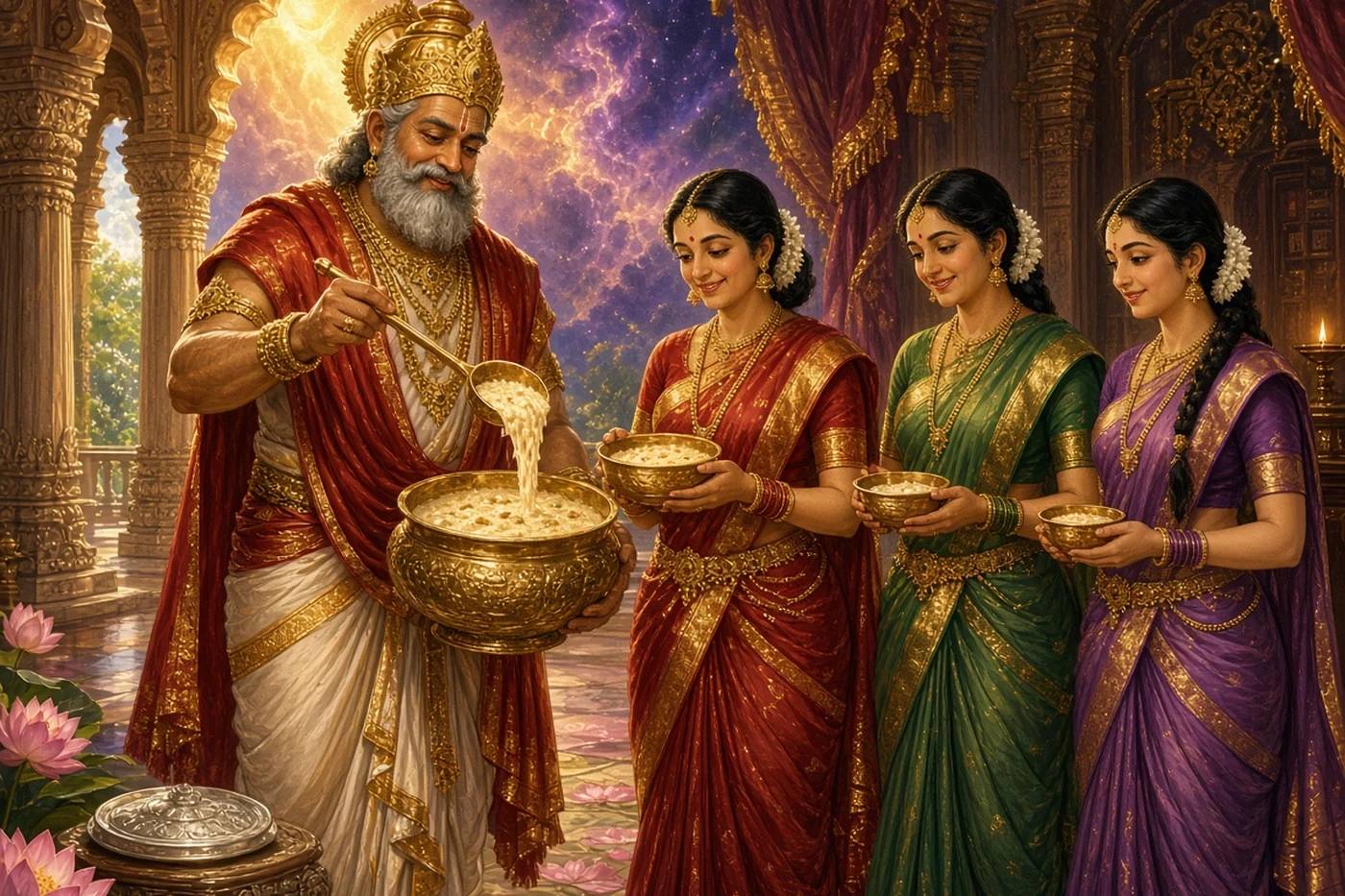
He went straight to the women's quarters. "Take this," he said to Kausalya, his first queen, and gave her half. To Sumitra he gave a quarter. To Kaikeyi he gave an eighth. Then he looked at what was left in the vessel, one eighth, thought for a moment, and gave that too to Sumitra. The three queens ate, and before long each of them knew she was carrying a child, and the king's grief was gone.
Six seasons turned. Then, in the month of Chaitra, on the ninth day of the bright fortnight, under the star Punarvasu, with five planets standing in their own exalted houses and the moon beside Jupiter in Cancer, Kausalya gave birth to a son with eyes like red lotuses and long arms, and all Ayodhya knew what she had borne. The next day Kaikeyi gave birth to Bharata under Pushya, and Sumitra to twins, Lakshmana and Shatrughna, under Ashlesha.
Drums sounded, singers sang in the sky, flowers fell, and the king gave the Brahmins thousands of cows. On the eleventh day Vasishtha named the boys. The eldest he called Rama, the one in whom all people delight.
As Tulsidas tells it: the mother and the four-armed child
Ramcharitmanas, Bal Kand, dohas 188 to 197 · 2 min read
In the Ramcharitmanas the king's sorrow is the same, but he takes it to his teacher. "I have no son," Dasharatha says to Vasishtha, and the sage tells him not to grieve, for he will have four. The sage Shringi performs the rite for a son, and the fire god himself comes out of the flames with the offering in a bowl, tells the king how to divide it, and vanishes. Dasharatha gives half to Kausalya. The other half he halves again, one part for Kaikeyi, and the last part, halved once more, goes to Sumitra with the consent of the other two.
Then Tulsidas stops the clock and describes the hour. It is the month of Chaitra, the bright ninth, the moment called Abhijit, the middle of the day, neither cold nor hot, the hour of rest for the whole world. A cool breeze blows, the forests are in flower, the rivers run with nectar, and the sky is crowded with gods, drums and falling flowers.
And the Lord appears, not as a newborn but as he is: dark as a rain cloud, four-armed, with weapons in his hands, jewels, a forest garland and wide eyes. Kausalya looks at him and folds her hands.
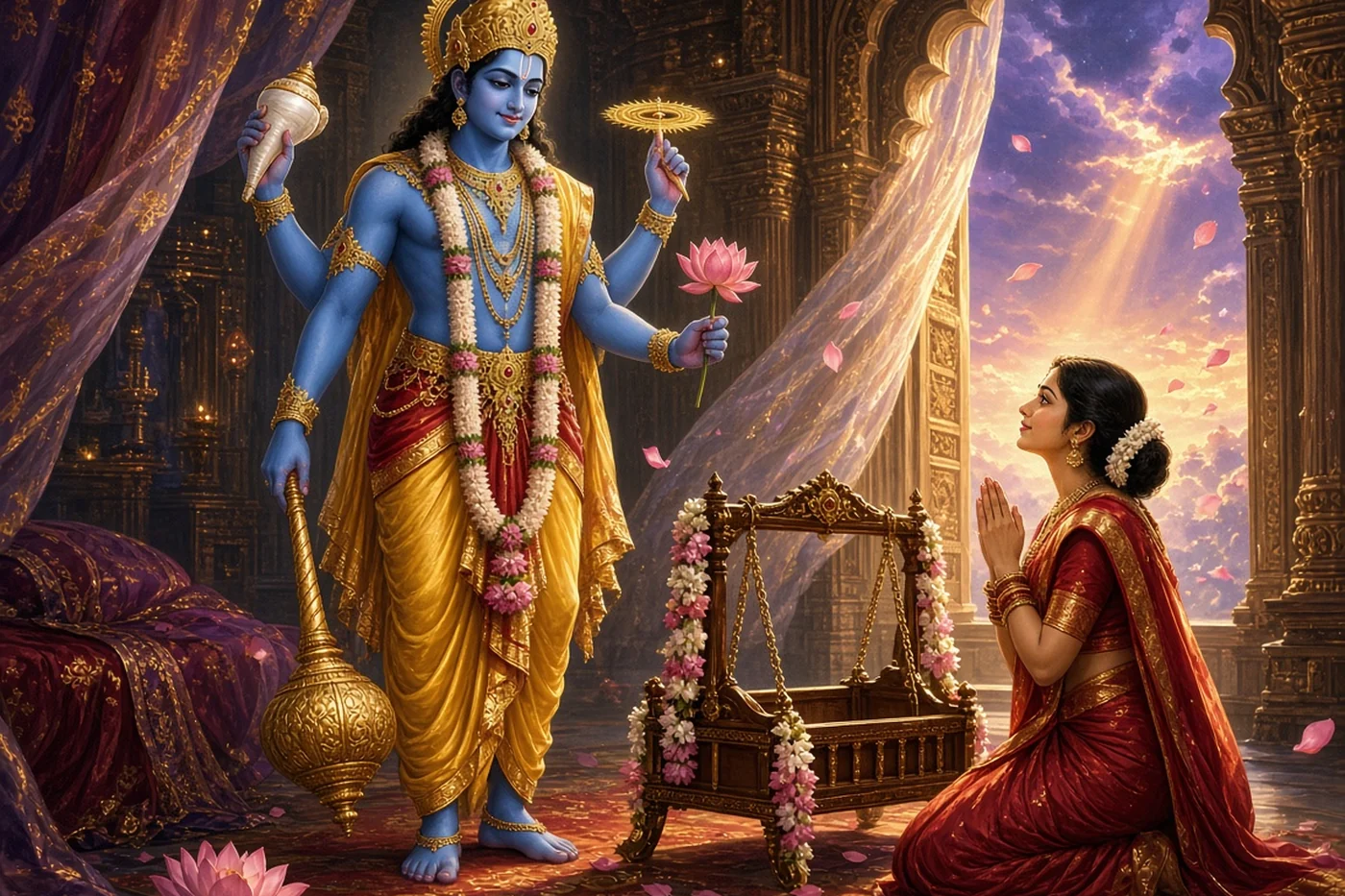
"How can I praise you?" she says. "The Vedas say you are beyond measure, beyond the three qualities, beyond Maya. Whole worlds live in a single pore of your body, and you have come into my womb for my sake."
The Lord smiles. He tells her a sweet story, the story of a life she has forgotten, to teach her to love him as a son. But a mother wants a son, not a god.
"Leave this form, my child," she says. "Play the play of a baby, which gives a mother a joy nothing else can give."
So the one who knows everything begins to cry, and the lord of the gods is a baby in his mother's arms.
The news runs through the palace. Dasharatha hears that a son is born and for a while cannot speak. Then he bathes, gives gold, cows and cloth to the Brahmins, and the city dresses itself in flags and arches, and women sing in every lane and wave lamps before the child. Kaikeyi and Sumitra bear their sons too. The sun forgets to set; for a month, Tulsidas says, there was no night in Ayodhya, and nobody noticed. At last Vasishtha comes and gives the names: Rama, who is bliss itself; Bharata, who sustains the world; Shatrughna, the enemy's end; and Lakshmana, Rama's own.