Festival · Seven months of nights when a dancer becomes the god and the village talks to him
Theyyam
Theyyam is the ritual dance of north Malabar, the old Kolathunadu of Kannur and Kasaragod in Kerala, in which a performer from the Vannan, Malayan, Velan, Pulayan, Mavilan or Koppalan communities is painted, dressed in a towering headdress and a skirt of coconut fronds, and becomes a god for a night in a kavu, a sacred grove, or the courtyard of an ancestral house. Some four hundred theyyams are danced, Puranic gods, goddesses, heroes, ancestors and Muslim figures among them, and when the dance is over the god sits and speaks to each family that comes to him. The season opens on Pathamudayam, the tenth of Thulam in late October, and closes in Edavam, in late May, at the Kolathiri family shrines of Madayi and Kalarivathukkal; only Muthappan of Parassinikkadavu is danced every day of the year.
When is Theyyam in 2026? Pathamudayam, when the season opens, is Monday 26 October 2026; it runs 26 October 2026 to 29 May 2027. In 2027: Wednesday 27 October 2027. From Pathamudayam, the tenth day of the Malayalam month of Thulam, in late October, to the middle of Edavam, in late May, with the greatest number of nights from December to April.
Also calledThe Theyyam seasonTheyyattamKaliyattamThiraPerumkaliyattam
In short
What is Theyyam?
The ritual dance of north Malabar in Kerala, in which a performer from a hereditary Dalit or tribal community is painted, dressed in a great headdress and becomes a god for a night in a sacred grove or an ancestral house, then speaks to and blesses the families who come to him. Some four hundred theyyams are danced.
When is the Theyyam season?
From Pathamudayam, the tenth of the Malayalam month of Thulam, to the middle of Edavam, about 26 October 2026 to the end of May 2027, with the busiest nights from December to April. The season opens at Nileshwaram and closes at the Kolathiri shrines of Madayi and Kalarivathukkal.
Where can Theyyam be seen every day?
At the Parassinikkadavu Muthappan Madappura on the Valapattanam river near Kannur, where Muthappan's two forms, Thiruvappana and Vellattam, are danced every morning and evening of the year, and boiled gram and tea are given to everyone.
Who performs Theyyam?
Men of the Vannan, Malayan, Velan, Pulayan, Mavilan, Koppalan and a few other communities, by hereditary right, each community with its own gods and its own shrines. The patrons are the kavus and ancestral houses of the Nairs, Thiyyas, Vaniyas and Namboothiris.
What is a thottam?
The song of a theyyam's origin, sung by the performer the evening before in plain dress, and the only text the tradition has. The thottam of Pottan, which asks a Brahmin whether a Pulaya's blood is not the same red, is the best known.
Next, in 2026Monday 26 October 2026
26 October 2026 to 29 May 2027
Prime godsVishnumoorthi and Muthappan and Pottan
with 5 more
WhereNorth Malabar, the Kannur and Kasaragod districts of Kerala and the edge of Kozhikode, with the Tulu border of Karnataka
How longEach theyyam is one night, from the thottam at dusk to the god's words in the morning; the season lasts about seven months
From Pathamudayam, the tenth day of the Malayalam month of Thulam, in late October, to the middle of Edavam, in late May, with the greatest number of nights from December to April
Why it is kept
Theyyam is not one festival but a season of nights. From the tenth of Thulam to the middle of Edavam, in every village of Kannur and Kasaragod, a man from one of the communities that have always held the right sits for hours while his face is painted, is dressed in a skirt of coconut fronds and a headdress taller than himself, and dances in the yard of a grove or an old house until, the people say, he is no longer himself. Then the god sits down and the village comes to talk to him. Four hundred gods are danced this way, and only one of them, Muthappan of Parassinikkadavu, does not sleep when the season ends.
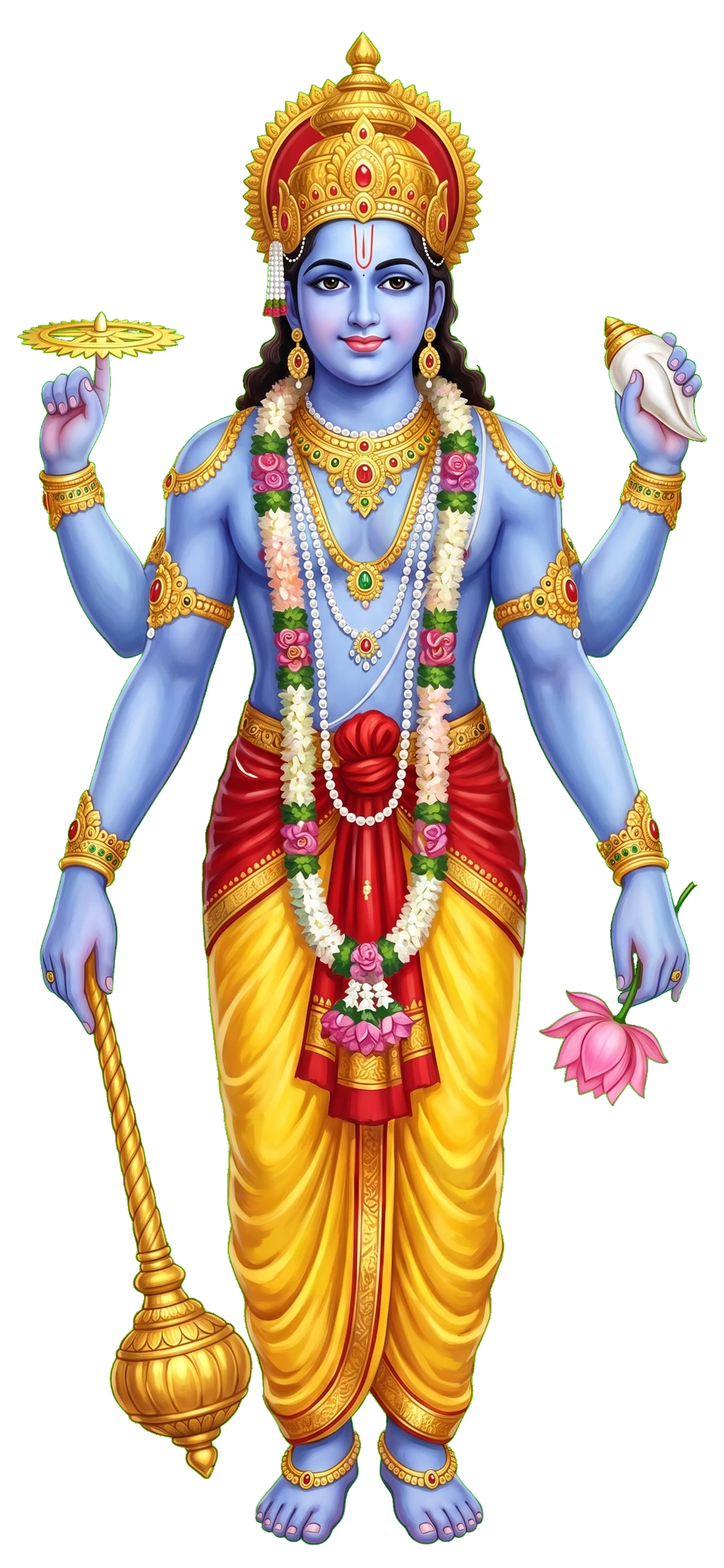
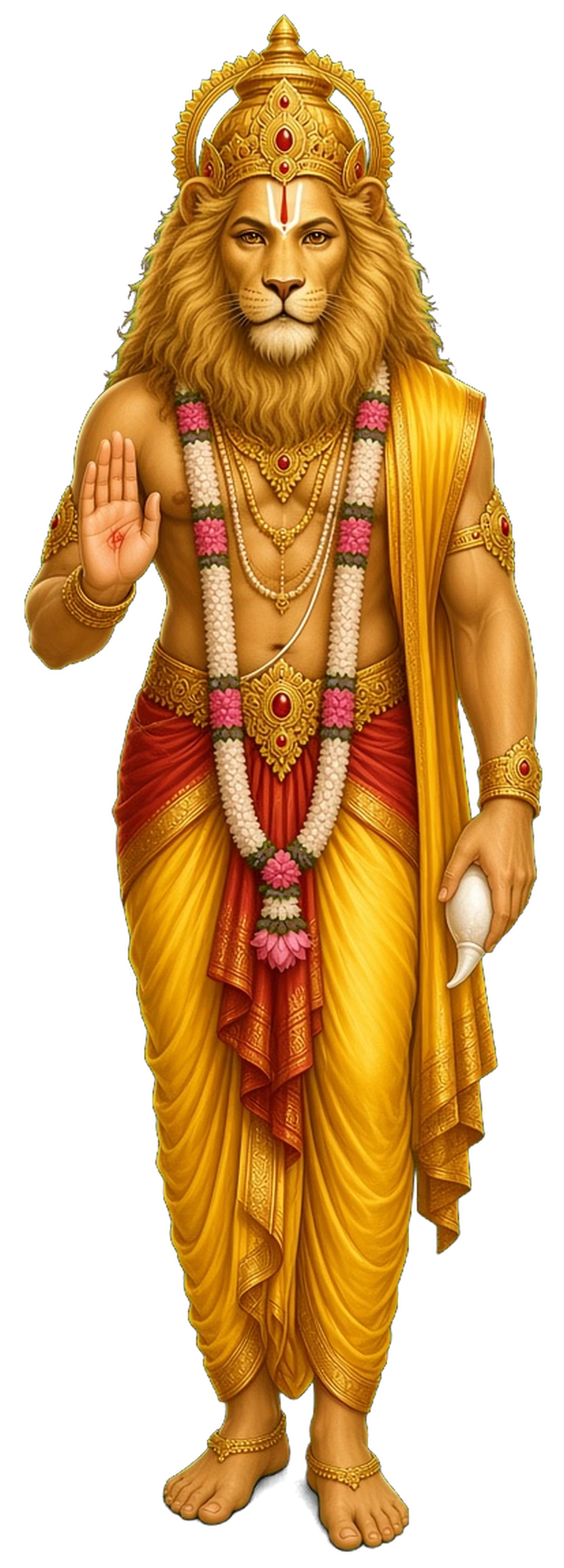
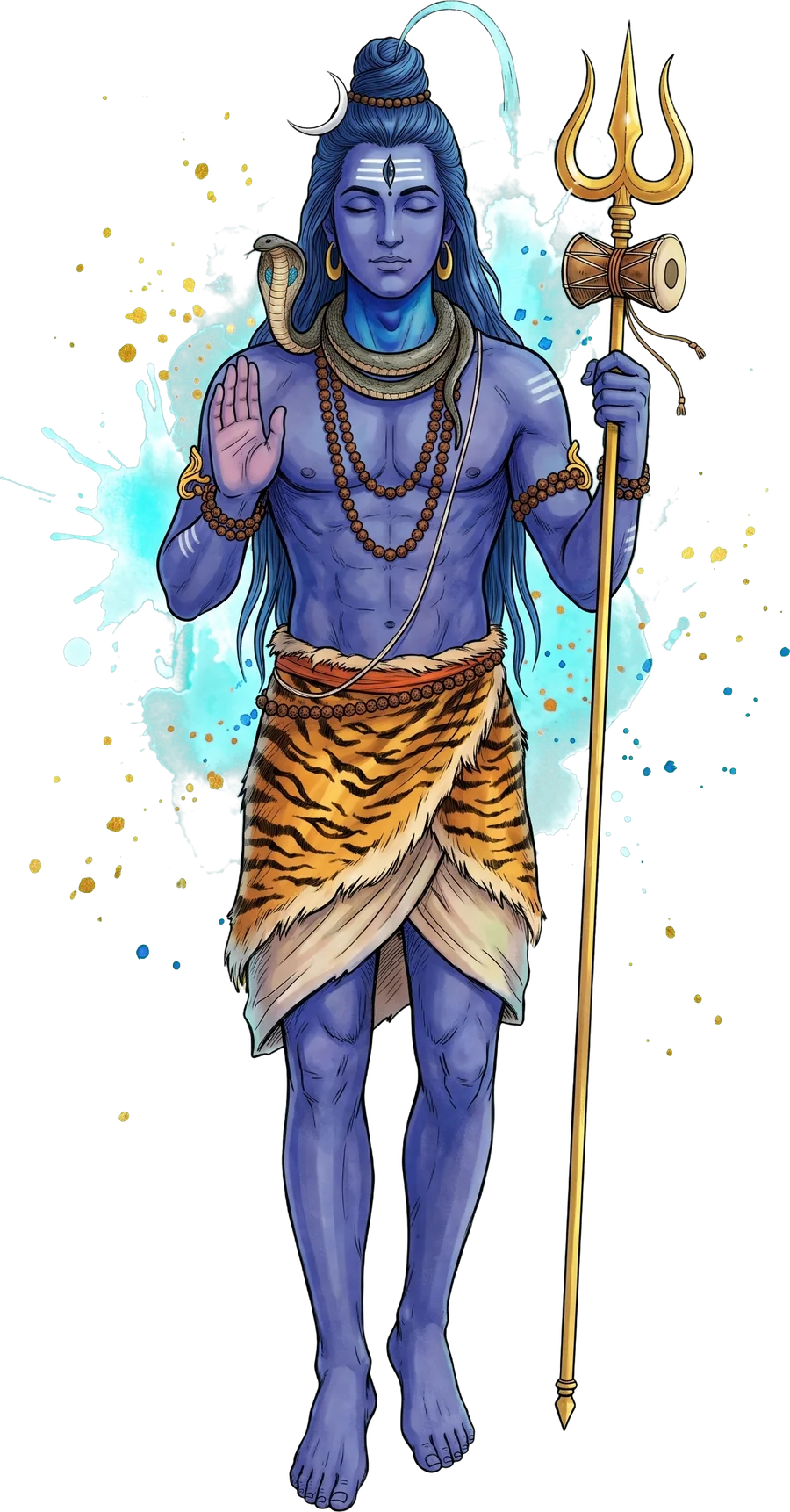
Each theyyam has its own reason, and it is in the thottam, the song sung before the paint goes on. Some are the great gods come down: Vishnumoorthi dances the man-lion's killing of Hiranyakashipu, Pottan is Shiva as a Pulaya who stopped Shankara on the road, Muthappan is Shiva as the hunter who left a Brahmin house for the forest and the toddy palms. Some are goddesses, Bhagavathis and Chamundis, born of fire or of a wronged woman's death. Many were people. Kathivanoor Veeran was a Thiyya warrior named Mandappan, Vishnumoorthi was a boy named Palanthai Kannan killed by a landlord's men at Nileshwaram, Manakkott Amma was a Nair woman who defied the caste rules and was killed, and the Mappila theyyams are Muslim neighbours who died and were kept. The murdered and the wronged of Malabar became gods, and once a year they are given a body and asked to speak.
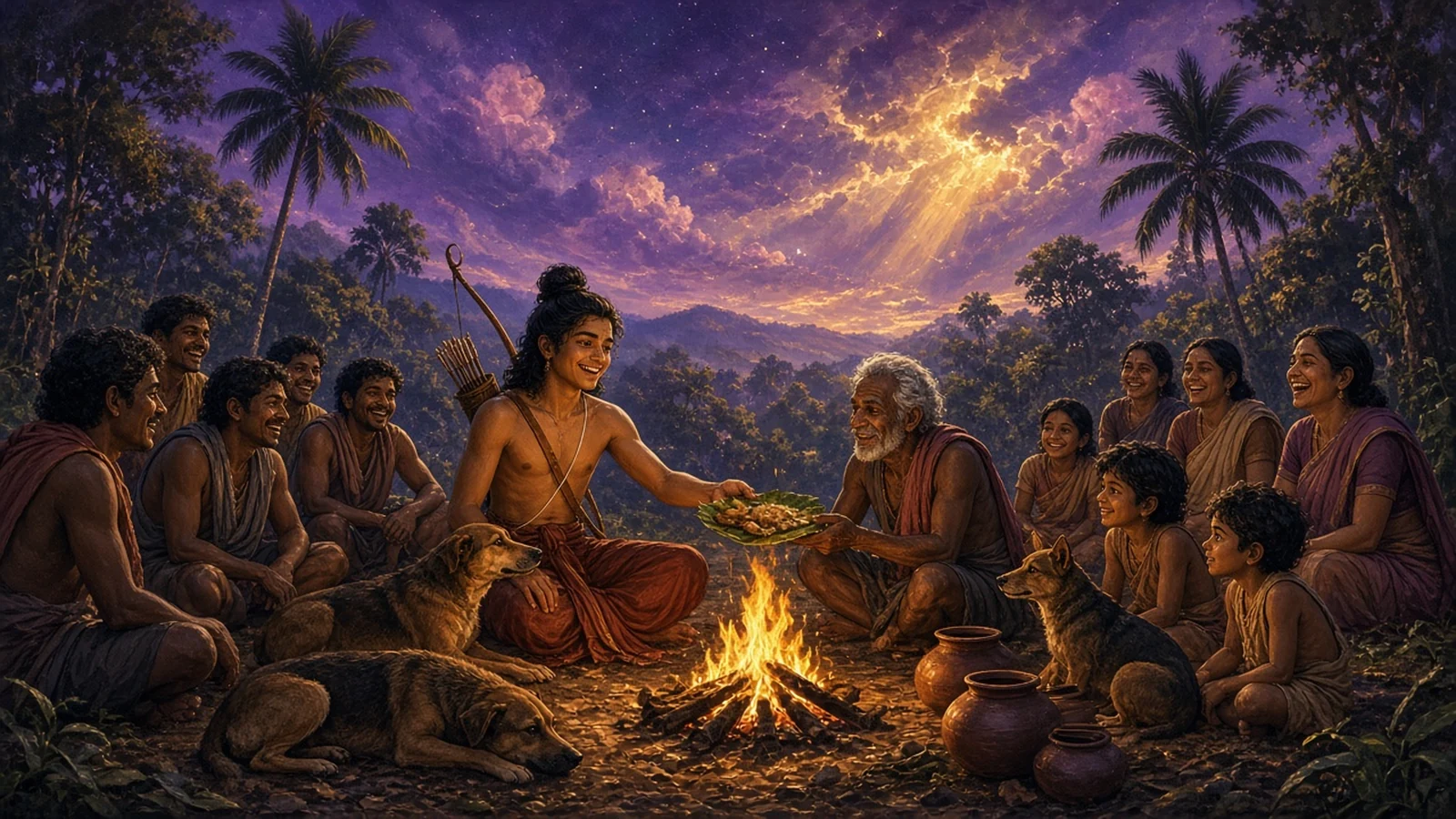
Muthappan, Shiva as the hunter with his bow and his dog, among the forest people
The reason the village gives is simpler. The theyyam protects the house and the fields, and in return it must be danced on its night. A tharavadu that misses its theyyam expects trouble. And the night is the one court in which the labourer's word is the god's and the landlord bows; the thottam of Pottan, asking whether a Pulaya's blood is a different red, is sung in front of the men who own the shrine.
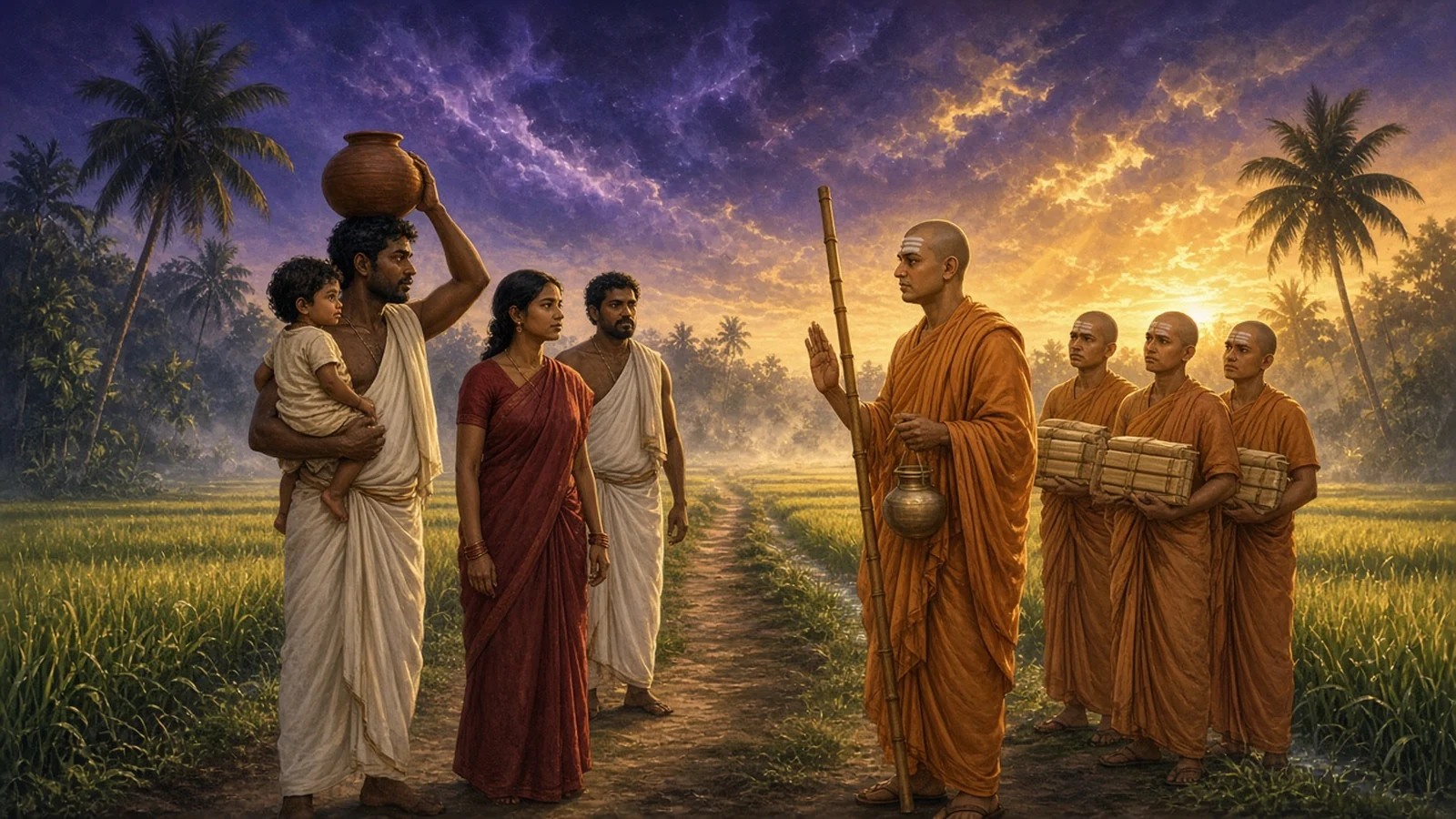
Pottan: Shiva as a Pulaya, with his wife and child, stands in Shankara's path
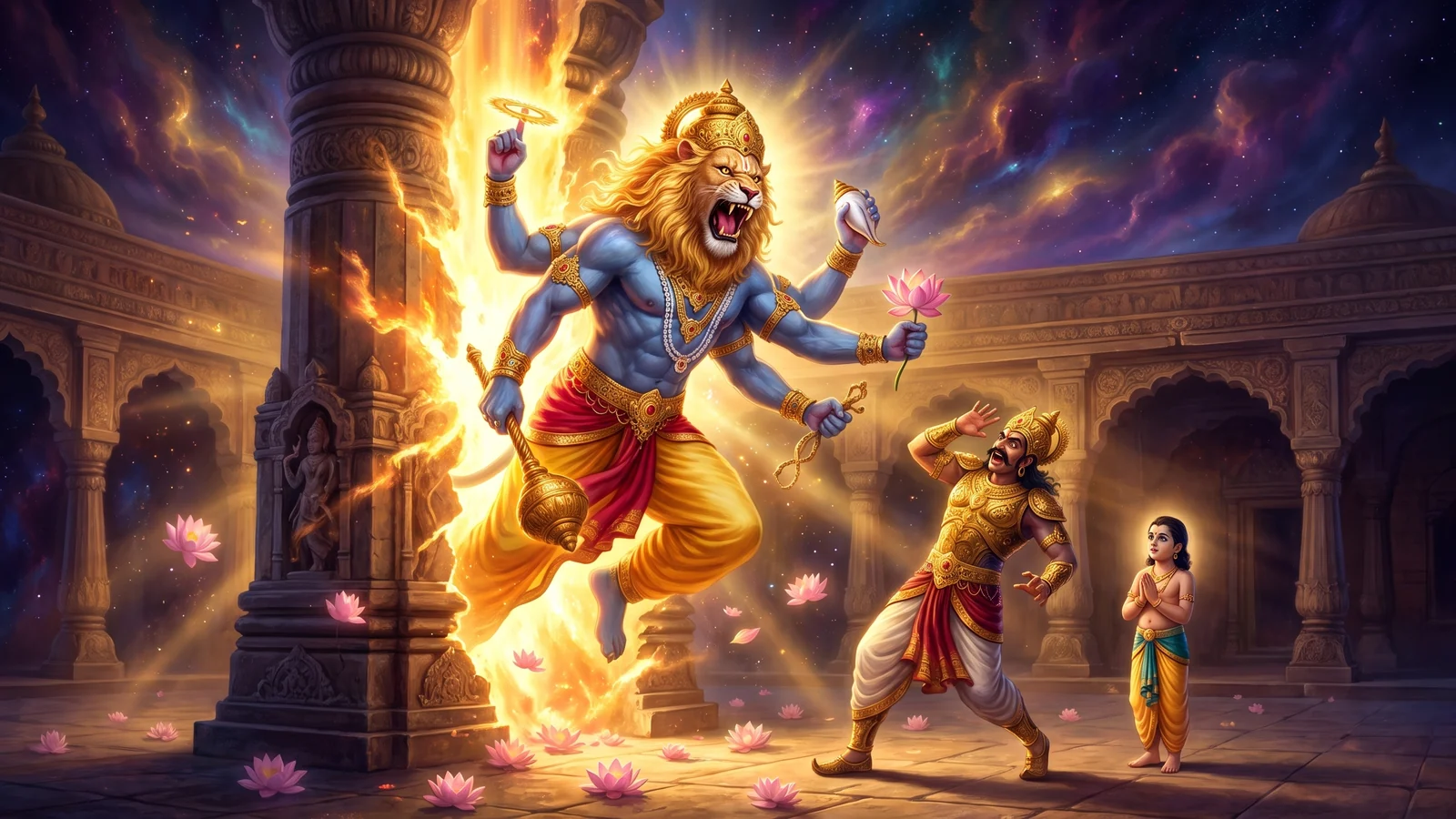
The best loved Vaishnava theyyam, who dances the man-lion's killing of Hiranyakashipu and walks through fire. In the local legend he is Palanthai Kannan, a Thiyya boy of Nileshwaram killed by a landlord's men, whom Vishnu avenged and who is now danced as the god himself.
The form Vishnumoorthi takes at the height of the night, when the song stops and the dancer tears at the air as the lion. The Bhagavata's story is told in the Lore as Prahlada and the man-lion.
Muthappan, the hunter god of Parassinikkadavu with his bow and his dog, is Shiva as the Kirata in most tellings, danced in two forms, Thiruvappana and Vellattam, which the tellers divide between Shiva and Vishnu. Pottan is Shiva as a Pulaya, the outcaste with a pot of toddy who made Shankara sit down in the dust.
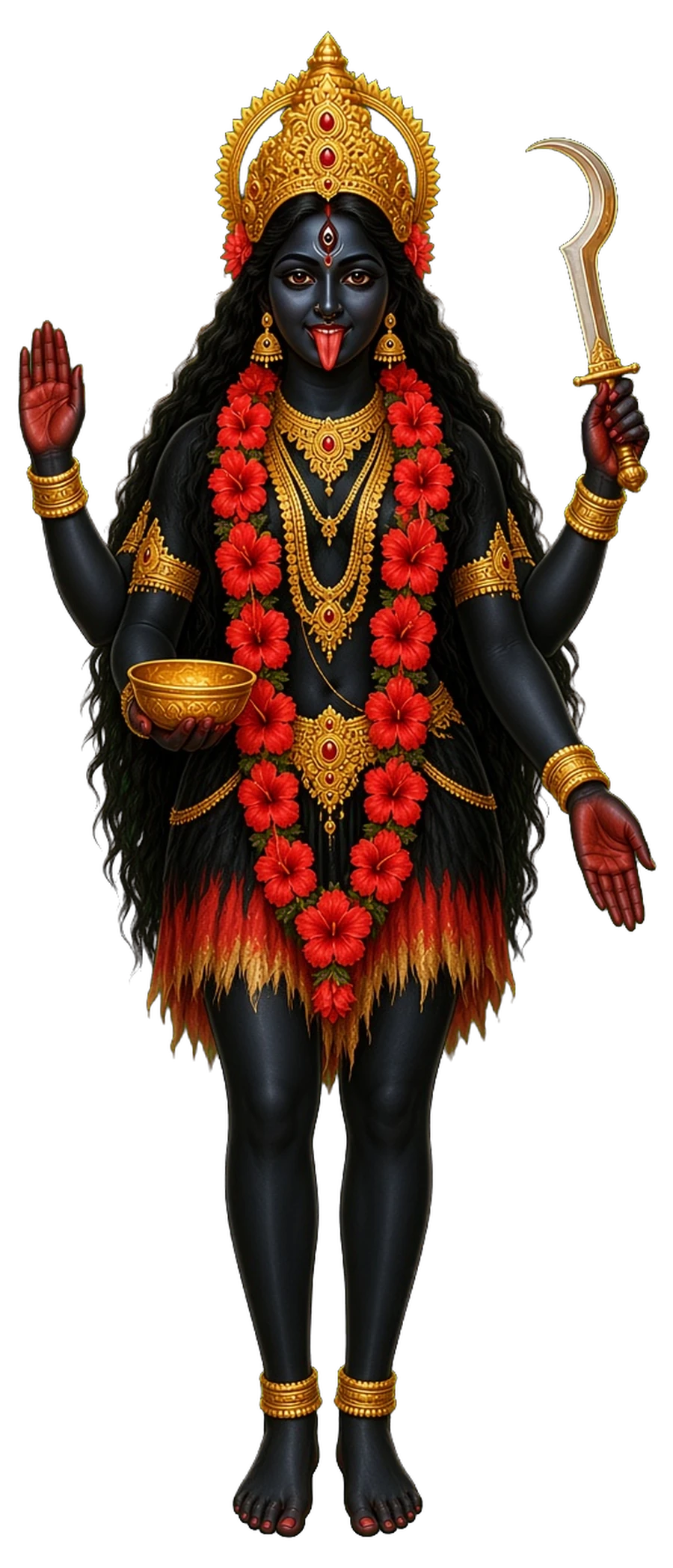
The goddesses are the largest family of theyyams, Muchilottu Bhagavathi of the Vaniyas, Puthiya Bhagavathi born of a sacrificial fire, the Chamundis, Raktha Chamundi and Madayil Chamundi, Kurathi, and Kalarivathukkal Bhagavathi, the Bhadrakali of the Kolathiris whose Kalasam ends the season. Most are read as forms of Kali and Bhadrakali.
G
Gulikan (Guliga)
The fierce guardian born of a stone in Shiva's ash, read in Malabar as a form of Yama, with his best known shrine at Benkanakavu in Nileshwar; the same spirit is Guliga across the border in the Bhuta Kola.
K
Kathivanoor Veeran
Mandappan Chekavar, a Thiyya warrior who died in battle and became a god; his theyyam is a night of kalaripayattu and one of the most watched in Kannur.
K
Kuttichathan
The trickster boy of the Kalakattu Illam at Payyanur, danced in three forms, the black, the flower and the fire Kuttichathan, and tied to a legend of three hundred and ninety-six Chathans.
A theyyam night
1
The thottam
Dusk, the evening before · Monday 26 October 2026
the songthe vellattamthe half-dress
The night begins without the god. The performer comes out in a plain dress and a small red headdress, with no paint on his face, and sings the thottam, the song of how this god came to be, to the chenda drum. It is the only text the theyyam has. Then he goes back into the green room, a hut of palm fronds beside the shrine, and the long work of becoming begins.
At dusk the performer, unpainted and in a small red headdress, sings the thottam to the chenda
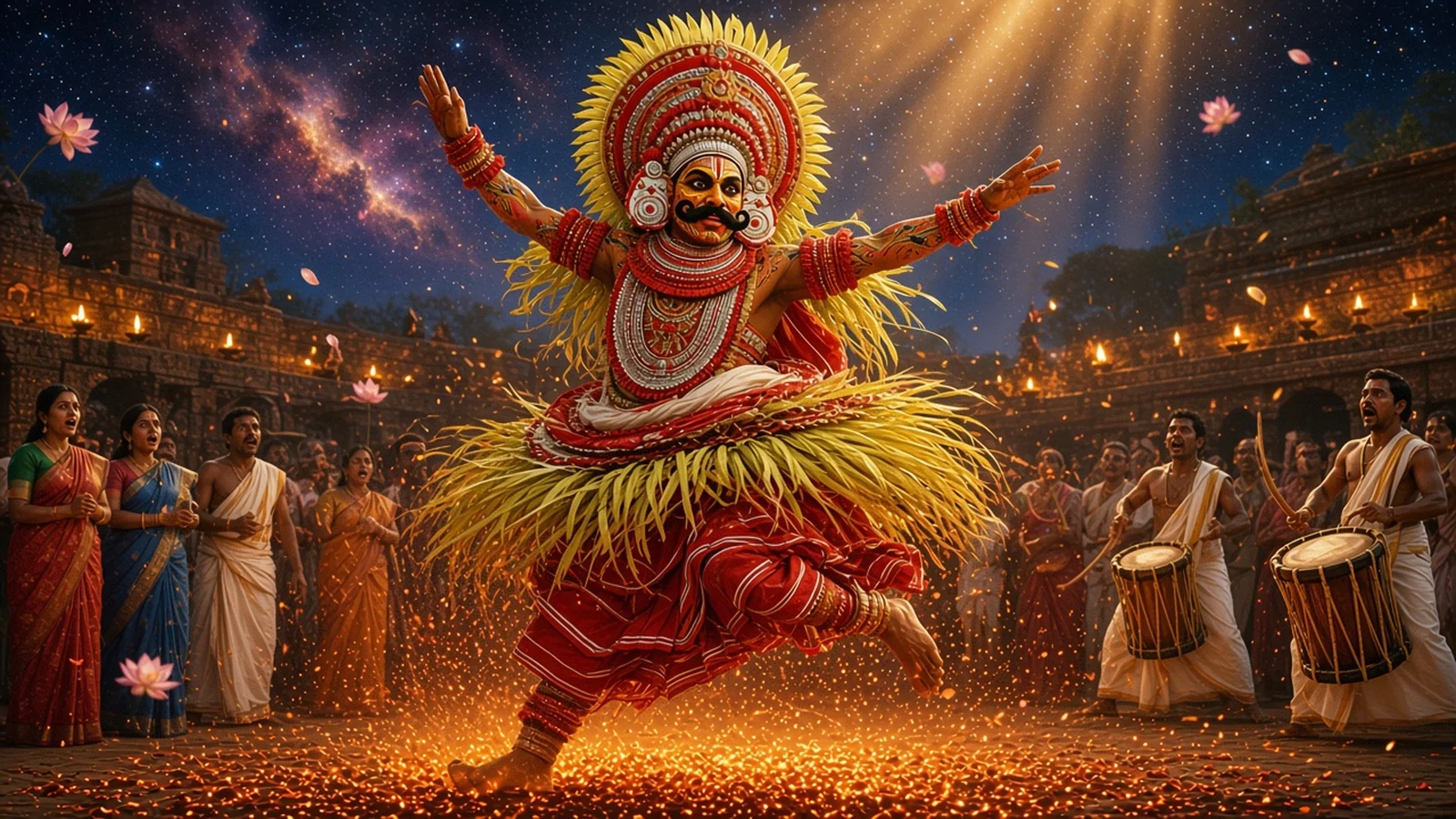
The performer lies on a mat for hours while the face is painted in fine lines of red, yellow, black and white, in patterns each god owns, with names like the diamond, the cockscomb and the bird's eye, made from turmeric, rice paste and laterite. The skirt of tender coconut fronds, the breastplate, the anklets and the arms go on, and last the mudi, the headdress of bamboo, cloth and flowers, some of them taller than the house. When the mudi is set on his head and he looks into the mirror, the god is said to have arrived.
Midnight in the green room: the face is painted in fine lines of red, yellow, black and white
3
The god rises
Before dawn
the dancethe agnipraveshamthe meleri
The drums quicken and the dancer circles the shrine with sword and shield, stamping the kalasams, his footwork, until his movements are no longer his own. The fire theyyams go into the fire: Theechamundi throws himself on the heap of embers called the meleri again and again while helpers drag him back, Vishnumoorthi plunges through the pyre, Pottan lies down on the coals and laughs, and Agni Kandakarnan dances with lit torches tied round his waist.
Before dawn the god circles the shrine with sword and shield as the drums quicken
The anger fades and the god sits. Nobody has spoken to the dancer as a man since the mudi went on, and now the families come forward one by one to tell him their troubles, and he answers each by name, promises, warns and blesses. Offerings of tender coconut, puffed rice, jaggery, betel and, for many theyyams, toddy, fish or a cockerel are made, and prasadam is handed out; at a Pottan night the ash of the fire goes to everyone, whatever their caste. Then the god leaves, the mudi comes off, and the performer is a man again.
Morning: the god sits and a family tells him its troubles, with tender coconut and puffed rice
5
The season's calendar
Thulam to Edavam
KaliyattamPerumkaliyattam
Chamundi sows the ceremonial seed in the fields of Cheruvathur as Thulam begins, and the first Kaliyattam is at the Veerarkavu of Nileshwaram's Theru Anjoottambalam the day after Pathamudayam. Kasaragod's kavus fill November and December, the Kannur tharavadus run through the spring, and the Perumkaliyattam, the great festival that a shrine holds once in twelve or twenty-five years with dozens of theyyams and a feast for a lakh, falls in February or March; Kappattu Kazhagam in Payyanur held its first since 1996 in 2024. The last Kalasam is at Kalarivathukkal and the Madayi Kavu in Edavam.
A Perumkaliyattam: many theyyams dance in the grove while the whole village gathers
The heart of the season. Every kavu and every old ancestral house of the Nairs, Thiyyas and Vaniyas has its own theyyams on its own nights, from the Muchilottu kavus of the Vaniyas to Kuttichathan's Payyanur. Parassinikkadavu's Madappura on the Valapattanam river dances Muthappan every morning and evening of the year, and Kunnathoor Padi, three thousand feet up with no building at all, keeps his festival from Dhanu to Makaram. The Andalur Kavu near Thalassery dances the Ramayana in Kumbham, Daivathar as Rama, Angakkaran as Lakshmana and Bappooran as Hanuman, and the whole village turns vegetarian for the week. The season closes at the two Kolathiri shrines, the Madayi Kavu and Kalarivathukkal at Valapattanam, whose Bhagavathi wears one of the largest headdresses in Malabar.
KasaragodNileshwaram, Cheruvathur and Bekal
The season opens here, with Chamundi in the Thimiri fields of Cheruvathur and the first Kaliyattam at the Veerarkavu of Nileshwaram, and Kasaragod's kavus are busiest in November and December. Nileshwaram's Mannampurathu Kavu and the Benkanakavu of Gulikan, the Muchilottu kavus of Kayyur and Cheemeni with their Perumkaliyattams, and the Vishnumoorthi shrines of Nileshwar, where Palanthai Kannan was killed, are its great houses. The Mappila theyyams are danced mostly here, and the Bekal coast fills with visitors in the season.
The Tulu borderBhuta Kola, the cousin across the river
Beyond Kasaragod the same kind of night is kept in Tulu as the kola of the daivas, with its own dancers, its own songs and some of the same spirits, Gulikan among them; it has its own page, Bhuta Kola, and Kasaragod keeps both.
The performersVannan, Malayan, Velan, Pulayan, Mavilan, Koppalan
The right to dance a god is hereditary, and each community has its own theyyams and its own shrines; a Vannan or Malayan theyyam is danced in the courtyard, a Mavilan, Velan or Nalkadaya one often in the field outside the wall. Senior performers carry titles given by the old chiefs, Peruvannan among the Vannans, Munnoottan and Anjoottan under the Nileshwaram raja, and a boy learns from his father at twelve. A 2015 study counted about a lakh performers, paid in rice and a little cash, who buy their own silver and go into debt for it, and who have told the press that the untouchability the thottams sing against still waits for them when the mudi comes off.
The visitorsThe season as a destination
Since the 2010s, and sharply after the film Kantara in 2022, travellers come to Kannur and Kasaragod for the season, with the Kerala Tourism calendar listing the nights, homestays in the kavu villages and photographers at every fire. The families who keep the theyyams ask that it be watched as worship, with shoes off, no flash in the god's face, and no leaving before he has spoken.
Patrons and performersEvery caste of north Malabar, in its place
The theyyams are owned by the shrines and tharavadus of the Namboothiris, Nairs, Thiyyas, Vaniyas and Maniyanis and danced by the Dalit and tribal communities, and for one night the order is reversed; the landlord bows to his own labourer and asks him for a blessing. The Thiyyas hold the right to the kalasam and can stop a theyyam; Muthappan is their ancestor and his Madappura is theirs. A woman's theyyam, the Devakkoothu, is danced at one shrine only, Thekkumbad Kulom.
Mappila MuslimsThe Mappila theyyams
About fifteen theyyams in Kasaragod and Kannur are Muslim figures, Aali, Mukri, Bappiriyan, Kunhali, Mammu, Mammad, Ummachi and others, danced by Mavilan, Koppalan and Vannan performers with the help of the Muslim neighbours. At Chittarikkal the spirit of Kalanthan Mukri of the Pulingome mosque, who drowned in the river, is danced beside Karinchamundi and opens with the call to prayer and the namaz; Bappiriyan is a Muslim merchant who captained the goddess Arya Poonkani's ship. The kavu and the mosque open each other's festivals.
Everyone at ParassiniThe open door
The Madappuras of Muthappan have no idol, no flagstaff and no caste at the door. Hindus, Muslims and Christians stand before the god, eat the boiled gram and tea together, and the first share goes to a dog. In the tellings he is the god who left a Brahmin house to eat with hunters.
How it is kept
At dusk the performer sings the thottam in a plain dress and a small red headdress. He goes into the palm-frond hut and lies down, and the face is written, the mukhathezhuthu, in lines so fine they take hours. The costume is built on him piece by piece, and last the mudi is set on his head and he looks in the mirror; that is the moment the god is said to come. He circles the shrine with sword and shield to the chenda, the footwork quickening, and the fire theyyams go into the fire: Theechamundi onto the meleri of embers again and again, Vishnumoorthi through the pyre, Pottan lying down on the coals and laughing while the crowd shouts for him to rise.
The mudi is set on his head and he looks into the mirror, the moment the god arrives
Towards morning he sits. From the mudi going on to its coming off he is not spoken to as a man, and now each family stands before him and tells him its troubles, and he answers, blesses and gives prasadam. Then he is a man again, paid in rice and a little money, and the caste that was reversed for a night is back by breakfast; the performers have said so to the press, and their own thottams say so every season. Muthappan is danced at Parassinikkadavu every day of the year in two forms, Thiruvappana and Vellattam, with boiled gram and tea for everyone who comes and the first share to a dog. The Tulu cousin of all this, the kola of the daivas across the Kasaragod border, has its own page, Bhuta Kola.
At Parassinikkadavu everyone shares boiled gram and tea, and the first share goes to a dog
In the old texts
There is no scripture. The theyyams are not in the Vedas or the Puranas, though several borrow their gods, and their texts are the thottams, songs in old Malayalam owned by the performing communities and passed from father to son, which differ from kavu to kavu and were written down only in the last century. The Pottan thottam is the most quoted of them, as one of the earliest Malayalam voices against caste; we have translated two of its lines in his story.
The scholarship began with K. K. N. Kurup's The Cult of Teyyam and Hero Worship in Kerala in 1973, which read the tradition as the hero and ancestor worship of the old megalithic coast, later entered by the Brahmanical gods and the Kolathiri kings. Since then Dilip Menon has read the theyyam as the dominated resisting authority for a night, M. Dasan of Kannur University has argued that calling Pottan a form of Shiva erases the Pulaya's critique, and Lissy V. Mathew has recorded the local tellings in which the man on the road was a Pulaya named Alankaran who died for his questions. William Dalrymple carried the Shiva telling to a wide readership in Nine Lives in 2009. Those readings are theirs; the thottam only sings the question.
Where this page comes from. Written by Devalok from the thottam songs and legends of Muthappan, Pottan and Vishnumoorthi as the theyyam communities and the Parassinikkadavu Madappura keep them, Kerala Tourism's accounts of the theyyams and their shrines, the encyclopaedias, the reports of the season's opening and closing in the Malayalam press, and the studies of the theyyam by K. K. N. Kurup, M. Dasan, Dilip Menon and the reporters who have written on its performers, as recorded in the Devalok Lore. Our own words throughout.