As the thottam sings it
North Malabar · sung the evening before a Pottan night · 3 min read
Shankara had beaten every scholar in the land. He had argued the Buddhists down in the east and the ritualists down in the north, and now he was walking to the Throne of All-Knowledge, the Sarvajna Peetham, which only the one who had no question left to answer could climb. His disciples walked behind him carrying his books.
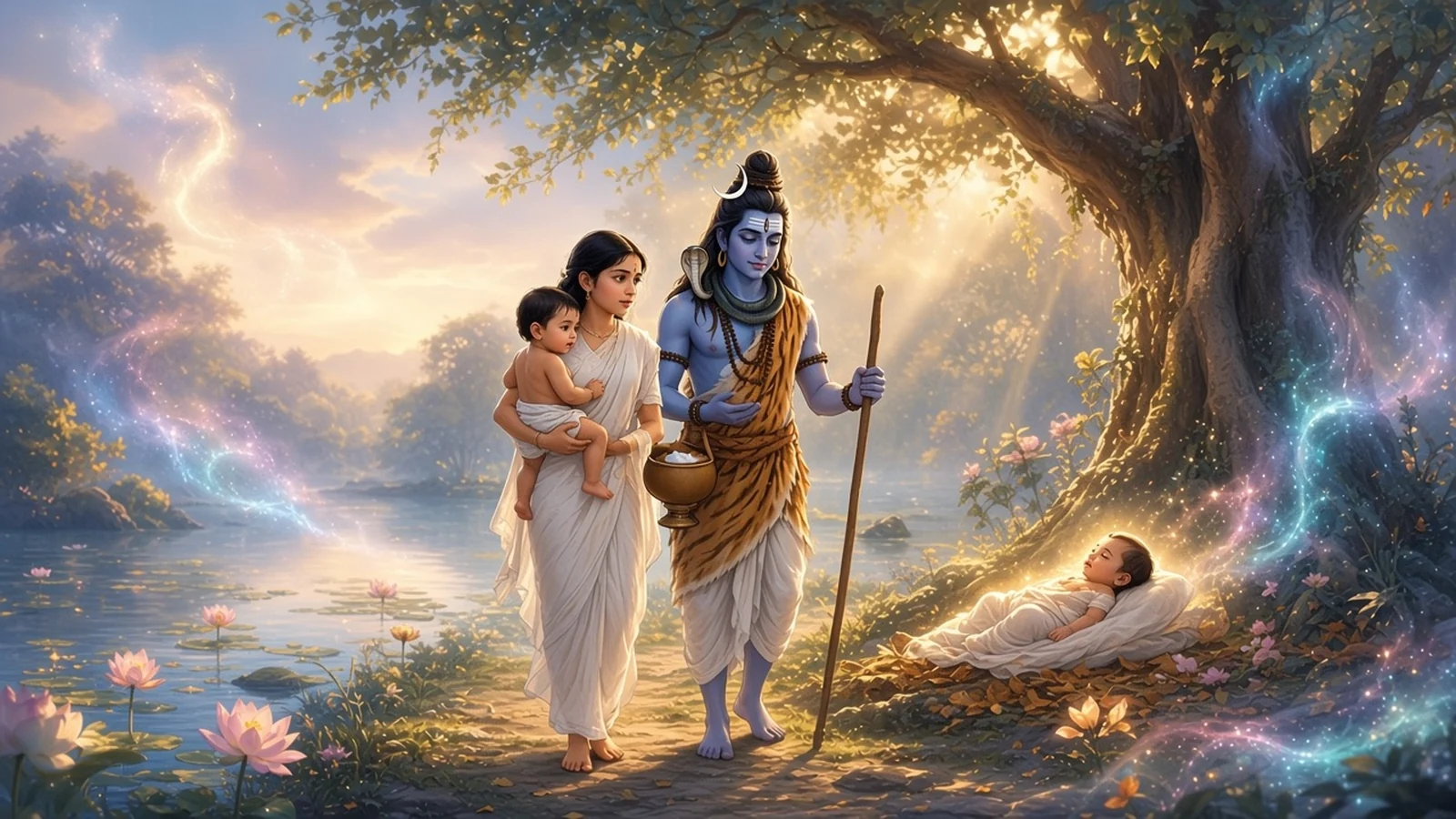
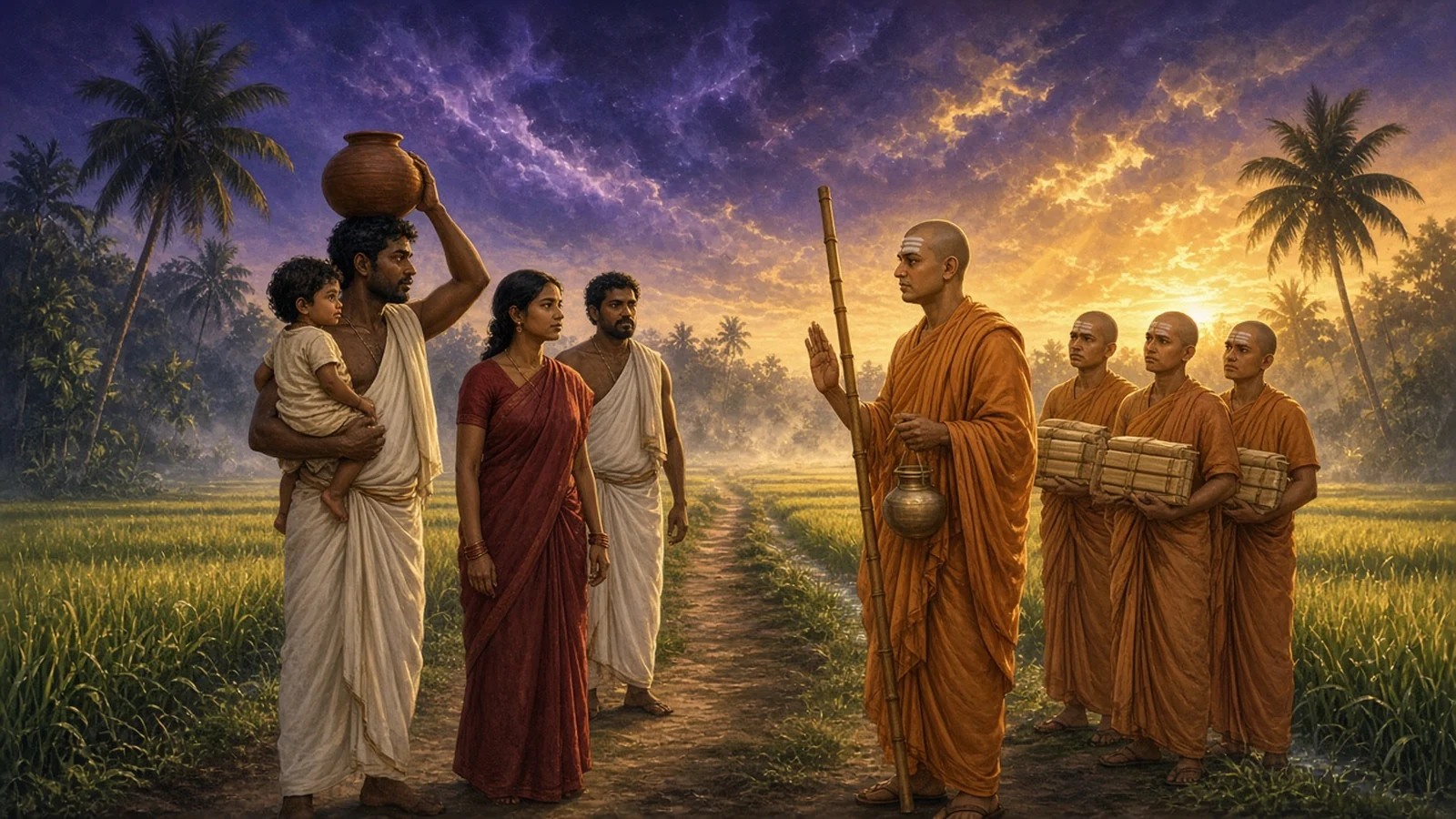
The road narrowed between the paddy fields. Coming the other way was a Pulaya man. He had a pot of toddy on his head and a small child on his hip, his wife walked beside him and a friend walked behind, and he did not step off the path.
"Off the road," said the first disciple. "Do you not see who this is?"
The man did not move. Shankara himself spoke then, not unkindly, the way a man speaks who has never been contradicted. "Stand aside, Pulaya. Keep your distance. You know what you are and what I am."
"Tell me what I am, master," said the man, "and I will stand aside."
"You know it without my telling."
"Then let me ask, since you are the one who knows everything." He shifted the child on his hip. "If you cut your arm and I cut mine, is my blood not red too? Is it a different red?"
The disciples began to shout him down, and Shankara raised a hand to stop them. He had been asked a thousand questions and he had an answer ready for each. He waited for this one to find its shelf.
"The rice you eat," the man went on, "comes out of this field. So does mine. Is it a different rice when it is in my pot? The plantain leaf you eat from, I eat from. The water you bathe in before your prayers, I bathe in after my work. Who dug the well you draw it from? My people dug it. Is it a different water when it is in my hands?"
"You are standing in a teacher's way," said a disciple.
"I am standing on a road," said the man. "You wear sandal paste and I wear mud. You wear a gold chain and I wear this child. The palm that gave me this toddy did not ask my name before it gave. Why then this quarrel over caste?"
Shankara said nothing. He had no answer, and he knew it, and the knowing was new to him. He sat down where he stood, in the dust of the road, and closed his eyes.
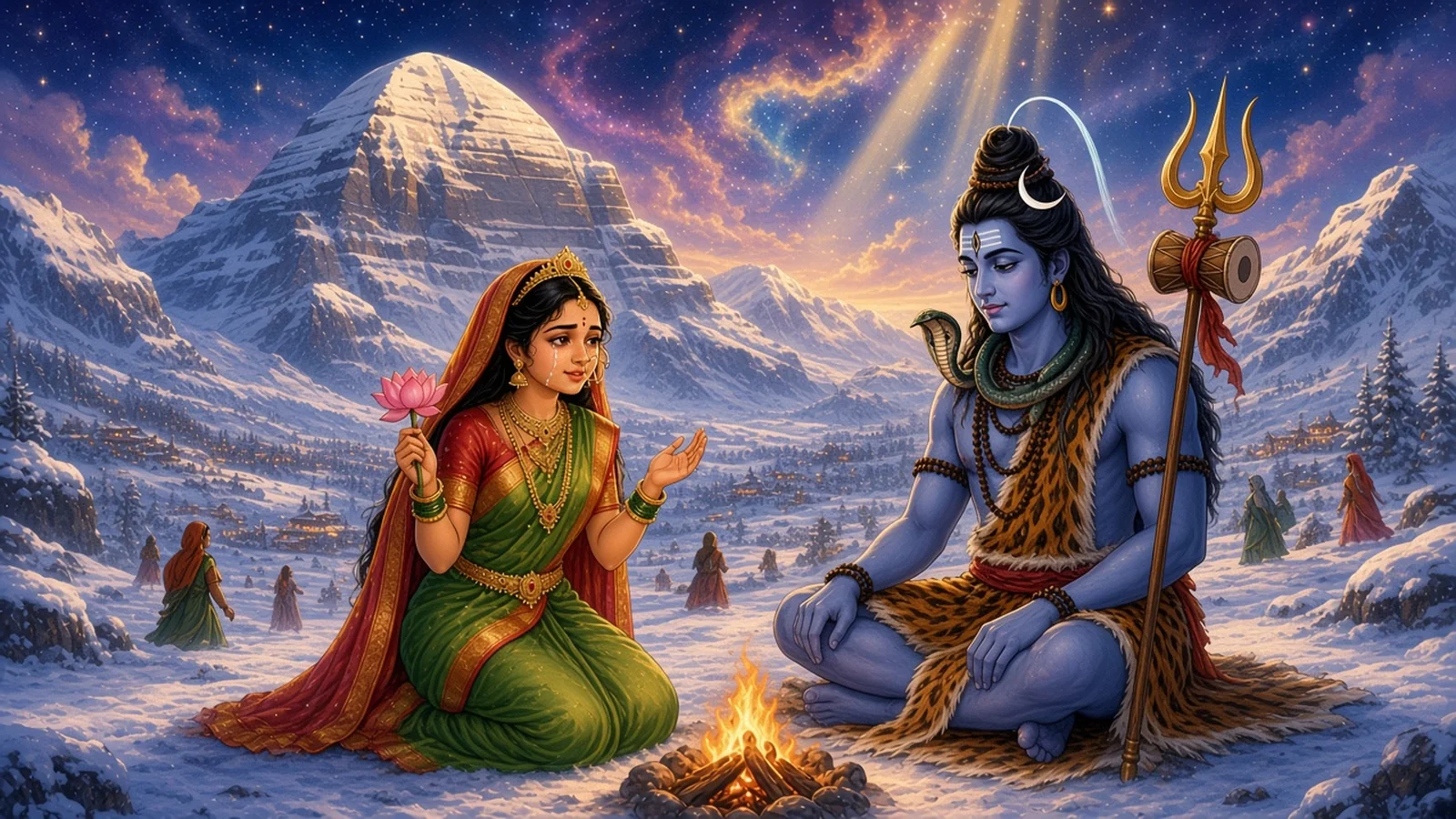
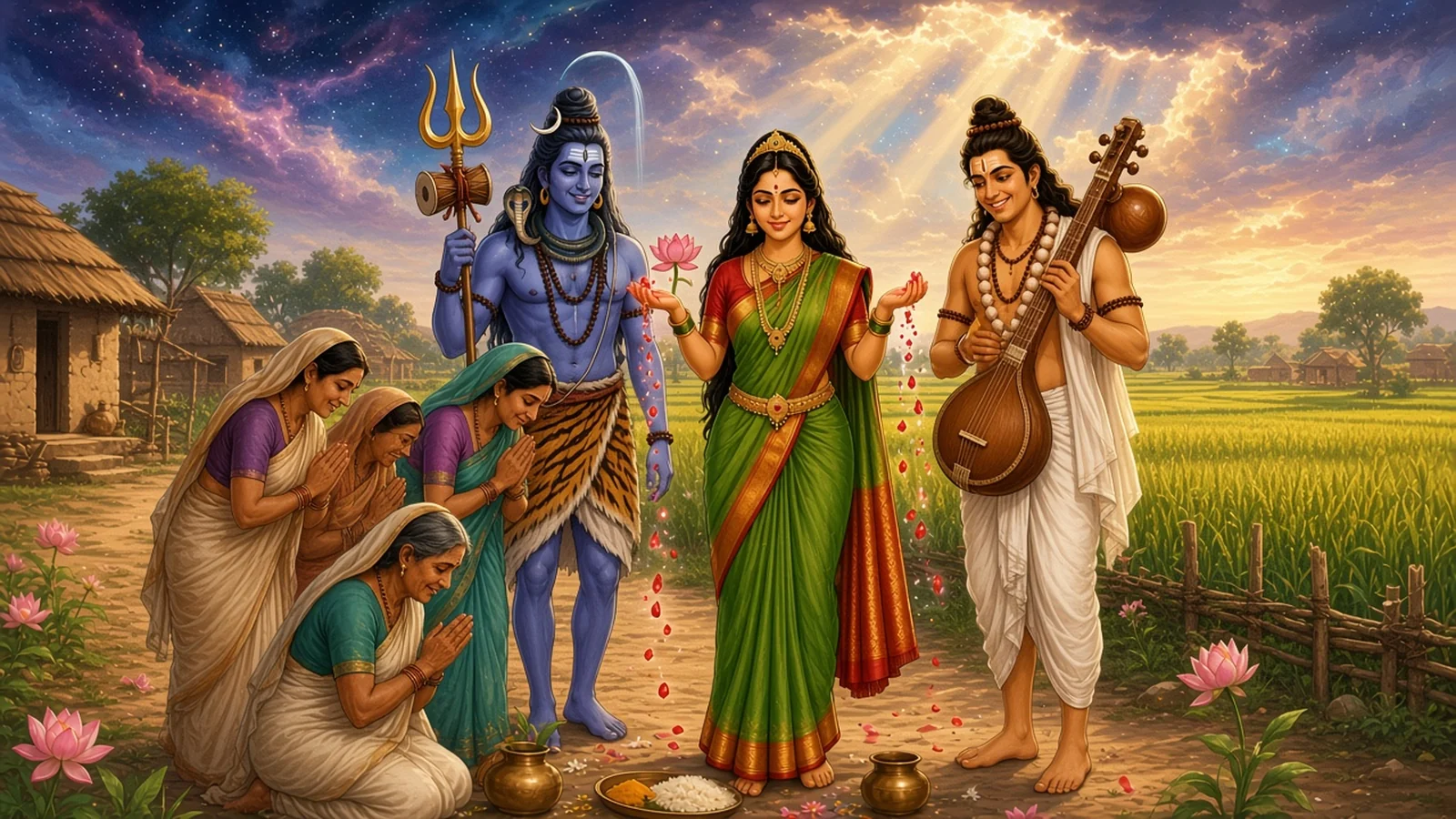
When he opened them, the Pulaya was not there. In his place stood Shiva, with the ash on his body and the moon in his hair, and beside him, where the wife had been, stood Parvati, and behind, where the friend had been, Nandikeshvara, his gatekeeper. The child was gone. The pot of toddy lay in the dust.
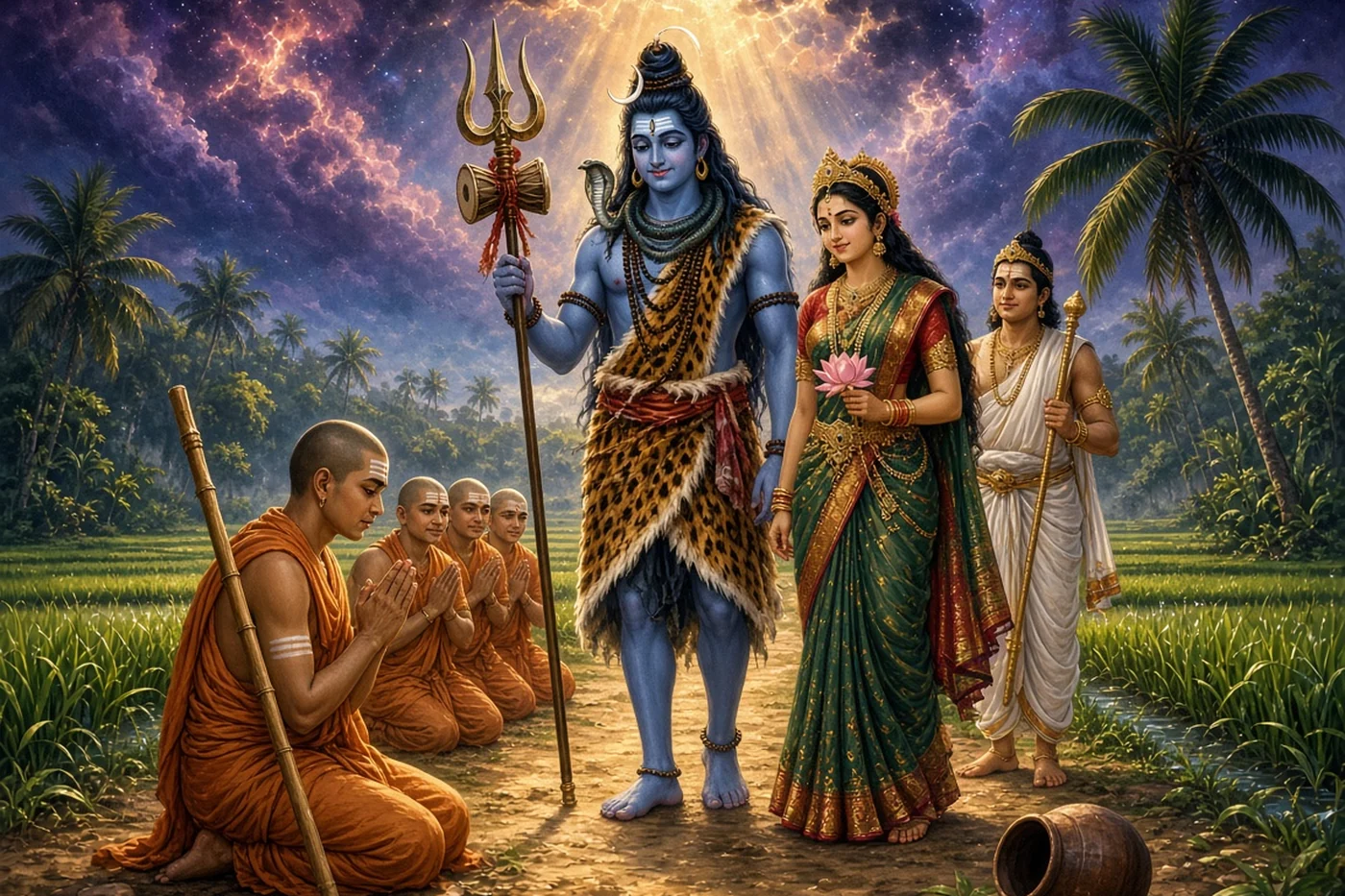
Shankara put his forehead to the ground. "I was going to sit on the throne of all knowledge," he said, "and I did not know this. Forgive me."
"You knew it," said Shiva. "It was written in your books. You had not met it on a road."
"What should I do?"
"Set me up as you saw me," said the god. "Not as the one with the moon in his hair. As the one with the pot on his head who would not step aside. Let them paint his face and light his fire every year, so that the question is asked in every village, out loud, and someone has to answer it."
So Shankara went on to the throne, and north Malabar got a god. They call him Pottan, the deaf and dumb one, because the one who heard nothing and said nothing is the one who made the wisest man in the land sit down in the dust. His wife is danced beside him as Pulachamundi and his friend as Pulamaruthan, and every season he walks into a kavu with a pot and a laugh and asks the road his question again.
As the scholars read it, and as a Pottan night goes
Kannur and Kasaragod · the kavu, the embers and the lecture hall · 2 min read
Not everyone who tells the story lets Shiva into it. In the local tellings that Lissy V. Mathew recorded, the man on the road is a Pulaya named Alankaran, with his wife Sundari and his friend Kannadan. He puts his questions to Shankara and the teacher cannot answer them, and the story does not end in a bow. The men of the upper castes kill Alankaran for the humiliation, and no god comes.
A telling kept at two shrines in Kasaragod adds why he is called Pottan at all. For seeing and hearing what a Pulaya was not permitted to, Alankaran was blinded, his ears were torn and he was made mute, and the name was given him as mockery before it was given him as worship. The dead man became a theyyam, as the murdered and the wronged of Malabar often did.
Scholars read the two endings side by side. K. K. N. Kurup, whose work on the cult of theyyam and hero worship opened the field in 1973, traced the whole tradition to the worship of heroes and ancestors that the Brahmanical gods entered later. M. Dasan of Kannur University argues that making Pottan an incarnation of Shiva is exactly that entry: the caste critique and Shankara's defeat, he writes, vanish once the questioner was a god all along. Dilip Menon calls the theyyam a strategy by which the dominated resist arbitrary authority for a night.
The performers themselves, who have sung Pottan's questions for generations, told the press in 2021 that they still could not be handed a shawl by the priest, or drink tea sitting at a table near a shrine.
The night itself goes like this. The thottam is sung the evening before, the plain song of the story with no costume but a small red headdress. After midnight the performer, a Vannan or a Malayan in most kavus, a Pulayan in some, comes out with his face painted in red, white and black and a low crown of palm leaves, a mask of palm sheath in some places, and a belly like a pot.
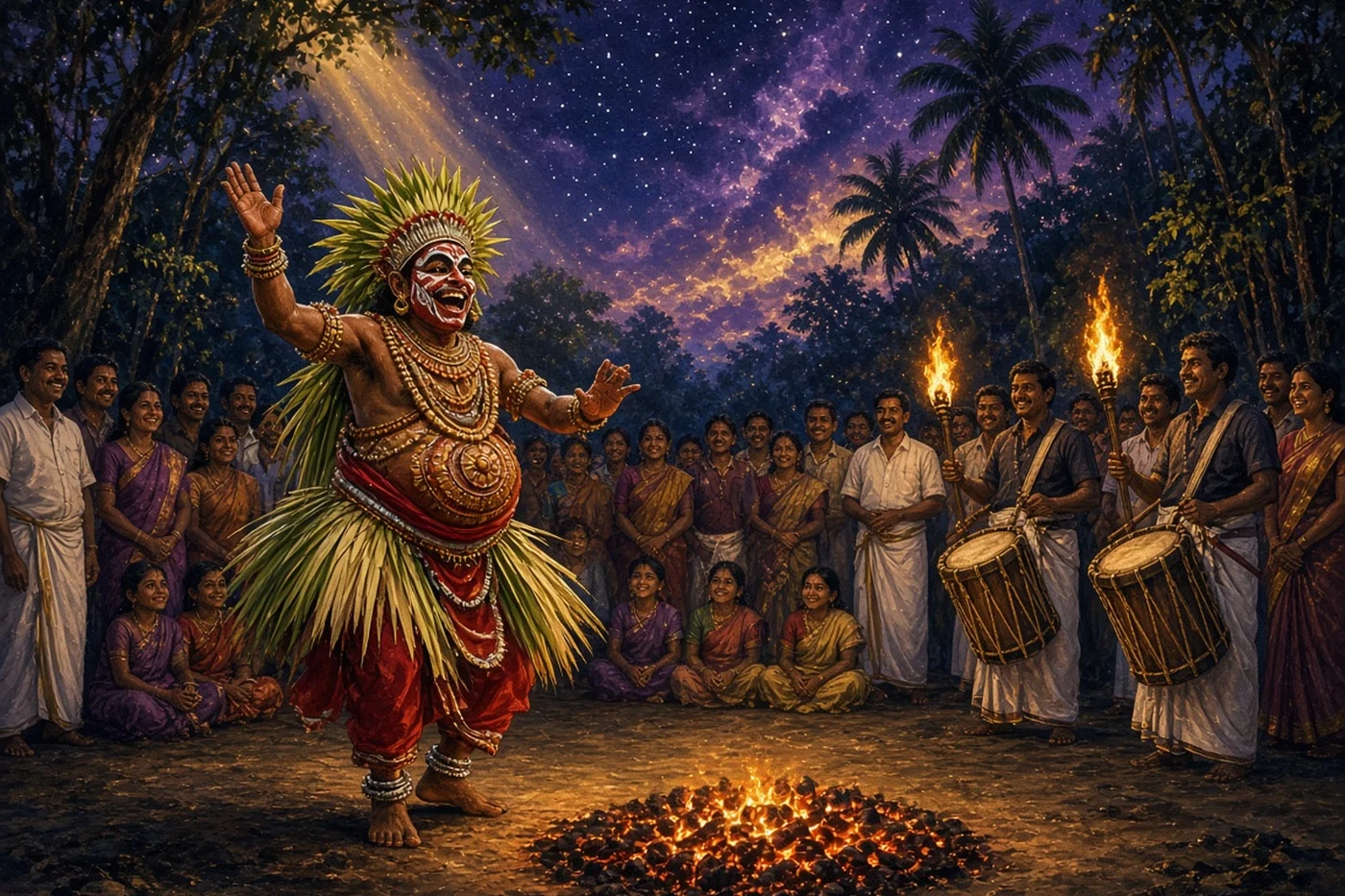
A heap of embers, the meleri, has been burning in the yard since dusk. He dances round it, talking all the while, mocking the crowd and himself in rough, funny Malayalam that changes from village to village, and then he lies down on the fire. The helpers pull him off and the crowd shouts for him to rise, and he goes back, again and again, until the embers are grey. The ash from that fire is handed out afterwards to everyone present, whatever their caste. Only after the fire does he enter the shrine, and only then do the families come forward to talk to him.