Festival · Five days for Yama's creatures, and one night of lamps
Tihar
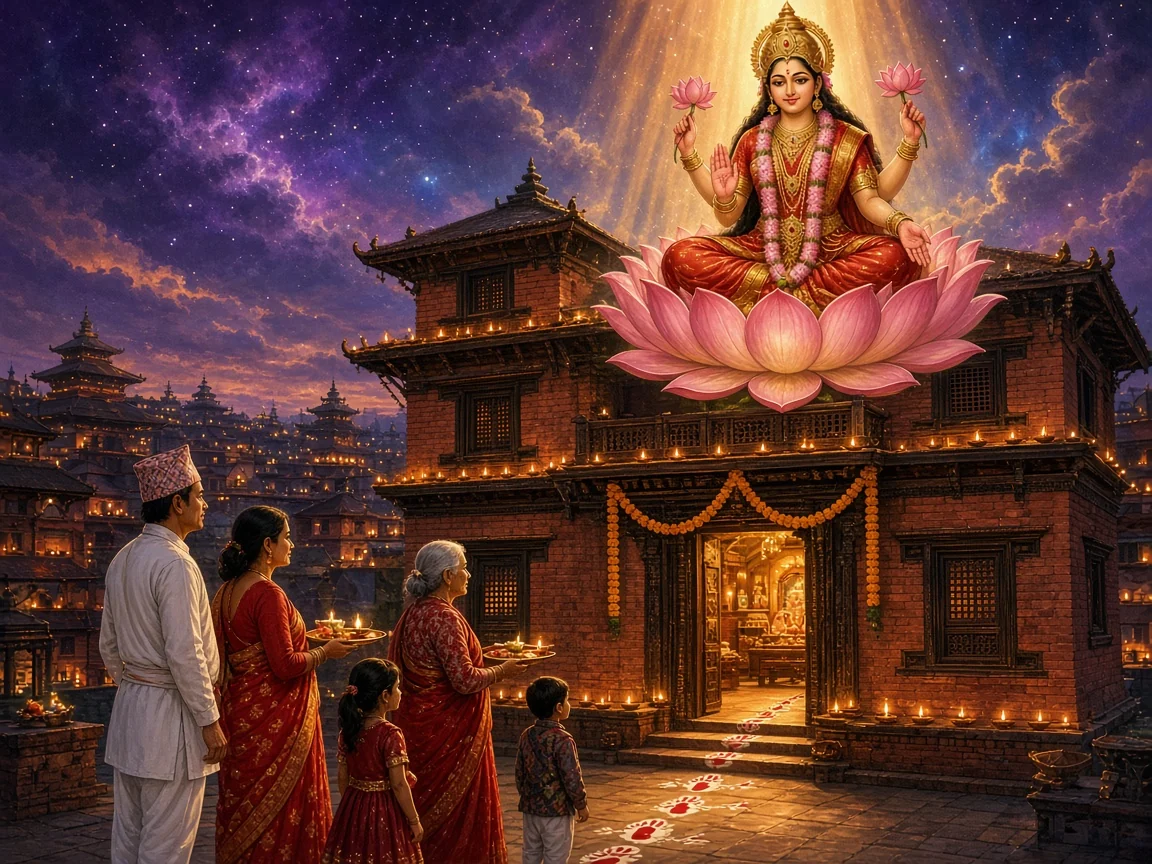
Tihar is Nepal's Diwali, and the five days around the new moon of Karttika are Yama's, the Yamapanchak. Each day has a creature in it, the crow fed on the roof, the dog garlanded and marked, the cow and then the ox, and in the middle is the night of lamps for Lakshmi, with her footprints drawn from the door to the puja room and the girls singing Bhailo outside. The Newars worship their own selves on the fourth night and begin a new year, and on the fifth sisters ring their brothers with oil and give them the tika of seven colours. Sikkim, Darjeeling and the Nepali diaspora keep it too.
When is Tihar in 2027? Laxmi Puja, the night of lamps, is Friday 29 October 2027; it runs 27 to 31 October 2027. The thirteenth day of the dark half of Karttika to the second day of the bright half, in October or November, by Nepal's own panchang.
Also calledYamapanchakSwantiDeepawaliDipawalithe Nepali DiwaliKaag TiharKukur TiharGai TiharLaxmi PujaMha PujaBhai Tika
In short
What is Tihar?
Nepal's festival of lights, five days around the new moon of Karttika in October or November. Each day honours a creature of Yama, the crow, the dog, the cow and the ox, with Lakshmi's night of lamps in the middle and the brother and sister day, Bhai Tika, at the end.
When is Tihar in 2026?
Kaag Tihar is Saturday 7 November 2026, Kukur Tihar and Laxmi Puja fall together on Sunday 8 November, Gai Tihar on Monday 9, Govardhan Puja and Mha Puja on Tuesday 10, and Bhai Tika on Wednesday 11 November. In 2027 the five days are expected to run from 27 to 31 October, with Laxmi Puja on Friday 29 October.
Why are crows and dogs worshipped in Tihar?
Because they are Yama's. The crow is his messenger and carries news of a house to the lord of the dead, so it is fed on the roof to carry good news. The two dogs of the Rigveda keep the gate of his kingdom and guard the path of the dead, so every dog is garlanded, marked and fed on Kukur Tihar.
What is Yamapanchak?
The five days of Yama. Nepal says the lord of the dead spent these five days at his sister Yamuna's house and was so pleased that he promised that nobody who dies in them enters his gate, and the whole festival is kept in his name, from the crows on the first day to the sister's tika on the last.
What are Deusi and Bhailo?
The songs of Tihar. Girls go from door to door singing Bhailo on the night of Laxmi Puja and boys sing Deusi the night after, a leader singing each line and the band answering Deusi re, with the refrain that they did not come on their own, King Bali sent them. The house gives rice, sel roti, fruit and money and gets a blessing.
Next, in 2027Friday 29 October 2027
27 to 31 October 2027
Prime godsLakshmi and Yama
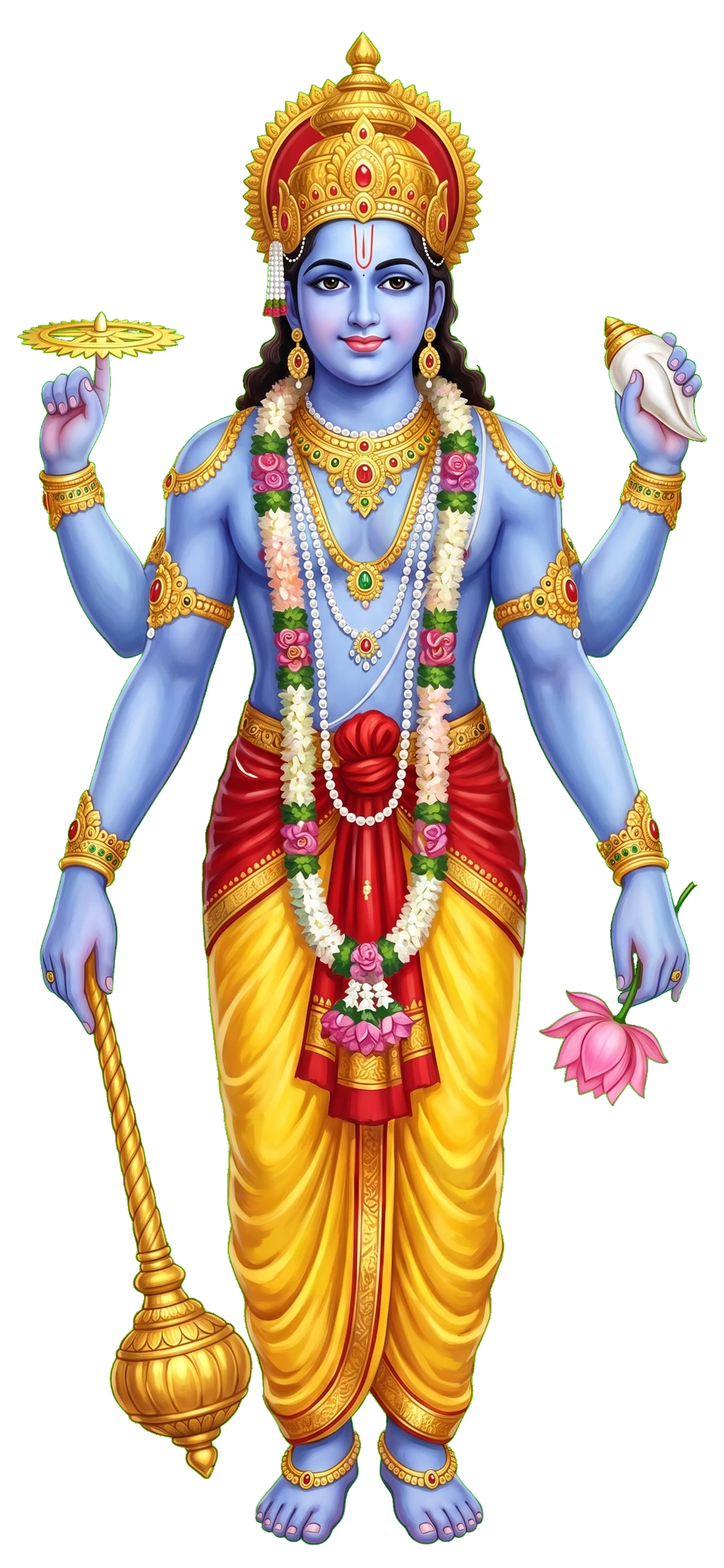
with 3 more
WhereNepal, from the Kathmandu valley to the hills and the Terai; Sikkim, Darjeeling and the Nepali towns of India; and the Nepali diaspora
How longFive days, Kaag Tihar to Bhai Tika
The thirteenth day of the dark half of Karttika to the second day of the bright half, in October or November, by Nepal's own panchang
Why it is kept
Tihar is what Nepal calls the days India calls Diwali, and the two are not quite the same festival. India lights lamps for Lakshmi and Rama; Nepal lights them for Lakshmi too, but the five days are named for Yama, the lord of the dead, and the first thing anyone does is climb to the roof with breakfast for a crow. By the end of the week a dog has worn a garland, a cow has eaten the household's best, the Newars have begun a new year, and every brother in the country has been ringed with oil by his sister.
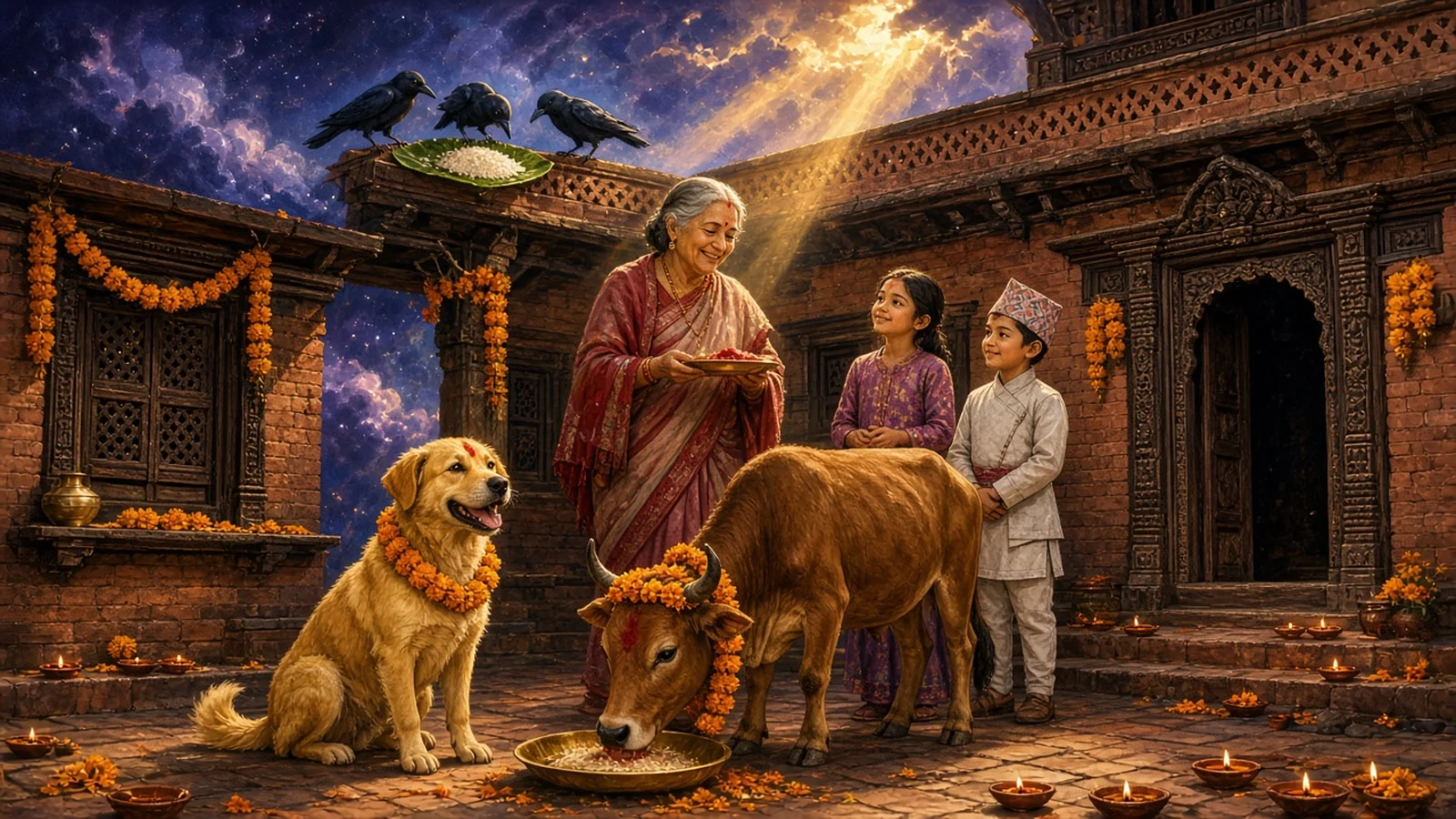
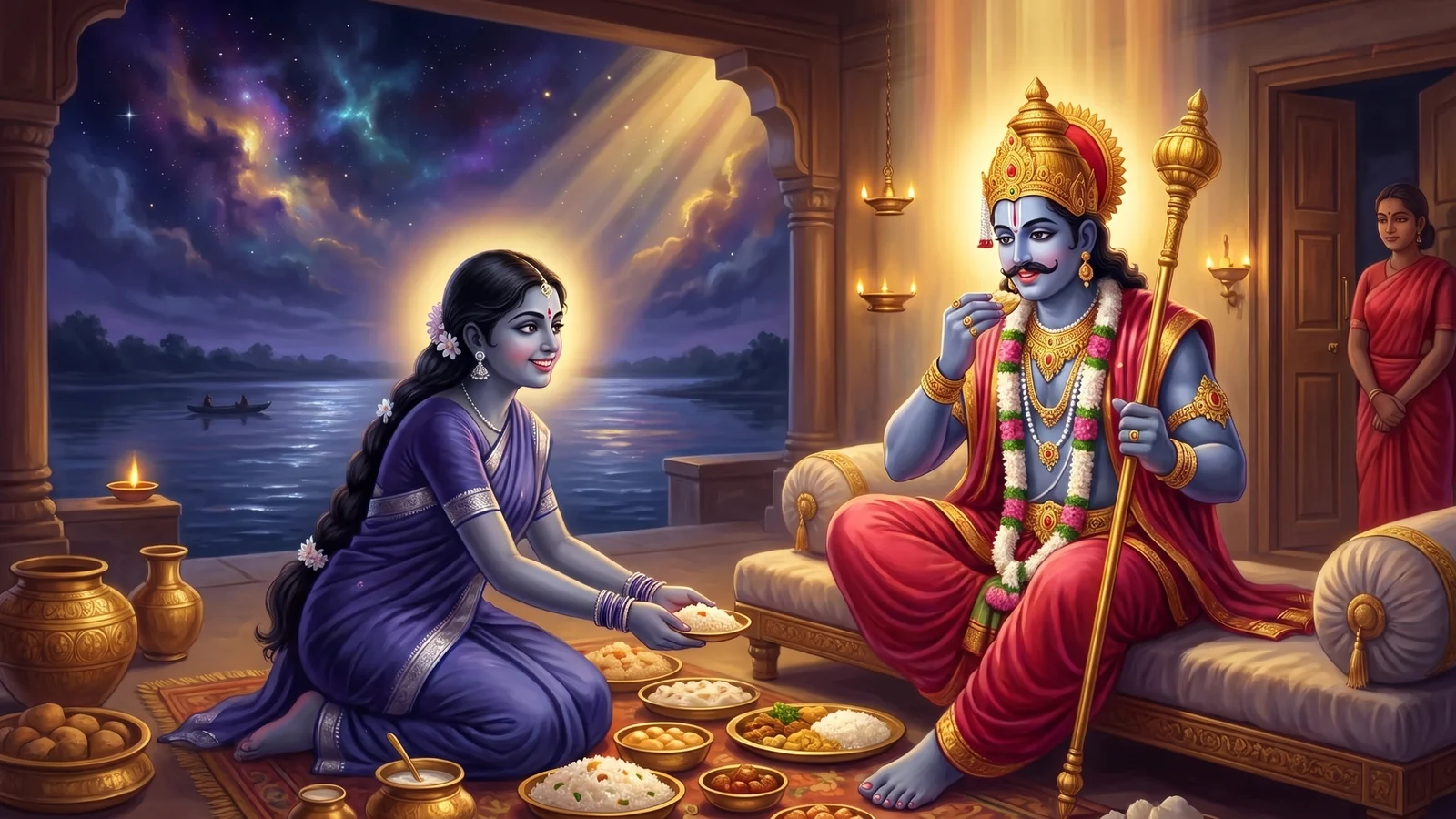
Nepal's answer is in the almanacs rather than the scriptures. Yama, the king of the dead, went to his sister Yamuna's house and stayed five days, and was so pleased with her welcome that he promised to come every year, and that nobody who died in those five days would go in at his gate. Some tellers say nobody dies at all. So the five days are his, the Yamapanchak, and the creatures of his kingdom are honoured in turn: the crow who carries his news, the two dogs who keep his gate, the cow who leads the dead across the river on his road. The Lore follows a valley grandmother through the week in The Crow, the Dog and the Cow, then looks for the creatures in the Rigveda and the Puranas.
Yama welcomed with lamps at Yamuna's door, while a crow, two dogs and a cow wait in the yard
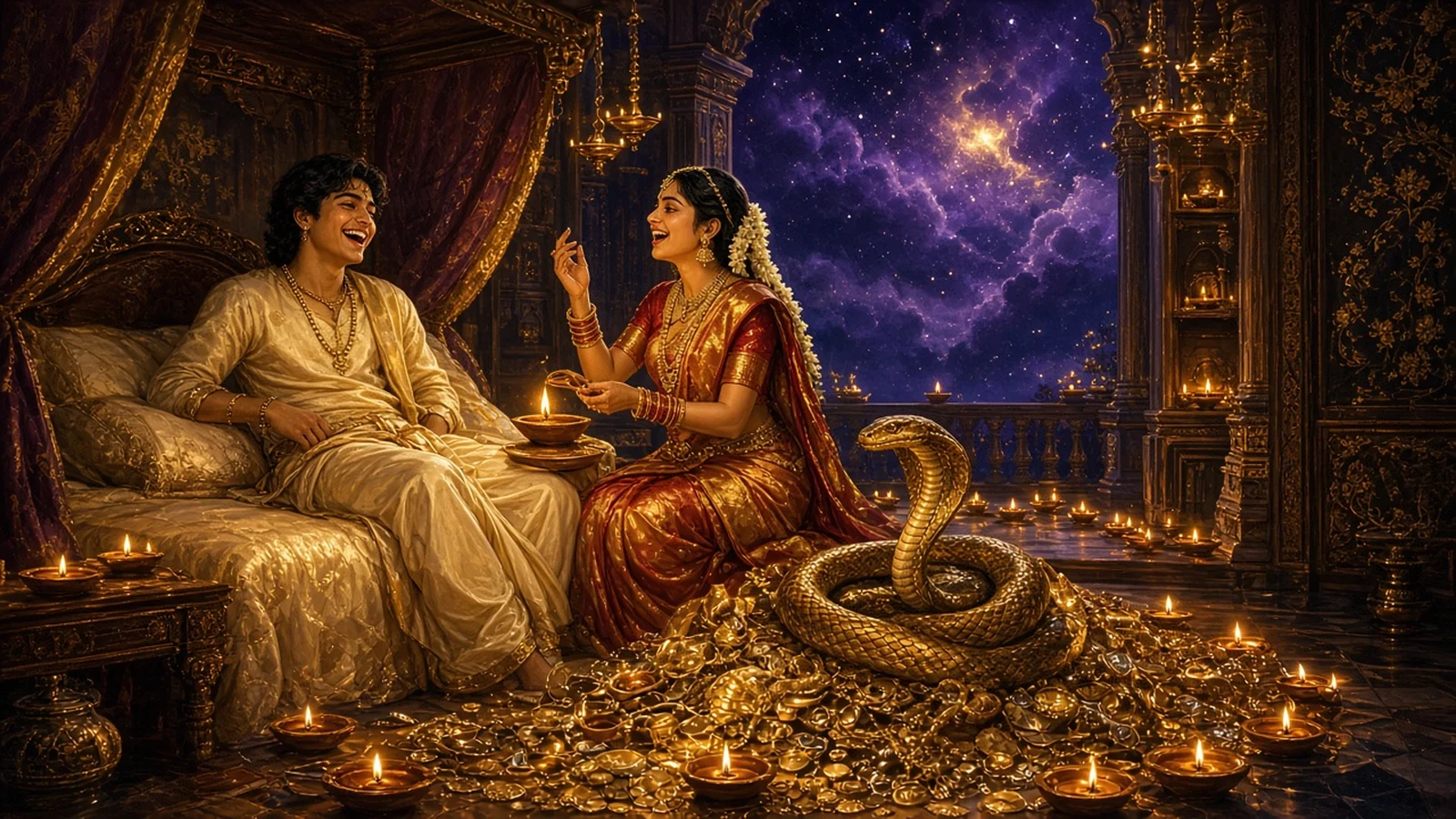
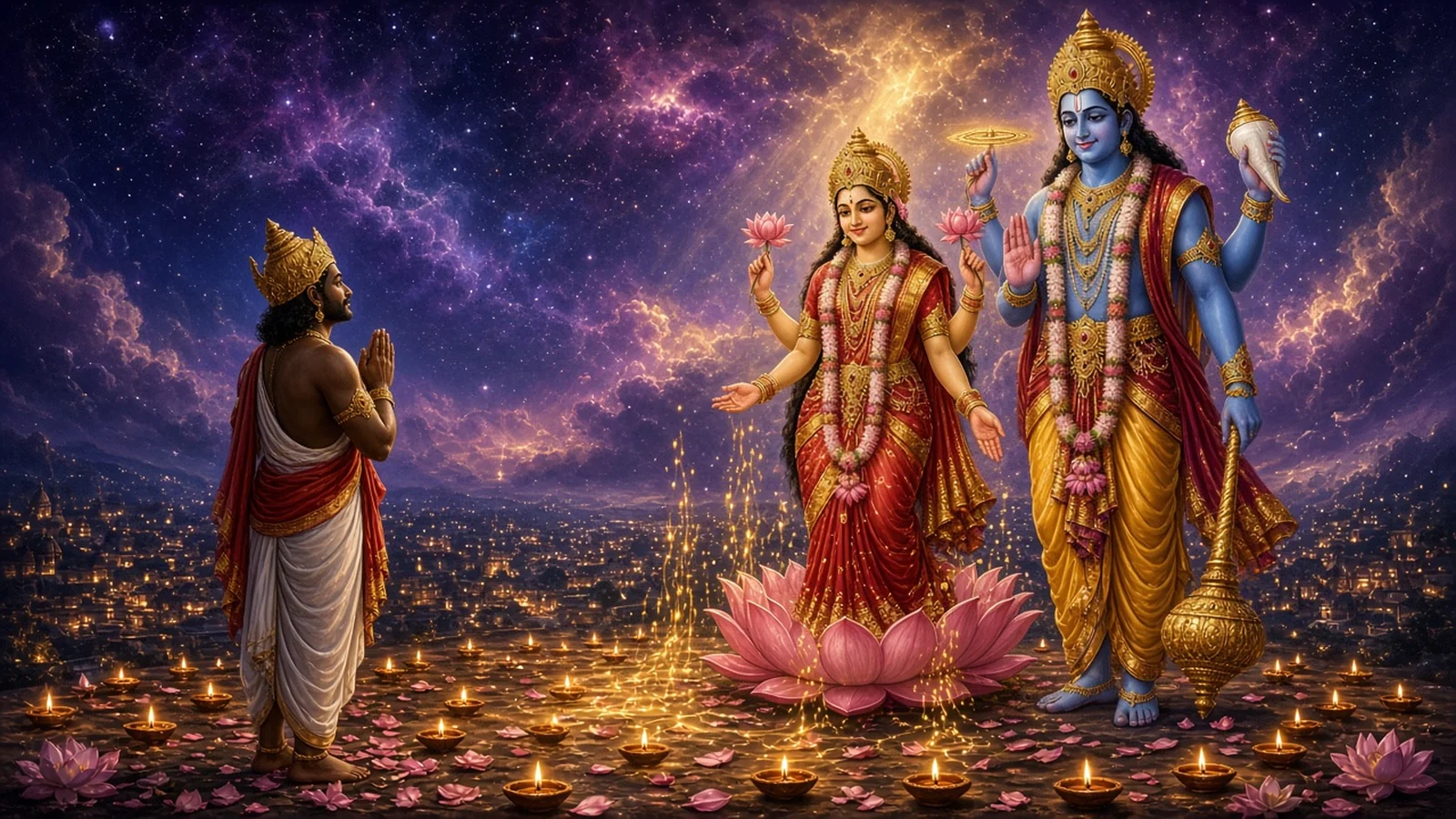
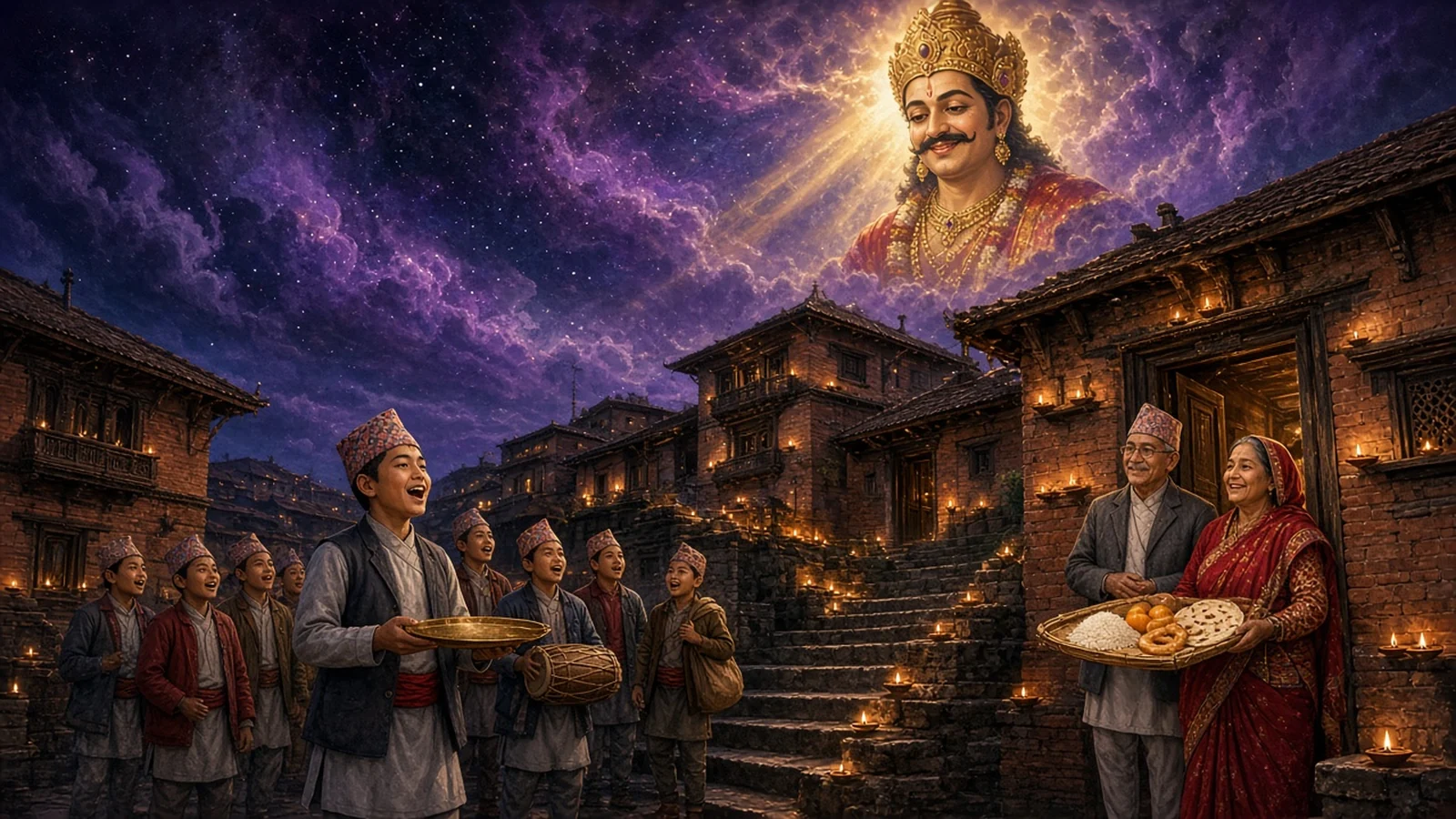
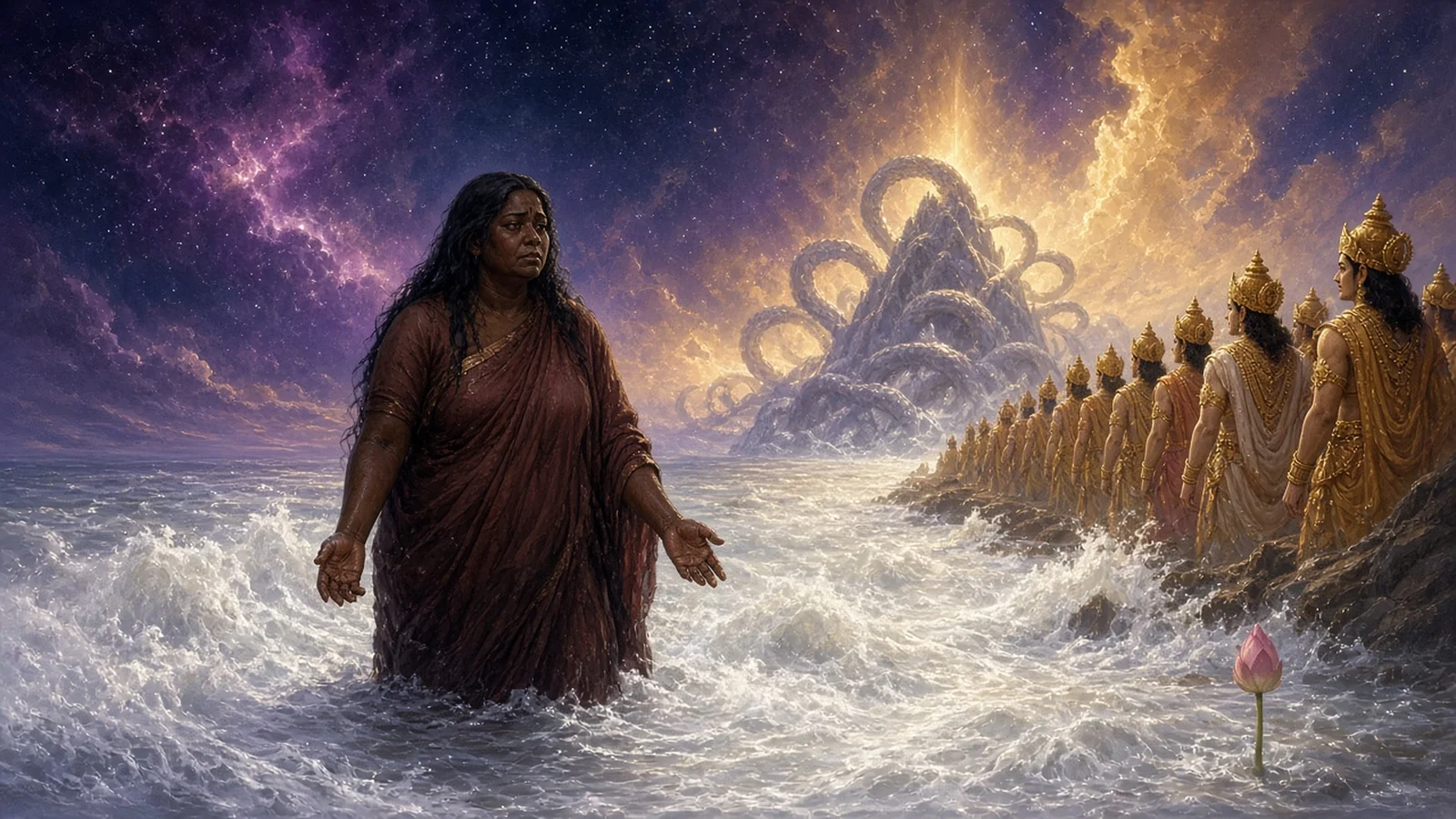
The night of lamps has the reason all India gives it. Lakshmi walks the earth on the new moon and comes into the house that is clean and bright, and the Skanda Purana says King Bali asked for exactly that when the dwarf took his kingdom. Nepal gives Bali more. The dwarf's three nights become five, and the singing bands that go from door to door announce themselves as his messengers: we did not come on our own, King Bali sent us. The Song King Bali Sent follows one Deusi band through a town.
King Bali grants Vamana his wish, and Lakshmi comes down to the hill houses lit with lamps
The fourth and fifth days, Krishna's hill and Yama's dinner at his sister's table, have pages of their own, Govardhan Puja and Bhai Dooj.
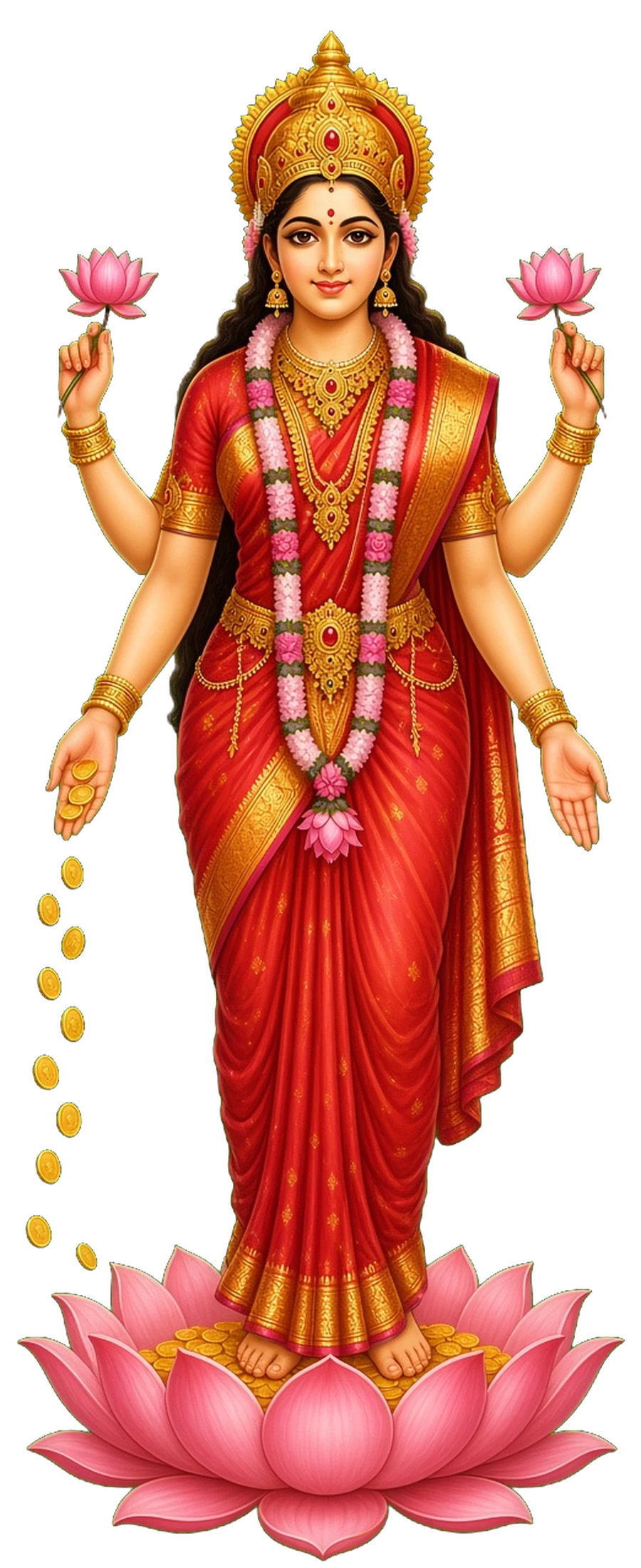
The goddess of the main night. At dusk on the new moon every house is lit for her, her small footprints are printed in rice flour and vermilion from the street door to the puja room, and the cow is honoured in the morning as her living form.
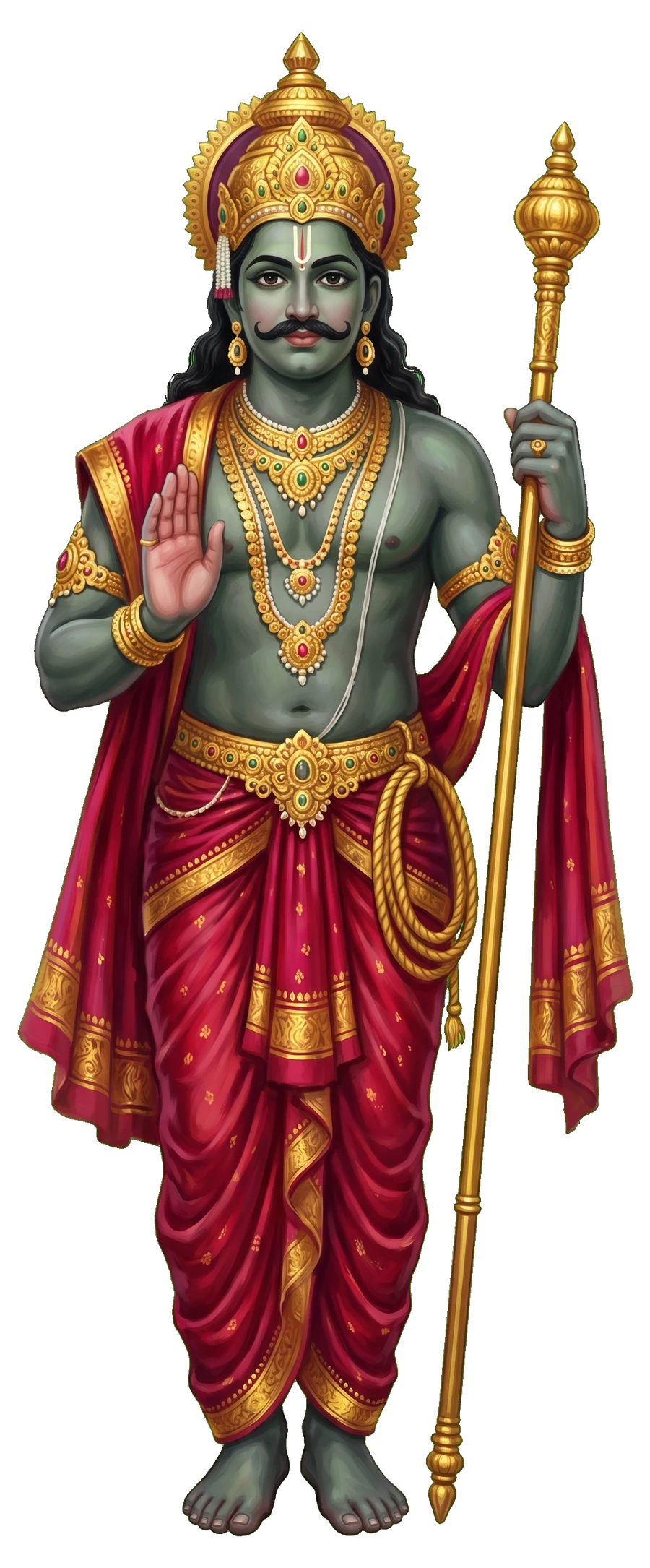
The lord of the dead, whose five days these are. The crow is his messenger, the two dogs keep his gate, the cow leads the dead across his river, and his lamp is lit at the door. Nepal says he spent these five days at his sister's house and promised that nobody who dies in them enters his gate.
Y
Yamuna (Yami)
The sister, the river. In the Skanda Purana she feeds her brother on the last day; in Nepal's own telling she holds Death off from a dying brother with a ring of oil, a garland that will not wilt and a mark that will not fade.
The dwarf who took the three worlds from King Bali and gave him his nights of lamps. Every Deusi and Bhailo band says that it did not come on its own, King Bali sent it.
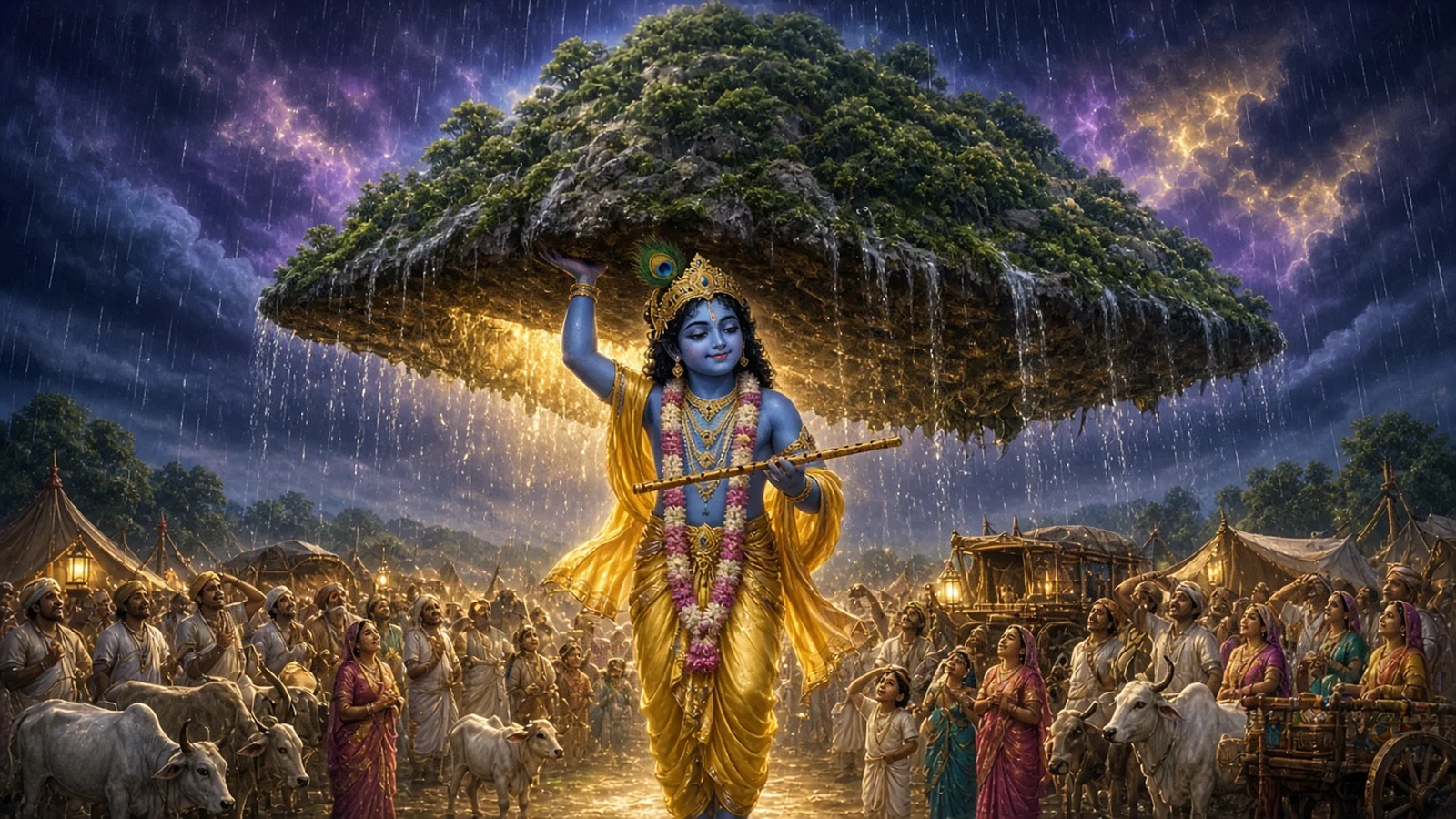
The lifter of Govardhan, for whom a hill of cow dung with marigolds in it stands in the courtyard on the fourth day.
The five days of Yamapanchak
1
Kaag Tihar
The thirteenth day of the dark half of Karttika · Saturday 7 November 2026
Kwah PujaDhanterasDhanvantari Jayanti
Before breakfast a leaf plate of rice, curd and curry goes up to the roof or out into the lane for the crows, Yama's messengers, who tell him what people are doing and whose caw on the roof means news. Fed today, they carry good news. In Kathmandu there is crow worship at the Kageshwari temples. The same day is Dhanteras, for buying metal, and in the evening a lamp for Yama goes out at the door.
Kaag Tihar: a leaf plate of rice, curd and curry set out on a Kathmandu rooftop for the crows
The fourteenth, and this year the new moon as well, which falls on the same day · Sunday 8 November 2026
Khicha PujaNaraka ChaturdashiSukharatriBhailo night
Every dog, the house dog, the stray on the corner and the police dogs on parade at the training school, is bathed, garlanded with marigolds, given a red tika between the eyes and fed sel roti, meat and milk; the pictures go round the world every year. Dogs keep Yama's gate and go with the dead. In 2026 the new moon follows at once, so the night of lamps is the same night: the house is cleaned and lit, Lakshmi's footprints run from the door inward, she is worshipped at dusk with the coins and the treasury, and the girls of the lane sing Bhailo at every door.
Kukur Tihar: a happy dog in a marigold garland with a red tika, a plate of sel roti before it
The morning of the new moon, which this year runs on into Monday · Monday 9 November 2026
Sa Pujathe cows' morning
The cow is washed, marked on the forehead, garlanded on the horns and given the best of the breakfast. She is Lakshmi in a living shape, and the Newars add that she guides the dead to the land of the dead. In most years this is the morning of Laxmi Puja day; in 2026 Nepal's panchang gives it the day after.
Gai Tihar: a family garlands their cow and marks her forehead in a village courtyard in the morning
The first day of the bright half of Karttika · Tuesday 10 November 2026
Goru PujaDeusi nightNepal Sambat New YearNhu Dan
The ox has his day for the ploughing, and a small Govardhan of cow dung stands in the courtyard with marigolds stuck in it for Krishna. After dark the boys go out with the madal drum singing Deusi from house to house, King Bali's messengers, and come home with rice, sel roti, fruit and money. The Newars sit before a row of mandalas for Mha Puja, the worship of one's own self, and the next morning Nepal Sambat 1147 begins with Bhintuna rallies through the three old cities.
Deusi night: boys with a madal drum sing at a lit door beside a little Govardhan of marigolds
The second day of the bright half of Karttika · Wednesday 11 November 2026
Kija PujaYama DwitiyaBhai Dooj
At the hour the calendar committee announces, sisters seat their brothers, ring them with oil and water, break a walnut at the door beside a citron, shut it, and give the tika of seven colours, the makhamali garland and a shagun of sel roti, fruit and spices; the brothers give money and a tika back. People with no sibling go to the temple at Rani Pokhari that opens for this one day. Bhai Dooj has its own page; the Lore tells the sister's story in The Day Death Came to Dinner.
Bhai Tika: a sister gives her brother the seven-colour tika inside a circle of oil on the floor
The Newars call the five days Swanti and keep them with their own names, Kwah Puja for the crows, Khicha Puja for the dogs, Sa Puja for the cows, then Mha Puja and Kija Puja. Lakshmi Puja is kept with a new painting of the goddess set up in an inner room, a sand mandala and coins offered before her. On the fourth night every member of the house, and the water pot, the winnowing tray, the broom and the two messengers of death, has a mandala on the floor, and the next morning is the new year of Nepal Sambat, with rallies in Kathmandu, Patan and Bhaktapur, women in black and red hakupatasi and dhime drums in Basantapur. The crows of Kathmandu have two temples of their own, the Kageshwari shrines, where they are worshipped on the first day, and the Asan and Indra Chowk markets sell marigold garlands by the mile.
The hills and the TeraiDeusi, Bhailo and Dipawali
In the hill towns the festival is heard before it is seen, as the girls go round with Bhailo on the night of lamps and the boys with the madal and Deusi the night after, and the money they collect pays for a school, a shrine or a picnic. The Madhesi communities of the Terai call the days Dipawali and keep them as northern India does, and six days after the new moon the Maithil, Bhojpuri and Tharu households of Janakpur and the Terai, and Kathmandu's Rani Pokhari, turn to the river banks for Chhath, which has its own page.
Sikkim, Darjeeling and KalimpongTihar in India's Nepali towns
The Nepali-speaking towns of Sikkim and the Darjeeling hills keep all five days, with Deusi and Bhailo bands in the bazaars of Gangtok, Darjeeling, Kurseong and Kalimpong, dogs garlanded on Kukur Tihar and the seven-colour tika on Bhai Tika. Sikkim lists Laxmi Puja among its state holidays, and the collections of the singing groups there have paid for scholarships and student hostels.
The diasporaTihar abroad
Nepalis in Australia, Britain, the United States, Japan, Korea and the Gulf keep what they can of the five days, a lamp in the window, a Tihar night in a hired hall, a Bhai Tika given over a video call to a brother at home. In Qatar the Nepali organisations keep Dashain and Tihar together in a Doha hotel and the Newars of Qatar sit down to Mha Puja for the new year of Nepal Sambat. The Nepal embassy in Delhi holds a Deusi Bhailo programme for Tihar and Diwali together, and the Gorkha regiments of India, Nepal, Britain and Singapore have their own.
Nepal's HindusYamapanchak
The five days are Yama's, and the lamps are Lakshmi's. The government gives the country three days off, from Laxmi Puja to Bhai Tika, and the Nepal Panchanga Nirnayak Samiti announces the hour of the tika each year. Firecrackers are banned and set off anyway, and the cowrie and card games come out in every house.
Newar BuddhistsSwanti and Mha Puja
The Buddhist Newars of the valley keep the same five days, feed the crows and the dogs, honour the cow, pray to Lakshmi on the night of lamps with the new painting and the coins, and sit down to Mha Puja and the new year with their Hindu neighbours. Mha Puja is kept in Buddhist and Hindu households alike, and the priest of the Golden Temple in Patan explains its mandala to the press.
The Magar and Kirat tellingsBali Hang and Jamuna
Among the Magars and Kirats the sister of Bhai Tika is Jamuna and her dying brother is their king Bali Hang, and some tellers make the same Bali Hang the king the Deusi refrain names. These are told as the communities' own stories, beside the Puranic Bali and Yama's Yamuna, and no text has been found for them.
How it is kept
The first morning belongs to the crows: rice, curd and curry on the roof before anyone eats, and speak well, speak well called back when one caws. The second day every dog in the country, down to the police dogs at the training school, is bathed, garlanded with marigolds, given a red tika and fed sel roti, and the photographs go round the world. On the third morning the cow is marked and garlanded, and at dusk the house is lit, Lakshmi's small footprints run in rice flour and vermilion from the street door to the puja room, the goddess is worshipped with the coins and the strongbox, and the girls of the lane sing Bhailo at the door for rice, coins and a sel roti each.
Laxmi Puja: Lakshmi's red footprints run from the lit door inward as girls sing Bhailo
The fourth day is the ox's, and a hill of cow dung stuck with marigolds stands in the courtyard for Govardhan. After dark the boys go round with the madal drum singing Deusi, one voice leading and the rest answering Deusi re, and the nanglo tray comes out at every door with rice, fruit, sel roti and a folded note. In the Newar houses the family sits before a row of mandalas, one for each person and two for the messengers of death, and receives the long wick, the thread, the citron and the sagan; the next morning Nepal Sambat has a new year and the three old cities fill with rallies.
Mha Puja: a Newar family seated in a row before small mandalas of rice and colour
On the fifth day, at the hour the calendar committee announces, the sisters take over. The brother sits; the sister circles him with oil and then water, breaks a walnut at the threshold, shuts the door, and gives the seven-colour tika, the makhamali garland that does not wilt, and the shagun of sel roti, fruit and spices. He gives money and a tika back. The country closes for three days, from Laxmi Puja to Bhai Tika, and the cowrie and card games run through all of them.
In the old texts
No old book describes Tihar as Nepal keeps it, but each of its creatures is there. The Rigveda's hymn to Yama, the fourteenth of the tenth book, has the two dogs, Sarama's offspring, brindled and four-eyed, who guard the path of the dead and roam among the living as Yama's envoys. The Skanda Purana's chapter on Karttika, which also gives the Yama lamp of the thirteenth, has a lamp offered on the fourteenth to Shyama and Shabala, the two dog brothers who attend on Yama, the very night the dogs are garlanded. Its eleventh chapter has Yama's dinner at Yamuna's house on the second of the bright half.
The cow at the river is the Garuda Purana's: the Vaitarani, a hundred leagues of blood and pus, crossed by boat only by those who gave a cow, and the dying man holding the tail of a black cow with gilded horns. The crow has no Vedic hymn behind him as Yama's bird; he is the bird of the shraddha, fed a share of the ancestors' rice. The Deusi songs are oral and unwritten. The merchant Shankhadhar Sakhwa, whose gold is said to have begun Nepal Sambat in 879, is in the valley's late chronicles, the Bhasa Vamsavali among them, and nowhere earlier.
Where this page comes from. Written by Devalok from the Rigveda (10.14), the Skanda Purana (Karttikamasa Mahatmya, chapters 9 and 11), the Garuda Purana (chapters 2 and 8), the Tihar, Kukur Tihar, Kaag Tihar, Deusi, Bhailo, Mha Puja, Nepal Sambat, Swanti and Sankhadhar Sakhwa articles of the English and Nepali Wikipedia, the Kathmandu Post, the Rising Nepal, the Himalayan Times, Onlinekhabar, Republica, ECS Nepal and the Nepal Tourism Board, and the Nepali calendars for 2083 and 2084 BS, as recorded in the Devalok Lore. Our own words throughout.