Festival · The morning the gate of Vaikuntha stands open, and the god walks through it first
Vaikuntha Ekadashi
Vaikuntha Ekadashi is the eleventh day of the bright fortnight of the solar month of Dhanu, Margazhi, in late December or early January, when the south says the gate of Vishnu's own world stands open. At Srirangam the Paramapada Vasal is unbarred before dawn and the god is carried through it with the pilgrims behind him; at Tirumala the Vaikuntha Dwaram round the sanctum opens for ten days. It is the holiest of the year's Ekadashis, kept with a fast without rice and a night awake, and at Srirangam it sits in the middle of twenty days of the Alvars' hymns that end with the saint Nammalvar taken into Vaikuntha and given back.
When is Vaikuntha Ekadashi in 2026? Vaikuntha Ekadashi, when the gate opens before dawn, is Sunday 20 December 2026. In 2028: Saturday 8 January 2028. The eleventh of the bright fortnight of Dhanu, the Tamil Margazhi, in late December or early January, the day the north keeps as Mokshada or Putrada Ekadashi.
The eleventh day of the bright fortnight of the solar month of Dhanu, Margazhi, in late December or early January, when Vaishnavas of the south say the gate of Vishnu's own world, Vaikuntha, stands open. It is the holiest Ekadashi of the year, kept with a fast and a night awake.
When is Vaikuntha Ekadashi in 2026?
Sunday 20 December 2026, with the fast broken on the morning of Monday 21 December. Because the day follows the solar month there is no Vaikuntha Ekadashi at all in 2027; the next are Saturday 8 January 2028 and Wednesday 27 December 2028.
What happens at Srirangam on Vaikuntha Ekadashi?
Before dawn the Paramapada Vasal, the northern gate shut all year, is opened and the processional god Namperumal is carried through it to the Thousand-Pillared Hall with the pilgrims behind him. The day sits in the middle of the twenty-day Adhyayana Utsavam, and on the last night the saint Nammalvar is covered in tulasi, taken into Vaikuntha, and given back.
What is the Vaikuntha Dwaram at Tirumala?
A passage that runs round the sanctum of Venkateswara and is shut all year. It is opened on Vaikuntha Ekadashi and kept open for ten days, and pilgrims walk through it after their darshan; in 2026 it is expected to be open from 20 to 29 December.
What may you eat on Vaikuntha Ekadashi?
No rice, and in most houses no grain or pulses. Some take only fruit and milk, some only water, and the strictest nothing at all until sunrise on the twelfth day, Dwadashi, when the fast is broken inside the tithi.
Next, in 2026Sunday 20 December 2026
Prime godRanganatha of Srirangam, Namperumal
with 2 more
WhereSouth India above all, Tamil Nadu, Andhra Pradesh, Telangana, Kerala and Karnataka, and Vishnu temples everywhere
How longOne day and night, with ten days of Pagal Pathu before it and ten nights of Ra Pathu after it at Srirangam, and ten days of the open Vaikuntha Dwaram at Tirumala
The eleventh of the bright fortnight of Dhanu, the Tamil Margazhi, in late December or early January, the day the north keeps as Mokshada or Putrada Ekadashi
Why it is kept
Vaikuntha Ekadashi is the morning the gate is open. On the eleventh day of the bright fortnight of Dhanu, in the cold of Margazhi, the south says that the door of Vishnu's own world stands unbarred, and the great Vishnu temples give that belief a door to walk through. At Srirangam it is a gateway in the north wall, shut for the rest of the year and opened before dawn for the god to pass through first. At Tirumala it is a passage round the sanctum, open for ten days. Everywhere else it is whatever door the temple has, or one built for the day, and the people walk through it after the god.
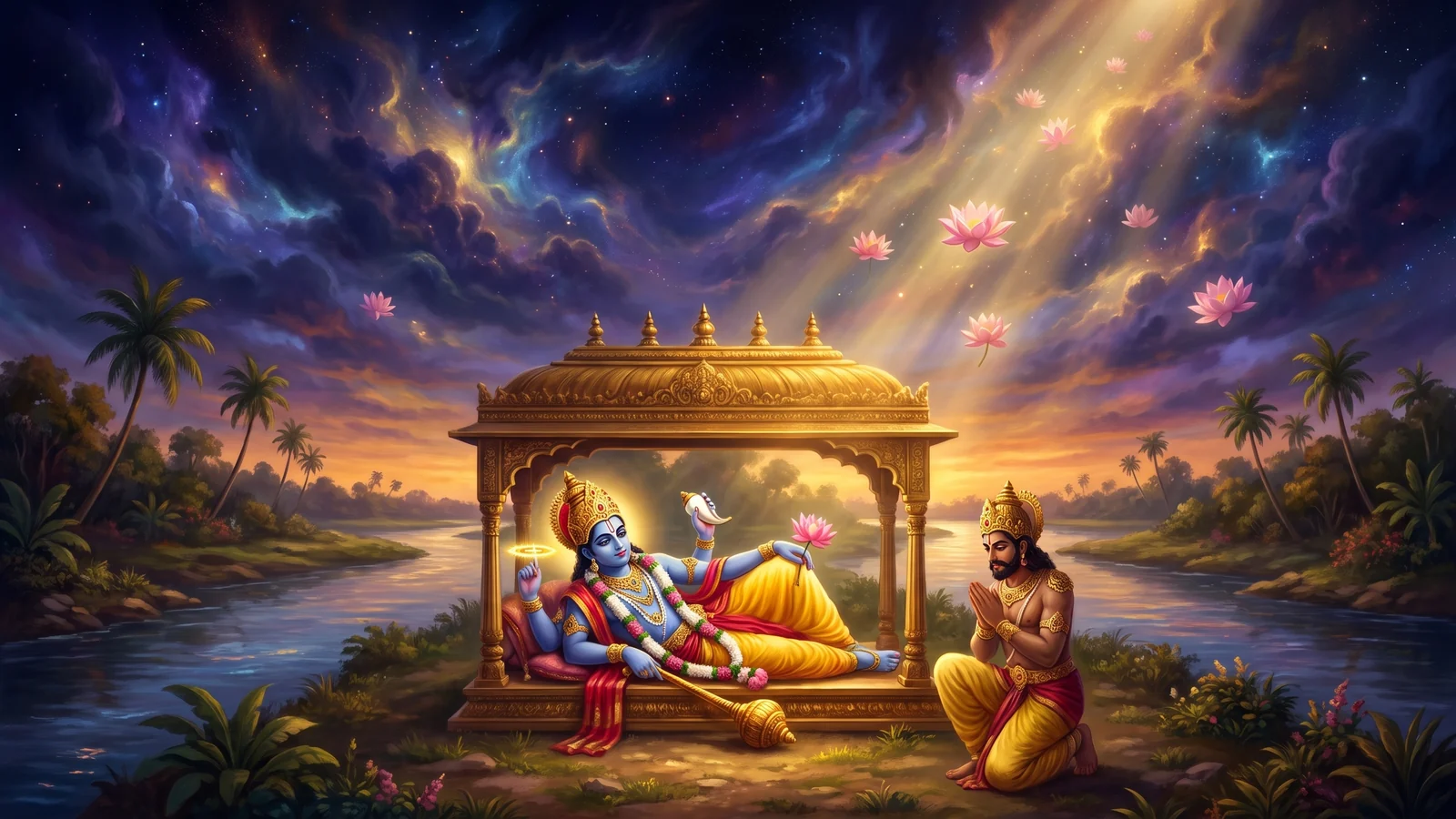
The name comes from a story. The Padma Purana tells how Vishnu, worn out by a war with the demon Mura, went to sleep in a cave, and how a woman made of light came out of him while he slept and destroyed the demon at the cave's mouth. He named her Ekadashi, for the eleventh day, and promised that whoever fasted on her day would not be born again. The Day the Gate Opens tells it, and tells how the devotees laid the open gate of Vaikuntha over the story, which the text itself does not mention.
Vishnu sleeps in the cave while Ekadashi, the woman of light, drives Mura away
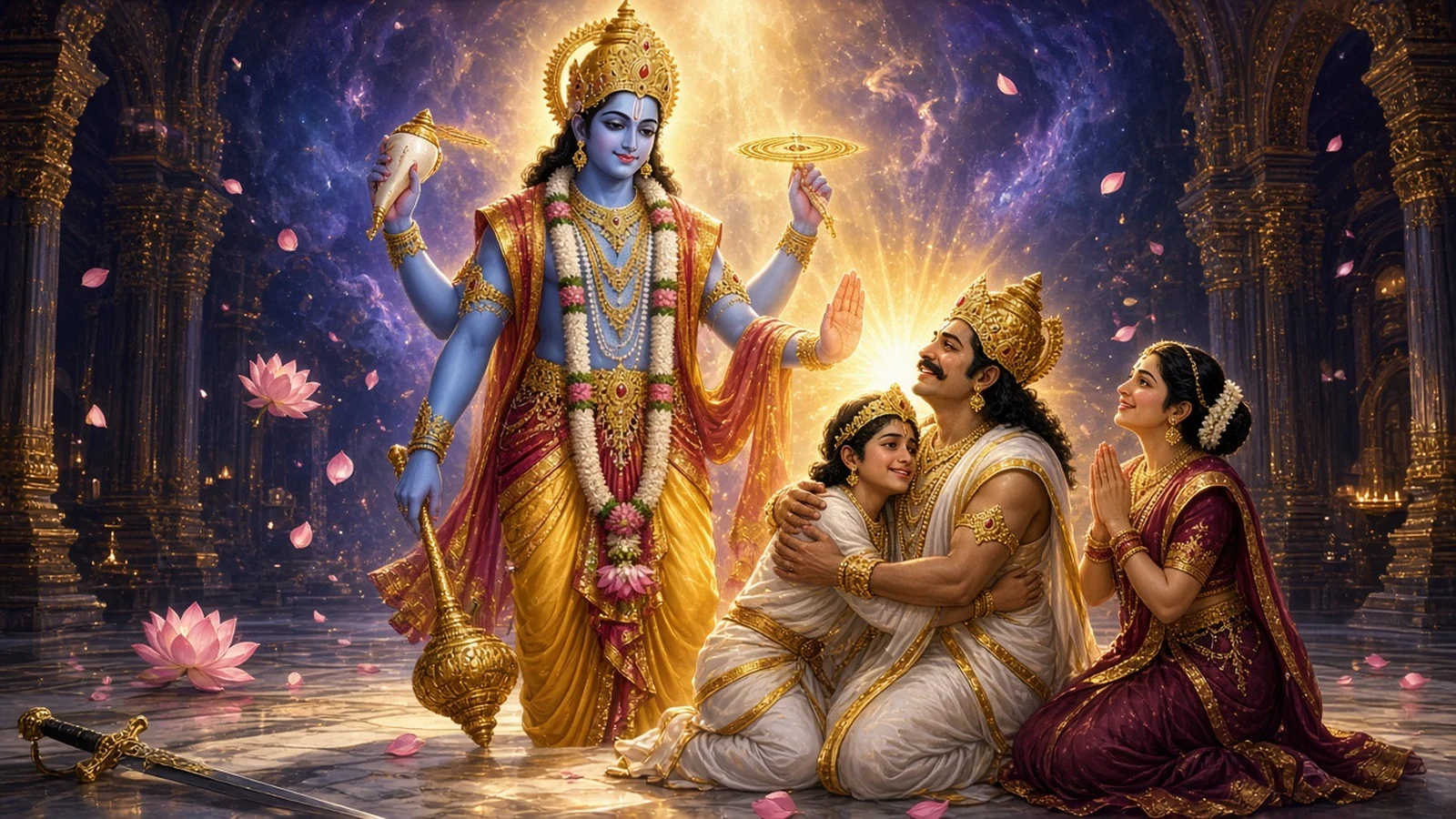
The fast has stories of its own. The Narada Purana's King Rukmangada made a whole country keep Ekadashi until Yama's hall stood empty, and lifted a sword over his own son rather than eat on the day; the Bhagavata's Ambarisha broke his fast with a sip of water as the twelfth day ran out and set a sage's curse against his own god's discus. Both are in The King Who Would Not Break His Fast.
King Ambarisha with joined hands as the discus of light chases Durvasa across the sky
And Srirangam has a third reason, which is a poem. The Srivaishnavas say that the saint Nammalvar reached Vaikuntha on this day, and for ten nights after it they sing his Tiruvaymoli before the god until, on the last night, he is taken in and given back. The Saint Who Was Sent Back follows that night and the life behind it.
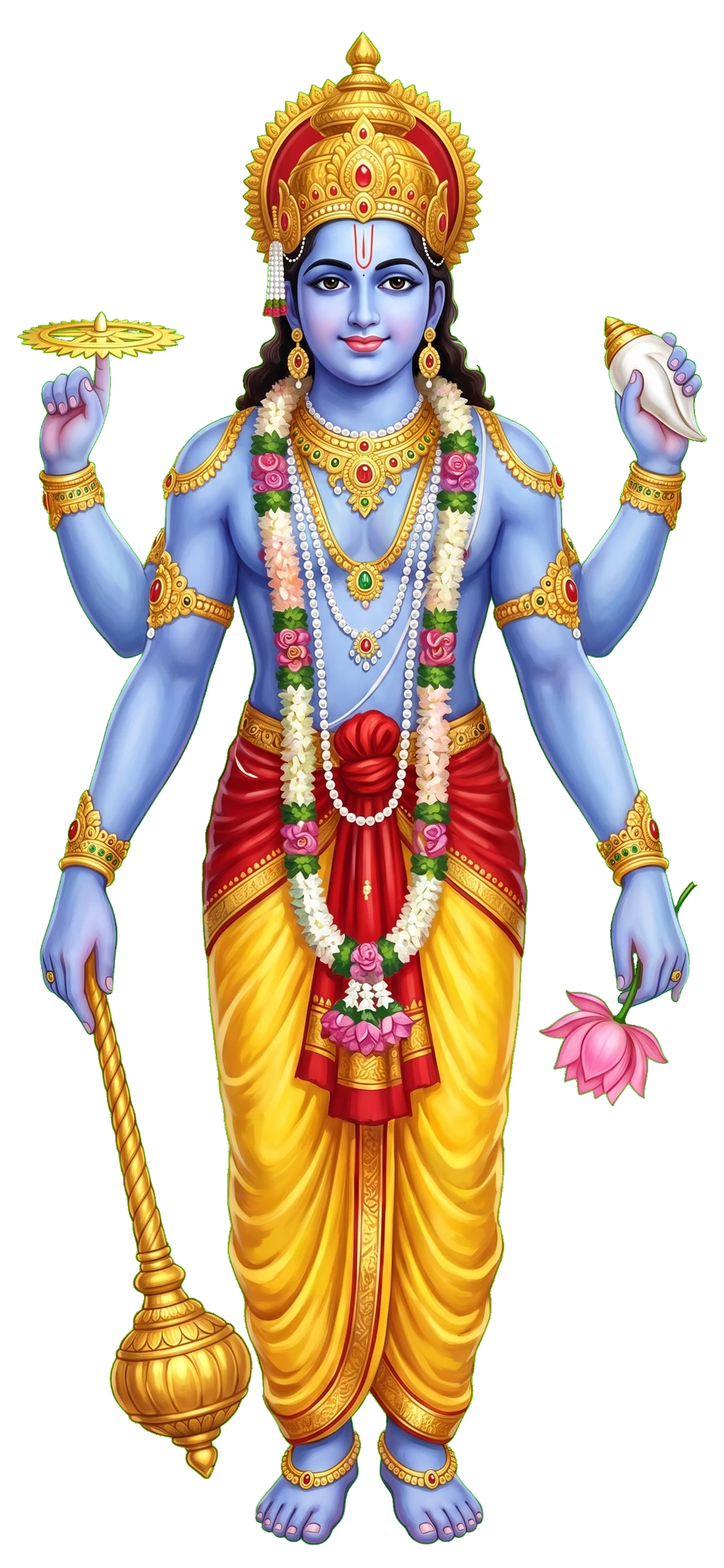
The lord of the day. The Padma Purana gives Ekadashi her name from him, and at Srirangam his processional image, Namperumal, goes through the Paramapada Vasal before dawn in his jewelled armour and listens for ten nights to the Tiruvaymoli in the Thousand-Pillared Hall.
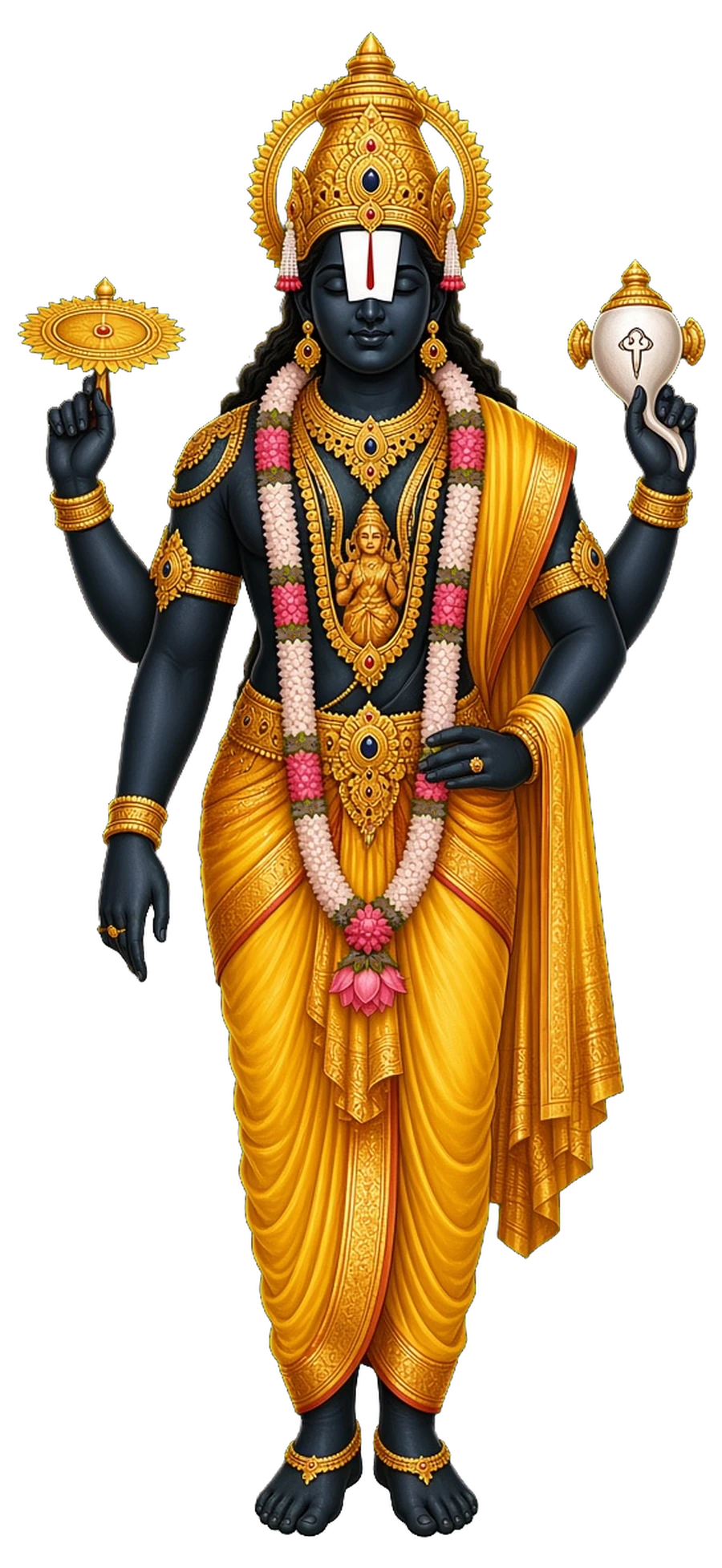
The lord of the seven hills, round whose sanctum the Vaikuntha Dwaram runs. It is opened on Ekadashi and kept open for ten days while lakhs of pilgrims queue to go round the god through it.
N
Nammalvar
The Alvar whose poem is sung through Ra Pathu and who, on the last night, is covered in tulasi at the god's feet, taken into Vaikuntha, and then given back to the world at the people's plea.
The day the gate opens
1
Pagal Pathu, the ten days before
The ten days before Ekadashi, in Margazhi
Pagal PathuThirunedunthandagamthe Mohini alankaram
At Srirangam the festival begins ten days early. Each day the Araiyars sing the other Alvars' hymns before Namperumal by daylight, and the god sits in his pearl armour, the Muthangi. On the tenth day of Pagal Pathu he is dressed as Mohini, the enchantress. Across the Tamil country the month of Margazhi is already under way, with the Thiruppavai sung at dawn in every Vishnu temple.
Pagal Pathu: Namperumal in his pearl armour while the Araiyars sing by daylight
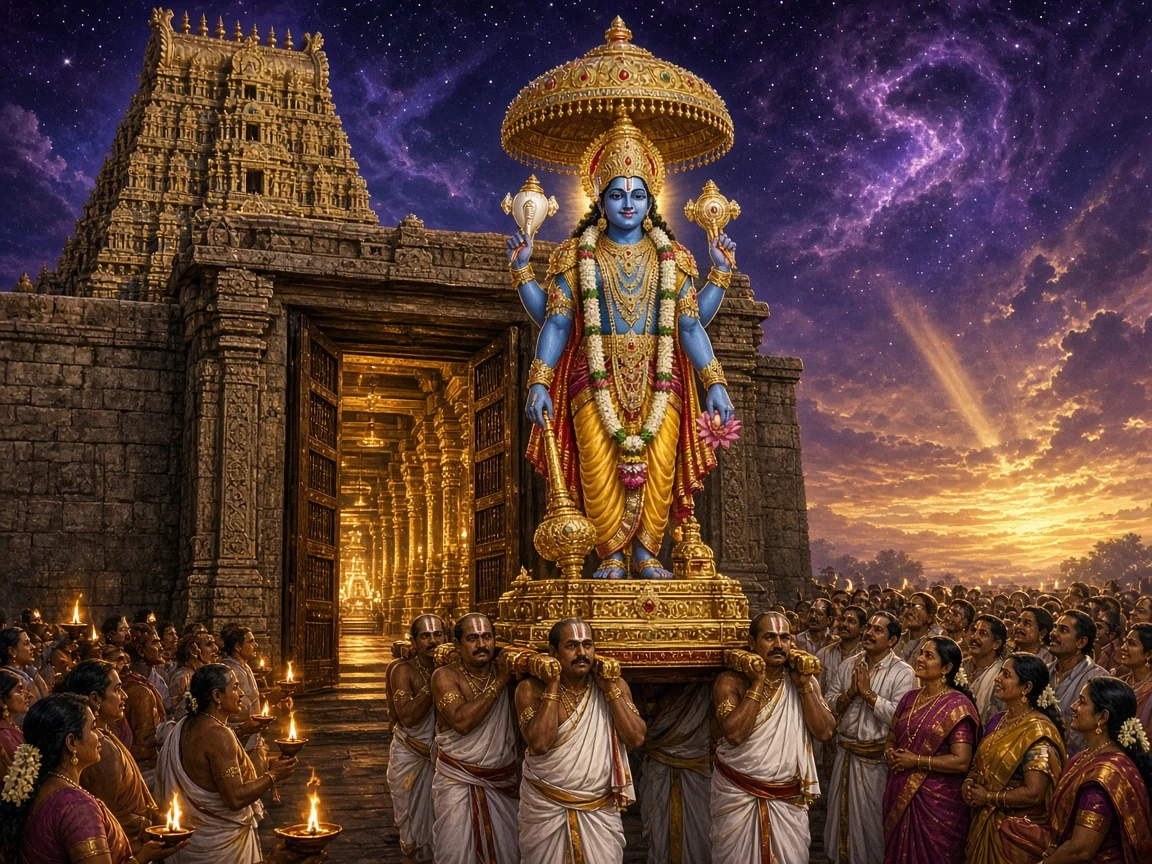
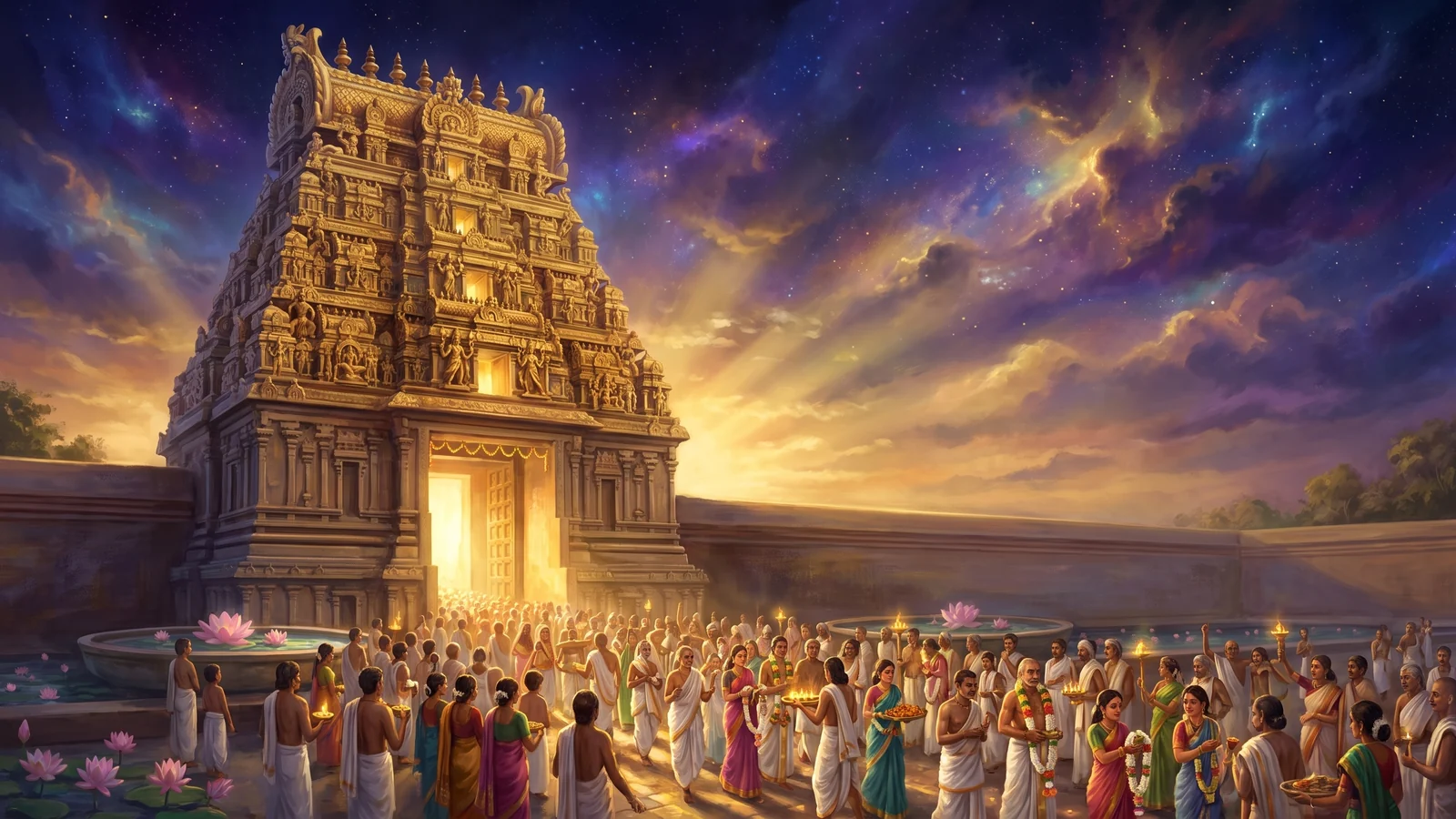
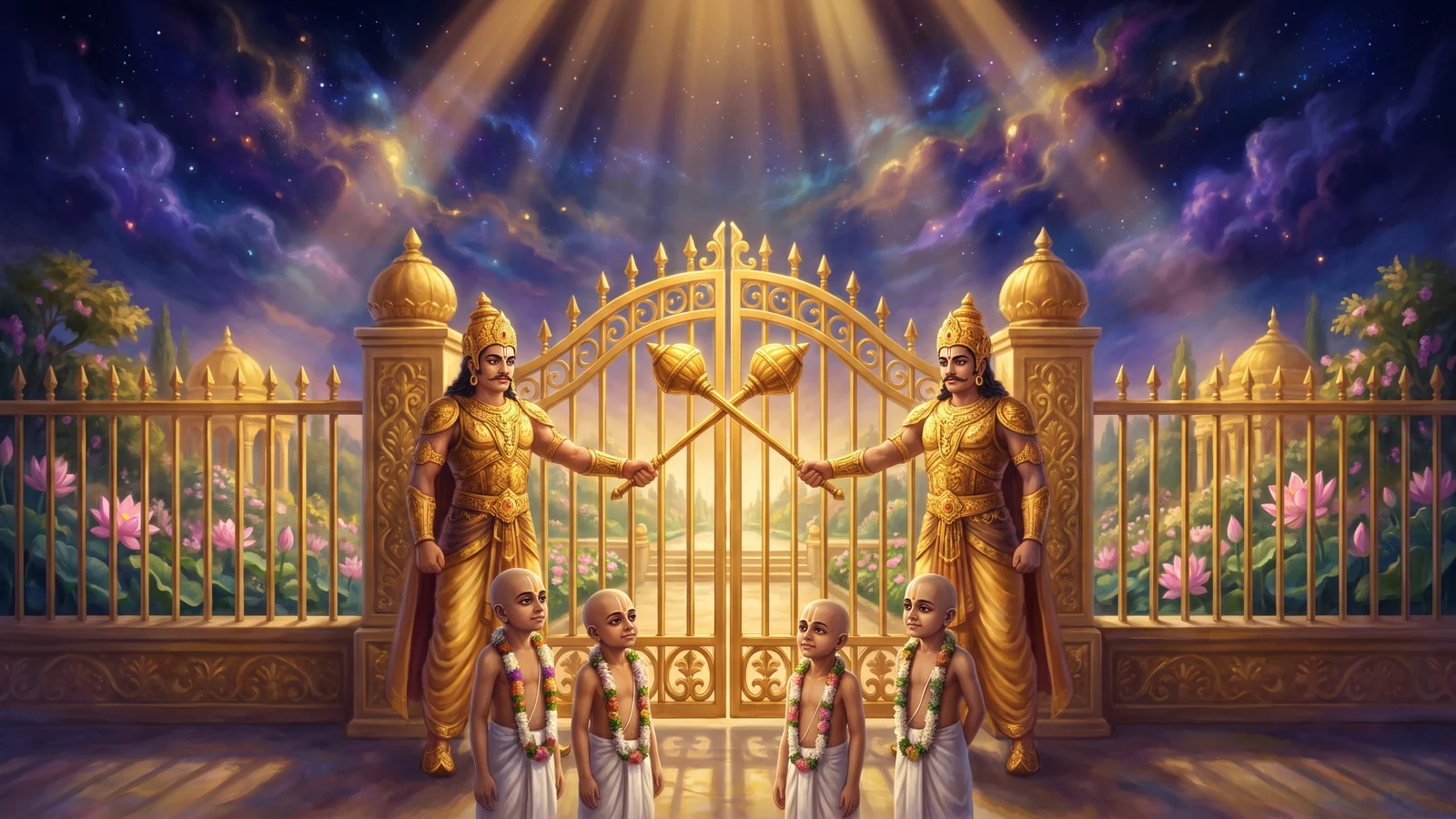
Before first light the bars are drawn back on the northern gateway of Srirangam, the Paramapada Vasal, which is shut the rest of the year, and Namperumal is carried through it in his diamond armour to the Thousand-Pillared Hall, with lakhs of pilgrims pressing to follow him through. The belief is simple: this gate, on this morning, is the gate of Vaikuntha. At Tirumala the same hour opens the Vaikuntha Dwaram, the passage round the sanctum of Venkateswara; at Bhadrachalam the northern tower gate; in Kerala and in Vishnu temples everywhere a door, and the people go in by one door and out by the other.
Tirumala at dawn: pilgrims walk the open Vaikuntha Dwaram round Venkateswara's sanctum
No rice today, and for many no grain at all, or only fruit and milk, or nothing but water; the stricter the house, the stricter the fast. The day is spent at the temple or with the name of Vishnu, and the night is kept awake. At Tirumala the queue through the Vaikuntha Dwaram runs for days; the Swarna Ratham goes round the four streets on Ekadashi and the Chakra Snanam is held at the Swami Pushkarini on Dwadashi. On Dwadashi morning the fast is broken, in Kerala with a little tulasi water and puffed rice. The three crores of gods, the Telugu lands say, have come down to watch, which is why they call it Mukkoti.
Dwadashi morning in Kerala: the fast is broken with tulasi water and puffed rice
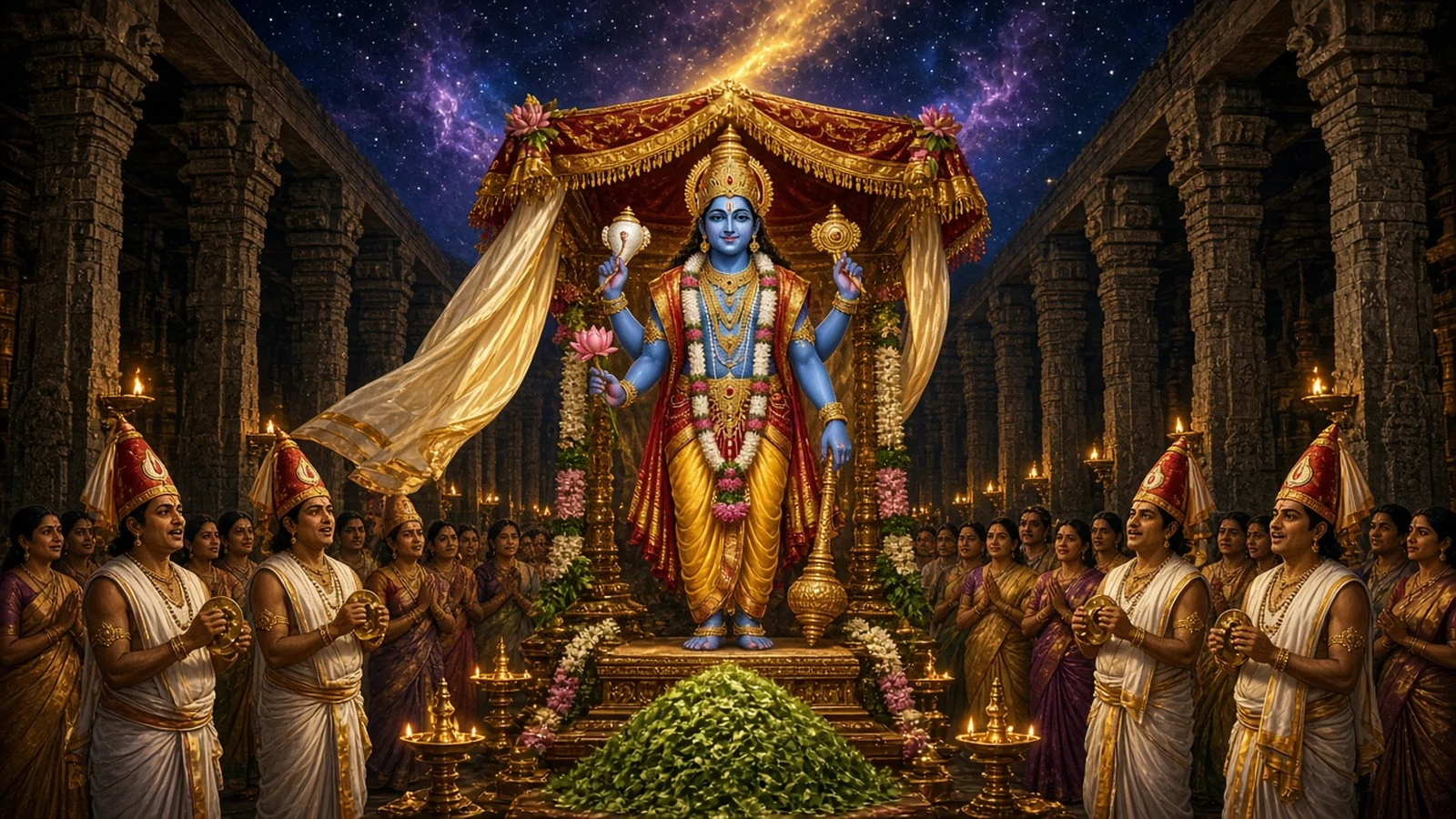
Every night for ten nights Namperumal sits in the Thousand-Pillared Hall and the Araiyars, in the conical cap with cymbals, sing and dance the Tiruvaymoli of Nammalvar, a hundred verses a night, with the Alvar's own image facing the god. On the tenth night the poem reaches Vaikuntha. The Alvar is carried round the god and laid at his feet, a curtain is drawn, and he is shown buried to the head in tulasi, taken in. Then a devotee asks for him back, three times, and three times the god gives him, and the tulasi is removed and his disciple's verses are sung. The Araiyars go in procession round the temple and the twenty days are over.
Ra Pathu's last night: Nammalvar heaped in tulasi at Namperumal's feet
Srirangam, Tamil NaduThe Paramapada Vasal and the Adhyayana Utsavam
The largest temple complex in India gives the day its fullest shape, a million people over twenty days. Ten days of Pagal Pathu by day, the gate opened before dawn on Ekadashi and Namperumal carried through it to the Thousand-Pillared Hall, then ten nights of Ra Pathu with the Araiyars singing and dancing the Tiruvaymoli, and Nammalvar's Moksham on the last night. The tradition says Tirumangai Alvar began the ten nights by bringing the Alvar's image from Alvar Tirunagari, that Nathamuni restored them in the tenth century and that Ramanuja added the ten days before. Alvar Tirunagari, Srivilliputhur, Tirukkurungudi and the other Srivaishnava temples keep the same twenty days on their own scale.
Tirumala, Andhra PradeshThe Vaikuntha Dwaram's ten days
The passage round the sanctum of Venkateswara, shut all year, is opened on Ekadashi and now stays open for ten days, so that the crowd can be spread; in 2026 that is expected to mean 20 to 29 December, with the temple's announcement due in November. Pilgrims have their darshan and then walk the passage. On Ekadashi Malayappa Swamy rides the golden chariot round the four streets, and on Dwadashi the Chakra Snanam is held at the temple tank. The first days are by online token only since the Tirupati stampede of January 2025.
Bhadrachalam and TelanganaMukkoti Ekadashi
The Telugu lands call the day Mukkoti, for the three crores of gods said to come down to watch. At Bhadrachalam on the Godavari, Ramadasu's temple of Rama, the night before is the Teppotsavam, when the gods are rowed five times round the river on a swan-shaped float under fireworks, and on the day Rama, Sita and Lakshmana are seated on Garuda and the people pass through the northern tower gate, which the temple built in 1974 as its Vaikuntha Dwaram.
KeralaSwargavathil Ekadashi
Kerala's name means the door of heaven. The Vishnu temples open the inner doors and the people go in by one and out by the other, in white, after a day without oil bath or sleep, and break the fast on Dwadashi with tulasi water and puffed rice; Thiruvambadi in Thrissur and Thirunakkara in Kottayam are among the temples named for it. Guruvayur's own great Ekadasi falls a month earlier, in Vrischikam, and should not be confused with this one.
Bengaluru and KarnatakaThe Vaikuntha Dwara set up for the day
Where there is no ancient gate one is built. At ISKCON's Hare Krishna Hill and Vaikuntha Hill in Bengaluru a Vaikuntha Dwara is raised every year for the day, which the temple keeps for Nammalvar's return to the spiritual world, with the deities taken through it in procession and the temple open from before dawn to night.
The north and KurukshetraMokshada Ekadashi and Gita Jayanti
By the lunar reckoning the same Ekadashi is Mokshada, the giver of liberation, the day King Vaikhanasa's fast freed his father from hell, and it is Gita Jayanti, the day Krishna is said to have spoken the Bhagavad Gita to Arjuna at Kurukshetra, where the Gita Mahotsav fills the Brahma Sarovar and devotees read the seven hundred verses through. In 2026 the two fall on the same day, 20 December; in some years the solar and lunar days part.
Srivaishnavas and all VaishnavasThe holiest Ekadashi
Every Vaishnava keeps the twenty-four Ekadashis of the year; this is the one above the rest, when the gate is open and the fast counts most. The Srivaishnavas of the Tamil country add the twenty days of the Alvars' hymns and Nammalvar's Moksham, and the Gaudiya and other Vaishnava houses of the north keep it as Mokshada with the Gita.
Every Hindu household that fastsThe Ekadashi fast
The fast has five grades and each house chooses its own. Nothing at all, not even water; water only; milk; fruit; or one meal late in the day without grain or pulses. Rice is out everywhere. One meal on Dashami so the stomach is empty by the morning, the night of Ekadashi kept awake, and the parana after sunrise on Dwadashi, inside the tithi and never in its first quarter.
ShaivasTrikoti Ekadashi
Shaiva devotees keep the same day under the name Trikoti Ekadashi, and at Srirangam and Tirumala the crowds through the gate are of every sect.
How it is kept
The day before, one meal. On Ekadashi, no rice and for most no grain; fruit, milk, water or nothing, as the house decides. The morning begins at the temple before light. At Srirangam the crowd has gathered in the dark outside the Paramapada Vasal, and when the bars are drawn Namperumal comes through in his diamond armour, and the people pour after him into the Thousand-Pillared Hall, something like a million of them over the festival. At Tirumala the queue for the Vaikuntha Dwaram has been forming for days; in recent years the first days have been by online token only, and the passage stays open until the tenth day so that everyone who came can go round the god. The golden chariot goes round the hill's four streets on Ekadashi, and the Chakra Snanam is held at the tank on Dwadashi.
The golden chariot rolls round the four streets of Tirumala on Ekadashi
In Kerala the day is Swargavathil Ekadashi, and the temples at Thrissur and Kottayam open the doors of heaven; the Telugu lands call it Mukkoti, for the three crores of gods who come to watch, and Bhadrachalam rows its gods round the Godavari on a swan the night before. Bengaluru builds its own gate. In the north the same day is Mokshada Ekadashi and Gita Jayanti, and the Gita is read through at Kurukshetra.
Bhadrachalam the night before: Rama, Sita and Lakshmana on the swan float on the Godavari
The night is kept awake, with the name of Vishnu, and the fast is broken after sunrise on Dwadashi, inside the tithi, in Kerala with tulasi water and puffed rice. At Srirangam the night is only the first of ten. Every evening the Araiyars sing a hundred verses of the Tiruvaymoli before Namperumal, and on the tenth night Nammalvar is covered in tulasi at the god's feet, asked back three times, and returned.
In the old texts
The Padma Purana's Ekadashi Mahatmya gives the day its name, with Mura, the cave and the woman of light; the open gate is the devotees' addition. The Narada Purana carries the long Rukmangada story in its second part, told by Vasishtha to King Mandhata, and the Bhagavata Purana tells Ambarisha's year of fasts in the fourth and fifth chapters of its ninth book. The Brahmanda and Padma Puranas give Mokshada Ekadashi the story of King Vaikhanasa, and the Mahabharata's Bhagavad Gita is held to have been spoken on this day.
The Tamil side rests on the Tiruvaymoli, Nammalvar's 1,102 verses, the heart of the Divya Prabandham that Nathamuni gathered in the tenth century and called the Tamil Veda; its last two decads, the road to Vaikuntha and the arrival, are what the Araiyars sing on the last night. The rite itself is recorded in the Koil Ozhugu, the Srirangam temple's chronicle, which also names Tirumangai Alvar, Nathamuni and Ramanuja as the festival's founders; scholars treat the chronicle as a work of centuries with interpolations, and the Alvars themselves as poets of the seventh to ninth centuries, where the tradition gives them dates before the Kali age.
Where this page comes from. Written by Devalok from the Padma Purana as the Vaikuntha Ekadashi tradition carries it, the Narada Purana's Rukmangada story, the Bhagavata Purana (9.4 to 9.5), Nammalvar's Tiruvaymoli, the Koil Ozhugu and the Srivaishnava accounts of Srirangam's Adhyayana Utsavam, the Tirumala, Bhadrachalam and Kerala observances as the temples, the press and the Wikipedia articles record them, and the Drik Panchang calendar for 2026 to 2028, as recorded in the Devalok Lore. Our own words throughout.