As Srirangam keeps the last night
Srirangam, Tamil Nadu · the tenth night of Ra Pathu · 3 min read
For ten nights the god has been listening to one man's poem.
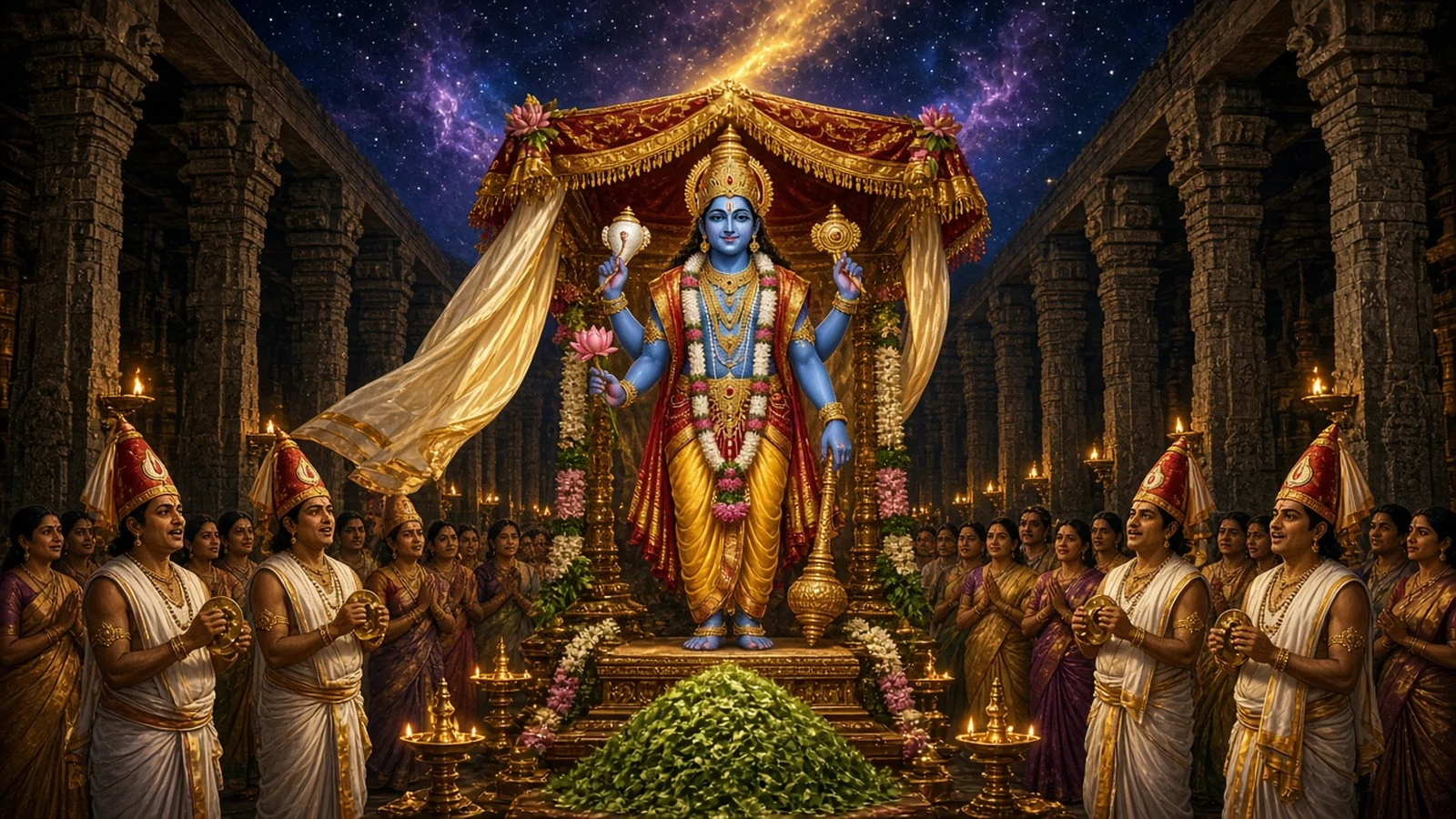
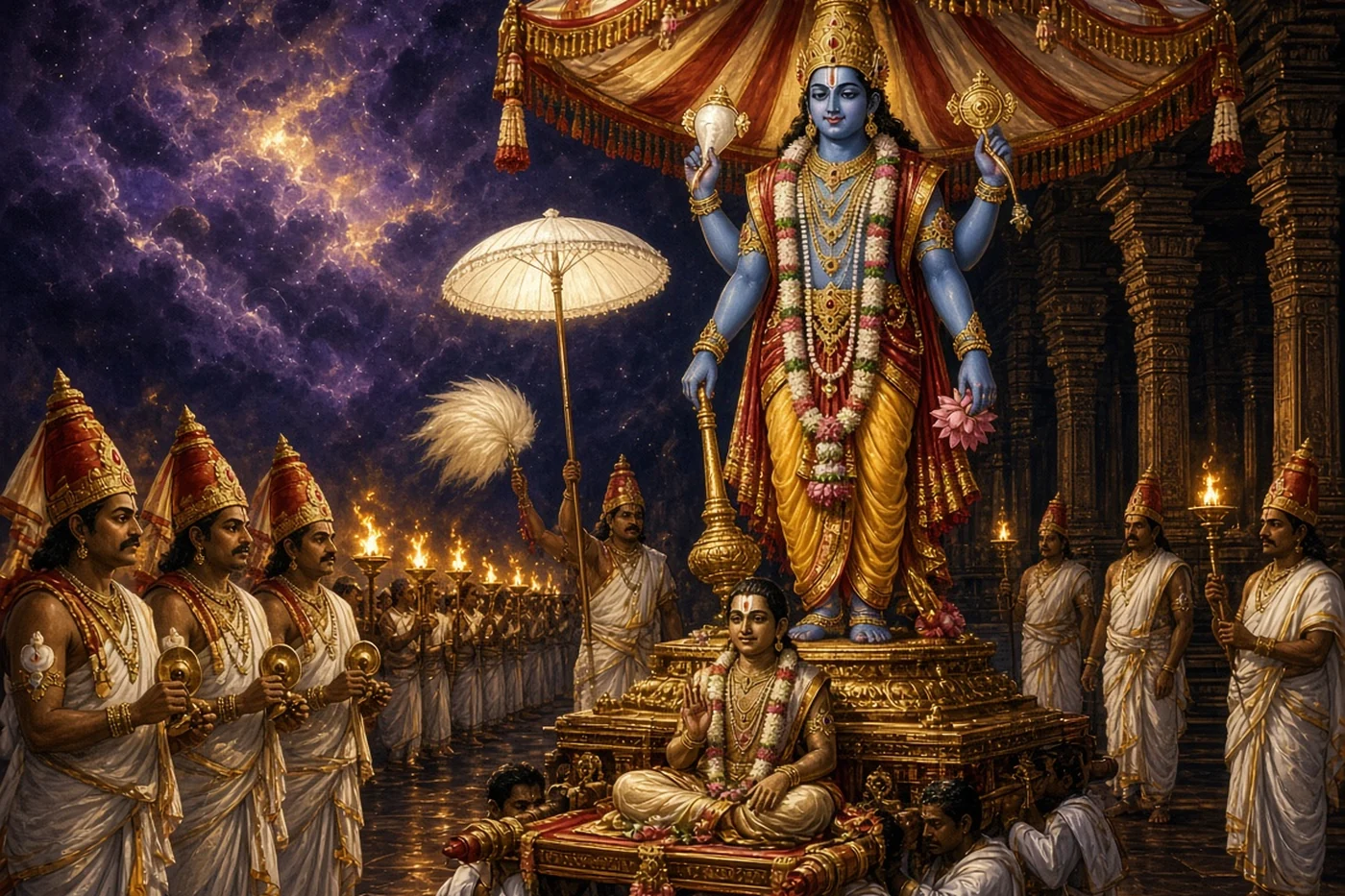
Every evening since Vaikuntha Ekadashi the processional image of Ranganatha, whom the temple calls Namperumal, our lord, has been carried into the Thousand-Pillared Hall of Srirangam and set on his seat, and the Araiyars have come before him. They are the hereditary singers of the temple. They wear a tall conical cap marked with the conch and the discus, with a strip of the god's own cloth tied to it, and they carry small cymbals. They sing the Tiruvaymoli of Nammalvar, a hundred verses a night, and they dance each verse as they sing it, so that the god sees it as well as hears it. The Alvar is there too, a small bronze on his own seat, facing the god he spent his life singing to.
On the tenth night they reach the last two decads.
The poem changes here. For nine hundred verses the saint has wanted the god, and been refused, and wanted again. Now, in the ninth decad of the tenth book, he is on the road to Vaikuntha, and the clouds sound like drums over his head, and the seas dance as he goes. In the tenth he arrives. He calls out to be taken, and he is taken, and the poem ends on the word it began with.
The Araiyars sing those twenty verses twice. While they sing, the Alvar's image is lifted and carried round the god, with torches going in front of it and the white umbrella and the fan held over it, as a king is carried. Then it is set down with its head at the god's feet.
A curtain is drawn across the two of them.
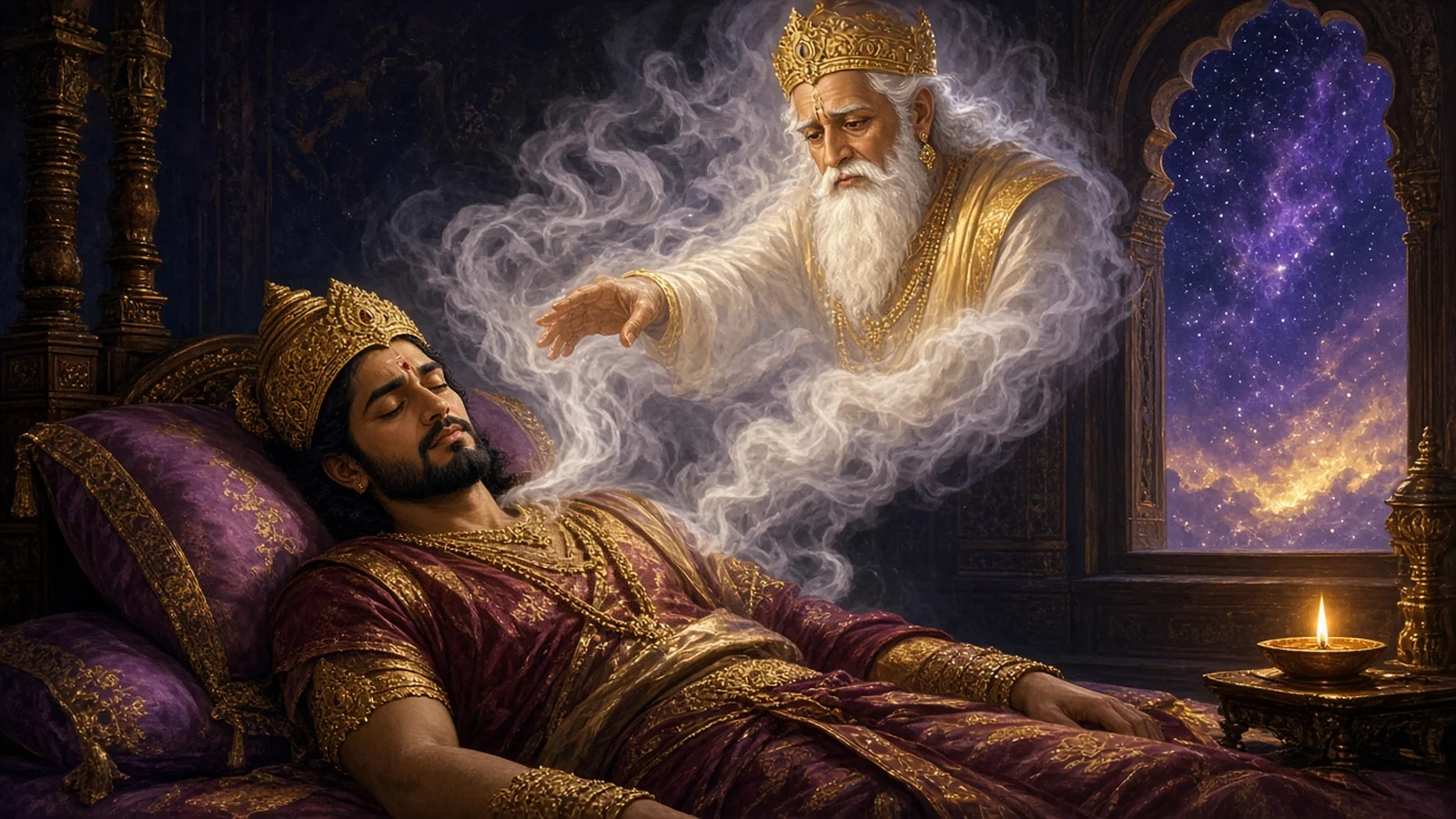
Behind it a lamp is waved, and there is a short silence. When the curtain opens again the people see where the Alvar was. There is a hill of tulasi leaves there, fresh and green, and the saint is somewhere under it, covered to the crown of his head. He has gone. The god has taken him in, the leaves say, exactly as the last decad says.
The singers sing the last ten verses once more, and then the first verse of the whole poem, so that the circle closes.
That would be the end of it, if the people let it be.
One of them steps out of the crowd. He is a Srivaishnava of the temple, chosen for this, and he speaks to the god first in the words of Ramanuja's prayer of surrender, the Saranagati Gadyam, and then plainly.
"Lord, you have taken him. Give him back to us."
A priest answers for the god. "We give him back to you."
"Give him back. Without him, who will sing to you for us?"
"We give him back to you."
"Give him back."
"We give him back."
Three times asked and three times granted, and the curtain is drawn again. When it opens the tulasi has been taken away, leaf by leaf, and the Alvar is sitting where he sat, facing the god, and a different poem is being recited. It is the eleven verses of Madhurakavi, the disciple who found him under the tamarind tree, which praise nothing and no one but his teacher.
Then the Araiyars go in procession round the temple, and the twenty days are over.
So the saint who reached Vaikuntha on the tenth night is in the world again on the eleventh morning. He goes back to his seat, and his poem goes on being sung at Srirangam every winter, for the sake of everyone who has not got there yet.
As the Guruparampara tells his life
Alvar Tirunagari, Tamil Nadu · Tirukkurugur on the Tamraparni · 3 min read
Before he was a bronze on a seat at Srirangam he was a child who would not open his eyes.
He was born at Tirukkurugur on the Tamraparni, the town now called Alvar Tirunagari after him, into a family of Vellala farmers, and from the first day he was wrong in every way a baby can be wrong. He did not cry. He would not take the breast. He kept his eyes shut. His parents waited, and when nothing changed they carried him to the temple of Adinatha, the Vishnu of the town, laid him at the god's feet, and left him there.
The child got up, the tradition says, walked to a tamarind tree in the temple ground, climbed into the hollow of its trunk, sat down cross-legged and stayed. Sixteen years.
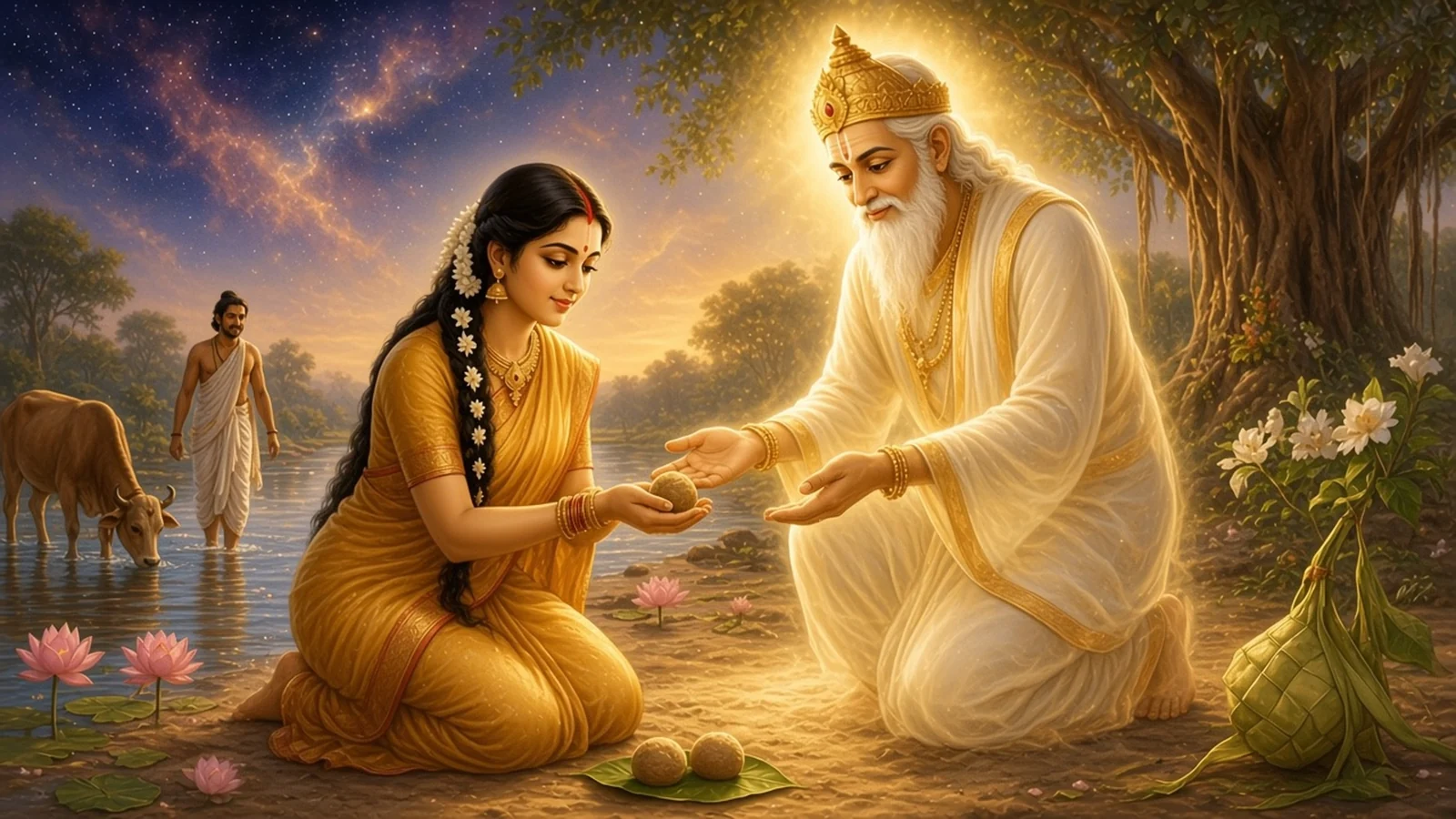
Far to the north, in Ayodhya, a brahmin of the Tamil country named Madhurakavi was on pilgrimage. One night he saw a light in the south, low and steady, and it did not go out. He followed it. It led him down the whole length of India, and at Tirukkurugur it went into the tamarind tree and vanished.
He found a young man sitting in the hollow, silent, with his eyes closed. He dropped a stone to see whether the sitter would stir. He did not. So Madhurakavi asked a question instead, the kind of riddle one scholar sets another.
"If the small one is born in the belly of the dead," he said, "what does it eat, and where does it lie?"
The eyes opened for the first time.
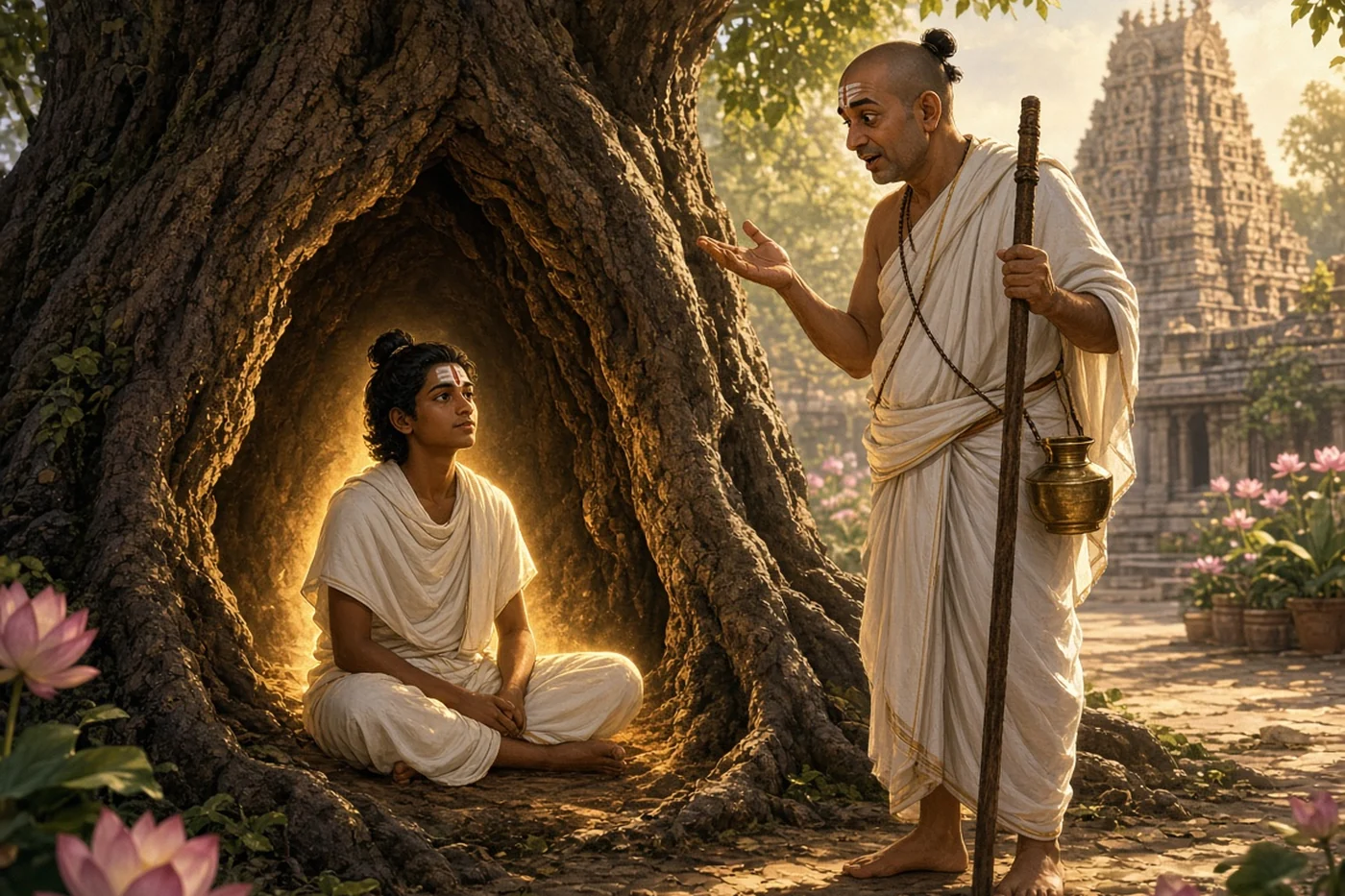
"That it eats," said the young man, "and there it lies."
The small one is the soul, the tradition explains, and the dead thing is the body it is born into, and the answer is that the soul lives on whatever it is given and stays where it is put, in the body or at the god's feet. Madhurakavi did not need it explained. He sat down at the foot of the tree and became the first disciple, and when the silent man began at last to speak, what came out of him was poetry, and Madhurakavi wrote it down.
There were four poems. The longest was the Tiruvaymoli, one thousand one hundred and two verses, each beginning with the word the one before it ended on, the last ending on the word the first began with. The Srivaishnavas set the four beside the four Vedas, and when Nathamuni gathered the four thousand verses of all the Alvars in the tenth century he called them the Tamil Veda.
Then Tirumangai Alvar, the last of the twelve, the robber chieftain who built the walls of Srirangam, went to Tirukkurugur and brought the saint's image to Srirangam on a Vaikuntha Ekadashi, and for ten nights had the Tiruvaymoli sung before Namperumal. That was the beginning. The custom lapsed, and Nathamuni restored it, and Ramanuja set ten days of the other Alvars' songs in front of it, the Pagal Pathu. The saint of the tamarind tree has gone to Srirangam every winter since, and been given back.