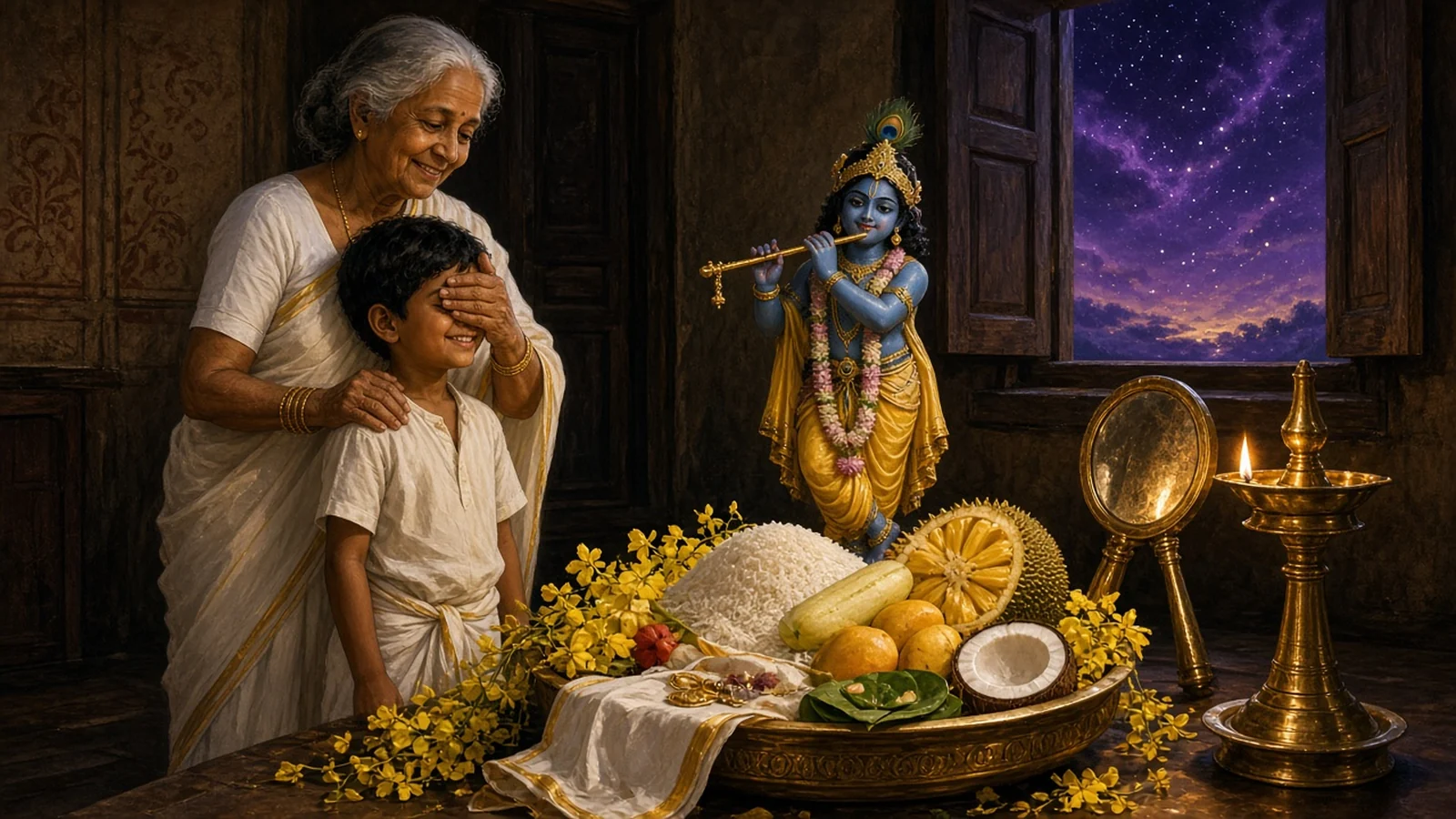
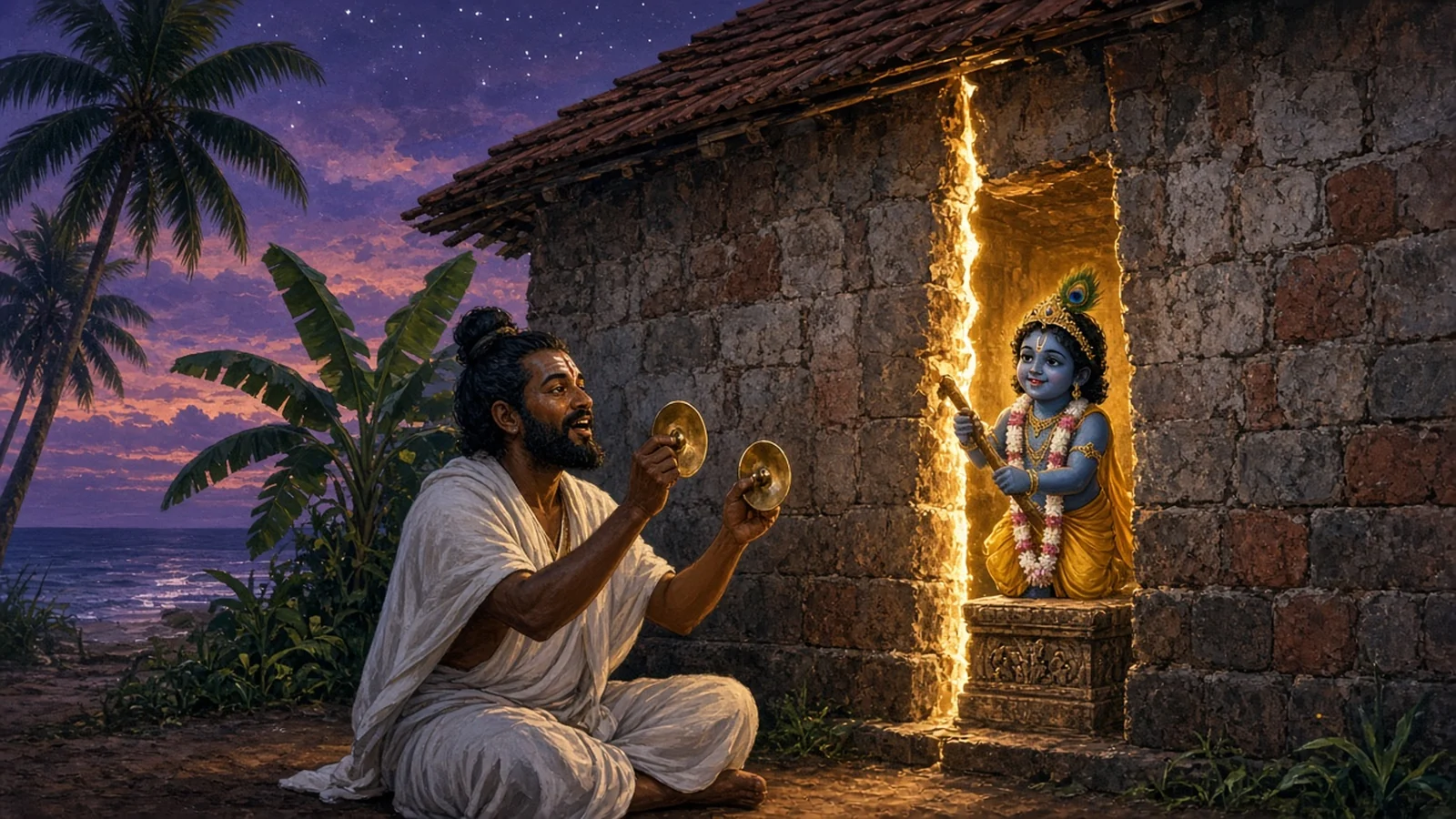
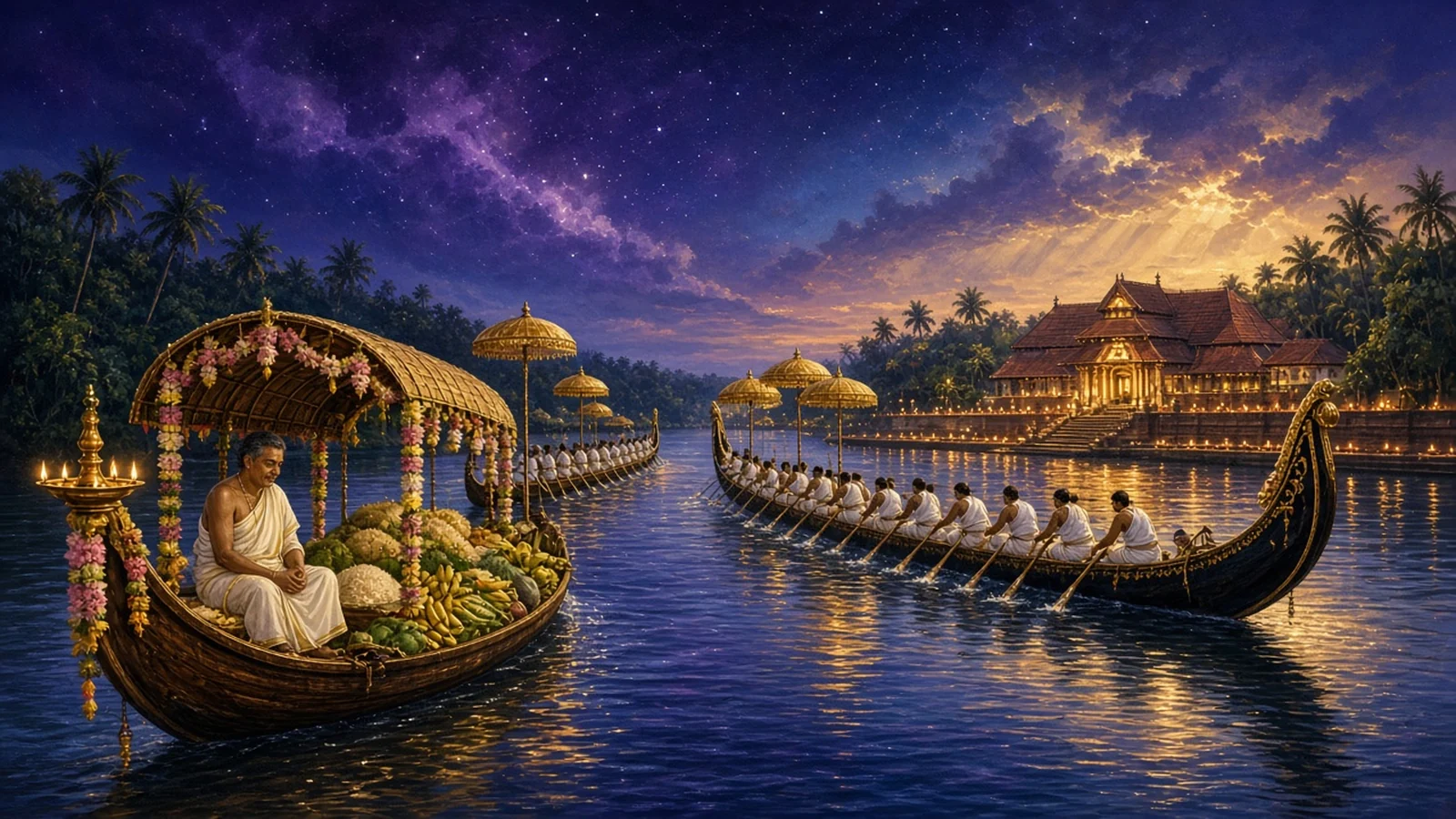
Vishu is the new year of Kerala and of the Tulu country of coastal Karnataka, kept on the first of Medam in mid April, when the sun enters Aries. Before dawn the eldest of the house lights a lamp before a tray laid out the night before, Krishna's image, rice, fruit, gold, a mirror and the golden konna flower, and leads the family in with their eyes shut, so that the first sight of the year is a good one. Then the elders give coins, the house eats a feast on banana leaves, and the temples of Guruvayur and Sabarimala show their own kani in the small hours.
When is Vishu in 2027? Vishu morning is Thursday 15 April 2027. In 2028: Friday 14 April 2028. The first of Medam, the day after the sun enters Aries, on 14 or 15 April.
Also calledVishukkaniMedam 1Bisu ParbaBisuMalayalam New YearMesha Sankranti
Next, in 2027Thursday 15 April 2027
Prime godKrishna
with 4 more
WhereKerala and Mahe, the Tulu country of coastal Karnataka, and Malayalis in the Gulf and across the world
How longOne morning and a day, with crackers the night before and the Pathamudayam lamps ten days later
The first of Medam, the day after the sun enters Aries, on 14 or 15 April
Why it is kept
Vishu is the new year of Kerala, and the word means equal. It falls on the first of Medam, in mid April, when the sun enters Aries and the hot weather has turned the konna trees gold. Nothing about the day is loud except the crackers. Its heart is a tray in a dark room, a lamp, and a hand over a child's eyes until the right moment.
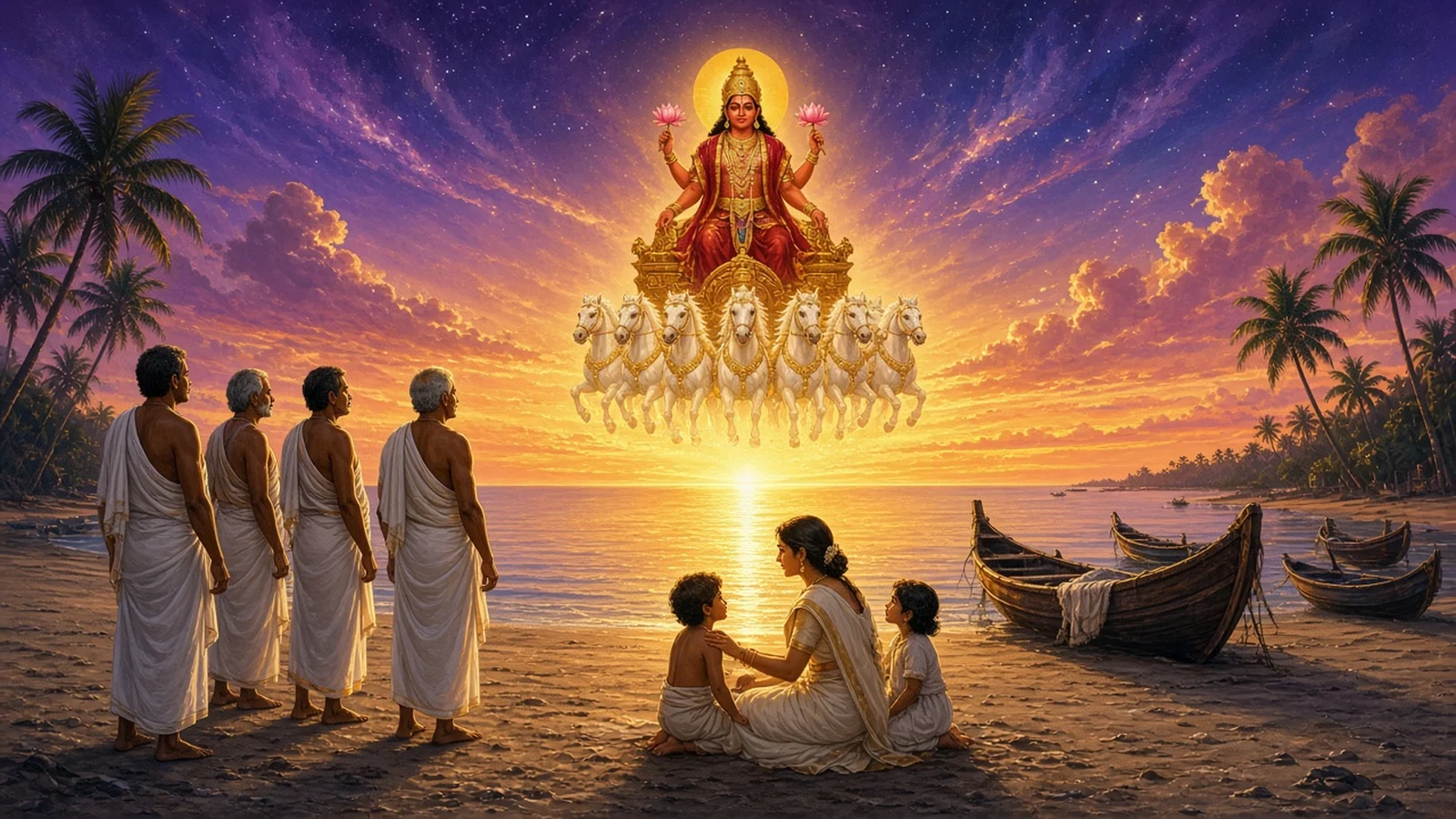
The sun's entry into Mesha, the Ram, begins the solar year across much of India, and in Kerala that morning was the new year long before the Kollam era, which begins in Chingam, was counted. Vishu once fell on the spring equinox, when the day and the night are equal and the sun rises due east, which is what the name remembers; the equinox has since drifted into March, but the day has stayed with the sun's sign.
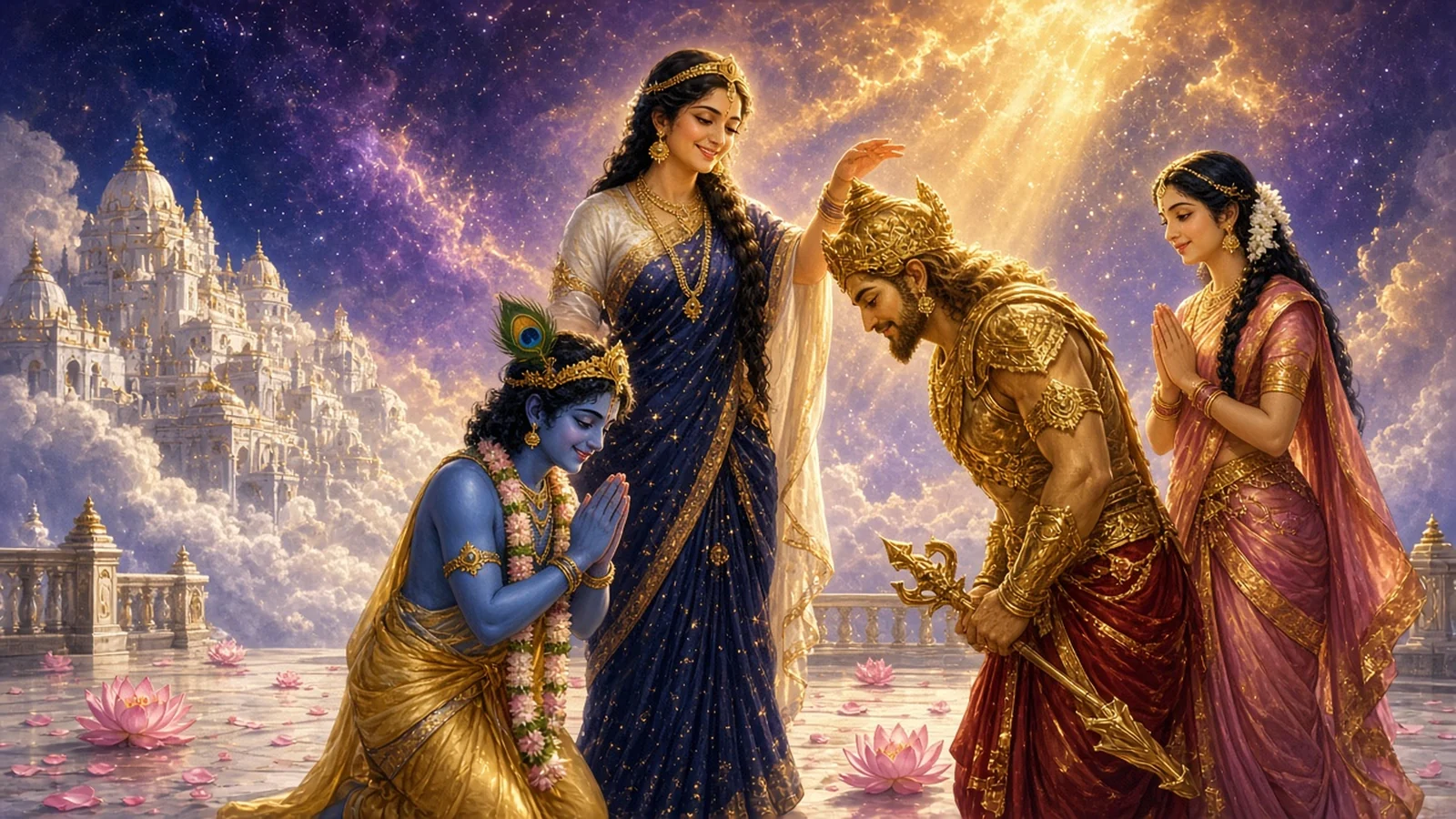
Kerala gives the morning two stories. In one, Ravana would not let the sun rise straight in the east while he ruled Lanka, and the first morning after Rama killed him the sun came up due east again; that sunrise was the first Vishu. In the other, this is the day Krishna killed the demon Naraka, and the crackers are for that. Both are told, and both are accepted. The konna has a story too, of a poor boy to whom Krishna gave his gold waist chain, and of the tree it landed in when his mother threw it away.
Underneath the stories the day is a farmer's new year. The kani is a tray of what the land has given and what the house owns, seen first so that the year starts on plenty, and in the old Kerala the farmer went from the kani to the field with his oxen, and the Tulu householder still sets aside the new seed that morning.
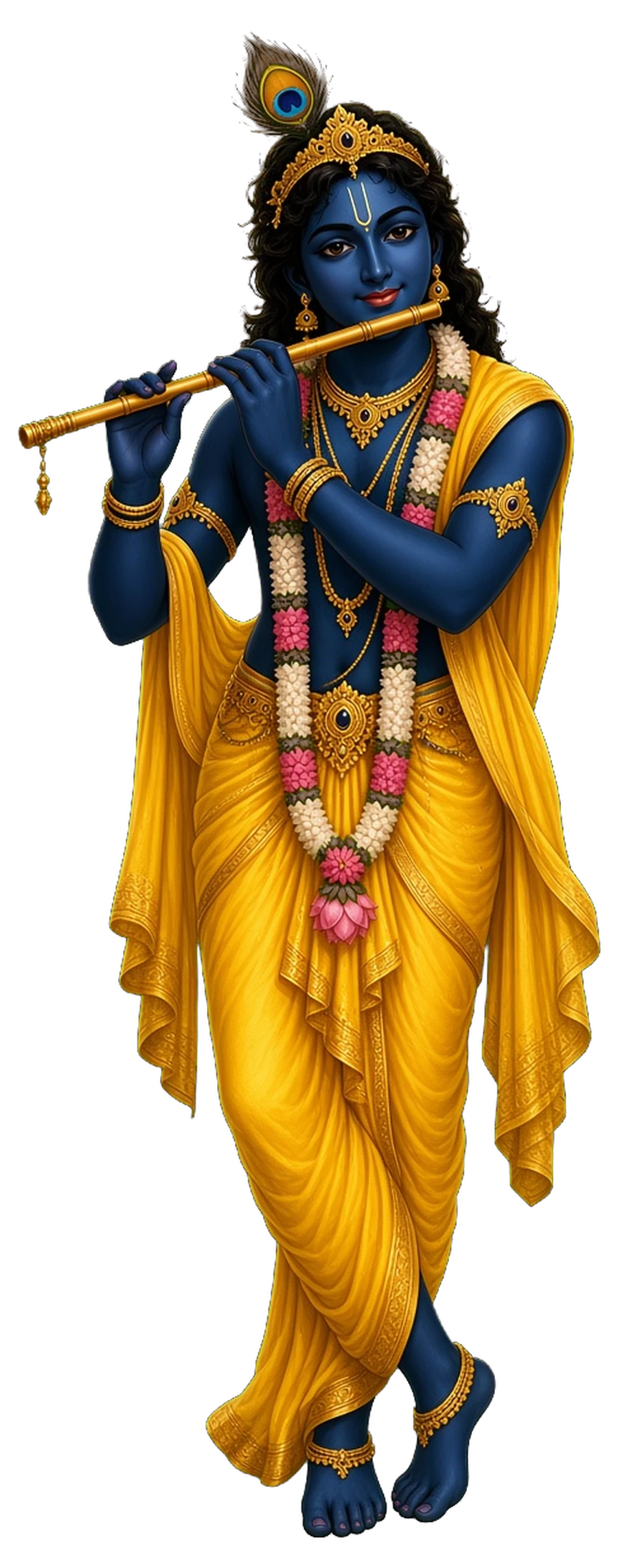
The face in the kani. His image, or Vishnu's, sits behind the uruli in every home, and at Guruvayur the temple's kani is shown before Guruvayurappan in the small hours. Kerala tells the konna legend of a boy to whom he gave his gold waist chain.
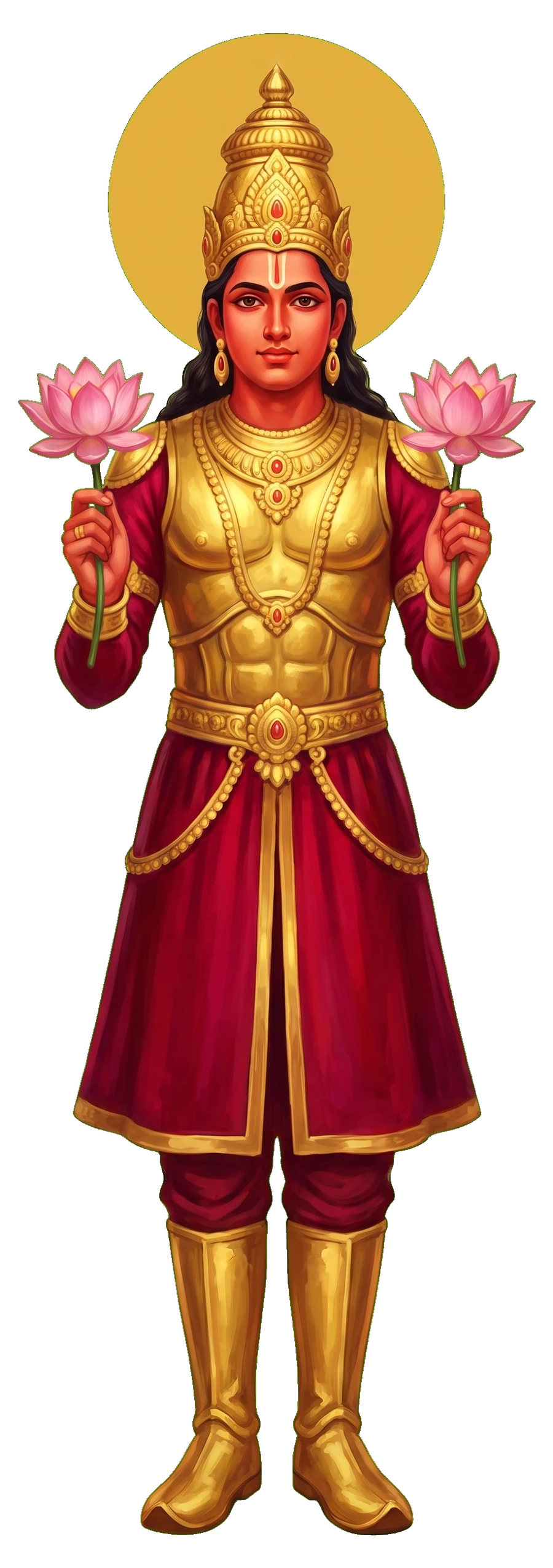
Vishu is read in Kerala as Vishnu's day, and the kani stands before his image where there is no Krishna. The day is also kept as the one on which Krishna, Vishnu born as a cowherd, killed the demon Naraka.
The sun, whose entry into Aries begins the solar year. Kerala's folk reading says he rose straight in the east for the first time after Ravana's death, and that morning was the first Vishu.
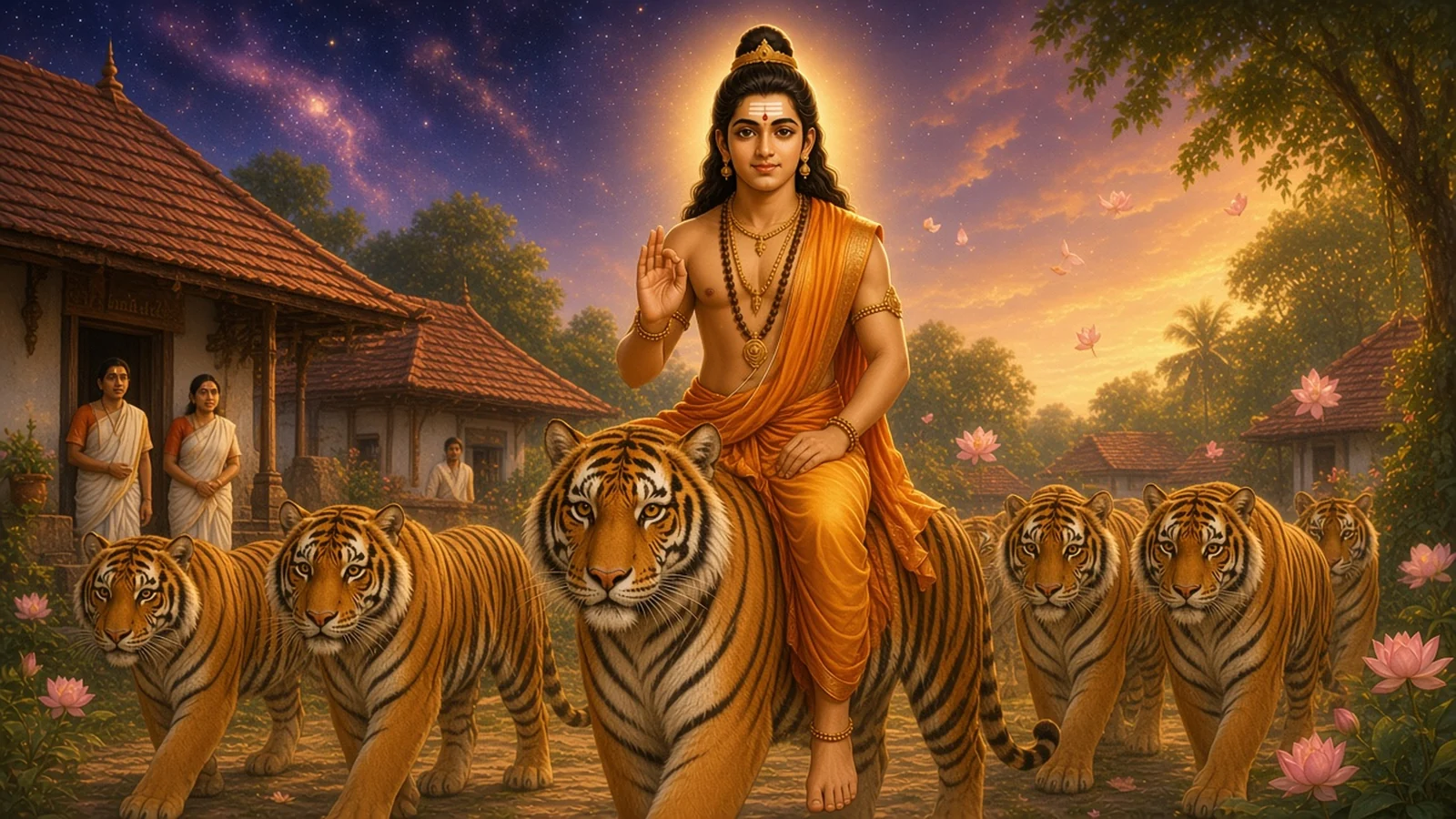
Sabarimala opens for Medam, and the kani is shown to Ayyappa by lamplight at three before the pilgrims see it at four, with the thantri giving the kaineettam.
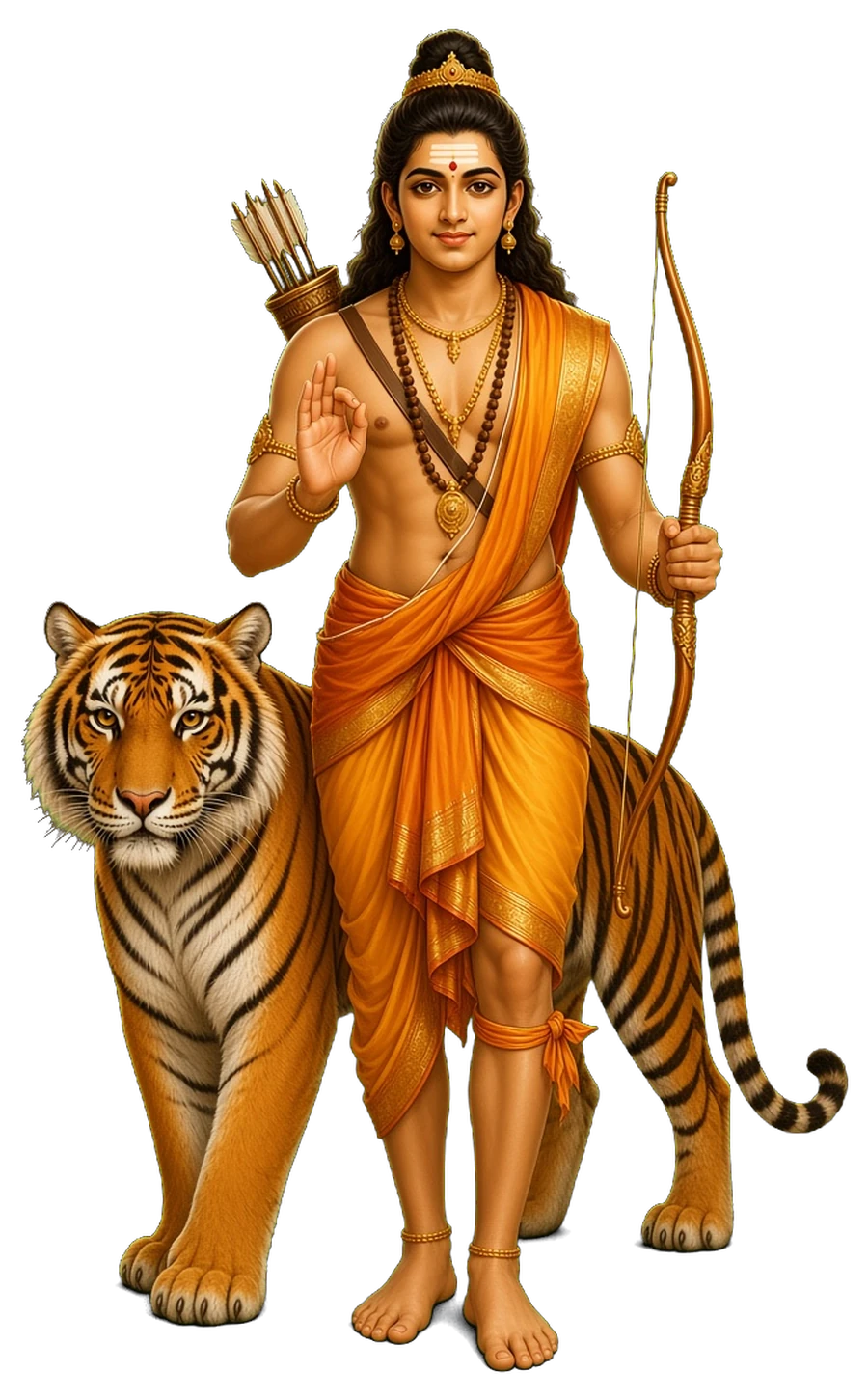
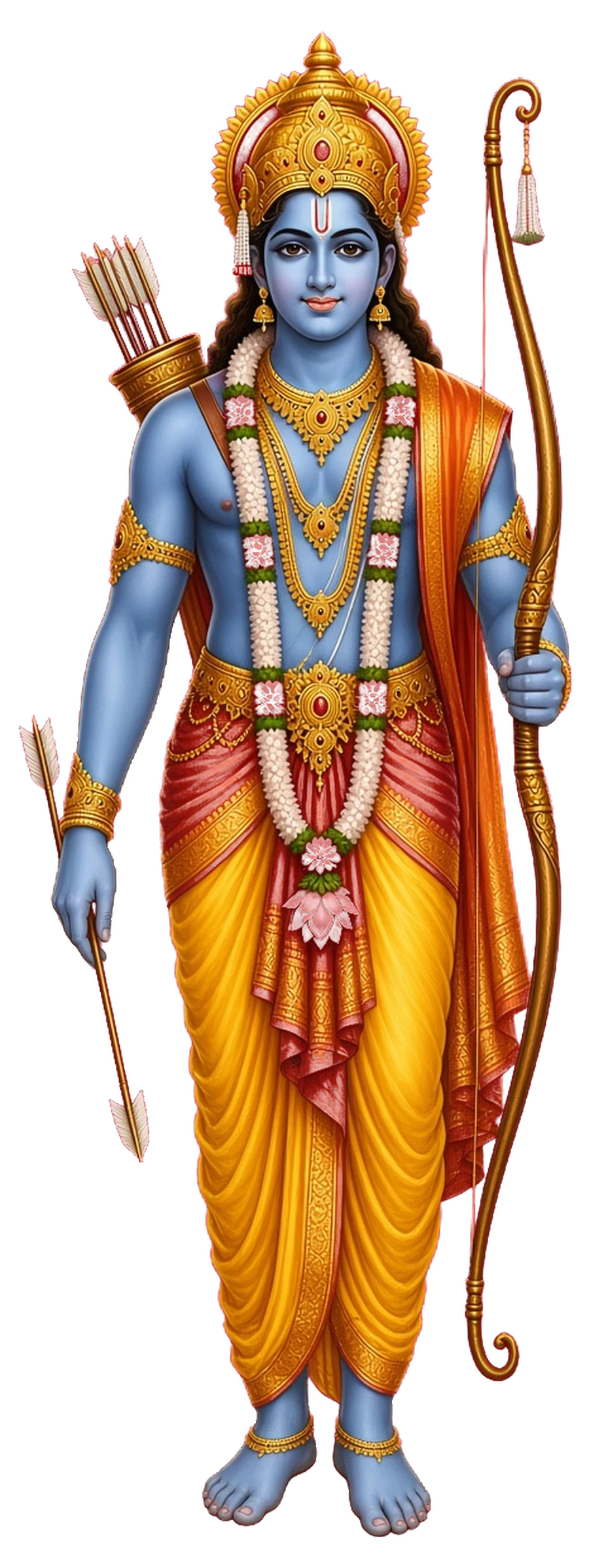
In the Ravana reading it is Rama's victory that frees the sun. Many homes keep the Ramayana on the kani tray.
The morning of Vishu
1
Before dawn, the Vishukkani
Medam 1, before sunrise · Thursday 15 April 2027
Kani kanalthe first sight
The eldest woman of the house, or the eldest member, lays the kani the night before in the puja room and covers it. In a bell-metal uruli go rice and paddy, with a golden cucumber, jackfruit, mango, a split coconut, betel leaves and arecanut, new cloth, gold, coins, the Ramayana or another holy book, and the valkannadi, the long-handled mirror, all round Krishna's image, and the kanikkonna tucked in everywhere. Before four she lights the nilavilakku, looks herself, then wakes the others one by one and leads them in with their eyes covered. In the Tulu country the Bisu kani of fruit and vegetables is set on the roof of the house.
After the kani the elders put coins into the hands of the children and of everyone who works in the house, the kaineettam, and new clothes are worn. Guruvayur shows its kani from about a quarter to three, Sabarimala from four, and the queues form the evening before. The Vishu sadya is eaten at midday on a banana leaf, with the sour mango curry and the bitter neem of the season, and the crackers that began days before go off loudest in the small hours of Vishu itself. Ten days later the Pathamudayam lamps with ten wicks are lit for the ten sunrises since.
The state's second festival after Onam, and a public holiday. Every Hindu home lays its kani, the shops sell konna by the bunch and uruli by the dozen, and the governor and the chief minister send Vishu greetings to the state. In the north the sadya may carry fish and meat; the south keeps the leaf vegetarian.
Guruvayur, Thrissur districtThe Vishukkani of Guruvayurappan
The temple's kani is laid in front of the sanctum with the image dressed, a gold replica on the golden seat and a second kani in the hall outside, and shown to devotees from about 2.45 in the morning. People once tied cloth over their eyes the night before so that Guruvayurappan would be the first thing seen; now they queue from the evening.
SabarimalaVishu at the Sannidhanam
The hill opens for Medam and stays open eight to ten days. The priests lay the kani after the evening pooja with vessels of rice and paddy, coconuts, fruit, cloth, gold and silver coins, then close the doors. At three the thantri lights the lamps and shows the kani to Ayyappa; at four the pilgrims see it and receive cucumber, flowers and grain, and the thantri gives kaineettam to the temple staff and the police.
Aranmula, Ambalappuzha, Thiruvarppu and the Krishna temples
At Aranmula the kani is laid from the sanctum down to the sopanam steps, with the gold and silver vessels and the Garuda mounts set north and south. Ambalappuzha lights its kani with ghee lamps. Thiruvarppu, which opens at two every morning, counts Vishu by its own flag-hoisting and may keep it a day after everyone else. At Cherukunnu in Kannur the Vishu Vilakku runs a week with fireworks and a kani inside the temple.
Tulu Nadu, coastal KarnatakaBisu Parba
The first of Paggu, the Tulu new year, the same morning. The kani of fruit and vegetables, jackfruit, cashew apple, mango, cucumber, pumpkin and gourds, is set on the roof, the shrine is laid with lamp, rice, betel, coconut, mirrors and the gold, juniors touch the feet of elders and receive money, and new paddy seed is set aside in the morning and sown in the evening.
The Gulf and the Malayali world
In Dubai, Sharjah and across the Gulf the kani is laid in flats and the sadya ordered from the supermarkets by the ten thousand; one chain imported a hundred and seventy tonnes of fruit and vegetables for the day in 2018. London, Toronto and every Malayali association keeps a Vishu, usually on the nearest weekend.
Across India and the seaThe same sun, other new years
The sun's entry into Aries is also Puthandu in Tamil Nadu, where the Kongu country keeps a kani of its own, Baisakhi in the Punjab, Bohag Bihu in Assam, Pohela Boishakh in Bengal and Pana Sankranti in Odisha, each with its own page in the Lore, and Aluth Avurudda in Sri Lanka. In Laos the same golden shower flower is part of the new year.
Hindus of Kerala and Tulu NaduThe kani and the temples
The kani is laid before Krishna or Vishnu, the Ramayana or the Gita lies on the tray, and the day is read as Vishnu's day. In the villages the elders of castes and clans met on Vishu night for the koorayidal, opening weeks in which no meat, no drink and no violence were allowed until the Vela or Kummatti ended.
Kerala as a wholeThe new year of the land
Vishu is a state holiday, kept as the old new year by Malayalis of every faith in the public way, the shopping, the new clothes, the feast and the crackers, though the kani and the temple visit are Hindu. When Vishu fell on Good Friday in 2017 the temples and the churches were both full, and Muslims were in the Ramadan fast; the newspapers reported the three side by side.
How it is kept
The kani is laid the night before by the eldest, in the puja room, and covered. In the small hours she lights the lamp, looks, and then wakes the house one at a time. Each is led in with eyes shut and set before the flame, and the first thing seen is Krishna, the lamp, the gold of the konna, and one's own face in the mirror among them. Then comes the kaineettam, a coin from the elder's hand into the younger's, to children, to the people who work in the house, and in the temples from the priests to the staff. New clothes are put on, the Vishukodi, and the family goes to the temple.
The temples keep their own kani. At Guruvayur it is shown from about a quarter to three in the morning, and at Sabarimala, open for Medam, the thantri shows it to Ayyappa at three and to the pilgrims at four. The sadya is eaten at midday on a banana leaf, with the season's mango curry and a dish of bitter neem, so that the year's tastes are all met at once. The crackers that have been going for days reach their peak before dawn. Ten days on, Pathamudayam, the lamps are lit with ten wicks for the ten sunrises since.
In the old texts
No Purana names Vishu. The day belongs to the almanac: the Malayalam calendar counts Medam 1 as the astronomical new year, the moment the sun crosses into Mesha, while the Kollam era of 825 begins its civil year in Chingam, in August. Where the Sankranti falls after sunrise the festival moves to the next morning, which is why Kerala keeps Vishu on 15 April in 2027 though the sun enters Aries on the afternoon of the 14th. Kerala writers point to an inscription of Bhaskara Ravi Varman's time, about a thousand years ago, that names a Chithira Vishu, and say the festival is older than that.
The stories come from elsewhere. Krishna's killing of Naraka is Bhagavata Purana 10.59, where he rides Garuda with Satyabhama, kills Mura and his sons and then Bhauma, and carries Aditi's earrings home. Ravana and the sun is a folk reading, but Valmiki's Ramayana gives it a root: Shurpanakha's brother is described in the Aranya Kanda as the one who forestalls the rising of the sun and the moon with his arms, Agastya teaches Rama the hymn to the sun before the last fight and the sun himself says hurry, and when Ravana falls the sky clears and the sun shines steady.
The Tamils count the same new year from Chithirai. The Sangam poem Nedunalvadai follows the sun from Mesha through the twelve signs, and the Purananuru and the Silappatikaram begin the year there too; Kongu Nadu keeps a kani for Puthandu that is Kerala's kani under another name.
Where this page comes from. Written by Devalok from the Vishu tradition of Kerala and Tulu Nadu as recorded by Kerala Tourism, the temples of Guruvayur, Sabarimala and Cherukunnu, the Malayalam press, Valmiki's Ramayana (Aranya 32, Yuddha 105 and 108) and the Bhagavata Purana (10.59), as recorded in the Devalok Lore. Our own words throughout.