Purana eraVaishnava · The third avatar of Vishnu, the great boar who dived to the bottom of the ocean, killed the demon Hiranyaksha and came up with the drowned Earth on his tusks
Varaha
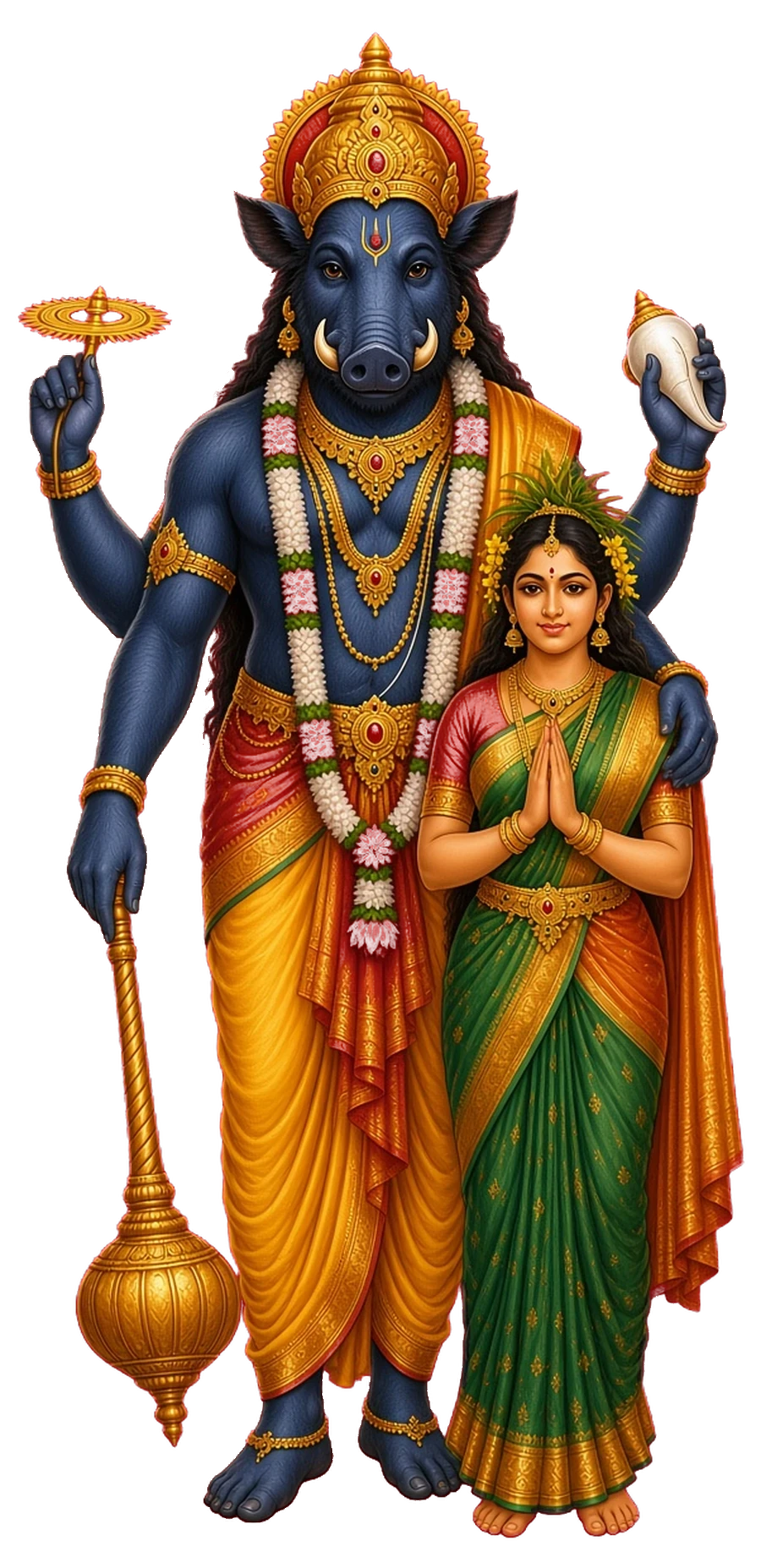
Varaha is the boar, the third of the ten avatars of Vishnu, who dived to the bottom of the ocean and came up with the drowned Earth on his tusks.
Also calledBhu VarahaAdi VarahaYajna VarahaVarahaswamyBhuvarahaswamythe Boar
In short
Who is Varaha?
The boar, the third of Vishnu's ten avatars, who went down to the bottom of the ocean and brought the drowned Earth back up on his tusks.
Why did Vishnu become a boar?
Because the Earth had sunk under the waters and had to be fetched from the mud at the bottom; the Brahmanda Purana says the boar was chosen because it loves to play in water. The Puranas add the demon Hiranyaksha, who fought him on the way up or, in some tellings, had carried the Earth down himself.
Who is Varaha's consort?
Bhudevi, the Earth goddess herself, whom he rescued. She sits on his tusk or his arm in his images, and the Varaha Purana is framed as his teaching to her.
Where is Varaha worshipped?
At Srimushnam in Tamil Nadu, at his own temple beside the pool at Tirumala, where pilgrims see him before Venkateswara, and in many old shrines of central and eastern India.
or a man's body with a boar's head, usually four-armed
With himBhudevi
the Earth, held on a tusk or seated on his arm or knee
Who Varaha is
Varaha is the boar, the third of the ten avatars of Vishnu, who dived to the bottom of the ocean and came up with the drowned Earth on his tusks.
The Puranas tell the dive in several ways. In the Bhagavata the Earth has sunk in a flood, a boar no bigger than a thumb drops from Brahma's nostril and grows to the size of a mountain, and on his way up he meets the demon Hiranyaksha, who has been looking everywhere for a fight and gets one. In the Linga and Padma Puranas the demon carried the Earth down himself. In every telling the boar sets her on the water and makes her float.
Vasati dashanashikhare dharani tava lagna, shashini kalankakaleva nimagna, keshava dhritasukararupa jaya jagadisha hare: the Earth clings to the tip of your tusk like the dark mark set in the moon; Keshava, who took the boar's form, victory to you, Hari, lord of the world.
So Jayadeva sang him in the Gita Govinda. He is shown in two ways: as a whole boar, colossal, his body covered in rows of tiny sages, or as a man with a boar's head, the Earth goddess Bhudevi held on his tusk or sitting on his arm. She is his consort. The Varaha Purana is framed as the long answer he gave her when she asked how the world was made, and the Srivaishnavas of the south say she came down as the poet Andal.
His great temple in the south is at Srimushnam in Tamil Nadu, where Bhuvarahaswamy stands with his hands on his hips, his body facing west and his face turned south, towards the demon who asked to be looked at as he died; in the Masi festival its procession stops at the dargah of a Sufi saint at Killai, and the two communities exchange offerings. At Tirumala he has his own shrine beside the temple pool, and pilgrims are told to see him before they see Venkateswara, because the hill was his first.
The site already tells his Vedic beginnings in The Boar Beyond Seven Hills and The Boar and the Tortoise, and why Hiranyaksha was born in The Gatekeepers of Vaikuntha.
Before the Puranas
The Vedic roots of Varaha
The Vedas know a boar, but not this one. In the Rigveda (1.61.7 and 8.77.10) a fierce boar, emusha, keeps a hoard that Indra shoots it through a mountain to win and Vishnu carries off; the Taittiriya Samhita (6.2.4) puts that robber boar behind seven hills. A different boar raises the earth in the books of ritual. In the Taittiriya Samhita (7.1.5) and Taittiriya Brahmana (1.1.3) the creator Prajapati becomes a boar and brings up the first mud from under the waters, and the Shatapatha Brahmana (14.1.2.11) calls that boar Emusha. Vishnu has no part in the raising yet.
The scholar John Brockington reads these as two boar myths, one of the hunted Asura boar and one of Prajapati's dive, which the Shatapatha Brahmana already begins to bring together. The epics and Puranas give the dive to Vishnu by stages. The Vishnu Purana says the diver is Brahma, but a Brahma who is Narayana wearing Brahma's form; by the Bhagavata the boar comes out of Brahma's own nose and is plainly Vishnu, and the robber is replaced by Hiranyaksha.
Stone shows how much he mattered. The earliest images, from Mathura, are of the first or second century. At Udayagiri near Vidisha, about 400, the Gupta court cut the great relief of Cave 5: a giant man-boar with the Earth hanging from his tusk and a crowd of gods and sages around him, and a bowing figure that many read as the king Chandragupta II. Heinrich von Stietencron and Michael Willis read the panel as a statement of Gupta kingship. At Eran, about 500, a red sandstone boar more than four metres long carries the Earth on his right tusk and rows of sages on his body; its inscription names the Huna king Toramana and a donor, Dhanyavishnu. The Khajuraho boar is of the early tenth century, and the Pratihara king Mihira Bhoja took the title Adivaraha.
The Varaha Purana, his own book, survives in a little over ten thousand verses of a traditional twenty-four thousand. In the south he lives on at Srimushnam, whose present temple took shape under the Thanjavur Nayaks, and at Tirumala, whose hill is still called Adi Varaha Kshetra.